
Dog Bad Breath: Causes, Warning Smells and When to Worry
By RexVet Team | Reviewed by Dr. Tiffany Delacruz, DVM
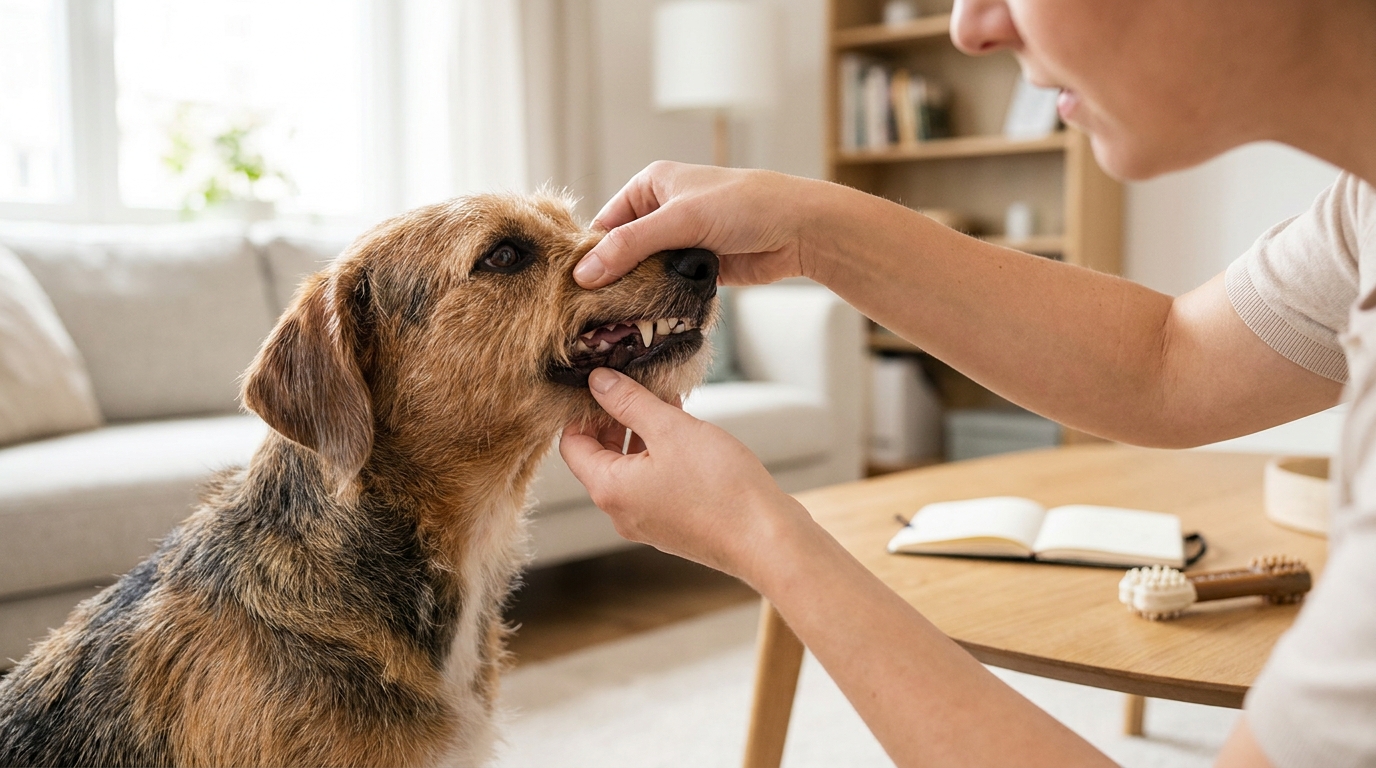
Most bad dog breath starts at the gums. How to read the smell, check the mouth in 60 seconds, and spot the signs that can't wait.
Quick answer: Most bad breath in dogs comes from dental disease: plaque, tartar and infected gums. Merck says up to 80% of dogs have some gum disease by age 2. Book a dental exam within a few weeks. See a vet within a day for swelling under the eye or jaw, and go to an ER now if bad breath comes with repeated vomiting, weakness or trouble breathing.
This article is general information, not a diagnosis. If you think your pet is in danger, go to the nearest emergency animal hospital.
Bad breath signs that need a vet now
Most bad breath builds slowly and can wait for a booked dental exam. These signs can't.
Go to an emergency vet now if bad breath comes with:
- A possible toxin in the mouth: sudden drooling, pawing at the mouth or mouth burns after a cane toad, a chewed electrical cord, a battery, or a cleaner or liquid potpourri. Call ASPCA Animal Poison Control at (888) 426-4435 (a consultation fee may apply) or Pet Poison Helpline at (855) 764-7661 (a per-incident fee applies) on the way. Do not make him vomit. Switch off the power before touching a dog near a live cord. For a cane toad (the Merck Veterinary Manual says it is established in Florida, Hawaii and Texas), rinse his mouth with running water, nose pointed down, then go.
- Swallowed human toothpaste, mouthwash, mints or gum. Pet Poison Helpline says these can contain xylitol, which can drop a dog's blood sugar within 10 to 15 minutes. Merck says signs can be delayed up to 12 to 18 hours with some gum, so go now even if he seems fine, and watch for vomiting, weakness, stumbling or a seizure. Don't make him vomit unless a poison line tells you to.
- Bleeding gums or blood-tinged drool plus bruises, purple spots, a nosebleed, or blood in the urine or stool. That can be a clotting problem, such as from rat bait; see what to do if your dog ate rat poison.
- Repeated vomiting, weakness, collapse, or fast or hard breathing, or not eating in a dog that has been drinking more. That can be diabetic ketoacidosis, which Merck calls a medical emergency, or a kidney crisis.
- Any chance he got into antifreeze, grapes or raisins, or human pain pills, even if he seems fine; with antifreeze, a dog can seem to recover for a while before kidney failure starts. See antifreeze poisoning signs and timeline.
- Trouble breathing or swallowing, swelling in the throat or under the tongue, facial swelling that spreads fast, or hives.
- Bleeding from the mouth or nose that is heavy or won't stop.
See a vet the same day for:
- Sudden bad breath with heavy drooling, pawing at the mouth, or not letting you look. A stick wedged across the roof of the mouth or a string under the tongue may be the cause. Don't pry the mouth open or pull out a string or stick. If he was outside where toads live (cane toads are established in Florida), or the drooling comes with bright red gums, head shaking, stumbling or a seizure, treat it as a toad exposure: rinse his mouth with running water, nose pointed down, don't make him vomit, and go to an ER now.
- Swelling under the eye or on the jaw with tiredness or not eating, or an eye swelling shut. This is often a tooth root abscess rather than an eye infection, so don't use eye drops.
- Vomiting or not eating after a dental cleaning. Call the clinic that did the work, and read about vomiting after surgery or anesthesia.
What the smell can tell you
A smell can't diagnose anything alone, but with what you see, it tells you how soon to act.
| Smell or sign | Common causes | How soon |
|---|---|---|
| Sour or 'doggy', worse over months | Plaque, tartar, gum disease | Dental exam within weeks |
| Fishy | Dental disease | Dental exam within weeks |
| Like poop | Eating poop, dental disease | Routine vet check |
| Rotten or 'dead' | Infected tooth, severe gum infection, mouth tumor | Within days; 1 day if the face swells |
| Any smell, plus drinking more, weight loss or mouth sores | Possible kidney disease or diabetes | Vet within 1 day; ER now if vomiting, weak or not eating |
| Sudden, with drooling or pawing at the mouth | Stuck stick, string, sharp plant | Same day; don't pry or pull; ER now if a toad is possible |
| Sudden drool after a toad, cord, battery or cleaner | Toxin or mouth burn | ER now or poison line |
A camera or a quick look can't see below the gumline: AAHA says 28% of normal-looking dog teeth had important findings on X-rays.
Dental disease: the main cause
VCA Animal Hospitals says the most common cause of bad breath in dogs is periodontal (gum) disease from plaque and tartar build-up. Plaque is a film of bacteria that make smelly sulfur compounds; left in place, it hardens into tartar.
Gingivitis (inflamed gums) comes first and, Merck says, can be reversed with proper cleaning. Periodontitis, where the tissue and bone that hold the tooth break down, cannot. Signs include bad breath; tartar; red, swollen or bleeding gums; gums pulling back; and loose or lost teeth. With an infected tooth, VCA says owners may see chewing on one side, dropped food, or pawing at the face. Small and toy breeds get more periodontitis, the back and upper teeth are hit hardest, and diabetes raises the risk.
A dog who still eats can still have painful teeth. AAHA's dental guidelines say dogs often mask mouth pain, which may show only as bad breath, teeth chattering, weight loss, or changes in eating or behavior.
Less often, the cause is a mouth tumor. Merck says these often cause bad breath, drooling and reluctance to eat, and may bleed or make the face swell.
The 60-second lift-the-lip check
In good daylight, gently lift the upper lip on each side and lower the bottom lip at the front; you don't need to open the jaws. Look at the gum edge at each tooth, then at the big back teeth. Merck says gingivitis turns the gums red or purple, swells the gum edge, and makes the gums bleed when touched.
| What you see | What it may mean | When to act |
|---|---|---|
| Pink gums (or naturally dark), clean teeth | Healthy | Routine care |
| Red line at the gum edge, yellow or brown tartar | Gingivitis, plaque | Exam within weeks |
| Gums bleed a little when brushed | Gum disease | Exam within weeks |
| Pus, a loose tooth | Infection, bone loss | Vet within days |
| Broken tooth, pink or red dot | Exposed pulp | Vet within 1-2 days |
| Broken tooth, black dot | Dead pulp | Vet soon, not an ER |
| A lump or growth | Tumor or other growth | Vet within days |
| Swelling under the eye or on the jaw | Tooth root abscess | Vet within 1 day; same day if not eating |
| Bleeding gums plus bruises or purple spots | Clotting problem, rat bait | ER now |
Healthy gum tissue is coral-pink where it isn't naturally dark. Take a photo of the back teeth, and stop if your dog pulls away or seems sore.
Merck says treatment to save exposed pulp (a pink dot) works best within 24 to 48 hours.
When bad breath isn't only about the teeth
- Drinking more, weight loss or a bigger appetite. Bad breath with mouth sores in a dog that drinks more, loses weight or vomits can be a sign of kidney disease. Merck says kidney failure (uremia) can cause mouth ulcers, and gum disease has been linked with a higher risk of chronic kidney disease (a link, not proof). Diabetes can also cause thirst and weight loss. He needs bloodwork in person within a day (ER now if he keeps vomiting, seems weak or stops eating); see why an old dog loses weight but still eats.
- Swelling under the eye. VCA says some upper tooth roots sit just below the eye, so an abscess there is often mistaken for an eye infection or a puncture wound. It is very painful and should be treated as soon as possible.
- Nasal discharge on one side. Merck says a tooth root abscess can spread into the sinus, and deep gum pockets beside the upper canine teeth can open a hole into the nose (an oronasal fistula) that needs the tooth pulled and the hole repaired. See a vet within days; sudden one-sided discharge with pawing at the face points to something stuck in the nose, so go the same day. See what clear, yellow or bloody nasal discharge means.
- Drooling or dropping food. Both can mean mouth pain, a tumor or something stuck.
Puppy breath and teething
Merck says baby teeth usually start to fall out around 14 weeks, and adult teeth are usually in by about 6 to 7 months. Check for "double teeth": a baby tooth still in place next to its adult tooth, common in toy breeds. AAHA says to have retained baby teeth pulled promptly, because the crowding worsens gum disease. Rotten breath needs a vet within days, swelling under the eye or on the jaw within a day, and a broken tooth with a pink or red dot within 1 to 2 days; a puppy who won't eat needs a vet the same day. AAHA recommends the first full cleaning with X-rays by age 1 for small and medium dogs and by age 2 for large breeds.
Old dogs: worse breath and the anesthesia worry
Gum disease builds over years and periodontitis can't be reversed, so breath often worsens with age. In an older dog, new or worse breath deserves an exam, not a new chew, especially with drinking more, weight loss or a mouth lump.
VCA says the fix for gum-disease breath is a full cleaning under general anesthesia with dental X-rays, and AAHA says cleaning needs a breathing tube and monitoring. If anesthesia worries you, AAHA says every pet is assessed individually, older dogs or dogs with other diseases get a plan made for them, and local nerve blocks lower the amount of gas anesthesia needed. Age alone is not a reason to skip care. Ask the clinic for an itemized estimate that lists anesthesia, X-rays and possible extractions.
What helps and what doesn't
- Brushing helps most. Merck says brushing daily, or at least every other day, is the most effective way to keep gums healthy. Brushing removes plaque, not hardened tartar, which takes a professional cleaning. If your dog won't accept a brush, wiping the outside of the teeth with gauze every 2 to 3 days is second best. Use a dog toothpaste designed to be swallowed (VCA).
- Look for the VOHC seal. The Veterinary Oral Health Council gives its seal to diets, treats, chews, water additives and rinses shown to slow plaque, tartar or both, based on data the company submits. They slow new build-up but don't treat existing gum disease or replace a cleaning.
- Skip anesthesia-free cleaning. The American Veterinary Dental College (AVDC) calls it inappropriate: cleaning under the gumline is impossible in an awake pet, and removing visible tartar is only cosmetic. AAHA calls it unacceptable.
- Skip very hard chews. AAHA sees no strong reason to give antlers or real or synthetic bones, which can break teeth.
- Skip human products: human toothpaste, mouthwash, mints, gum, baking soda, hydrogen peroxide and essential oils. Several can contain xylitol (Pet Poison Helpline).
- Never give human pain pills for a sore tooth. See why human pain relievers are dangerous for dogs.
- Medicine can't replace dental treatment. VCA says antibiotics and pain medicine treat the symptoms of a tooth root abscess but won't cure it alone; the only two treatments are a root canal or pulling the tooth. Give any medicine the clinic prescribes exactly as directed.
When a video visit helps
These need a clinic or an ER, not a video visit: a possible toxin (go to an ER now and call a poison line on the way); swelling under the eye or on the face; mouth bleeding that won't stop, or bleeding gums with bruises; and bad breath with repeated vomiting, weakness, not eating or trouble breathing.
If your dog's breath has been bad for a while but your dog is eating and acting normally, a $64.99 live video visit with Dr. Tiffany Delacruz, DVM, can help you judge how urgent it is. RexVet is a 501(c)(3) non-profit. Dr. Delacruz is licensed in Florida, New York and Virginia, your dog must be located in one of those states, and live video slots run about 8 AM-11 PM ET. While you lift the lip on camera, she can look for signs that point to a painful or infected tooth (red, swollen or bleeding gums, a broken or discolored tooth, chewing on one side), tell you how soon to get an exam, help you plan home care and read a dental estimate, and tell you what to ask the clinic for: a cleaning under anesthesia with dental X-rays.
A camera can't see below the gumline, and she can't clean teeth, take X-rays or pull a tooth by video. An abscessed tooth needs a root canal or an extraction in person, medicine alone won't cure it, and no antibiotic or pain medicine is promised. For more than one pet, the one-time $120 Family Plan covers 4 visits over 12 months for every pet in the home and never auto-renews.
For a dog who is eating and acting normally, book a live video visit.
Need an Expert Opinion on This Topic?
Book a video visit with a licensed vet, evenings and weekends included
See open timesFrequently Asked Questions
Why does my dog's breath smell like fish?
Usually dental disease: bacteria in plaque and tartar make smelly sulfur compounds (VCA). Book a dental exam within a few weeks, or within days if you see pus, a loose tooth or a lump. A fishy smell on its own is not an emergency.
Why does my dog's breath smell like poop?
The most common reasons are eating poop and advanced dental disease. If the poop-eating started suddenly, especially with weight loss or a bigger appetite, read about a dog eating poop all of a sudden and book a vet check. If your dog vomits repeatedly, refuses food or suddenly seems weak, go to an ER now.
Why does my dog's breath suddenly smell like death?
A new rotten smell often means an infected tooth, a severe gum infection, a mouth tumor or something stuck. See a vet within days, within a day if the face swells, and the same day if he drools heavily or paws at his mouth (ER now after a possible toad, cord, battery or cleaner).
Does sweet or ammonia-smelling breath mean diabetes or kidney disease?
Not reliably. Fruity breath is a ketone sign in people (CDC), but Merck's owner guide lists no breath smell among the signs of diabetic ketoacidosis in dogs, and a smell alone can't confirm kidney disease. A new sweet or ammonia smell still deserves a vet check with bloodwork within days, or within a day with mouth sores, drinking more or weight loss. Go to an ER now if your dog is vomiting, weak, not eating or breathing hard.
Can I use human toothpaste on my dog?
No. Merck says toothpastes made for people should not be used on dogs. Use a dog toothpaste, which is made to be swallowed. Some human toothpastes and mouthwashes contain xylitol, so if your dog swallowed one, call a poison line or go to an ER right away, and don't make him vomit unless they tell you to.
Do dental chews and water additives work?
Products with the VOHC seal have been shown to slow plaque, tartar or both, but they don't treat existing gum disease or replace a cleaning. Brushing daily or at least every other day works best (Merck). Skip antlers, bones and other very hard chews.
Is my older dog too old for a dental cleaning?
Age alone doesn't rule out anesthesia; AAHA says each pet is assessed individually, and older dogs get a plan made for them. Anesthesia-free cleaning is not a safer swap: AVDC says no one can clean under the gumline of an awake pet, where gum disease does its damage.
Can an online vet check my dog's teeth by video in Florida, New York or Virginia?
Yes, for sorting out how urgent it is, if your dog is located in Florida, New York or Virginia. While you lift the lip on camera, Dr. Delacruz can look for signs of a painful or infected tooth, tell you how soon your dog needs an exam and plan home care. She can't see below the gumline. An abscess, a loose or broken tooth, a mouth lump, bloodwork, X-rays, cleaning and extractions need an in-person vet. No prescription is promised; whether any medicine fits is her call. In Florida, a telehealth-only prescription is limited to FDA-approved animal drugs used as labeled, for up to 14 days (1 month for products labeled only for flea and tick control), with no renewal without an in-person exam. Human-labeled, controlled and compounded anti-infective drugs need an in-person exam. Federal rules require an in-person relationship for extralabel or human-drug use in every state. Virginia allows the exam to be electronic. New York's rules are unsettled, and a telehealth bill is still in committee. RexVet is not a pharmacy; if she sends a prescription to an outside pharmacy, a pharmacy transfer fee applies.
FAQs
Why does my dog's breath smell like fish?
Usually dental disease: bacteria in plaque and tartar make smelly sulfur compounds (VCA). Book a dental exam within a few weeks, or within days if you see pus, a loose tooth or a lump. A fishy smell on its own is not an emergency.
Why does my dog's breath smell like poop?
The most common reasons are eating poop and advanced dental disease. If the poop-eating started suddenly, especially with weight loss or a bigger appetite, read about a dog eating poop all of a sudden and book a vet check. If your dog vomits repeatedly, refuses food or suddenly seems weak, go to an ER now.
Why does my dog's breath suddenly smell like death?
A new rotten smell often means an infected tooth, a severe gum infection, a mouth tumor or something stuck. See a vet within days, within a day if the face swells, and the same day if he drools heavily or paws at his mouth (ER now after a possible toad, cord, battery or cleaner).
Does sweet or ammonia-smelling breath mean diabetes or kidney disease?
Not reliably. Fruity breath is a ketone sign in people (CDC), but Merck's owner guide lists no breath smell among the signs of diabetic ketoacidosis in dogs, and a smell alone can't confirm kidney disease. A new sweet or ammonia smell still deserves a vet check with bloodwork within days, or within a day with mouth sores, drinking more or weight loss. Go to an ER now if your dog is vomiting, weak, not eating or breathing hard.
Can I use human toothpaste on my dog?
No. Merck says toothpastes made for people should not be used on dogs. Use a dog toothpaste, which is made to be swallowed. Some human toothpastes and mouthwashes contain xylitol, so if your dog swallowed one, call a poison line or go to an ER right away, and don't make him vomit unless they tell you to.
Do dental chews and water additives work?
Products with the VOHC seal have been shown to slow plaque, tartar or both, but they don't treat existing gum disease or replace a cleaning. Brushing daily or at least every other day works best (Merck). Skip antlers, bones and other very hard chews.
Is my older dog too old for a dental cleaning?
Age alone doesn't rule out anesthesia; AAHA says each pet is assessed individually, and older dogs get a plan made for them. Anesthesia-free cleaning is not a safer swap: AVDC says no one can clean under the gumline of an awake pet, where gum disease does its damage.
Can an online vet check my dog's teeth by video in Florida, New York or Virginia?
Yes, for sorting out how urgent it is, if your dog is located in Florida, New York or Virginia. While you lift the lip on camera, Dr. Delacruz can look for signs of a painful or infected tooth, tell you how soon your dog needs an exam and plan home care. She can't see below the gumline. An abscess, a loose or broken tooth, a mouth lump, bloodwork, X-rays, cleaning and extractions need an in-person vet. No prescription is promised; whether any medicine fits is her call. In Florida, a telehealth-only prescription is limited to FDA-approved animal drugs used as labeled, for up to 14 days (1 month for products labeled only for flea and tick control), with no renewal without an in-person exam. Human-labeled, controlled and compounded anti-infective drugs need an in-person exam. Federal rules require an in-person relationship for extralabel or human-drug use in every state. Virginia allows the exam to be electronic. New York's rules are unsettled, and a telehealth bill is still in committee. RexVet is not a pharmacy; if she sends a prescription to an outside pharmacy, a pharmacy transfer fee applies.
Medically Reviewed
Reviewed by Dr. Tiffany Delacruz, DVM — licensed veterinarian and CEO of RexVet. Last reviewed October 30, 2026.
Content is for informational purposes and does not replace professional veterinary advice.
Chief Executive Officer · Licensed Veterinarian
Dr. Delacruz is a licensed Doctor of Veterinary Medicine specializing in preventive care and veterinary telehealth. She reviews all health content on RexVet to ensure accuracy and clinical relevance.
Sources & References
- · American Veterinary Medical Association — Telehealth Guidelines
- · AVMA — Pet Care Resources
- · U.S. FDA — Animal & Veterinary