
Dog Vomiting After Surgery or Anesthesia: Normal or Not?
By RexVet Team | Reviewed by Dr. Tiffany Delacruz, DVM
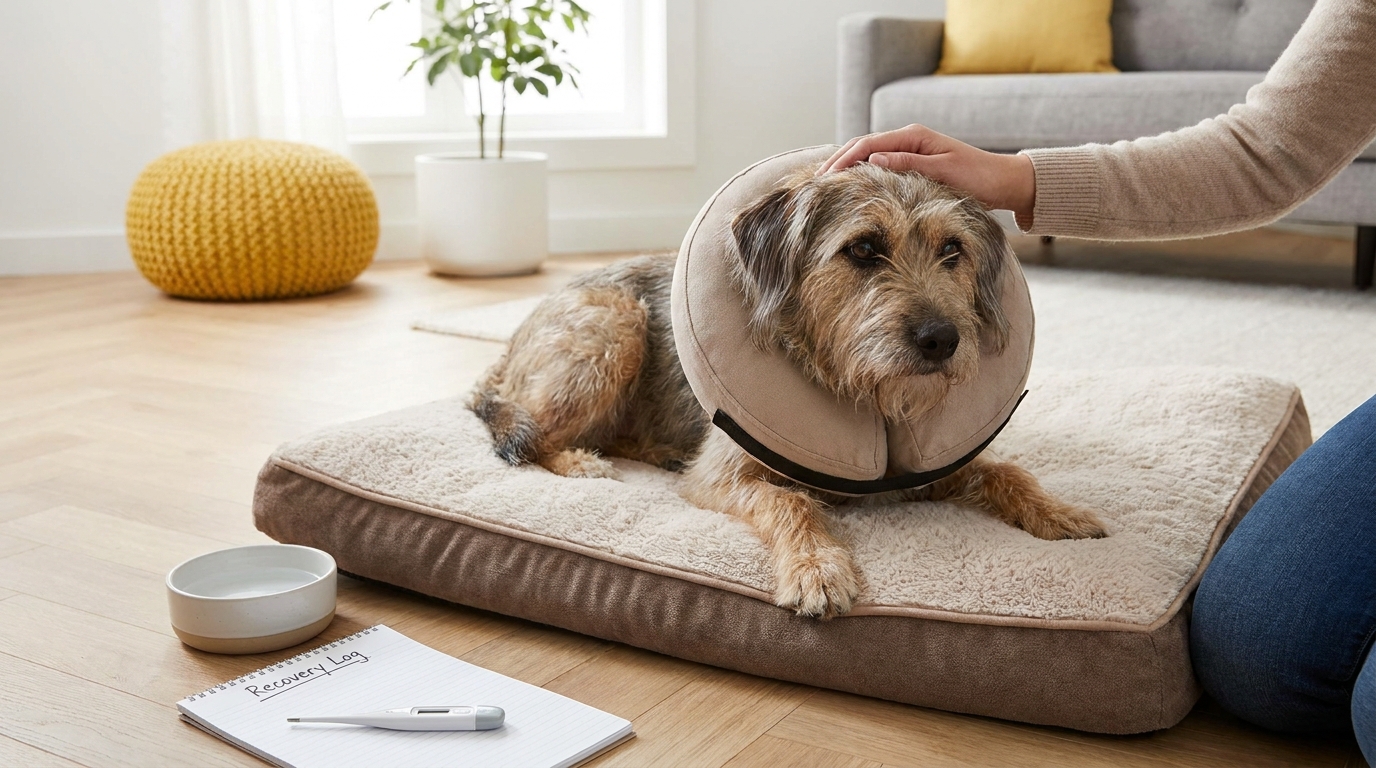
One vomit on the first night can be normal. Here is when to watch, when to call the surgical clinic, and when to go to an ER now.
Quick answer: One vomit on the first night after routine surgery can be normal and may be watched if your dog is alert and your discharge sheet allows it. Call the surgical clinic for a second vomit, vomiting after the first day, or vomiting after each pill. Go to an ER now for blood, a swelling belly, dry heaving, labored breathing, pale gums, or any vomiting after stomach or intestinal surgery.
This article is general information, not a diagnosis. If you think your pet is in danger, go to the nearest emergency animal hospital.
Is vomiting after surgery normal? The first 24 hours
Once, it can be. The San Antonio Humane Society's post-op sheet says one episode of vomiting can be normal after anesthesia, but more than one is not normal and usually is not caused by the anesthesia. Sonoma County Animal Services and Richmond SPCA both treat vomiting after the first 24 hours as a sign of a possible problem.
Some clinics are stricter: the ASPCA Spay/Neuter Alliance and the Maryland SPCA want a call for any vomiting. Your own discharge sheet decides.
Why dogs vomit around surgery:
- Opioid premeds. The pain injection given before surgery often makes dogs vomit, but in studies this happens in the hospital, usually within about 30 minutes of the shot and before anesthesia starts. Rates ran from about 1 in 4 dogs (Hay Kraus, JAVMA 2014) to 87% in a spay study (Claude, Journal of Veterinary Internal Medicine 2014).
- Anesthetic drugs. The SPCA of York County's spay sheet says some dogs stay nauseated from them for up to about a day.
- An empty stomach, then a big drink. Gulping water or a full meal at pickup can bring it back up. VCA notes that smaller portions may lower the risk. Yellow liquid or foam can come up too, but its color alone does not tell you the cause, and a second vomit of any color still means calling the clinic.
- The car ride and stress. A groggy dog in a moving car may vomit once.
Shivering is also common on the first night; see our guide to a dog shaking after surgery.
Normal, call the clinic, or ER now
Your clinic's discharge sheet comes first. Some clinics want a call for any vomit.
| What you see | Likely meaning | What to do |
|---|---|---|
| One vomit night one; alert | Drugs or empty stomach | Follow your sheet; some want a call |
| A second vomit, or any after day 1 | Not routine | Call the clinic now |
| Vomits after each pill | Drug upset | NSAID: stop, call. Others: call first |
| Can't keep water down; very dull | Dehydration risk | Same-day exam or ER |
| Blood, coffee grounds, or black stool | Possible bleeding or ulcer | ER now |
| Dry heaving, or a swelling belly | Possible bloat | ER now |
| Vomit with cough or fast breathing | Possible aspiration | ER now |
| Pale gums, weakness, collapse | Possible internal bleeding | ER now |
| Too groggy to lift head | Can inhale vomit | Clinic or ER now |
| Any vomit after stomach or gut surgery | Possible leak | Surgeon or ER now |
| Fever, very dull, or draining incision | Possible infection or leak | Call the surgeon now |
| Effortless spit-up, days to weeks later | Sore or narrowed esophagus | Book an in-person exam |
Dry heaving means retching with nothing coming up. The American College of Veterinary Surgeons (ACVS) lists it, a swelling belly, drooling, an anxious look or looking at the belly, and standing and stretching as early signs of bloat. Panting, weakness and collapse come later. Any one early sign alone is enough to go now.
Tacky gums, sunken eyes or very low energy in a dog that can't keep water down need a same-day exam; puppies, toy breeds and seniors dehydrate fastest. The FDA warns that NSAID pain relievers can reduce blood flow to the kidneys in a dehydrated dog.
After stomach or intestinal surgery, any vomit is an emergency
After surgery on the stomach or intestines, such as removing a swallowed object, a biopsy, a gastropexy or bloat surgery, any vomiting on any day means calling the surgeon or going to an ER now.
The worry is a leak, where a sutured closure fails and gut contents spill into the belly. The ACVS says a leak can happen in the first 5 days and lists lethargy, a worse appetite, vomiting, fever, incision drainage and a swelling belly as signs that need a recheck as soon as possible. Cornell's Riney Canine Health Center puts the highest risk of suture failure in the first 3 to 5 days. Most studies report leaks in about 2% to 14% of dogs, and closer to 1 in 5 when the belly was already infected before surgery. A leak is life-threatening, and no later day is a safe day.
A spay is belly surgery too. Pale or white gums, weakness or collapse in the first 24 to 48 hours after a spay or other belly surgery can mean internal bleeding. Go to an ER now.
When it started: night one, days 2 to 5, or weeks later
| When it starts | Common causes | What to do |
|---|---|---|
| First 24 hours | Opioids, anesthesia, empty stomach, gulping, car ride | One vomit: follow sheet. More: call clinic |
| Days 2 to 5 | Pills, inflamed pancreas, sore esophagus; gut-surgery leak | Call the clinic now; after gut surgery, ER |
| 1 to 4 weeks | Esophagus narrowing (stricture) after reflux | In-person exam; ER if coughing |
Vomiting that starts after the first day is not explained by anesthesia.
In days 2 to 5, think of the take-home medicines, table scraps, and pancreatitis, which can show as a painful belly or hunched posture after fatty food. Any dog on an NSAID, especially a senior, that vomits, stops eating, or drinks or urinates much more or less than usual needs a same-day exam and bloodwork. Straining to urinate with little or no urine means calling the clinic now.
Days to a few weeks later, think of the esophagus. Stomach acid can flow back into it under anesthesia; studies report this reflux in roughly 1 in 6 to more than half of dogs. The AAHA anesthesia guidelines say reflux can lead to esophagitis, aspiration pneumonia and, in extreme cases, a narrowing called a stricture, and that it cannot be consistently prevented. Sherding, DVM, DACVIM, writes in conference proceedings that esophagitis signs usually appear within 1 to 3 days, and a stricture is suspected when spitting up starts within 1 to 4 weeks.
Vomiting or spitting up? How to tell them apart
Vomiting and regurgitation (spitting up) look alike on the floor but mean different things. The Merck Veterinary Manual's owner guide describes vomiting as forceful, with heaving as the belly muscles push. Regurgitation is passive and effortless: undigested food slides out, sometimes tube-shaped, and coughing or trouble breathing goes with it more often.
| Sign | Vomiting | Spitting up |
|---|---|---|
| Effort | Heaving; belly muscles push | No effort; food slides out |
| What comes up | Often partly digested | Undigested; may be tube-shaped |
| Cough or noisy breathing | Less common | More common |
| After surgery, think | Drugs, stomach upset, leak | Reflux injury to esophagus |
Effortless spitting up days to weeks after surgery, especially with painful or repeated swallowing, gagging, drooling or weight loss, points to the esophagus. In one study (Leib, 2001), 18 of 28 benign esophageal strictures in dogs and cats followed a recent anesthetic, and these problems are often diagnosed late (Wilson and Walshaw, 2004). Book an in-person exam soon, since diagnosis needs imaging or a scope. With a cough or fast breathing, go to an ER now. See also dog throwing up undigested food.
Is it the pain medicine or the antibiotic?
Vomiting within about an hour of each dose suggests a take-home drug is the cause. Call the clinic before the next dose.
- NSAID pain relievers. Carprofen (Rimadyl) is FDA-approved for pain after soft tissue and orthopedic surgery, and its label lists decreased appetite, vomiting, diarrhea and dark or tarry stools among adverse reactions. Meloxicam is an arthritis-labeled NSAID some clinics also send home after surgery. The FDA and both labels say to stop the NSAID and contact your vet if these signs appear.
- Antibiotics. The Clavamox (amoxicillin-clavulanate) label lists vomiting, diarrhea, poor appetite and lethargy among reported side effects. Call before stopping one.
For other medicines, don't skip, stop or repeat a dose without asking. The FDA warns never to give two NSAIDs together, or an NSAID with a steroid such as prednisone. If your dog went home on carprofen and gabapentin together, that guide covers what to watch.
Vomiting with a cough or fast breathing: possible aspiration
A dog that vomits or spits up can inhale some of it and develop aspiration pneumonia. Coughing, fast breathing or labored breathing after any anesthesia means an ER now.
In a study of 140,711 anesthesias at 6 veterinary colleges (Ovbey, 2014), aspiration pneumonia followed about 0.17% of them. Risk was higher with regurgitation, belly surgery other than spay or neuter, upper airway or chest surgery, neurosurgery, endoscopy, hydromorphone at induction, megaesophagus and earlier lung or neurologic disease. Neutering and dental, orthopedic and eye surgery were not linked to extra risk. That lowers the odds but does not rule it out, especially in a dog too groggy to lift its head.
What to do tonight after a vomit
- Follow the sheet on food and water. Clinics differ on when food restarts, but the sheets that cover it hold off after a vomit: Sonoma County Animal Services advises nothing by mouth until morning, and Richmond SPCA offers food and water only if there has been no vomiting. When food restarts, the San Antonio Humane Society uses small portions. If your sheet doesn't say, call and ask.
- Stick to the usual food. No table scraps, fatty treats or new diets.
- Give no human medicine. No human anti-nausea drugs, pain pills or Pepto-Bismol, which Pet Poison Helpline lists as a source of an aspirin-type salicylate. The ASPCA Spay/Neuter Alliance warns that human medication can be fatal, and the Merck Veterinary Manual notes that prolonged aspirin use can cause stomach ulcers in dogs. See human pain relievers for dogs.
- No leftover anti-nausea tablets. They treat the symptom, not the cause. The Cerenia (maropitant) label says safe use has not been evaluated in dogs with a gut blockage, and that the cause of vomiting should be found. After surgery, that cause could be a leak.
- Don't make your dog throw up unless a poison line or a vet tells you to.
- Keep the cone on and check the incision after each vomit for bleeding, discharge or gaping.
- Keep a log of vomit times, what came up and medicine times. A photo helps the clinic.
Who to call: the surgical clinic, an ER or a video vet
Start with the clinic that did the surgery: it has your dog's anesthesia record. Check the discharge sheet for an after-hours number.
If the clinic is closed and that line can't be reached, a $64.99 live video visit with Dr. Tiffany Delacruz, DVM, can give you a second look when all of these are true: your discharge sheet does not say to call for any vomiting; it is still the first day after anesthesia; your dog has vomited once or twice, is alert and keeps water down; your dog is in Florida, New York or Virginia at the time of the visit; and it is within her live video hours (about 8 AM to 11 PM ET). RexVet is a 501(c)(3) non-profit, and Dr. Delacruz is its one bookable vet. She can go through the discharge sheet and medication list with you, look at your dog's gums, breathing, belly shape and incision on camera, and help you decide whether to keep watching, call the surgeon in the morning, or go in tonight. She works alongside your surgeon's plan, not instead of it. Whether any medicine is appropriate depends on the exam, the surgeon's plan and state rules, and no prescription is promised. Book a video visit with Dr. Delacruz.
A video visit is not the right call for: any vomiting after stomach or intestinal surgery; blood or coffee-ground material in the vomit, or black, tarry stool; retching without bringing anything up, or a swelling or tight belly; vomiting with coughing or labored breathing; vomiting again and again, or not keeping water down; pale gums, weakness or collapse; fever, a very dull dog, or an open or draining incision; or vomiting that keeps going past the first day or starts later. Those go to the surgeon or the nearest ER now. Outside her hours, use the clinic's after-hours line or an ER. If your dog may have eaten something toxic or was given a human medicine, call ASPCA Animal Poison Control at (888) 426-4435 (a consultation fee may apply) or Pet Poison Helpline at (855) 764-7661 (per-incident fee), or go to an ER.
Need an Expert Opinion on This Topic?
Book a video visit with a licensed vet, evenings and weekends included
See open timesFrequently Asked Questions
Is it normal for a dog to throw up after anesthesia?
It can be, once. Opioid drugs given before surgery often cause vomiting in the hospital, and one vomit on the first night home can also be normal (San Antonio Humane Society). More than one is not normal and usually not from anesthesia, so call the surgical clinic. Some clinics, such as the ASPCA Spay/Neuter Alliance, want a call for any vomiting. After stomach or intestinal surgery, any vomiting means calling the surgeon or going to an ER now.
How long does nausea last after anesthesia in dogs?
Usually not long. One shelter discharge sheet says some dogs feel queasy from the anesthetic drugs for up to about a day. The ASPCA Spay/Neuter Alliance treats lethargy lasting more than 24 hours as not normal, so if appetite and energy are not returning by the next day, call the clinic. Don't wait out repeated vomiting: call the clinic for a second vomit, and for vomiting that keeps going after the first day or starts later, which anesthesia does not explain (Richmond SPCA, Sonoma County Animal Services).
My dog threw up after being spayed or neutered. Should I worry?
One vomit on the first night, in an alert dog, can be normal, but many spay/neuter clinics want a call for any vomiting, and a second vomit always means calling them. A spay is belly surgery, so pale or white gums, weakness, a swelling belly or collapse in the first day or two means an ER now. If your dog also got vaccines that day, face swelling, hives, vomiting, weakness or collapse within hours can be a reaction that needs an ER now (see dog lethargic after vaccines). For incision worries, see swollen scrotum or open incision after a neuter.
Should I give the next pain pill if my dog vomited?
Don't decide on your own. If the pill is an NSAID such as carprofen or meloxicam, the FDA and the drug labels say to stop it and call your vet when side effects like vomiting appear. For any other take-home medicine, including an antibiotic, call the clinic before the next dose. Never add a human pain reliever or a second NSAID. Blood or coffee-ground material in the vomit means an ER now.
When can my dog eat again after vomiting post-surgery?
Follow your discharge sheet, because clinics differ on when food restarts. The sheets that cover it hold off after a vomit: Sonoma County Animal Services says nothing by mouth until morning, and Richmond SPCA offers food and water only if there has been no vomiting. When food does restart, the San Antonio Humane Society offers a small portion of the usual food and waits about an hour without vomiting before offering more. Offer water the way your sheet says. If your dog can't keep water down, call the clinic the same day.
Can an online vet help if my dog is vomiting after surgery?
Partly. A video visit can help if your dog is in Florida, New York or Virginia at the time of the visit, it is within Dr. Tiffany Delacruz's live video hours (about 8 AM to 11 PM ET), and no ER sign applies. Call the surgical clinic first. On camera, she can review the discharge sheet and medicines, check breathing, alertness, gum color, belly shape and the incision, and help you choose between watching, calling the surgeon or going in tonight. Feeling the belly, bloodwork, X-rays, ultrasound, fluids, injections and incision repair need an in-person visit. If medicine comes up, Florida limits a video-only prescription to FDA-approved animal drugs used as labeled, for up to 14 days, with no renewal without an in-person exam. Human-labeled, controlled and compounded anti-infective drugs need an in-person exam; gabapentin, trazodone and tramadol, common take-home post-op drugs, fall in those groups. Under federal rules, extralabel or human-drug use needs a vet-client-patient relationship built on an in-person exam. Virginia allows the exam to be electronic, though the federal rule still applies there. New York's rules are unsettled, so expect more limits there. No prescription is promised. If a prescription is sent, a pharmacy transfer fee applies, because RexVet is not a pharmacy.
FAQs
Is it normal for a dog to throw up after anesthesia?
It can be, once. Opioid drugs given before surgery often cause vomiting in the hospital, and one vomit on the first night home can also be normal (San Antonio Humane Society). More than one is not normal and usually not from anesthesia, so call the surgical clinic. Some clinics, such as the ASPCA Spay/Neuter Alliance, want a call for any vomiting. After stomach or intestinal surgery, any vomiting means calling the surgeon or going to an ER now.
How long does nausea last after anesthesia in dogs?
Usually not long. One shelter discharge sheet says some dogs feel queasy from the anesthetic drugs for up to about a day. The ASPCA Spay/Neuter Alliance treats lethargy lasting more than 24 hours as not normal, so if appetite and energy are not returning by the next day, call the clinic. Don't wait out repeated vomiting: call the clinic for a second vomit, and for vomiting that keeps going after the first day or starts later, which anesthesia does not explain (Richmond SPCA, Sonoma County Animal Services).
My dog threw up after being spayed or neutered. Should I worry?
One vomit on the first night, in an alert dog, can be normal, but many spay/neuter clinics want a call for any vomiting, and a second vomit always means calling them. A spay is belly surgery, so pale or white gums, weakness, a swelling belly or collapse in the first day or two means an ER now. If your dog also got vaccines that day, face swelling, hives, vomiting, weakness or collapse within hours can be a reaction that needs an ER now (see dog lethargic after vaccines). For incision worries, see swollen scrotum or open incision after a neuter.
Should I give the next pain pill if my dog vomited?
Don't decide on your own. If the pill is an NSAID such as carprofen or meloxicam, the FDA and the drug labels say to stop it and call your vet when side effects like vomiting appear. For any other take-home medicine, including an antibiotic, call the clinic before the next dose. Never add a human pain reliever or a second NSAID. Blood or coffee-ground material in the vomit means an ER now.
When can my dog eat again after vomiting post-surgery?
Follow your discharge sheet, because clinics differ on when food restarts. The sheets that cover it hold off after a vomit: Sonoma County Animal Services says nothing by mouth until morning, and Richmond SPCA offers food and water only if there has been no vomiting. When food does restart, the San Antonio Humane Society offers a small portion of the usual food and waits about an hour without vomiting before offering more. Offer water the way your sheet says. If your dog can't keep water down, call the clinic the same day.
Can an online vet help if my dog is vomiting after surgery?
Partly. A video visit can help if your dog is in Florida, New York or Virginia at the time of the visit, it is within Dr. Tiffany Delacruz's live video hours (about 8 AM to 11 PM ET), and no ER sign applies. Call the surgical clinic first. On camera, she can review the discharge sheet and medicines, check breathing, alertness, gum color, belly shape and the incision, and help you choose between watching, calling the surgeon or going in tonight. Feeling the belly, bloodwork, X-rays, ultrasound, fluids, injections and incision repair need an in-person visit. If medicine comes up, Florida limits a video-only prescription to FDA-approved animal drugs used as labeled, for up to 14 days, with no renewal without an in-person exam. Human-labeled, controlled and compounded anti-infective drugs need an in-person exam; gabapentin, trazodone and tramadol, common take-home post-op drugs, fall in those groups. Under federal rules, extralabel or human-drug use needs a vet-client-patient relationship built on an in-person exam. Virginia allows the exam to be electronic, though the federal rule still applies there. New York's rules are unsettled, so expect more limits there. No prescription is promised. If a prescription is sent, a pharmacy transfer fee applies, because RexVet is not a pharmacy.
Medically Reviewed
Reviewed by Dr. Tiffany Delacruz, DVM — licensed veterinarian and CEO of RexVet. Last reviewed October 30, 2026.
Content is for informational purposes and does not replace professional veterinary advice.
Chief Executive Officer · Licensed Veterinarian
Dr. Delacruz is a licensed Doctor of Veterinary Medicine specializing in preventive care and veterinary telehealth. She reviews all health content on RexVet to ensure accuracy and clinical relevance.
Sources & References
- · American Veterinary Medical Association — Telehealth Guidelines
- · AVMA — Pet Care Resources
- · U.S. FDA — Animal & Veterinary