
Dog Ate Rat Poison: What to Do Now, by Bait Type
By RexVet Team | Reviewed by Dr. Tiffany Delacruz, DVM
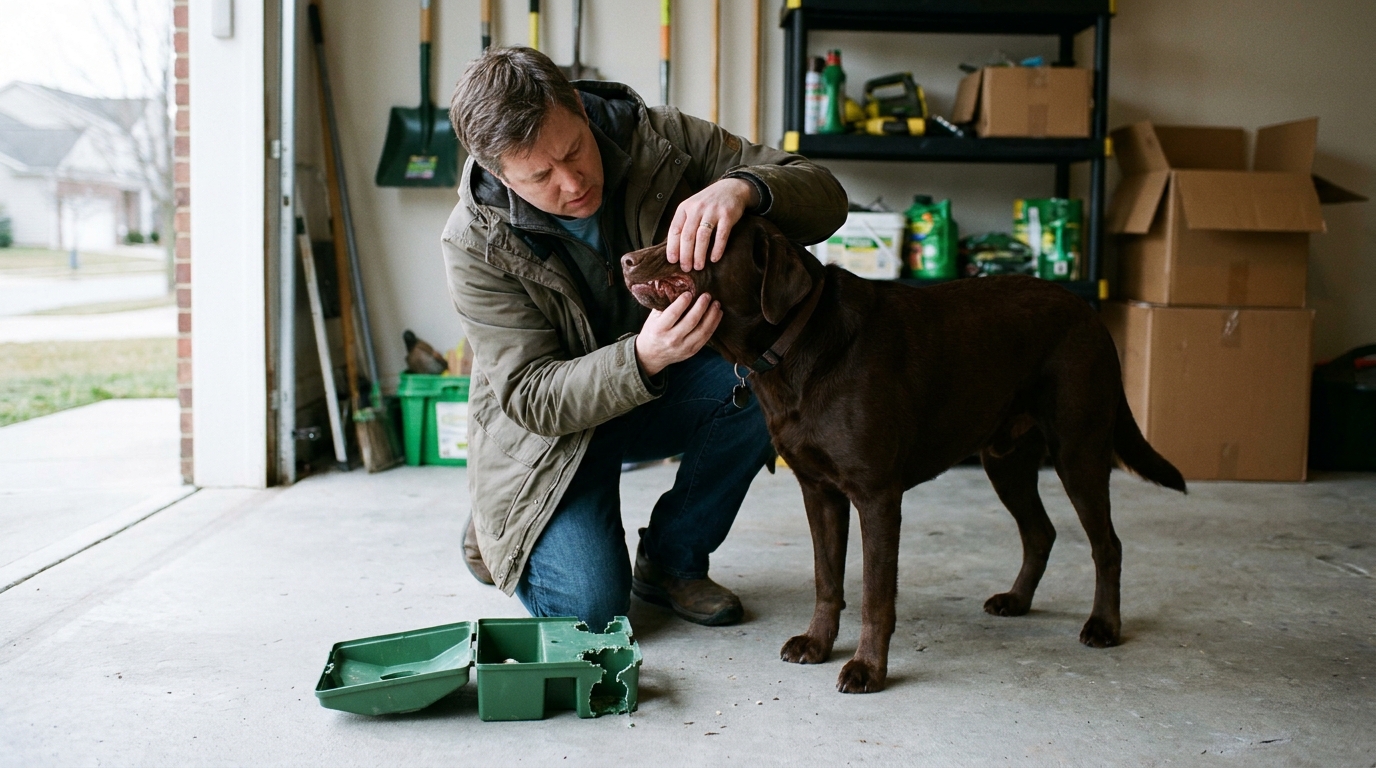
A dog that ate rat bait can look fine for a week. What to do first, how to tell which poison it was, and the signs that mean the ER now.
Quick answer: If your dog ate rat or mouse bait, go to an emergency vet now, even if your dog seems fine, and call ASPCA Animal Poison Control (888) 426-4435 or Pet Poison Helpline (855) 764-7661 on the way. Bring the package: the active ingredient decides treatment. Anticoagulant baits can cause bleeding 3 to 7 days later. Do not make your dog vomit at home unless told to.
This article is general information, not a diagnosis. If you think your pet is in danger, go to the nearest emergency animal hospital.
Dog ate rat poison: what to do first
Treat any bait your dog ate, or may have eaten, as an emergency, even if your dog acts completely normal.
- Move your dog away from the bait. Put the rest of the bait, the package and any chewed station where no pet can reach them, and check every other pet in the home.
- Photograph the label. Get the active-ingredient line and the EPA Reg. No. in focus, and bring the package if you have it.
- Write down three things: the time your dog may have eaten the bait, your dog's weight and how much bait is missing.
- Go to the nearest emergency vet now. Call a poison line on the way (have a passenger call, or use hands-free), not instead of going. ASPCA Animal Poison Control, (888) 426-4435, answers 24 hours a day; a consultation fee may apply. Pet Poison Helpline, (855) 764-7661, also answers 24 hours a day; a per-incident fee applies.
- Skip home treatment. Do not make your dog vomit unless the poison line or the ER vet tells you to. Give no activated charcoal, food, milk or home remedy.
Vomiting induced by a vet helps most in the first few hours, so go now, however long ago your dog ate it. Home methods can cause harm, especially in a dog that is already vomiting, trembling or struggling to breathe. See when making a dog throw up helps and when it harms.
Some mole and gopher baits contain zinc phosphide. After mole, gopher or any other phosphide bait, never make your dog vomit at home: fumes from the vomit can sicken people, so drive with the windows open. Anyone who gets a headache, nausea or trouble breathing from the smell needs medical care.
| Situation | First step |
|---|---|
| Saw it eat bait, or a chewed station | ER now; call a poison line on the way |
| Not sure, but bait was in reach | ER now anyway; call on the way |
| Bleeding, seizing, weak or collapsed | ER now |
| Ate a dead or dying rodent | Poison line now; follow its advice |
| Home after the ER, any new sign | Back to the ER now |
| Home after the ER, a question | The treating hospital first |
Why "seems fine" is not safe after rat bait
A dog can look normal for 3 to 7 days before bleeding shows, so looking fine is never a reason to wait. The Merck Veterinary Manual says anti-clot (anticoagulant) baits change the clotting test only after 2 to 5 days, and bleeding usually shows 3 to 7 days after the dog eats the bait. A normal clotting test on day one does not clear your dog, and a recheck at about 48 hours is the vet's plan, never a reason to wait at home.
The other baits run on their own clocks:
- Bromethalin: the seizure form usually starts within 4 to 36 hours and the paralysis form within 1 to 5 days, with signs possible up to about a week out. There is no antidote.
- Vitamin D3 (cholecalciferol): signs and bloodwork changes often appear within 12 to 48 hours, and kidney damage can start by days 2 to 3.
- Phosphides: signs can start almost right away, or rarely up to a day later.
With every bait, treatment works best before signs appear.
The four rat poison types at a glance
Pet Poison Helpline groups the common baits into four kinds, each with its own effect and timing.
| Bait type | What it does | When signs show |
|---|---|---|
| Anti-clot | Stops blood from clotting | Usually 3-7 days |
| Bromethalin | Swells the brain | Hours to about a week |
| Vitamin D3 | Raises calcium, harms kidneys | Often 12-48 hours |
| Zinc or aluminum phosphide | Makes toxic gas in the stomach | Fast; rarely up to a day |
Anti-clot (anticoagulant) baits include warfarin, diphacinone, chlorophacinone, brodifacoum, bromadiolone and difethialone. Vitamin D3 appears on labels as cholecalciferol.
No signs yet is not a reason to wait. Bromethalin has no antidote at any stage, so hospital decontamination before signs start matters most.
After EPA's consumer-bait rules took effect (decided 2008, in force from 2011), consumer baits had to be blocks in tamper-resistant stations without second-generation anti-clot ingredients. The anti-clot ingredients in today's consumer stations, diphacinone and chlorophacinone, are still long-acting, and pest control professionals may still use second-generation baits in homes. Bromethalin is now the most common bait exposure in pets, per Merck.
Warning signs by day
Any sign below means the ER now. Don't wait for morning.
The first 36 hours (most often bromethalin, vitamin D3 or phosphide):
- Tremors, seizures or overexcitement
- Wobbly, weak or dragging back legs
- Overheating, or unusual dullness or sleepiness
- Vomiting (severe or bloody after phosphide) or not eating
- Heavy drinking and peeing, or weakness
- Belly pain or bloating, fast breathing, or a rotten-fish or garlic smell
Days 2 to 7 (most often anti-clot baits, plus later bromethalin and vitamin D3 signs):
- Pale or white gums
- Unusual tiredness, not eating, or tiring fast on walks
- Nosebleed, bleeding gums, vomiting blood, or black or bloody stool
- Blood in the urine, or bruising
- Fast or labored breathing, coughing (sometimes with blood), weakness or collapse
- A swollen belly, or a sudden limp or swollen joint
- Wobbly or weak back legs, and heavy thirst
Day 7 is not an all-clear. Signs can start later, or sooner if bait was eaten more than once, and clotting trouble can return after the vitamin K course. Any sign, at any point, means the ER now.
Internal bleeding can show no blood at all, only fast breathing, weakness or a swollen belly, so know a dog's normal breathing rate while sleeping. Blood in the urine can appear while a dog still acts normal; see what blood in a dog's urine can mean and how soon to act.
How to tell which bait it was
Color alone can't tell you the poison. The label's EPA Reg. No., the maker, or the pest company that placed the station can. The Merck Veterinary Manual and Pet Poison Helpline both warn that shape and size don't reveal it either.
A brand name doesn't tell you the poison either: one major brand switched poisons in 2018 (from anti-clot to vitamin D3, per Purdue University's Animal Disease Diagnostic Laboratory), so an older box can differ from a newer one. The EPA Reg. No. lets Pet Poison Helpline look up the exact ingredient and strength.
| What you have | Tell the line | Bring |
|---|---|---|
| The package | Active ingredient, its % and EPA Reg. No. | Package or a photo of the label |
| Only a bait block | Color, shape and where you found it | Photo, plus any station label |
| Pest firm station | Company name and visit date | Their product label (call them) |
| Only a suspicion | When the dog was alone, and where | Notes of the times |
Once you're on your way, call the pest company for its label. In an apartment, ask building management which product was used.
What the emergency vet will do
Treatment depends on the bait, the timing and whether signs have started:
- Decontamination. If it's early and safe, the vet may make your dog vomit. VCA Animal Hospitals says only a veterinarian should give activated charcoal; for bromethalin, Merck describes several rounds.
- A clotting test. The prothrombin time (PT) test can stay normal for days after anti-clot bait, so the vet may repeat it.
- Vitamin K1, for anti-clot baits only. It does nothing for bromethalin, vitamin D3 or phosphide baits. For rat poison it is a prescription medicine, and EPA's poisoning manual notes that vitamin K3 and K4 are not antidotes. The course usually runs several weeks, often about a month, depending on the bait. Give every dose even if your dog seems fine. The clotting recheck, usually 2 to 3 days after the last dose, checks that the problem has not returned. Ask how long to keep your dog calm and leashed. Your treating vet sets the length.
- Bromethalin care. With no antidote, care is supportive. Signs can last weeks, with a slow recovery.
- Vitamin D3 care. IV fluids often run 2 to 3 days (Pet Poison Helpline, quoted by Purdue). Bloodwork is usually repeated over the next 3 to 4 days, and for weeks if calcium or kidney values rise. Your vet sets the schedule.
- Phosphide care. The vet induces vomiting only in a well-ventilated area, only early and only in a dog with no signs yet. There is no specific antidote.
- Transfusion. A bleeding dog may need fresh frozen plasma or whole blood.
Call the treating hospital the same day if a dose is missed or vomited, if you're unsure when the recheck is, or if you're thinking about stopping the course. Never stop it early because your dog seems fine.
What treatment can cost
There is no single price for rat poison treatment, because the cost depends on the bait and the timing. The bill climbs in steps:
- Exam, decontamination and a test, such as a clotting test or bloodwork.
- An antidote course with rechecks: for anti-clot baits, weeks of vitamin K1 and a clotting recheck.
- Hospital care: IV fluids, seizure care or a transfusion.
CareCredit (May 2026, citing a 2025 Synchrony study) puts the average ER exam alone at $135 for dogs ($107 to $246), before any test or treatment. Pet Poison Helpline charges a per-incident fee, and for ASPCA Animal Poison Control a consultation fee may apply. Going before signs start gives the best chance of stopping at the first step.
Not sure your dog ate it?
You may find an empty or chewed station, bait crumbs, or a dead mouse near your dog. If your dog ate a dead or dying rodent, call a poison line now and follow its advice, because poison can pass from the prey to the dog.
If bait was within reach and you can't rule it out, go now anyway. At the hospital the vet may make your dog vomit and give charcoal, then either start vitamin K1 or check a clotting test about 48 hours after the exposure. That choice belongs to the treating vet, and it only applies to anti-clot baits.
Tell the vet which baits are in the home or yard, and whether bait may have been eaten more than once over several days.
If your cat ate rat poison
Cats are more sensitive to bromethalin than dogs are and more resistant to anti-clot baits, but you can't tell which one your cat ate, so it's the ER now. Merck notes that cats usually get the paralysis form of bromethalin poisoning, with weak or paralyzed back legs. Never make a cat vomit at home: Pet Poison Helpline says there is no safe way to do it.
If your cat ate a mouse that may have been poisoned, call a poison line. Black or bloody stool can be a bleeding sign; see bright red vs black blood in cat stool. After possible bait, any sign means the ER now.
Where a video visit fits, and where it does not
A video visit is not the first call when a dog ate rat bait. Go to an emergency vet now and call a poison line on the way. A video visit cannot make your dog vomit, give charcoal, run or read a clotting test, or treat bleeding or seizures.
RexVet is a nonprofit telehealth service with one vet, Dr. Tiffany Delacruz, DVM, licensed in Florida, New York and Virginia. Once the ER has treated your dog and it is home, stable and located in one of those states, a $64.99 live video visit with her (about 8 AM to 11 PM ET) can cover how to check gum color at home and which colors mean you go straight back, what to watch for over the next few days, and rodent-proofing with pets.
For a dog who is home and stable, book a live video visit with Dr. Delacruz.
Antidote questions go to the treating hospital first, because it has the clotting results; the vitamin K course and the recheck stay there. Dr. Delacruz cannot start, extend or refill vitamin K1 or any antidote course by video, in any state, and no prescription is promised.
If you're asking whether the gums look pale, treat them as pale. Pale gums, bleeding, bruising, trouble breathing, a swollen belly, weakness, wobbly back legs, tremors, seizures, vomiting, heavy thirst or collapse means the ER now, not a video call. Outside about 8 AM to 11 PM ET, or whenever your dog may have eaten bait, go to an ER; don't wait for morning.
Safer rodent control with pets this fall
Mice and rats move indoors in fall, when many homes put bait down.
- Pet-resistant stations lower the risk but don't remove it. EPA requires consumer stations to resist tampering by children and dogs, but Merck notes pets can still break through, and older products may not meet the standard.
- Place every station where your dog can't reach it, and count them.
- Tell the pest company you have pets. Ask which bait it uses, and keep the label where you can find it fast.
- Put snap traps inside enclosed boxes out of your dog's reach.
- Skip glue traps where pets roam, because pets get stuck in them too.
- Ask before a yard treatment. Some mole and gopher products are phosphide baits placed underground, where a digging dog can reach them.
Holiday plants are the next seasonal hazard: see whether poinsettias, mistletoe and holly are toxic to pets.
Need an Expert Opinion on This Topic?
Book a video visit with a licensed vet, evenings and weekends included
See open timesFrequently Asked Questions
My dog ate rat poison and seems fine. Now what?
Go to an emergency vet now and call a poison line on the way: ASPCA Animal Poison Control (888) 426-4435 (a consultation fee may apply) or Pet Poison Helpline (855) 764-7661 (a per-incident fee applies). Looking fine means nothing yet. Anti-clot baits usually cause bleeding 3 to 7 days later, and bromethalin has no antidote at all. Bring the package or a photo of the label's EPA Reg. No.
How long until rat poison symptoms show in a dog?
It depends on the bait. Phosphides can cause signs almost right away, vitamin D3 often within 12 to 48 hours, and bromethalin within hours to about a week. Anti-clot baits usually show bleeding 3 to 7 days later, and a clotting test can stay normal for the first 2 to 5 days. Don't wait for signs.
Can a dog survive eating rat poison?
Many dogs recover, but some baits can kill even with treatment. The best chance comes from treatment before signs appear. Anti-clot baits have an antidote, vitamin K1, given over a course the treating vet sets. Bromethalin has no antidote, so early decontamination matters most. Vitamin D3 and phosphide baits need hospital care. Go now rather than waiting to see.
Should I make my dog throw up after eating rat poison?
Not unless the poison line or the ER vet tells you to. Home methods can cause harm, and vomit after a phosphide bait gives off fumes that are toxic to people. Never give activated charcoal at home, and never make a cat vomit at home. More on when vomiting helps and when it harms.
Can I give my dog store-bought vitamin K for rat poison?
No. Don't give any vitamin K at home. Vitamin K1 helps only anti-clot baits, and vitamin K3 and K4 don't work at all. For rat poison, vitamin K1 is a prescription that the treating vet chooses, times and checks with clotting tests.
Is one bite of a bait block dangerous?
Treat any bite as an emergency. The danger depends on the poison, its strength and your dog's size, and only the poison line or a vet can work that out from the package and your dog's weight. Go now.
A pest company placed the bait station. Who do I call?
The ER and a poison line first. Then call the pest company and ask for the product label or its EPA Reg. No. Professionals may still use long-acting baits that stores no longer sell to consumers.
FAQs
My dog ate rat poison and seems fine. Now what?
Go to an emergency vet now and call a poison line on the way: ASPCA Animal Poison Control (888) 426-4435 (a consultation fee may apply) or Pet Poison Helpline (855) 764-7661 (a per-incident fee applies). Looking fine means nothing yet. Anti-clot baits usually cause bleeding 3 to 7 days later, and bromethalin has no antidote at all. Bring the package or a photo of the label's EPA Reg. No.
How long until rat poison symptoms show in a dog?
It depends on the bait. Phosphides can cause signs almost right away, vitamin D3 often within 12 to 48 hours, and bromethalin within hours to about a week. Anti-clot baits usually show bleeding 3 to 7 days later, and a clotting test can stay normal for the first 2 to 5 days. Don't wait for signs.
Can a dog survive eating rat poison?
Many dogs recover, but some baits can kill even with treatment. The best chance comes from treatment before signs appear. Anti-clot baits have an antidote, vitamin K1, given over a course the treating vet sets. Bromethalin has no antidote, so early decontamination matters most. Vitamin D3 and phosphide baits need hospital care. Go now rather than waiting to see.
Should I make my dog throw up after eating rat poison?
Not unless the poison line or the ER vet tells you to. Home methods can cause harm, and vomit after a phosphide bait gives off fumes that are toxic to people. Never give activated charcoal at home, and never make a cat vomit at home. More on when vomiting helps and when it harms.
Can I give my dog store-bought vitamin K for rat poison?
No. Don't give any vitamin K at home. Vitamin K1 helps only anti-clot baits, and vitamin K3 and K4 don't work at all. For rat poison, vitamin K1 is a prescription that the treating vet chooses, times and checks with clotting tests.
Is one bite of a bait block dangerous?
Treat any bite as an emergency. The danger depends on the poison, its strength and your dog's size, and only the poison line or a vet can work that out from the package and your dog's weight. Go now.
A pest company placed the bait station. Who do I call?
The ER and a poison line first. Then call the pest company and ask for the product label or its EPA Reg. No. Professionals may still use long-acting baits that stores no longer sell to consumers.
Medically Reviewed
Reviewed by Dr. Tiffany Delacruz, DVM — licensed veterinarian and CEO of RexVet. Last reviewed October 28, 2026.
Content is for informational purposes and does not replace professional veterinary advice.
Chief Executive Officer · Licensed Veterinarian
Dr. Delacruz is a licensed Doctor of Veterinary Medicine specializing in preventive care and veterinary telehealth. She reviews all health content on RexVet to ensure accuracy and clinical relevance.
Sources & References
- · American Veterinary Medical Association — Telehealth Guidelines
- · AVMA — Pet Care Resources
- · U.S. FDA — Animal & Veterinary