
Antifreeze Poisoning in Dogs and Cats: Signs and Timeline
By RexVet Team | Reviewed by Dr. Tiffany Delacruz, DVM
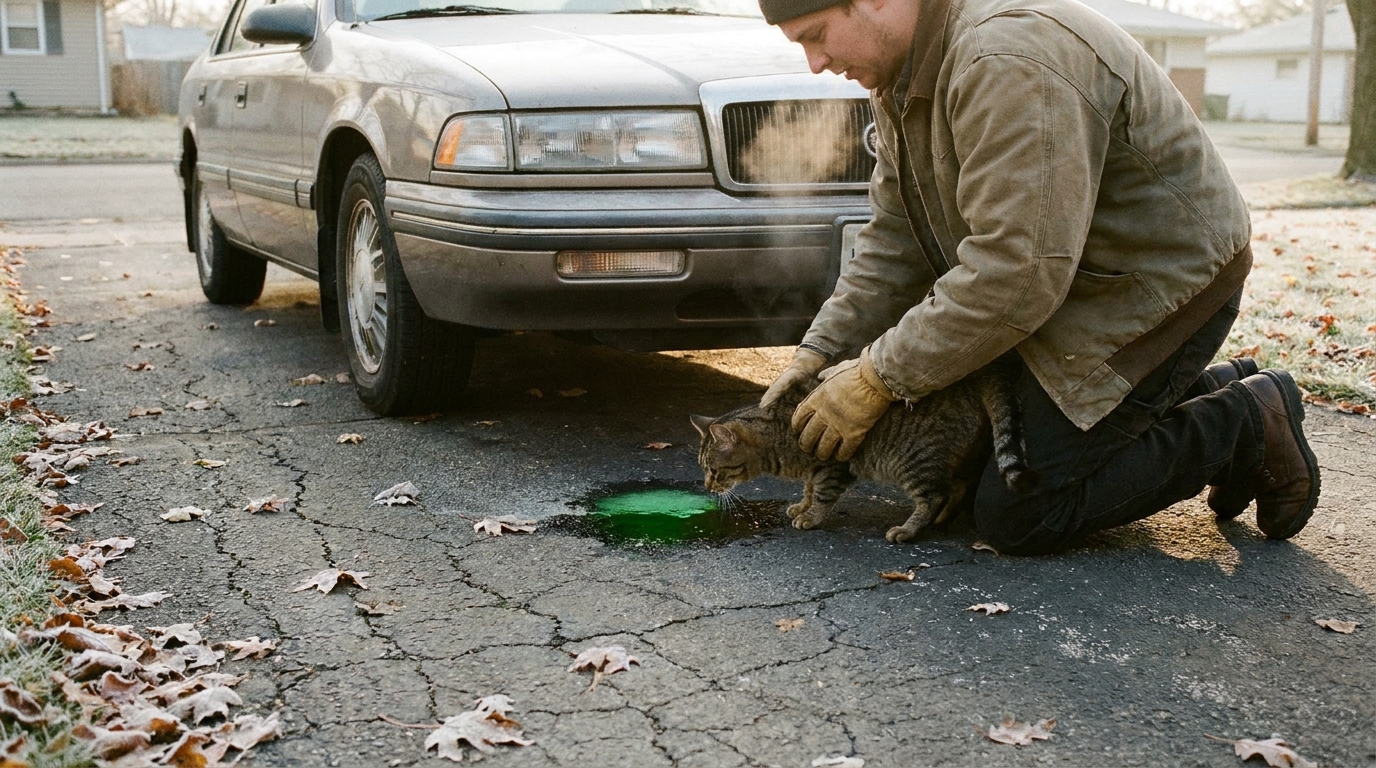
A very small amount of antifreeze can kill a dog or cat that seems fine at first. Here are the signs by stage, the antidote window, and what to do now.
Quick answer: If your dog or cat may have licked or drunk antifreeze, go to an emergency vet now and call a pet poison line on the way. Don't wait for signs. The antidote works best early: within about 3 hours in cats and about 8 in dogs, but go even if more time has passed. A pet that acts drunk, then seems better, is not recovering.
This article is general information, not a diagnosis. If you think your pet is in danger, go to the nearest emergency animal hospital.
Go to an ER now for any lick or drink, seen or not: a puddle under a car, a chewed or knocked-over coolant jug, a broken snow globe, a drink from a winterized toilet, wet or sticky paws or fur after time in the garage, or a pet that suddenly walks drunk. Call on the way: ASPCA Animal Poison Control (888) 426-4435 (a consultation fee may apply) or Pet Poison Helpline (855) 764-7661 (a per-incident fee applies). Both lines answer 24 hours a day.
Why ethylene glycol antifreeze is so dangerous
Most car antifreeze and radiator coolant is made with ethylene glycol, which tastes sweet. A very small amount can kill a dog or a cat (VCA, in a page by Pet Poison Helpline authors), and cats are poisoned by far less than dogs, pound for pound (Merck Veterinary Manual). You can't tell from a puddle or a wet paw how much your pet swallowed.
There is an antidote: an IV treatment given only in an animal hospital, for dogs and cats. It works best when it starts early, before the kidneys are hurt. So every possible exposure, seen or not, means an emergency vet now. Every pet that could have reached the spill goes too, not only the one you saw.
Why you should not wait for signs
Signs can start within 30 minutes or take hours, and some pets look normal at first. Pet Poison Helpline's team, writing for PetMD, tells owners not to wait for symptoms, because delay is so often fatal.
The drunk-then-better trap. Many pets stumble or vomit in the first hours, then perk up around 12 to 24 hours after drinking it. That is not recovery: Pet Poison Helpline says the damage goes on, and fast breathing, a fast heart rate and dehydration can show up. In cats this stage overlaps kidney failure, so a cat that looks brighter may already be very sick.
The antidote has to beat the kidney damage. The Merck Veterinary Manual says it helps only before kidney failure sets in, and the outlook gets worse the longer treatment waits. Once kidney failure develops, the outlook is grave (Dr. Langston, DVM, DACVIM, in dvm360).
A cat's window is hours, not a day. In a 2010 university lab study in the Journal of Veterinary Emergency and Critical Care (Connally and colleagues), the IV antidote prevented fatal kidney failure in cats when started within 3 hours, while cats treated at 4 hours developed kidney failure. For dogs, PetMD's Pet Poison Helpline team says treatment should start within about 8 hours for the best outcome. These are not hard cutoffs: if more time has passed, or you don't know when it happened, go anyway. The hospital decides what can still help.
Many exposures are never seen. An outdoor cat or a dog on a walk can find antifreeze without you knowing. If your pet had any chance to reach it and now acts drunk, vomits or is very sleepy, go to the ER now.
What to do in the next 10 minutes
- Move every pet away and close off the spill.
- Get fluid off the fur, fast. Wipe or rinse it off quickly, or wrap your pet in a towel so it can't lick, then leave. Cats groom it off: DoveLewis, a Portland emergency hospital, treated a cat that swallowed snow-globe fluid by licking its paws. Never let cleaning delay leaving.
- Grab the labels. Bring every container that could be involved, or a photo of each label.
- Note the time it happened, or when your pet last seemed normal, and how much may be gone.
- Check every pet in the home. Any pet that could have reached it comes too.
- Call on the way. Call the ER so staff are ready, and call one of the poison lines above. If two people are there, one drives and one calls.
What not to do. Don't make your dog vomit unless a poison line or vet tells you to, never try it with a cat, and never if your pet is already wobbly, very sleepy or having a seizure. The Merck Veterinary Manual explains that antifreeze is absorbed so fast that vomiting may not help even within an hour or two, and a pet with nervous-system signs can breathe vomit into its lungs. See when making a dog throw up helps and when it harms.
Don't give activated charcoal, milk, cooking oil, salt, hydrogen peroxide, alcohol, food or any home remedy. Pet Poison Helpline warns that a pet can inhale oil into its lungs. Nothing at home replaces the antidote.
Symptoms by stage: dogs vs cats
The stages are the same in both species, but cats reach kidney failure sooner and have a shorter antidote window. Sources: the Merck Veterinary Manual, Pet Poison Helpline, PetMD and the 2010 cat study.
| Stage | Dogs | Cats |
|---|---|---|
| Acts drunk, vomits, very thirsty | 30 min-12 h | 30 min-12 h |
| Seems better, still poisoned | About 12-24 h | About 12-24 h |
| Kidney failure | 36-72 h | 12-24 h |
| Antidote works best | Within about 8 h | Within about 3 h |
Go now however long it has been, or if you don't know when it happened; the hospital decides what can still help. Seizures can happen in the first stage. In cats, the "seems better" stage and kidney failure fall in the same window.
Early signs (30 minutes to 12 hours). Stumbling or a dazed, drunk look, vomiting, drooling, sudden strong thirst, heavy peeing and sometimes seizures.
Kidney failure signs. Peeing little or nothing after peeing a lot, not eating, vomiting, drooling, mouth sores, a painful belly, deep lethargy, collapse, seizures or coma. The Merck Veterinary Manual notes that vets find painful, enlarged kidneys at this stage. Any of these after possible access means the ER now, however long it has been. A dog that suddenly drinks less is another warning sign; our page on how long is too long for a dog not to drink lists antifreeze among the causes.
Not sure it was antifreeze? Other products that can poison
Radiator coolant is the main source of ethylene glycol, but Pet Poison Helpline also flags some brake fluids, windshield de-icers, cabin-toilet and RV plumbing antifreeze, and imported snow globes found to contain it. Not every antifreeze contains it, so the exact product matters.
| Product | Main chemical | What to do |
|---|---|---|
| Car coolant or antifreeze | Ethylene glycol (EG) | ER now |
| Unknown puddle or jug | Treat as EG | ER now |
| Broken snow globe | Some held EG | ER now |
| Toilet or pipe winterizer | EG or PG | Treat as antifreeze: ER now |
| "Pet-safe" RV or boat type | Propylene glycol (PG) | Poison line now; bring label |
| Windshield washer fluid | Methanol; some add EG | Poison line now; bring bottle |
| Some brake fluids, de-icers | May contain EG | Poison line now |
If your pet is wobbly or sleepy, or you aren't sure which product it was, go to the ER now. The label helps the ER and the poison line; it is not a way to decide at home.
"Pet-safe" antifreeze. These use propylene glycol, which the ASPCA says has a much wider safety margin, though pets should still be kept away from it. It can still make a pet act drunk (Merck Veterinary Manual), and the puddle may not be the jug on your shelf. Safer is not safe: call a poison line now.
Windshield washer fluid. Most washer fluid contains a moderate to high amount of methanol, and some also contain ethylene or propylene glycol (Pet Poison Helpline). Bring the bottle, or note its exact name and temperature rating.
For mouse and rat bait, the other big garage poison, see what to do if your dog ate rat poison, by bait type.
What happens at the emergency vet
Call the ER on the way and ask whether they can test and treat for antifreeze, because not every clinic has the test (VCA); if not, ask where to go. Have these answers ready:
| Tell the ER | Why |
|---|---|
| Product, or a photo of the label | EG vs PG changes the treatment |
| Time it happened, or last seen fine | Guides how fast to treat |
| How much may be gone | Helps judge the risk |
| Signs so far (wobbly, vomiting) | Shows the stage |
| Weight and other medicines | Shapes the treatment plan |
| Other pets that could reach it | Each may need a check |
- A blood test. A negative result doesn't always rule poisoning out, especially in cats or when the test is done late (Langston, dvm360) or very early (Merck Veterinary Manual), and propylene glycol can cause a false positive (Merck Veterinary Manual). PetMD notes that hospitals often start treatment out of caution, before or without a confirmed test.
- The antidote. It is given by IV in the hospital and works best in the first hours.
- IV fluids and kidney checks. Expect IV fluids, kidney bloodwork and urine checks.
- If kidney failure has set in. Some referral hospitals offer dialysis. It helps some pets, but the outlook is still poor, so it is never a reason to delay going in.
If the product turns out to be propylene glycol, the plan changes: it is treated with supportive care, not the ethylene glycol antidote (Merck Veterinary Manual). That call belongs to the hospital, never to a guess at home.
Can a dog or cat survive antifreeze poisoning?
Yes, when treatment starts early. Pets treated early usually recover with no lasting effects, according to PetMD's dog and cat pages, written with the Pet Poison Helpline team. Once kidney failure sets in, the outlook is poor, and most cats that already show signs do not survive.
Speed is the one factor you control, and even a pet that is already wobbly may still be helped. In a 2026 Canadian Veterinary Journal case series from one Saskatoon hospital, every pet that survived reached the hospital within about 7 hours of its first signs. The best odds come before any signs, but if signs have started, go now anyway.
Once home, if your pet pees less or not at all, vomits, won't eat, drools or seems weak, call the hospital that treated them or go back to the ER now. Don't wait for the recheck.
Winter antifreeze safety at home
- Wipe up spills and drips right away, and keep pets out until the area is clean.
- Store jugs tightly closed in a cabinet, where a dog can't chew them and a cat can't knock them over.
- Keep pets out of the garage and driveway while anyone works on a car.
- Check under parked cars for puddles.
- Get rid of old antifreeze properly; never leave an open jug or drain pan out.
- In a winterized cabin, RV or boat, keep toilet lids down and those rooms closed.
- Watch for outdoor and neighbor cats around garages and parked cars, and keep snow globes out of reach.
Bittered antifreeze. Most consumer antifreeze is now bittered (Virginia requires it by law), but older jugs and the coolant already in a car may not be, and a bitter taste doesn't make it safe.
Where you live changes the risk, not the rule. In New York and Virginia, cold snaps bring winterizing of cars, cabins and RVs. Florida boaters lay up boats, and snowbirds winterize the RVs and northern homes they leave behind. Summer counts too: leaking radiators and car work cause cases, and one small Canadian hospital study saw more cases in summer than in any other season.
For other cold-weather limits, see how cold is too cold for dogs, by size and coat. Holiday plants are the next seasonal worry; here's what to know about poinsettias, mistletoe and holly.
When a RexVet video visit helps, and when it does not
Antifreeze is not a video-visit problem. If there is any chance your pet licked or drank it, go to the nearest emergency hospital now and call ASPCA Animal Poison Control at (888) 426-4435 (a consultation fee may apply) or Pet Poison Helpline at (855) 764-7661 (a per-incident fee applies) on the way. A video vet cannot test for antifreeze, give the antidote, or tell you by camera that your pet is safe. If your pet pees less or not at all, vomits, won't eat, drools or seems weak after coming home, call the hospital that treated them or go back to the ER now.
A video visit fits only questions that can wait. RexVet is a 501(c)(3) non-profit. Dr. Tiffany Delacruz, DVM, licensed in Florida, New York and Virginia, sees pets located in those states by live video for $64.99, in slots about 8 AM-11 PM ET. She can help you plan a pet-safe garage or a winterized home, cabin, RV or boat. Once your pet is home and stable, she can also help you make sense of a discharge instruction; the treating hospital stays your first call. She can't refill or change medicines the hospital sent home, and no prescription or medication is promised. Book a video visit for a question that can wait.
Need an Expert Opinion on This Topic?
Book a video visit with a licensed vet, evenings and weekends included
See open timesFrequently Asked Questions
How long does antifreeze poisoning take in dogs and cats?
Signs usually start 30 minutes to 12 hours after drinking it: acting drunk or wobbly, vomiting, strong thirst, heavy peeing and sometimes seizures. Around 12 to 24 hours the pet may seem better while the poison keeps working. Kidney failure follows at about 12 to 24 hours in cats and 36 to 72 hours in dogs (Merck Veterinary Manual), and without early treatment it is often fatal. Don't wait for signs: go to an emergency vet now.
How much antifreeze can kill a dog or cat?
A very small amount can kill, and cats are poisoned by far less than dogs, pound for pound. Premixed coolant is still dangerous, and you can't judge how much was swallowed from a puddle or a lick. Any possible lick or drink means going to an emergency vet now.
Is pet-safe antifreeze safe for dogs and cats?
Safer, not safe. Pet-safe types use propylene glycol, which is less toxic than car coolant's ethylene glycol, but it can still make a pet act drunk, and a puddle may not be the product on your shelf. Call a poison line now and bring every label. If your pet is wobbly or you aren't sure what it drank, go to an emergency vet now.
Can I test for antifreeze poisoning at home?
Don't try to rule it out yourself. The test is a blood test done at an animal hospital, and not every clinic has it. A negative result doesn't always rule poisoning out, especially in cats, so the ER may start treatment before or without the result. Go to an emergency vet now.
My dog licked a tiny bit of antifreeze and seems fine. Can I wait?
No. Pets often seem fine early, and a pet that acts drunk and then seems better is not recovering. The antidote works best within about 8 hours in dogs and about 3 in cats, but go even if more time has passed or you don't know when it happened; the hospital decides what can still help. Go to an emergency vet now.
Is antifreeze poisoning painful for pets?
It can be. In the kidney-failure stage, vets may find painful, enlarged kidneys, along with vomiting, mouth sores, drooling, a fast heart rate and breathing, seizures or coma (Merck Veterinary Manual). Don't give any human pain medicine or home remedy. Go to an emergency vet now.
Can a dog or cat survive antifreeze poisoning?
Yes, when treatment starts early. Pets treated early usually recover with no lasting effects (PetMD, written with Pet Poison Helpline). Once kidney failure sets in the outlook is poor, and most cats that already show signs do not survive. The best odds come from arriving before signs, so go to an emergency vet now.
Is antifreeze only a winter danger?
No. Winterizing in New York and Virginia, and Florida boaters and snowbirds closing up boats and northern homes, raise the risk, but leaking radiators and summer car work cause cases too. One small Canadian hospital study saw more cases in summer than in any other season. In any season, a possible exposure means an emergency vet now.
FAQs
How long does antifreeze poisoning take in dogs and cats?
Signs usually start 30 minutes to 12 hours after drinking it: acting drunk or wobbly, vomiting, strong thirst, heavy peeing and sometimes seizures. Around 12 to 24 hours the pet may seem better while the poison keeps working. Kidney failure follows at about 12 to 24 hours in cats and 36 to 72 hours in dogs (Merck Veterinary Manual), and without early treatment it is often fatal. Don't wait for signs: go to an emergency vet now.
How much antifreeze can kill a dog or cat?
A very small amount can kill, and cats are poisoned by far less than dogs, pound for pound. Premixed coolant is still dangerous, and you can't judge how much was swallowed from a puddle or a lick. Any possible lick or drink means going to an emergency vet now.
Is pet-safe antifreeze safe for dogs and cats?
Safer, not safe. Pet-safe types use propylene glycol, which is less toxic than car coolant's ethylene glycol, but it can still make a pet act drunk, and a puddle may not be the product on your shelf. Call a poison line now and bring every label. If your pet is wobbly or you aren't sure what it drank, go to an emergency vet now.
Can I test for antifreeze poisoning at home?
Don't try to rule it out yourself. The test is a blood test done at an animal hospital, and not every clinic has it. A negative result doesn't always rule poisoning out, especially in cats, so the ER may start treatment before or without the result. Go to an emergency vet now.
My dog licked a tiny bit of antifreeze and seems fine. Can I wait?
No. Pets often seem fine early, and a pet that acts drunk and then seems better is not recovering. The antidote works best within about 8 hours in dogs and about 3 in cats, but go even if more time has passed or you don't know when it happened; the hospital decides what can still help. Go to an emergency vet now.
Is antifreeze poisoning painful for pets?
It can be. In the kidney-failure stage, vets may find painful, enlarged kidneys, along with vomiting, mouth sores, drooling, a fast heart rate and breathing, seizures or coma (Merck Veterinary Manual). Don't give any human pain medicine or home remedy. Go to an emergency vet now.
Can a dog or cat survive antifreeze poisoning?
Yes, when treatment starts early. Pets treated early usually recover with no lasting effects (PetMD, written with Pet Poison Helpline). Once kidney failure sets in the outlook is poor, and most cats that already show signs do not survive. The best odds come from arriving before signs, so go to an emergency vet now.
Is antifreeze only a winter danger?
No. Winterizing in New York and Virginia, and Florida boaters and snowbirds closing up boats and northern homes, raise the risk, but leaking radiators and summer car work cause cases too. One small Canadian hospital study saw more cases in summer than in any other season. In any season, a possible exposure means an emergency vet now.
Medically Reviewed
Reviewed by Dr. Tiffany Delacruz, DVM — licensed veterinarian and CEO of RexVet. Last reviewed October 28, 2026.
Content is for informational purposes and does not replace professional veterinary advice.
Chief Executive Officer · Licensed Veterinarian
Dr. Delacruz is a licensed Doctor of Veterinary Medicine specializing in preventive care and veterinary telehealth. She reviews all health content on RexVet to ensure accuracy and clinical relevance.
Sources & References
- · American Veterinary Medical Association — Telehealth Guidelines
- · AVMA — Pet Care Resources
- · U.S. FDA — Animal & Veterinary