
Old Dog Losing Weight but Still Eating: When to Worry
By RexVet Team | Reviewed by Dr. Tiffany Delacruz, DVM
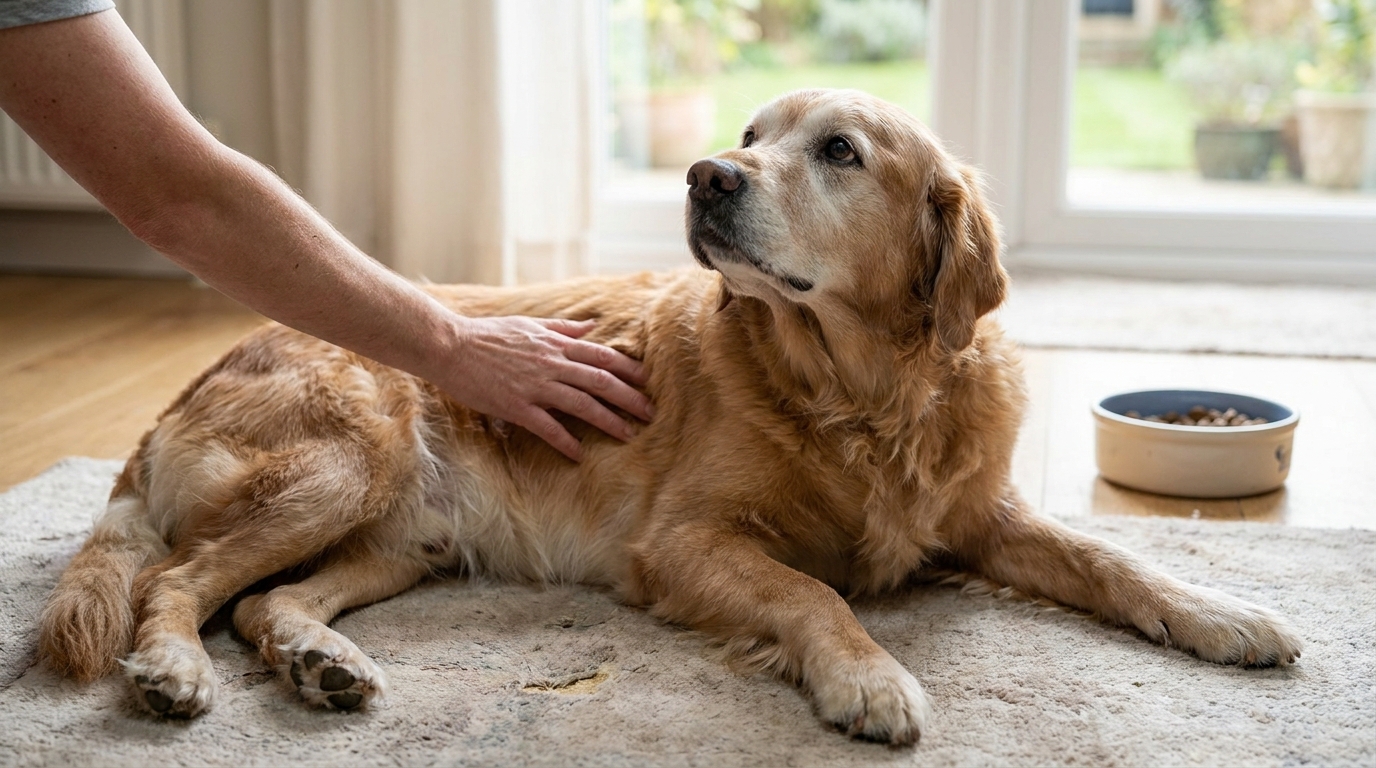
Why a senior dog can eat well yet get thinner, how much loss matters, and when it's urgent.
Quick answer: An old dog that keeps eating but gets thinner should not be written off as aging. Vets treat losing more than 10% of body weight as significant (7 lb on a 70-lb dog), but don't wait for that: book an exam within a week or two, or a day or two if thirst and peeing are up. Pale gums, collapse or a suddenly swollen belly mean the ER now.
This article is general information, not a diagnosis. If you think your pet is in danger, go to the nearest emergency animal hospital.
Signs that mean the ER now
If your dog has eaten nothing for more than 24 hours, go to an emergency vet now. Our guide to an old dog that stopped eating covers that situation. The rest of this guide is for a dog that still eats but is getting thinner. That dog also needs the ER now for any of these:
- Collapse, severe weakness, pale or white gums, or fast or labored breathing. In older, large-breed dogs this can be a bleeding tumor (Cornell's Riney Canine Health Center).
- A suddenly swollen, tight belly, especially with weakness, pale gums or retching that brings nothing up.
- Black, tarry stool or vomiting blood, which the Merck Veterinary Manual links to stomach ulcers and tumors.
- Fainting, or vomiting again and again.
- Sudden labored breathing, pale gums and dark, bloody or coffee-colored urine in a dog with heartworm or not on prevention. The American Heartworm Society calls this caval syndrome.
A dog that is drinking and peeing more and is also vomiting, refusing food, dehydrated or very dull needs an in-person vet today. Go to an emergency vet if your clinic can't see your dog right away. This can be a diabetic crisis called ketoacidosis. AAHA's diabetes guidelines say these dogs need hospital care.
Is it normal for an old dog to lose weight?
Some change is expected. AAHA's 2023 Senior Care Guidelines say senior dogs tend to lose muscle and gain fat, and that dogs in advanced age can lose some overall weight. Slow, age-related muscle loss is called sarcopenia. Illness is different: kidney disease, heart disease and cancer cause cachexia, which is weight loss with heavy muscle loss.
But AAHA names weight loss over time as a common sign of chronic disease in senior pets, so it should not be written off as aging. If you can't point to a clear reason, book an exam within a week or two.
How much weight loss is concerning in a dog?
Vets call weight loss significant when a dog loses more than 10% of its normal body weight, not counting fluid loss or dehydration. That is VCA Animal Hospitals' cutoff, but you don't need to wait for that number. Any steady, unexplained loss in an older dog is worth an exam.
| Usual weight | 5% loss | 10% loss |
|---|---|---|
| 10 lb | 0.5 lb | 1 lb |
| 25 lb | 1.25 lb | 2.5 lb |
| 50 lb | 2.5 lb | 5 lb |
| 70 lb | 3.5 lb | 7 lb |
| 90 lb | 4.5 lb | 9 lb |
Vets call more than 10% significant (VCA's example is 7 lb on a 70-lb dog). The 5% column is not a vet cutoff; it is an early marker to start weekly weigh-ins and book a check. Any steady loss you can't explain is worth an exam, and a belly or legs that swell can hide loss on the scale.
Speed matters too: VCA notes that the faster a dog loses weight, the more concerning it is, so 10% in one month is more urgent than 10% over six months. Slow loss still deserves an exam. Fast loss, such as 10% in a month, calls for an exam within a few days rather than a week or two.
Weigh at home by stepping on the scale while holding your dog and subtracting your own weight, using the same scale at the same time of day each week; a clinic scale is more accurate for small dogs. Also watch for newly visible ribs, spine or hip bones, and take side and top-down photos weekly.
Why old dogs lose weight while still eating
VCA's list of causes covers malabsorption and maldigestion, cancer, infections, major organ disease, diabetes and Addison's disease. In a senior dog, think of:
- Diabetes: more thirst, peeing and appetite with weight loss, sometimes with cataracts or weakness (Merck).
- Kidney disease: drinking and peeing more, with slow weight loss and muscle loss, is often the first sign owners notice, and by then about two-thirds of kidney function may be gone (International Renal Interest Society).
- Gut and pancreas problems: exocrine pancreatic insufficiency (EPI) and chronic enteropathy, often called IBD. Merck says vets must rule out intestinal lymphoma when gut signs last more than 3 weeks. A protein-losing form can cause belly fluid and leg swelling that keeps the scale steady, so see a vet within days for diarrhea with swollen legs.
- Worms: a fecal test is part of the standard weight-loss workup.
- Cancer: have new or growing lumps or swollen glands checked within about a week. AAHA calls a "watch and see" approach to lumps risky.
- Heart disease and heartworm: AAHA and the Tufts Cummings School link heart disease to cachexia. Merck lists coughing, trouble breathing and tiring easily as common heart failure signs, and a faster breathing rate while sleeping can be an early clue; if it stays fast on a recount, see a vet in person today. A dog not on year-round heartworm prevention should get a heartworm test, especially in Florida and Virginia.
- Tick-borne infections: AAHA's senior dog screening includes tick testing.
- Mouth pain: AAHA advises a good oral exam when a senior has trouble picking up, chewing or swallowing food.
- Swallowing problems: food that comes back up soon after meals may be regurgitation, not vomiting (VCA). Food brought up this way can be breathed into the lungs, so a dog that regurgitates and also coughs or seems feverish needs an in-person vet today, and fast or labored breathing means the ER now. See undigested food that comes back up.
- Higher needs or nutrient loss: long exposure to cold raises energy needs, and ongoing vomiting, diarrhea or heavy urination drain nutrients (VCA).
- Medicines: a dog on an anti-inflammatory arthritis medicine (an NSAID) that is losing weight needs a vet within days, since Merck lists NSAIDs among the leading causes of stomach ulcers in dogs. See arthritis pain medicine safety.
- Canine cognitive dysfunction: AAHA lists appetite changes among the signs of this age-related brain decline.
What about the thyroid? An overactive thyroid is a common cause of weight loss in older cats but rare in dogs. In dogs it usually means a thyroid tumor, too much thyroid medication, or food or treats that contain thyroid gland or thyroid hormone, such as some raw diets (Merck, FDA). An underactive thyroid, the common type in dogs, tends to cause weight gain. A dog on thyroid medication that is hungry, restless and getting thinner needs a vet within days.
Match the pattern: what else you notice
Other signs point to the cause and how soon to see a vet.
| What you see | Likely causes | How soon |
|---|---|---|
| Steady loss, dog seems well | Many causes | Exam in 1-2 weeks |
| Drinks and pees more | Diabetes, kidney disease | Vet in 1-2 days |
| Thirst up, plus vomiting or very dull | Diabetes crisis | In-person vet today |
| Ravenous, big, pale, loose stools | EPI, gut disease, worms | Within a week |
| Drops food, trouble chewing | Mouth or tooth pain | Exam in 1-2 weeks |
| Food comes back up soon after meals | Swallowing problem | Within days |
| Bony back and hips, scale steady | Muscle loss, arthritis | Exam in 1-2 weeks |
| Belly slowly getting bigger | Fluid, mass, Cushing's | Within days |
| Cough, tires fast on walks | Heart disease, heartworm | Within days |
| Sleeping breaths stay fast | Possible heart failure | In-person vet today |
| On thyroid pills, hungry, restless | Too much thyroid medicine | Within days |
| New lumps or swollen glands | Possible cancer | Within a week |
| Black, tarry stool or vomits blood | Stomach ulcer, tumor | ER now |
| Sudden big belly, pale gums, collapse | Internal bleeding, bloat | ER now |
| New food, new pet, cold nights | Feeding change, cold | Recheck in 2-4 weeks* |
Timing is general guidance, not a diagnosis. *Only if your dog is otherwise well; book an exam if the weight keeps dropping.
Dog eating a lot but losing weight
A dog that acts starved yet keeps getting thinner points first to diabetes or EPI. If it also drinks and pees more, see a vet within a day or two. Merck says dogs with EPI are often ravenous, with big, pale, loose stools that may smell bad, and vets confirm it with a TLI blood test. The best-known form affects young adult German Shepherds, but EPI after long-term pancreatitis can appear in any breed at any age. Cushing's syndrome also brings a big appetite and heavy thirst, along with a potbelly and weak muscles, so the dog may not look thin overall even as muscle fades over the back and hips (Merck). Finding the cause usually takes an in-person exam with blood and urine tests, and treatment for conditions like diabetes starts in person.
Old dog losing weight and drinking a lot of water
More thirst and peeing with weight loss point first to diabetes or kidney disease; Cushing's syndrome also causes heavy thirst. See a vet within a day or two, even if your dog seems bright, since AAHA notes that untreated diabetes can lead to ketosis within several days. If the thirst comes with vomiting, dullness or dehydration, or your dog is an unspayed female (Merck lists thirst as a sign of pyometra, a womb infection), see an in-person vet today. Go to an emergency vet if your clinic can't see your dog right away.
Start a 2-3 day water log now, without delaying the visit: fill the bowl from a measuring cup each morning, top it up with measured amounts whenever it runs low and add those to the total, then measure what is left 24 hours later. The bowl should never run dry. Never limit water. Our guide to a dog drinking too much water covers the causes.
Senior dog losing muscle in back legs: muscle loss vs weight loss
Muscle loss usually shows first along the spine, so a dog can look bony over the back while the scale barely moves. The Tufts Cummings School notes that even an overweight dog, or one with a normal appetite, can lose significant muscle. Thin hips and back legs can come from sarcopenia, from arthritis that makes a dog use its legs less, from spine or nerve disease (disc disease, degenerative myelopathy), or from illness (cachexia).
Book an exam within a week or two for a bony back and hips. If the belly is growing at the same time, fluid may be hiding weight loss, so see a vet within days. A dog that suddenly can't stand or drags its back legs needs an emergency vet now. For weak or wobbly legs, see our guide to old dog back legs giving out.
What the vet will check
VCA describes a history and a nose-to-tail exam, then blood and urine tests, X-rays and possibly an abdominal ultrasound.
| What the vet may check | What it looks for |
|---|---|
| Weight, body and muscle score | Fat vs muscle loss |
| Mouth exam | Tooth or mouth pain |
| CBC and chemistry | Anemia, kidney, liver, sugar |
| Urinalysis | Kidney function, diabetes |
| Fecal test | Worms, parasites |
| TLI blood test | EPI |
| Thyroid (T4) test | Thyroid disease |
| Heartworm test | Heartworm |
| Tick tests | Tick-borne infection |
| Blood pressure | High blood pressure |
| X-rays, ultrasound | Tumors, heart, organs |
Sources: VCA, AAHA 2023 Senior Care Guidelines, WSAVA and Merck.
Tell the vet whether your dog gets year-round heartworm prevention, any arthritis pain or thyroid medication, any raw diet, and any meat-based treats or chews. Bring dated weights, photos, your water log, a fresh stool sample, the food label and short videos of your dog eating, which AAHA says help.
What to do at home while you wait
- Weigh weekly and keep a log of food, water, stool and energy.
- Feed pets separately so you know who eats what.
- If chewing seems hard, you may soften the usual food with warm water.
- If you changed foods, compare the calories per cup or can on the new and old bags; most dog food labels now list them.
- Never withhold water.
Don't pile on calories, add fatty foods, or switch diets before a diagnosis. Your vet will match the diet to the cause, and Tufts notes that more protein is not always better. If there is an obvious non-medical reason, such as a new food, another pet eating the food or nights outside in the cold, and your dog is otherwise well, fix it and recheck the weight in 2-4 weeks. Book an exam if the weight keeps dropping.
Can an online vet help?
RexVet is a 501(c)(3) non-profit. A $64.99 live video visit with Dr. Tiffany Delacruz, DVM (your pet must be located in Florida, New York or Virginia; live video slots about 8 AM-11 PM ET) fits a dog that is losing weight slowly and is otherwise bright and active.
On the call she can go over your weigh-in log, your food, water and stool notes, and photos or video of your dog's body and of your dog eating. She can help you judge how urgent it is, tell you which tests to ask for at an in-person clinic (bloodwork, urine and stool tests, and a heartworm test if your dog isn't on year-round prevention), and explain results you already have. She cannot weigh your dog, feel the belly and muscles, look closely at the teeth or draw blood over video, so finding the cause still needs a hands-on exam at a clinic.
Treatment options are her call after the visit and within state law, and no prescription is promised. In Florida a prescription based only on a video visit is limited to FDA-approved animal drugs used as labeled, lasts up to 14 days (1 month for products labeled only for flea and tick) and can't be renewed without an in-person exam. In New York the rules for prescribing after a video visit are still unsettled. If she sends a prescription to an outside pharmacy, a pharmacy transfer fee applies (RexVet is not a pharmacy).
A video visit is not the right step for a dog with a suddenly swollen belly, pale gums, collapse, labored breathing, black stool, repeated vomiting or no food for more than 24 hours. Go to an emergency vet now.
Need an Expert Opinion on This Topic?
Book a video visit with a licensed vet, evenings and weekends included
See open timesFrequently Asked Questions
Do dogs lose weight before they die?
Serious illnesses such as kidney disease, heart disease and cancer cause cachexia, so many dogs do get thinner as those diseases advance. But weight loss alone does not mean your dog is dying; dental pain, worms or a food change can cause it too. Book an exam within a week or two, or within a day or two if your dog is also drinking more or seems weak. Collapse, severe weakness or pale gums mean the ER now.
Why can I suddenly feel my dog's spine?
Muscle loss usually shows first along the spine, so the back can look bony while the scale barely moves. Age brings some slow loss (sarcopenia), but illness causes faster wasting (cachexia). Book an exam within a week or two, or within days if the belly is also growing.
What should I feed a senior dog that is losing weight?
Keep the usual food until your vet knows the cause. Don't pile on calories, add fatty foods or table scraps, or switch diets, because the right diet depends on what is wrong. Feed pets separately and never limit water.
Can worms cause weight loss in an old dog?
Yes. Intestinal parasites are one of the causes vets check for, and a fecal test is part of the standard workup. Bring a fresh stool sample to the exam rather than deworming at home and waiting.
Is weight loss a sign of cancer in dogs?
It can be, and intestinal lymphoma is one cause vets rule out when gut signs last for weeks. But diabetes, kidney disease, dental pain and parasites are on the same list, so testing matters more than guessing. Have new or growing lumps or swollen glands checked within about a week.
Why is my old dog losing weight and drinking a lot of water?
It points first to diabetes or kidney disease. See a vet within a day or two, even if your dog seems bright. If your dog is also vomiting, very dull or dehydrated, see an in-person vet today, or go to an emergency vet if your clinic can't see your dog. Never limit water.
Can a video vet help if my dog is in Florida, New York or Virginia?
Yes, as a first step for a dog that is losing weight slowly and is otherwise bright. Dr. Tiffany Delacruz, DVM, is licensed in all three states. She can review your weight log, photos and videos and suggest tests to ask for, but she can't weigh your dog or draw blood over video, and no prescription is promised. For pale gums, collapse or a suddenly swollen belly, go to an emergency vet instead.
FAQs
Do dogs lose weight before they die?
Serious illnesses such as kidney disease, heart disease and cancer cause cachexia, so many dogs do get thinner as those diseases advance. But weight loss alone does not mean your dog is dying; dental pain, worms or a food change can cause it too. Book an exam within a week or two, or within a day or two if your dog is also drinking more or seems weak. Collapse, severe weakness or pale gums mean the ER now.
Why can I suddenly feel my dog's spine?
Muscle loss usually shows first along the spine, so the back can look bony while the scale barely moves. Age brings some slow loss (sarcopenia), but illness causes faster wasting (cachexia). Book an exam within a week or two, or within days if the belly is also growing.
What should I feed a senior dog that is losing weight?
Keep the usual food until your vet knows the cause. Don't pile on calories, add fatty foods or table scraps, or switch diets, because the right diet depends on what is wrong. Feed pets separately and never limit water.
Can worms cause weight loss in an old dog?
Yes. Intestinal parasites are one of the causes vets check for, and a fecal test is part of the standard workup. Bring a fresh stool sample to the exam rather than deworming at home and waiting.
Is weight loss a sign of cancer in dogs?
It can be, and intestinal lymphoma is one cause vets rule out when gut signs last for weeks. But diabetes, kidney disease, dental pain and parasites are on the same list, so testing matters more than guessing. Have new or growing lumps or swollen glands checked within about a week.
Why is my old dog losing weight and drinking a lot of water?
It points first to diabetes or kidney disease. See a vet within a day or two, even if your dog seems bright. If your dog is also vomiting, very dull or dehydrated, see an in-person vet today, or go to an emergency vet if your clinic can't see your dog. Never limit water.
Can a video vet help if my dog is in Florida, New York or Virginia?
Yes, as a first step for a dog that is losing weight slowly and is otherwise bright. Dr. Tiffany Delacruz, DVM, is licensed in all three states. She can review your weight log, photos and videos and suggest tests to ask for, but she can't weigh your dog or draw blood over video, and no prescription is promised. For pale gums, collapse or a suddenly swollen belly, go to an emergency vet instead.
Medically Reviewed
Reviewed by Dr. Tiffany Delacruz, DVM — licensed veterinarian and CEO of RexVet. Last reviewed October 28, 2026.
Content is for informational purposes and does not replace professional veterinary advice.
Chief Executive Officer · Licensed Veterinarian
Dr. Delacruz is a licensed Doctor of Veterinary Medicine specializing in preventive care and veterinary telehealth. She reviews all health content on RexVet to ensure accuracy and clinical relevance.
Sources & References
- · American Veterinary Medical Association — Telehealth Guidelines
- · AVMA — Pet Care Resources
- · U.S. FDA — Animal & Veterinary