
Dog Throwing Up Undigested Food: Right After Eating vs Hours Later
By RexVet Team | Reviewed by Dr. Tiffany Delacruz, DVM
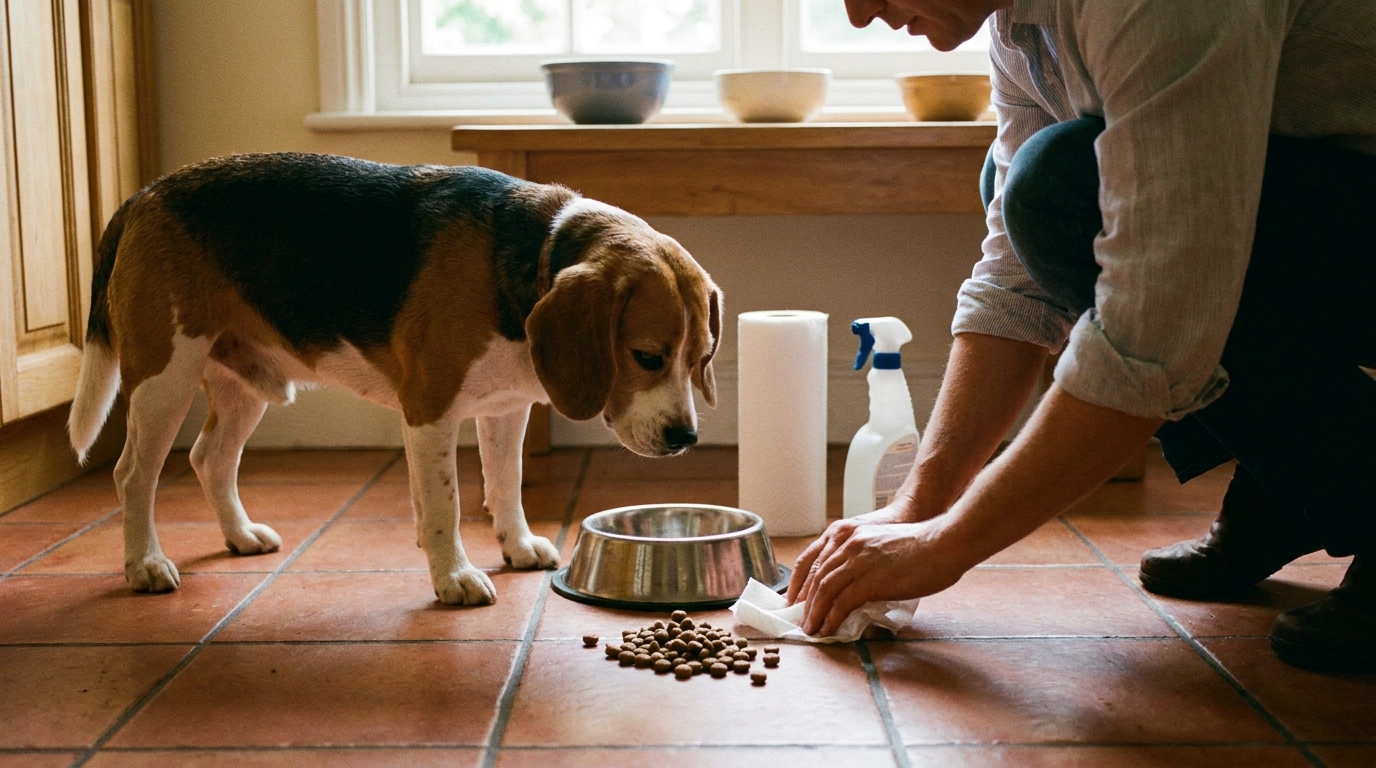
When the food came up and how hard your dog worked to bring it up tell you whether to watch at home, see a vet or go to the ER.
Quick answer: Undigested food that slides out right after eating, with no heaving, is most often regurgitation from gulping; one episode in a healthy, non-senior adult dog who acts normal can be watched at home. Food still undigested 12 or more hours after a meal, repeat episodes, or coughing afterward needs an in-person vet. Dry retching, a swollen belly or water not staying down means the ER now.
This article is general information, not a diagnosis. If you think your pet is in danger, go to the nearest emergency animal hospital.
Regurgitation or vomiting? The 10-second check
Vomiting takes effort and comes from the stomach. Regurgitation is a passive backflow from the esophagus, the food pipe between the throat and the stomach. The Merck Veterinary Manual says vomiting usually follows nausea, heavy drooling and retching. VCA Animal Hospitals adds that regurgitation usually happens quickly, with no belly contractions or warning.
| Sign | Passive backflow | Vomiting |
|---|---|---|
| Effort | None. Food slides out, often with the head down | Belly heaves and retching |
| Warning first | Usually none | Nausea, drooling, lip-licking |
| Timing | Often right after eating, but can be hours later | Minutes to hours after a meal |
| What comes up | Undigested food, may be tube-shaped with slimy mucus | Partly digested food, maybe yellow bile |
| Bile | Little or none, though some can back up | Yellow bile is a clue, not proof |
| Comes from | Esophagus (food pipe) | Stomach or upper gut |
Merck notes that regurgitated food tends to be undigested and may be cylinder-shaped, and Washington State University's Veterinary Teaching Hospital adds that it is often coated in slimy mucus. Yellow bile points toward vomiting but doesn't prove it, because bile can back up into the esophagus (PetMD). Dogs often try to re-eat either one, so that doesn't tell you which it was.
Film the next episode on your phone to show effort and timing. Never delay the ER to film.
What the timing tells you
Timing is a clue, not proof. Dr. Willard, a board-certified veterinary internist writing in dvm360, notes that regurgitation can come hours or even days after eating, and vomiting can start minutes after a meal.
| When it came up | Most likely | What to do |
|---|---|---|
| Right after eating, no heaving | Backflow from gulping. An enlarged esophagus can do this too, even hours later | Once, in a bright adult dog: watch and slow the next meal. Keeps happening: in-person vet |
| A few hours later, with heaving (undigested or partly digested) | Stomach upset: a food switch, scraps or trash | Pick up food, keep water handy. Over 2 in a day, or vomiting past 6-12 hours: same-day vet |
| 12 or more hours later, still undigested | Stomach emptying slowly, or partly blocked | In-person vet within a day (X-rays may be needed). Same day if it repeats |
| Again and again, or water won't stay down | Blockage, bloat, poisoning or serious illness | ER now |
A normal stomach is usually empty about 6-8 hours after an average meal (Twedt, Blackwell's Five-Minute Veterinary Consult). The same textbook says vomiting undigested food more than 12 hours after a meal suggests poor stomach movement or possibly an outflow blockage, and that normal emptying times vary a lot. That doesn't make undigested food before 12 hours normal, and repeated vomiting is a reason to go in no matter when your dog ate.
If what comes up is mostly water or clear liquid, see dog throwing up clear liquid or water. If episodes happen late in the evening, note the time since the last meal; the same rules apply.
When a RexVet video visit can help
If your adult dog brings food up now and then, or did it once or twice today, and is bright, drinking, keeping water down, with a soft belly, normal breathing and no chance of a swallowed object or toxin, a $64.99 live video visit with Dr. Tiffany Delacruz, DVM, can help you decide what comes next. Visits are for dogs located in Florida, New York or Virginia at the time of the visit, in open slots between about 8 AM and 11 PM ET; a same-day slot is not guaranteed.
During the live visit you can show her a short phone clip of an episode and go over meal timing. She can help sort out whether it looks more like regurgitation or vomiting, and say whether your dog needs an in-person exam or X-rays, and how soon. A video visit can't take X-rays, run bloodwork, feel the belly or give fluids, so it can't rule out a blockage, bloat or pneumonia, and no prescription is promised.
Vomiting that keeps going or lasts past 6-12 hours, any puppy, a senior or diabetic dog, or a dog losing weight needs an in-person vet. Dry retching, a swollen belly, blood, pale gums, collapse, fast breathing, a possible swallowed object or water not staying down is an ER trip, not a video visit. Before about 8 AM or after about 11 PM ET, if no slot is open, or if anything is getting worse, go to an emergency vet.
If your adult dog is bright, keeping water down, with a soft belly, normal breathing and no chance of a swallowed object or toxin, you can book a live video visit. For follow-ups after an in-person diagnosis, the Family Plan is a one-time $120 for 4 visits over 12 months, covering every pet in the home, and never auto-renews.
ER now vs book a vet: where to go
Act on the most urgent row that fits your dog.
| Sign | Where to go |
|---|---|
| Dry retching, with or without a swollen belly | ER now |
| Swollen, tight belly, pacing or drooling after a big meal | ER now |
| Pale, white, gray or blue gums, weakness or collapse | ER now |
| Blood in vomit (red or like coffee grounds) or black, tarry stool | ER now |
| Fast or labored breathing after food comes up | ER now |
| Swallowed, or may have swallowed, a bone, toy, sock, corn cob or string | ER now, even if acting normal. Never pull a string out |
| Drooling, gagging or repeated swallowing after a bone, rawhide or chew | ER now |
| Water won't stay down, even small sips | ER now (or your own vet, if they can see your dog right away) |
| Possible poison or toxin | Call a poison line or go to an ER |
| Cough, fever, nasal discharge or lethargy after food comes up | Same-day vet |
| More than 2 episodes in 24 hours, or vomiting past 6-12 hours (sooner in small dogs) | Same-day vet |
| Vomiting with diarrhea, fever, belly pain, no appetite, lethargy or dehydration (tacky gums) | Same-day vet |
| Puppy not fully vaccinated, senior dog, or one with diabetes, kidney or heart disease | Same-day vet |
| Brings up most meals, keeps doing it, or losing weight | In-person exam, chest X-rays, often bloodwork |
| Second episode this week, but bright and keeps water down | Book a vet visit |
| One episode, bright adult (not a senior), soft belly, normal breathing, keeps water down, nothing swallowed | Watch at home, slow the next meal |
For a possible poison, call ASPCA Animal Poison Control at (888) 426-4435 (a consultation fee may apply) or the Pet Poison Helpline at (855) 764-7661 (a per-incident fee applies). Never pull on a string hanging from your dog's mouth or rear end (Merck), and never put your fingers in the mouth of a gagging or choking dog (VCA).
What to do right after an episode
If no ER sign fits and your dog is bright:
- Pick up the food bowl for now and ask your vet when to feed again. Keep water available and don't force it. Never fast a puppy, and if your dog is diabetic, call the vet who manages the insulin before the next meal or dose.
- If even small sips come back up, get in-person care now: your vet, or an ER if your vet can't see your dog right away.
- Don't give any human medicine, including anti-nausea or stomach products, without talking to a vet first (FDA), and don't try to make your dog vomit unless a vet or poison line tells you to. Learn when making a dog throw up helps and when it harms.
- If your dog takes a prescription pain reliever (an NSAID) and starts vomiting, stop giving it and call your vet (FDA).
- Write down the time since the meal, what came up and whether your dog heaved first.
- Check the gums and belly. Pale, white, gray or blue gums, or a tight or swollen belly, mean the ER; pink gums and a soft belly don't rule out bloat or a blockage.
Common, usually minor causes
These explain many single episodes in a bright adult dog, but not repeat episodes, a puppy's episodes or any dog with a red flag.
- Eating too fast. Gulping, often with another dog nearby, is the classic reason food slides back out right after a meal. In a large study of big and giant-breed dogs (Glickman, JAVMA 2000), faster eating was also linked to higher bloat risk.
- Too much at once. A dog that got into the food bag or bin may bring up a large load of kibble. A big binge stretches the stomach, and large meals are linked to bloat (ACVS), so call your vet or an ER for advice now, even if your dog seems fine. A swollen belly, pacing, drooling or retching afterward is an ER trip.
- A sudden food switch. This usually shows up as stomach upset, with heaving and partly digested food.
- Trash and table scraps. Holiday leftovers and garbage are common culprits; check which holiday dishes dogs can and can't eat. If your dog may have eaten bones, corn cobs or string from the trash, treat it as a swallowed object: ER now, even if your dog acts normal. If the trash held anything possibly toxic, call a poison line or go to an ER. Belly pain, hunching, weakness or diarrhea after scraps or trash needs a same-day vet.
When undigested food points to something serious
Food that keeps coming up undigested needs an in-person exam with chest X-rays, and often bloodwork to look for a cause.
Megaesophagus. The esophagus is widened, so food and water pool in it and come out by gravity when the dog lowers its head, with no heaving first (VCA). In adults it can follow myasthenia gravis, hypothyroidism or Addison's disease, so bloodwork often follows. Young dogs may grow poorly, adults lose weight, and the main risk is aspiration pneumonia, when food is breathed into the lungs (VCA).
Something stuck in the esophagus. Merck lists drooling, gagging, trouble swallowing, regurgitation and repeated attempts to swallow. Bones are most common; rawhide, dental chews, needles, fishhooks and wood also turn up. Merck advises removing it right away: go to an ER.
A stomach or intestinal blockage. Merck calls this an emergency, with signs like not eating, vomiting, diarrhea, lethargy or shock. VCA adds belly tenderness, straining to poop, and biting or growling when the belly is touched.
Slow stomach emptying. Food still undigested 12 or more hours after a meal fits this pattern (Twedt). Internist Washabau (WSAVA) lists physical narrowing (a tumor, thickened tissue or a foreign body), poor stomach movement (inflammation, an ulcer or recent surgery), electrolyte or metabolic problems, some drugs and acute stress as causes.
Pancreatitis. Merck says eating trash, large amounts of table scraps or other wrong foods is thought to be a common risk factor. Severe cases bring loss of appetite, vomiting, weakness, belly pain, dehydration and diarrhea. Vomiting after scraps with belly pain, hunching or weakness needs a same-day vet.
Bloat (GDV). This is a life-threatening emergency (Merck). The American College of Veterinary Surgeons (ACVS) lists the early signs as retching with nothing coming up, a swelling belly and drooling, followed by weakness and collapse. VCA says that if your dog keeps trying to vomit, don't wait: go to the hospital right away. Don't wait for the belly to swell. Learn the signs of bloat, and treat dry retching alone as an ER trip.
Puppies, seniors and higher-risk breeds
Puppies. A puppy that starts bringing food up around weaning, or when it starts solid food, needs an in-person exam soon with chest X-rays. Don't assume it's just from eating too fast. Merck says inborn megaesophagus usually shows up at this stage. It is hereditary in Wire-haired Fox Terriers and Miniature Schnauzers and runs in families of German Shepherds, Newfoundlands, Great Danes, Irish Setters, Chinese Shar-Peis and Labrador Retrievers.
The other classic cause is a vascular ring, most often a persistent right aortic arch, in which an extra blood vessel traps the esophagus at the base of the heart. Merck notes it especially in German Shepherds, and also in Boston Terriers and Irish Setters; surgery is recommended. Merck calls aspiration pneumonia a frequent and often fatal complication of esophageal disorders present from birth.
Seniors. Any vomiting in a senior dog needs a same-day vet. Weight loss needs chest X-rays and often bloodwork (VCA, Merck).
Large, deep-chested breeds. Merck names Great Danes, Saint Bernards, Weimaraners, Irish Setters, Standard Poodles, Dobermans and German Shepherds among the large, deep-chested dogs bloat mainly affects. ACVS adds other risks: one large daily meal, older age, stress and relatives who had bloat.
Flat-faced breeds. Pugs, Bulldogs and other flat-faced dogs have a higher risk of esophageal problems, including hiatal hernia, so repeat episodes deserve a vet exam (PetMD).
How to stop a dog from eating too fast
For a healthy adult dog whose food comes up after gulping, vets often suggest:
- A slow-feeder or puzzle bowl.
- Splitting the daily food into smaller meals.
- Scatter feeding.
- Feeding dogs apart.
- A calm rest after meals instead of play.
The evidence is thin: one 2016 study of 10 dogs (a poster published in Veterinary Evidence) found a go-slow feeder slowed eating but didn't measure regurgitation or vomiting. Smaller meals spread over the day do have backing for lowering bloat risk (ACVS).
Keep the bowl on the floor. In Glickman's study, about 20% of bloat cases in large breeds and 52% in giant breeds were attributed to a raised bowl. Upright feeding is only for dogs diagnosed with megaesophagus: your vet will show you how (some owners use a Bailey chair) and what food texture to use.
Need an Expert Opinion on This Topic?
Book a video visit with a licensed vet, evenings and weekends included
See open timesFrequently Asked Questions
Is it normal for a dog to throw up undigested food?
One episode right after a fast meal, in a bright adult dog that keeps water down, is common and is most often regurgitation from gulping. Watch at home and slow the next meal. It is not normal if it keeps happening, comes 12 or more hours after a meal or happens in a puppy; those need an in-person vet. Diarrhea or a cough afterward needs a same-day vet, and dry retching, a swollen belly, blood or fast breathing means the ER now.
Why would my dog throw up undigested food hours after eating?
A few hours after a meal, food brought up with heaving, even undigested, is most often stomach upset; more than 2 episodes in 24 hours needs a same-day vet. Food still undigested 12 or more hours after a meal can mean the stomach is emptying slowly or is partly blocked: see a vet in person within a day, or the same day if it happens again or your dog seems dull. Dry retching, a swollen belly, water not staying down or a possible swallowed object means the ER now. An enlarged esophagus can also bring food up hours later.
Should I feed my dog again after he throws up undigested food?
Pick up the bowl for now and ask your vet when to feed again. Keep water available without forcing it. Never fast a puppy, and for a diabetic dog, call the vet who manages the insulin first. If even small sips come back up, get in-person care now.
Why is my dog's throw-up tube-shaped?
Tube-shaped, undigested food, often coated in slimy mucus, usually comes from the esophagus (regurgitation). In an adult dog, one episode after gulping can be watched at home. Repeat episodes, especially in a puppy or a dog losing weight, need an in-person exam with chest X-rays to check for megaesophagus or something stuck.
Is regurgitation more dangerous than vomiting?
A one-off episode usually isn't. Repeated regurgitation can let food be breathed into the lungs and cause aspiration pneumonia. A cough, fever or nasal discharge afterward needs a same-day vet, and fast or labored breathing means the ER now.
Can an online vet help if my dog throws up undigested food?
A live video visit can help you judge urgency for an adult dog that is bright and keeping water down, or follow up after an in-person diagnosis. RexVet, a 501(c)(3) non-profit, offers visits with Dr. Tiffany Delacruz, DVM, for dogs located in Florida, New York or Virginia at the time of the visit. A video visit can't take X-rays or rule out a blockage, bloat or megaesophagus, and no prescription is promised. In Florida, a video-only prescription is limited to FDA-approved animal drugs used as labeled, for up to 14 days in most cases, with no controlled drugs and no renewal without an in-person exam. Virginia allows an electronic exam, but federal rules require an in-person exam or premises visit for extra-label or human-drug use, and New York's rules are unsettled. RexVet is not a pharmacy, and a pharmacy transfer fee applies when it sends a prescription out.
FAQs
Is it normal for a dog to throw up undigested food?
One episode right after a fast meal, in a bright adult dog that keeps water down, is common and is most often regurgitation from gulping. Watch at home and slow the next meal. It is not normal if it keeps happening, comes 12 or more hours after a meal or happens in a puppy; those need an in-person vet. Diarrhea or a cough afterward needs a same-day vet, and dry retching, a swollen belly, blood or fast breathing means the ER now.
Why would my dog throw up undigested food hours after eating?
A few hours after a meal, food brought up with heaving, even undigested, is most often stomach upset; more than 2 episodes in 24 hours needs a same-day vet. Food still undigested 12 or more hours after a meal can mean the stomach is emptying slowly or is partly blocked: see a vet in person within a day, or the same day if it happens again or your dog seems dull. Dry retching, a swollen belly, water not staying down or a possible swallowed object means the ER now. An enlarged esophagus can also bring food up hours later.
Should I feed my dog again after he throws up undigested food?
Pick up the bowl for now and ask your vet when to feed again. Keep water available without forcing it. Never fast a puppy, and for a diabetic dog, call the vet who manages the insulin first. If even small sips come back up, get in-person care now.
Why is my dog's throw-up tube-shaped?
Tube-shaped, undigested food, often coated in slimy mucus, usually comes from the esophagus (regurgitation). In an adult dog, one episode after gulping can be watched at home. Repeat episodes, especially in a puppy or a dog losing weight, need an in-person exam with chest X-rays to check for megaesophagus or something stuck.
Is regurgitation more dangerous than vomiting?
A one-off episode usually isn't. Repeated regurgitation can let food be breathed into the lungs and cause aspiration pneumonia. A cough, fever or nasal discharge afterward needs a same-day vet, and fast or labored breathing means the ER now.
Can an online vet help if my dog throws up undigested food?
A live video visit can help you judge urgency for an adult dog that is bright and keeping water down, or follow up after an in-person diagnosis. RexVet, a 501(c)(3) non-profit, offers visits with Dr. Tiffany Delacruz, DVM, for dogs located in Florida, New York or Virginia at the time of the visit. A video visit can't take X-rays or rule out a blockage, bloat or megaesophagus, and no prescription is promised. In Florida, a video-only prescription is limited to FDA-approved animal drugs used as labeled, for up to 14 days in most cases, with no controlled drugs and no renewal without an in-person exam. Virginia allows an electronic exam, but federal rules require an in-person exam or premises visit for extra-label or human-drug use, and New York's rules are unsettled. RexVet is not a pharmacy, and a pharmacy transfer fee applies when it sends a prescription out.
Medically Reviewed
Reviewed by Dr. Tiffany Delacruz, DVM — licensed veterinarian and CEO of RexVet. Last reviewed October 24, 2026.
Content is for informational purposes and does not replace professional veterinary advice.
Chief Executive Officer · Licensed Veterinarian
Dr. Delacruz is a licensed Doctor of Veterinary Medicine specializing in preventive care and veterinary telehealth. She reviews all health content on RexVet to ensure accuracy and clinical relevance.
Sources & References
- · American Veterinary Medical Association — Telehealth Guidelines
- · AVMA — Pet Care Resources
- · U.S. FDA — Animal & Veterinary