
Swollen Scrotum or Open Incision After Neuter: Normal or Not?
By RexVet Team | Reviewed by Dr. Tiffany Delacruz, DVM
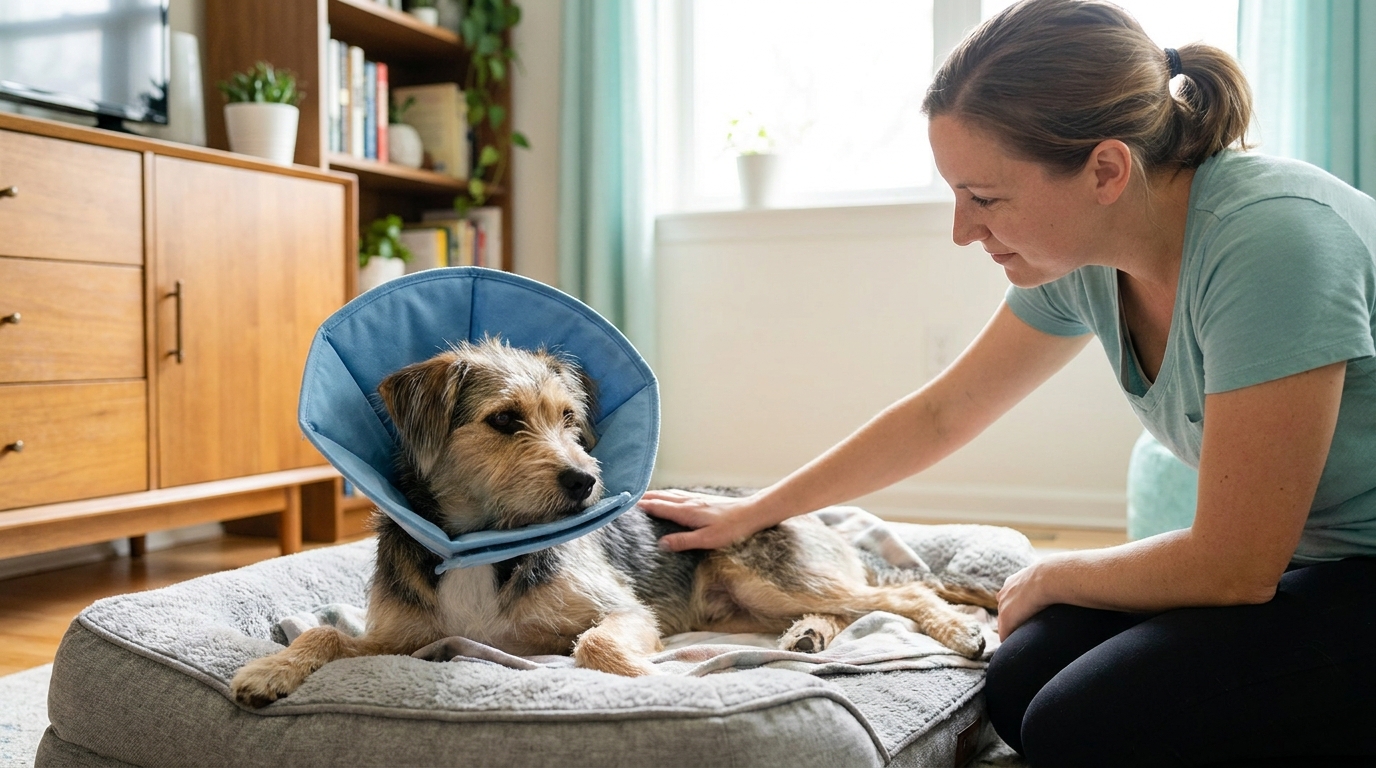
Most neuter swelling shrinks a little each day, and cat incisions are often left open. Here's what's normal, when to call and when to go to an ER.
Quick answer: Mild scrotal swelling and bruising that shrink each day are common after a neuter, and male cats' incisions are often left open. Call the clinic today if swelling keeps growing, the area is hot or leaks pus, or your pet won't eat the next day. Go to an ER now for steady bleeding, a scrotum growing by the hour, a closed incision that opens, anything poking out, or pale gums.
This article is general information, not a diagnosis. If you think your pet is in danger, go to the nearest emergency animal hospital.
First, find out which incision your pet had
What's normal depends on where the cut is and whether it was closed. The ASPCA says a male cat's neuter incision is so small that it isn't closed with stitches or surgical glue, and one or two small openings on the scrotum are fine.
Dogs vary. Association of Shelter Veterinarians guidelines describe two approaches: through the scrotum, where the incision may be closed or left open, or just in front of it (prescrotal), where the skin is closed. A retained testicle may also mean a belly or groin incision, closed by design. Your discharge sheet usually says which one your dog had. If not, ask the clinic before comparing photos online, because the ASPCA's healing guide says its male-dog photos show only the scrotal approach.
| Incision | What's expected | Not expected |
|---|---|---|
| Male cat, on the scrotum | One or two small open slits; mild swelling that slowly goes down | Pus, a bad smell, swelling that grows; anything sticking out (ER now) |
| Dog, on the scrotum | Left open or closed; if open, a few drops of thin pink fluid early, less each day | Steady dripping, bright red blood, clots, a scrotum filling up |
| Dog, just in front of the scrotum | Closed with stitches or glue; should not drip or gap | Any gap or missing stitches (ER now); scrotum filling up (call now, ER if fast) |
| Belly or groin (retained testicle) | Closed with stitches or glue | Any gap or anything poking out (ER now) |
Day by day: what's normal and when to call
Per the ASPCA, the incision's look on going-home day is its normal baseline. Check it at least twice a day and watch the direction, not the date: swelling and bruising should shrink a little each day.
| Days | Usually normal | Call the clinic today |
|---|---|---|
| Days 1-2 | Groggy the first evening; many cats skip dinner the first night | Not drinking; any vomiting or diarrhea (call right away) |
| Days 1-2 | Mild swelling and bruising; in cats, one or two small open slits | Swelling that keeps growing |
| Days 1-2, dog | Open scrotal cut: a few drops of thin pink fluid that lessen | Drainage that grows, thickens, turns yellow or green, or smells |
| Days 3-5 | Swelling and bruising smaller each day; eating and peeing normally | Still sluggish or not eating; swelling or redness not shrinking; heat or pus |
| Days 6-10 | Bruise fading; incision dry; cone still on (often 7-10 days) | Swelling that got better, then worse; a new, firm or painful lump |
| Days 10-14 | Most incisions healed; stitches or staples out when your clinic says | Still swollen or not healed: ask about a recheck |
ER now, any day after surgery. Go to the nearest emergency vet and call the surgical clinic on the way, without waiting for a callback:
- Steady dripping or bright red blood, clots, or blood soaking through a cloth.
- Anything sticking out of the incision. Don't push it back in; cover it loosely with a clean, dry cloth and keep the cone on.
- A stitched or glued incision that has opened, missing stitches or staples, or any gap in a belly or groin incision.
- A scrotum that is filling up fast or getting bigger by the hour, or scrotal swelling in a dog who is weak or has pale gums.
- Pale or white gums, weakness, collapse, fast or labored breathing, a cold body or a swelling belly, which can mean bleeding inside with no blood showing.
- A male cat straining in the litter box, passing little or no urine, crying, licking his penis over and over, or vomiting. That can be a urinary blockage, on any day after surgery.
- A male dog straining to pee, passing no urine, or with blood in his urine.
- Trouble breathing after vaccines, a pet who can't get comfortable or cries out in pain, repeated vomiting or diarrhea, or wobbly walking after the first night.
Why a male cat's incision is left open
Today's Veterinary Practice explains that a cat's small scrotal incisions are usually left open to heal from the inside out, which helps prevent an abscess. The ASPCA Spay/Neuter Alliance adds that a male cat may look as if he still has testicles; in cats that is normal, and the swelling should go down slowly.
Litter dust can get into the open incision and cause infection, so the ASPCA suggests shredded paper, paper-pellet litter or uncooked long-grain rice for at least a week. Keep him indoors. Neutered at a shelter just before adoption? See our guide to a newly adopted cat who isn't eating.
Bleeding after a neuter: how much is too much
After a dog neuter through the scrotum, DiGangi, Johnson and Isaza (Clinician's Brief) describe a little blood-tinged fluid in the first few hours as expected, and say continuous bleeding or clots calls for a recheck; at home, that means an ER now. Sources disagree on how long pink drainage lasts, so go by the trend: a wet, pink-tinged incision should get drier each day, and a closed incision should not drip. With other approaches, bleeding may not show until the scrotum swells, or until pale gums and weakness point to bleeding inside.
Normal swelling, hematoma, infection or a bump?
In a 2015 study of 437 dogs summarized by Veterinary Evidence, swelling was the most common problem after castration, and swelling, bleeding and pain did not differ between scrotal and prescrotal incisions. No technique rules out a hematoma.
| Problem | What it can look like | What to do |
|---|---|---|
| Blood-filled scrotum (hematoma) | Scrotum filling up, firm and getting bigger; a bruise that spreads | Call the clinic now; it needs an in-person recheck today. ER now if it grows by the hour or he's weak or pale |
| Infection or abscess | Heat, pus, yellow or green discharge, a bad smell, redness that comes back | Same-day recheck in person; no leftover antibiotics; put nothing on it |
| Small bump along the incision | A small, soft-to-firm bump that stays the same or shrinks | Call the clinic if it grows, is hot or painful, or oozes; don't squeeze it |
A bump can have several causes, including a stitch reaction; let the clinic decide.
Same day, in person. These need hands-on care today at the surgical clinic, or an emergency vet if it's closed; video can't check them:
- An incision that feels hot, or pus, yellow or green discharge, or a bad smell.
- Redness or swelling that improved and then got worse, or a firm, painful lump.
- A bruise that spreads or darkens, or swelling that keeps growing over the day (by the hour means an ER now).
- Scrotal skin that seems to be breaking down (oozing, peeling or turning very dark), or an incision that looks different after licking.
Cornell University Hospital for Animals lists infection, incision problems, scrotal blood clots, death of scrotal skin and severe bleeding as known complications of castration. They are more common in large-breed dogs and dogs with an undescended testicle, so lean toward an in-person recheck for them. Today's Veterinary Practice adds that a moderate to severe scrotal hematoma can make a dog seriously ill, and some dogs need a second surgery. If an older dog may need a second surgery, see whether a senior pet is too old for anesthesia.
Swelling somewhere else? Vaccines and the green tattoo
If your pet got vaccines at surgery, the ASPCA says to call the clinic for face swelling, hives, limping, drooling, itchiness, or pain or swelling at the shot site; trouble breathing means an ER now, and so do sudden vomiting or diarrhea, pale gums, cold legs, weakness or collapse, since in dogs a severe reaction often shows up as stomach and gut signs rather than breathing trouble. Some clinics also place a small green tattoo to show a pet is neutered, beside the incision in dogs or on the lower belly in male cats. It is not a bruise.
Groggy, not eating or shivering: what's normal
Grogginess the first evening is expected. Watching a sleeping cat breathe? See how to count a cat's resting breathing rate. Call the clinic if he's still lethargic past about 24 hours or isn't eating by the next day, and the same day for shivering or drinking less; call right away for any vomiting or diarrhea. Weakness, pale gums, collapse, repeated vomiting or diarrhea, or wobbly walking after the first night mean an ER now. Ask the clinic what pain relief was given and when the next dose is due. Never give human medicine; the ASPCA warns it can be fatal.
How to photograph the incision
Dated photos show whether things are shrinking or growing.
| What to capture | Why |
|---|---|
| A photo on the day you bring your pet home | Your baseline for later photos |
| Same spot, light and angle, twice a day, dated | Shows the trend |
| A wide shot of the scrotum plus a close-up of the incision | Shows the swelling and the incision edges |
| A coin held near the area, not touching it | Gives scale |
| A short video of your pet walking and sitting | Shows pain and stiffness |
Don't press, clean or squeeze the incision for a photo, and if the cone comes off, put it right back on.
Cone, licking and home care
The ASPCA advises keeping the cone on at all times for 7 to 10 days, because even a little licking can open the incision or cause a painful infection. Take it off for meals only while you watch. If he can still reach the incision, chews at it through the cone, or snaps when you touch the area, call the clinic.
- Activity: leash walks only, with no running or jumping on furniture. Follow your clinic's limits, usually one to two weeks (ASPCA: seven days; American College of Veterinary Surgeons, or ACVS: two weeks).
- Bathing: none until your clinic's date (the ASPCA says 10 days). Water can weaken surgical glue.
- Stitches: many neuters use dissolving stitches and glue; visible stitches or staples come out 10 to 14 days after surgery, per ACVS.
- Nothing on the incision: no creams, ointments, peroxide, alcohol or home remedies unless your clinic says so, and a cold compress only if your surgeon recommended one.
- No wraps: never wrap or bandage the scrotum. If your dog came home with a wrap, ask the clinic when it comes off; Clinician's Brief says such wraps should stay on only a few hours.
- Unspayed females: a newly neutered male can still cause a pregnancy for up to 30 days, the ASPCA says, so keep them apart.
Your clinic is closed: who to call
Your surgeon knows how the incision was closed, so outside an emergency, their instructions come first.
- For any ER sign above, go to the nearest emergency vet now and call the clinic on the way.
- Otherwise, call the post-op or after-hours number on your discharge papers. Many spay/neuter clinics want that first call and may treat surgery-related problems at low cost. If no one answers and your pet has a same-day sign (heat, pus, yellow or green discharge, a bad smell or swelling that keeps growing), see an emergency vet tonight.
- If your pet swallowed something he shouldn't have, such as a medicine, call ASPCA Animal Poison Control at (888) 426-4435 (a consultation fee may apply) or the Pet Poison Helpline at (855) 764-7661 (a per-incident fee applies).
Can a vet look at the incision by video tonight?
If your surgical clinic is closed with no after-hours line, and none of the ER signs above apply, a $64.99 live video visit with Dr. Tiffany Delacruz, DVM, can give you a second look. RexVet is a 501(c)(3) non-profit. Dr. Delacruz is licensed in Florida, New York and Virginia, so your pet must be in one of those states at the time of the visit. Video slots run about 8 AM to 11 PM Eastern, if one is open.
She watches your pet walk and settle, looks at the incision on camera and at photos you took earlier, including one from going-home day, and tells you whether it looks like normal healing, needs a call to your surgical clinic when it opens, or needs an emergency vet now.
Video can't feel heat or firmness, take a temperature, treat a hematoma or re-close an incision, and it doesn't replace your surgical clinic's recheck. If medication seems appropriate, she can prescribe only where state and federal rules allow, and antibiotics are not promised. In Florida, a vet who has seen your pet only by video may prescribe only FDA-approved animal drugs used as labeled, for up to 14 days (one month for flea and tick products), and can't renew without an in-person exam; drugs approved for human use, controlled drugs and compounded anti-infectives need an in-person exam. Federal rules require an in-person relationship for off-label or human-drug use. Virginia allows the exam to be electronic; New York's rules are still unsettled. Pain relief comes from your surgical clinic, and she won't change the plan it sent home. RexVet is not a pharmacy; if she prescribes, the prescription goes to an outside pharmacy and a pharmacy transfer fee applies (Terms 5.4).
A video visit fits when any opening is expected by design (a male cat, or a dog whose clinic confirmed a scrotal incision was left open), nothing is sticking out, there's no steady bleeding, clots, green or yellow discharge or bad smell, the area isn't hot, the swelling isn't growing, and your pet is bright, eating and peeing normally. If you don't know which incision your dog had, call the clinic instead of booking a visit to find out.
Book a video visit with Dr. Delacruz
Frequently Asked Questions
Is it normal for my dog's scrotum to be swollen after neutering?
Mild swelling and bruising that shrink each day are common early on. Call the clinic if swelling or redness isn't shrinking after several days. A scrotum that is filling up, firm or getting bigger can mean bleeding under the skin (a hematoma). Call the surgical clinic now; a growing scrotum needs an in-person recheck today (an emergency vet if the clinic is closed), and some need a second surgery. Go to an ER now if it grows by the hour or your dog is weak or pale.
My cat's neuter incision is open. Is that normal?
Usually, yes. Clinics often leave a male cat's scrotal incisions open to heal, and he may still look as if he has testicles while the swelling goes down. Call the clinic for pus, a bad smell or growing swelling. Anything sticking out of the opening means an ER now; don't push it back in. Straining in the litter box with little or no urine means an ER now.
My dog's neuter incision opened. What should I do?
It depends on the incision. A scrotal incision may be left open on purpose, but one just in front of the scrotum is closed. If a stitched or glued incision opened, stitches are missing or anything pokes out, go to an ER now and call the clinic on the way. Not sure which he had? Call the clinic.
How much bleeding is normal after a dog neuter?
After an open scrotal incision, a few drops of thin pink fluid early on can be normal if it lessens each day; a closed incision should not drip. Steady dripping, bright red blood or clots mean an ER now, as do pale gums or weakness, which can signal bleeding inside.
What does an infected neuter incision look like?
Heat, pus, yellow or green discharge, a bad smell, a firm painful lump, or redness that improved and then got worse. It needs a hands-on recheck the same day, ideally at the surgical clinic. Don't use leftover antibiotics or put anything on the incision unless your surgeon says to.
How long does my pet need the cone after neutering?
The ASPCA advises 7 to 10 days, on at all times, because even a little licking can open the incision or cause infection. If he can still reach the incision with the cone on, call the clinic about a better fit.
My vet's clinic is closed. Who do I call about the incision?
For any ER sign, go to the nearest emergency vet now and call the clinic on the way. Otherwise, call the after-hours number on your discharge papers. If no one answers, see an emergency vet tonight for heat, pus, yellow or green discharge, a bad smell or swelling that keeps growing. If none of those or the ER signs apply, a $64.99 video visit with Dr. Tiffany Delacruz, DVM, can give you a second look if your pet is in Florida, New York or Virginia at the time of the visit and a slot is open (about 8 AM to 11 PM Eastern). She can't treat a hematoma or re-close an incision, and prescriptions aren't promised.
FAQs
Is it normal for my dog's scrotum to be swollen after neutering?
Mild swelling and bruising that shrink each day are common early on. Call the clinic if swelling or redness isn't shrinking after several days. A scrotum that is filling up, firm or getting bigger can mean bleeding under the skin (a hematoma). Call the surgical clinic now; a growing scrotum needs an in-person recheck today (an emergency vet if the clinic is closed), and some need a second surgery. Go to an ER now if it grows by the hour or your dog is weak or pale.
My cat's neuter incision is open. Is that normal?
Usually, yes. Clinics often leave a male cat's scrotal incisions open to heal, and he may still look as if he has testicles while the swelling goes down. Call the clinic for pus, a bad smell or growing swelling. Anything sticking out of the opening means an ER now; don't push it back in. Straining in the litter box with little or no urine means an ER now.
My dog's neuter incision opened. What should I do?
It depends on the incision. A scrotal incision may be left open on purpose, but one just in front of the scrotum is closed. If a stitched or glued incision opened, stitches are missing or anything pokes out, go to an ER now and call the clinic on the way. Not sure which he had? Call the clinic.
How much bleeding is normal after a dog neuter?
After an open scrotal incision, a few drops of thin pink fluid early on can be normal if it lessens each day; a closed incision should not drip. Steady dripping, bright red blood or clots mean an ER now, as do pale gums or weakness, which can signal bleeding inside.
What does an infected neuter incision look like?
Heat, pus, yellow or green discharge, a bad smell, a firm painful lump, or redness that improved and then got worse. It needs a hands-on recheck the same day, ideally at the surgical clinic. Don't use leftover antibiotics or put anything on the incision unless your surgeon says to.
How long does my pet need the cone after neutering?
The ASPCA advises 7 to 10 days, on at all times, because even a little licking can open the incision or cause infection. If he can still reach the incision with the cone on, call the clinic about a better fit.
My vet's clinic is closed. Who do I call about the incision?
For any ER sign, go to the nearest emergency vet now and call the clinic on the way. Otherwise, call the after-hours number on your discharge papers. If no one answers, see an emergency vet tonight for heat, pus, yellow or green discharge, a bad smell or swelling that keeps growing. If none of those or the ER signs apply, a $64.99 video visit with Dr. Tiffany Delacruz, DVM, can give you a second look if your pet is in Florida, New York or Virginia at the time of the visit and a slot is open (about 8 AM to 11 PM Eastern). She can't treat a hematoma or re-close an incision, and prescriptions aren't promised.
Medically Reviewed
Reviewed by Dr. Tiffany Delacruz, DVM — licensed veterinarian and CEO of RexVet. Last reviewed October 18, 2026.
Content is for informational purposes and does not replace professional veterinary advice.
Chief Executive Officer · Licensed Veterinarian
Dr. Delacruz is a licensed Doctor of Veterinary Medicine specializing in preventive care and veterinary telehealth. She reviews all health content on RexVet to ensure accuracy and clinical relevance.
Sources & References
- · American Veterinary Medical Association — Telehealth Guidelines
- · AVMA — Pet Care Resources
- · U.S. FDA — Animal & Veterinary
Need an Expert Opinion on This Topic?
Connect with a certified vet via video call in minutes
Talk to Vet Now