
Dog Lethargic After Vaccines: How Long and When to Worry
By RexVet Team | Reviewed by Dr. Tiffany Delacruz, DVM
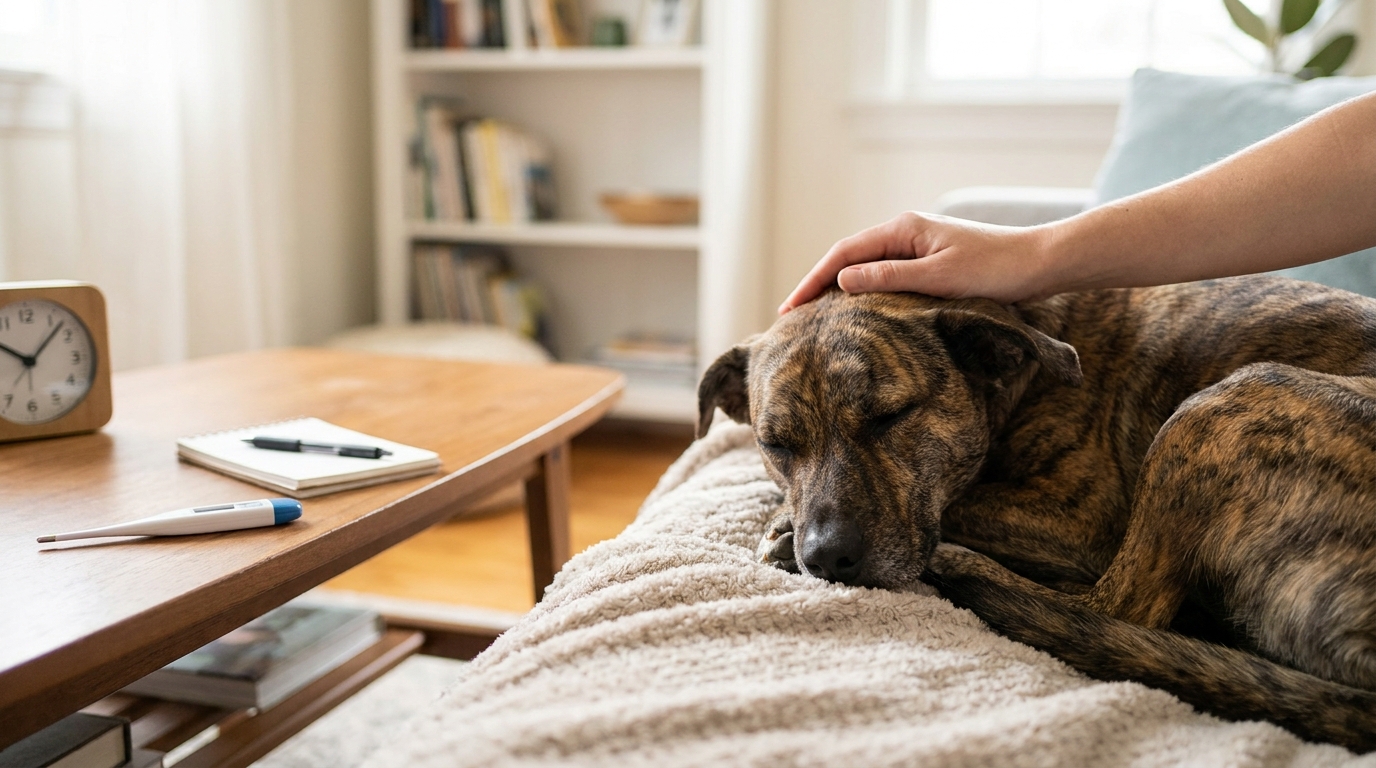
Many dogs are sleepy for a day after shots. See the normal timeline, the signs that mean go now, and how to spot a cause other than the vaccine.
Quick answer: Mild tiredness, a low fever, a sore shot site or smaller appetite is common after vaccines and usually fades within a day. Call your vet if it worsens or lasts more than a day or two. Hives, a puffy face, sudden vomiting or diarrhea, pale gums, trouble breathing or collapse mean emergency care now. A wobbly puppy must be seen now; one that later vomits or won't eat, today.
This article is general information, not a diagnosis. If you think your pet is in danger, go to the nearest emergency animal hospital.
How long tiredness after vaccines lasts: the timeline
The American Veterinary Medical Association (AVMA) lists the common, mild vaccine effects as soreness and swelling at the shot site, tiredness, a mild fever and a smaller appetite. They usually start within hours and fade within about 24 hours. Call your vet if they get worse, last more than a day or two, or your dog seems very uncomfortable. Red flags in the table override that timeline.
| Time after the shot | What is common | When to act |
|---|---|---|
| First hour | Most dogs act normal or a bit quiet | Hives, puffy face, vomiting, diarrhea, pale gums, hard breathing or collapse: ER now |
| 1 to 12 hours | Sleepy, sore shot site, eats less | Hives or puffy face: get seen now. Vomiting or weak: ER now |
| Day 1 | Tired, mild fever, smaller appetite | Getting worse, won't drink or very sore: call your vet |
| Day 2 | Most dogs are back to normal | Still flat or not eating: call your vet |
| Days 2 to 5 | Nose shot: sneezing or mild cough | Cough with fever or thick discharge: vet today |
| Day 3 and later | Back to normal | Puppy with new vomiting or diarrhea: go in today |
| 1 to 3 weeks | Small firm lump that shrinks | Past 3 weeks, painful or growing: call your vet |
| Weeks later (rare) | Nothing expected | Pale gums with weakness: ER now. Yellow gums, red or brown urine, bruises: vet today |
In a Japanese survey of 57,300 dogs given non-rabies combined vaccines (Miyaji and colleagues, 2012), every anaphylaxis case began within 60 minutes, but 83.3% of all reactions were noticed within 12 hours. Hives, a puffy face or vomiting later the same day still count.
ER now vs call your vet today vs watch at home
Follow the most urgent row that fits your dog.
| Sign | How urgent | Next step |
|---|---|---|
| Puffy face with noisy or hard breathing, or throat swelling | ER now | Go to the nearest ER |
| Any face swelling in a flat-faced breed | ER now | Go to the nearest ER |
| Sudden vomiting or diarrhea in the first hours, even once or twice | ER now | Do not wait to see if it repeats |
| Pale, white, gray or blue gums; cold legs; hard breathing; fainting, collapse, can't stand or seizure | ER now | Go to the nearest ER |
| Severe, persistent cough, or open-mouth breathing at rest | ER now | Go to the nearest ER |
| Hives or a puffy face alone | Now | Vaccinating clinic, or an ER if it is closed |
| Toy-breed puppy weak, wobbly or trembling | Now | Clinic or ER now; seizure means ER |
| Puppy in the shot series with vomiting, diarrhea or not eating | Today | In person for a parvo test; call ahead |
| Worse, won't drink or cries when touched; still flat after a day or two | Today | Call your vet |
| Shot-site lump that is hot, red, oozing or growing; won't use the leg | Today | Vet visit |
| Sleepy but eats, drinks and toilets normally; mild soreness; small lump | Watch | Rest, check again in the morning |
Why the stomach row is so strict: the Merck Veterinary Manual explains that anaphylaxis in dogs shows up mainly as gut signs, such as sudden diarrhea, drooling and vomiting, along with shock, pale gums and cold legs. Hives and facial swelling usually appear within 20 minutes. Vets treat these in the clinic, and an allergy pill at home is no substitute.
Why shots can make dogs tired: the immune response
A vaccine gives the immune system something to react to, and that reaction can leave a dog briefly run down. The 2024 World Small Animal Veterinary Association (WSAVA) guidelines list shot-site pain and swelling, lethargy, poor appetite and fever as commonly seen; hives and anaphylaxis are less common. A quiet dog that is brighter by the next morning is on track.
Merck puts a dog's normal temperature at 101 to 102.5 F (38.3 to 39.2 C). Vaccine guidance sets no temperature cutoff, so call your vet if a fever lasts more than a day or two or your dog seems very unwell, and never give a human fever reducer.
Rabies, DHPP, lepto, Bordetella, Lyme, flu: what each shot tends to cause
The American Animal Hospital Association (AAHA) 2022 guidelines call distemper, adenovirus-2, parvovirus (given with parainfluenza as DHPP), leptospirosis and rabies core vaccines; Bordetella, Lyme and canine flu depend on risk.
| Vaccine | Typical mild effect | Watch for |
|---|---|---|
| Rabies | Sore shot site, tired for a day | Hives or puffy face: get seen now. Rare bald patch 3 to 6 months later: call vet |
| DHPP | Sore shot site, tired, eats less | Puppy vomiting or diarrhea days later: parvo test, not just the shot |
| Lepto | Sore shot site, tired | Serious reactions rare; hives or swelling: get seen now |
| Bordetella (nose) | Sneezing or mild cough, days 2 to 5 | Cough with fever, thick discharge or poor appetite: vet today |
| Lyme | Sore shot site, tired | Reactions lean mild; hives or swelling: get seen now |
| Canine flu | Sore shot site, tired | Low reaction rate; needs 2 doses to protect |
In a 2023 study of more than 4.6 million dogs at Banfield hospitals (Moore and colleagues, JAVMA), adverse events were recorded within 3 days after 19.4 of every 10,000 vaccine visits. Within that small number:
- Rabies had the highest odds of any reaction.
- Rabies and DHPP had the highest odds of moderate or severe reactions.
- Lepto and Lyme had the highest odds of reactions that stayed mild.
- Bordetella and canine flu visits had the lowest rates.
AAHA says reformulated lepto vaccines cause reactions rarely (fewer than 53 per 10,000 doses), mostly minor, with serious anaphylaxis no more common than for other vaccines.
If a nasal Bordetella vaccine is accidentally injected, AAHA warns the reaction can be serious, so a hot, red or oozing lump needs a vet today.
Dogs more likely to react: small dogs, several shots at one visit, a past reaction
Moore's 2005 JAVMA study of 1,226,159 dogs recorded 38.2 adverse events per 10,000 dogs within 3 days of vaccination. Risk fell as body weight rose. Each extra vaccine at the same visit raised the risk by 27% in dogs of 10 kg (22 lb) or less, and by 12% in larger dogs. In the 2023 study, rates were highest in dogs of 5 kg (11 lb) or less, and French Bulldogs (55.9 per 10,000 visits), Dachshunds (49.4) and Boston Terriers (44.9) far outpaced mixed breeds (14.0). The two studies count per dog and per visit, so their numbers are not a trend.
In 2005, young adult dogs of about 1 to 3 years and neutered dogs had higher risk than puppies and intact dogs. A past reaction is the other big flag. WSAVA advises watching a dog that reacted before closely for up to 24 hours after its next shots.
Is it the vaccine or something else?
Vaccine tiredness starts within hours and improves day by day. Look for another cause when it doesn't.
Parvo picked up before protection built. A mother's antibodies can block the parvo vaccine until 13 to 15 weeks or longer, so puppies need boosters until they are over 16 weeks old (AAHA). Merck says parvo signs usually start 5 to 7 days after infection (range 2 to 14), beginning with vague lethargy, poor appetite and fever. A 2007 study in the journal Vaccine (Decaro) found parvo-like illness soon after shots is usually a real parvo infection, not the vaccine. A partly vaccinated puppy with vomiting, diarrhea or no appetite needs an in-person visit the same day; call ahead so the clinic can keep it away from other dogs.
A cough picked up around other dogs. Kennel cough spreads where dogs are kept close together, including veterinary hospitals, and its honking cough starts 5 to 10 days after exposure (Merck). Nasal-vaccine signs can start 2 to 5 days after the shot, so the calendar can't tell them apart. A cough with fever, thick discharge or poor appetite needs a vet today, especially in a puppy, and hard breathing means ER. See kennel cough symptoms and how long it lasts.
Pain. A sore shot site is common. Crying when touched, refusing to use the leg, limping that gets worse, or swollen joints with fever need a vet today.
New signs days to weeks later. Rarely, immune-mediated hemolytic anemia (IMHA), where the immune system destroys red blood cells, has been reported after shots, but studies are mixed and the link is not proven. Pale gums with weakness or fast breathing mean ER now. Yellow gums or eyes, red or brown urine, pinpoint red spots, new bruising or a nosebleed mean a vet visit today.
Why puppies and toy breeds can't wait as long
Puppies did not react more often than young adults in the 2005 study, but waiting is riskier for them. Young toy and miniature breeds can develop low blood sugar (Merck; Canadian Veterinary Journal, 2018), with weakness, trembling, wobbliness, sleepiness, collapse or seizures. A toy-breed puppy that skips a meal after shots needs a call to the vet now, and one that is weak, wobbly or trembling needs to be seen now. Never put food or syrup in the mouth of a seizing or unresponsive puppy.
Helping your dog rest at home
For a dog with mild signs only, meaning sleepy but still eating, drinking, peeing and pooping normally:
- Let your dog rest for a day or two in a quiet spot.
- Keep water close. If your dog won't drink, see how long is too long for a dog not drinking water.
- Offer the usual food. If an adult dog still won't eat after more than a day, call your vet. A puppy that skips a meal needs a call to the vet now.
- Check the shot site and gum color once or twice a day.
- Count breaths while your dog sleeps (see the normal resting breathing rate) and listen for wheezing. Wheezing, noisy or hard breathing at rest means ER.
Never give human pain or fever relievers such as ibuprofen, aspirin, naproxen or acetaminophen (Merck). If your dog swallowed one, go to an ER or call ASPCA Animal Poison Control at (888) 426-4435 (a consultation fee may apply) or the Pet Poison Helpline at (855) 764-7661 (per-incident fee). Don't give an antihistamine or any allergy pill at home for hives or swelling; those need to be seen in person, and the vet there decides on any treatment.
Planning the next vaccine visit after a reaction
Don't skip future vaccines on your own; tell the clinic about the reaction first. AAHA's options include fewer vaccines per visit, especially in small dogs, at least 2 weeks between spaced-out shots, and a nose vaccine where guidelines allow. Split doses are not advised. After a past reaction, or if you are worried, the AVMA suggests waiting 30 to 60 minutes at the clinic. Premedication is the vaccinating vet's decision.
Titers (antibody blood tests) do not replace vaccination (AVMA), and no titer level proves rabies protection (AAHA). Florida and Virginia require rabies shots for dogs 4 months and older, and New York requires one by 4 months of age with a second within a year. In Florida, a medical exemption needs a vet who has examined the dog. In all three states the shot is given in person, so an online vet cannot vaccinate.
When a video visit helps
RexVet is a 501(c)(3) non-profit with one vet, Dr. Tiffany Delacruz, DVM, licensed in Florida, New York and Virginia. A live, two-way video visit fits the in-between cases: still flat or eating less after a day or two, a sore shot site, or a new sign you can't place. For a puppy, it helps only when there is no vomiting, diarrhea or appetite loss.
Video is not for facial, eye or neck swelling; hives; sudden or repeated vomiting or diarrhea; pale, blue or gray gums; trouble breathing or a severe cough; weakness, collapse or seizures; a weak or wobbly toy-breed puppy; a partly vaccinated puppy with vomiting, diarrhea or no appetite, which needs an in-person parvo test the same day; or pale or yellow gums weeks after shots. Those go to an emergency clinic or the vaccinating clinic, because a video visit cannot treat anaphylaxis, give vaccines, run a parvo test, or issue a rabies certificate or exemption.
On an evening or a weekend within booking hours (live video slots run about 8 AM-11 PM ET), a $64.99 live video visit with Dr. Delacruz, for pets located in Florida, New York or Virginia, can walk you through gum color, breathing and the shot site on camera and help you choose between watching at home, calling your vet or going in. Outside those hours, use your clinic's after-hours line or an emergency clinic.
Any medication decision is the vet's after the exam and within state telehealth law; no prescription is promised. RexVet is not a pharmacy, and a pharmacy transfer fee applies when a prescription is sent to an outside pharmacy (Terms 5.4). Florida limits telehealth-only prescriptions to FDA-approved animal drugs used on-label for up to 14 days, with no human-labeled drugs. Virginia allows an electronic exam, and New York's rules are still unsettled.
Book a live video visit with Dr. Delacruz
Need an Expert Opinion on This Topic?
Book a video visit with a licensed vet, evenings and weekends included
See open timesFrequently Asked Questions
Is it normal for my dog to be lethargic after vaccines?
Yes. Mild tiredness, soreness, a mild fever and a smaller appetite are common and usually fade within about a day (AVMA). Call your vet if your dog gets worse, is still flat after a day or two, or seems very uncomfortable. Hives, a puffy face, sudden vomiting or diarrhea, pale gums, hard breathing, a severe cough or collapse need emergency care now.
How long does a puppy stay tired after shots?
Mild tiredness should be clearly better by the next day. A toy-breed puppy that skips a meal needs a call to the vet now; one that is weak, wobbly or trembling needs to be seen now, since its blood sugar can drop. A partly vaccinated puppy with vomiting, diarrhea or no appetite in the next two weeks may have parvo: call ahead and go in today.
Can a rabies shot make a dog tired?
Yes. A day of tiredness or soreness is common after any vaccine, including rabies. In the 2023 Banfield study, rabies had the highest odds of a reaction, though reactions were uncommon overall (about 19 per 10,000 visits).
Why is my dog shaking after shots?
Trembling is not on the AVMA's list of typical vaccine effects, so check gum color, breathing and the shot site. A trembling toy-breed puppy may have low blood sugar and needs to be seen now. Shaking with vomiting, facial swelling, pale gums, weakness or hard breathing means ER now.
Can I give my dog Benadryl for a vaccine reaction?
Not on your own: hives or a swollen face after a shot need to be seen in person now, and the vet there decides on any treatment. Benadryl is a human medicine, so a Florida telehealth-only vet cannot prescribe it, and federal rules require an in-person exam for that use.
When should I worry if my dog is not eating after vaccines?
Eating less for about a day is a common vaccine effect (AVMA). Call your vet if your dog still won't eat after more than a day, won't drink or seems worse. A toy-breed puppy that skips a meal needs a call to your vet now, and a puppy in its shot series that won't eat needs an in-person visit today.
Can an online vet help if my dog is lethargic after shots in Florida, New York or Virginia?
For the in-between cases, yes. A live video visit with Dr. Tiffany Delacruz, DVM, licensed in Florida, New York and Virginia, can walk you through gum color, breathing and the shot site on camera and help you decide whether to watch, call your vet or go in. Slots run about 8 AM-11 PM ET. Emergency signs go to an ER, since video cannot treat an allergic reaction, give vaccines or run a parvo test. New York's telehealth rules are still unsettled.
FAQs
Is it normal for my dog to be lethargic after vaccines?
Yes. Mild tiredness, soreness, a mild fever and a smaller appetite are common and usually fade within about a day (AVMA). Call your vet if your dog gets worse, is still flat after a day or two, or seems very uncomfortable. Hives, a puffy face, sudden vomiting or diarrhea, pale gums, hard breathing, a severe cough or collapse need emergency care now.
How long does a puppy stay tired after shots?
Mild tiredness should be clearly better by the next day. A toy-breed puppy that skips a meal needs a call to the vet now; one that is weak, wobbly or trembling needs to be seen now, since its blood sugar can drop. A partly vaccinated puppy with vomiting, diarrhea or no appetite in the next two weeks may have parvo: call ahead and go in today.
Can a rabies shot make a dog tired?
Yes. A day of tiredness or soreness is common after any vaccine, including rabies. In the 2023 Banfield study, rabies had the highest odds of a reaction, though reactions were uncommon overall (about 19 per 10,000 visits).
Why is my dog shaking after shots?
Trembling is not on the AVMA's list of typical vaccine effects, so check gum color, breathing and the shot site. A trembling toy-breed puppy may have low blood sugar and needs to be seen now. Shaking with vomiting, facial swelling, pale gums, weakness or hard breathing means ER now.
Can I give my dog Benadryl for a vaccine reaction?
Not on your own: hives or a swollen face after a shot need to be seen in person now, and the vet there decides on any treatment. Benadryl is a human medicine, so a Florida telehealth-only vet cannot prescribe it, and federal rules require an in-person exam for that use.
When should I worry if my dog is not eating after vaccines?
Eating less for about a day is a common vaccine effect (AVMA). Call your vet if your dog still won't eat after more than a day, won't drink or seems worse. A toy-breed puppy that skips a meal needs a call to your vet now, and a puppy in its shot series that won't eat needs an in-person visit today.
Can an online vet help if my dog is lethargic after shots in Florida, New York or Virginia?
For the in-between cases, yes. A live video visit with Dr. Tiffany Delacruz, DVM, licensed in Florida, New York and Virginia, can walk you through gum color, breathing and the shot site on camera and help you decide whether to watch, call your vet or go in. Slots run about 8 AM-11 PM ET. Emergency signs go to an ER, since video cannot treat an allergic reaction, give vaccines or run a parvo test. New York's telehealth rules are still unsettled.
Medically Reviewed
Reviewed by Dr. Tiffany Delacruz, DVM — licensed veterinarian and CEO of RexVet. Last reviewed October 28, 2026.
Content is for informational purposes and does not replace professional veterinary advice.
Chief Executive Officer · Licensed Veterinarian
Dr. Delacruz is a licensed Doctor of Veterinary Medicine specializing in preventive care and veterinary telehealth. She reviews all health content on RexVet to ensure accuracy and clinical relevance.
Sources & References
- · American Veterinary Medical Association — Telehealth Guidelines
- · AVMA — Pet Care Resources
- · U.S. FDA — Animal & Veterinary