
Dog Shaking After Surgery: Cold, Pain or Anesthesia?
By RexVet Team | Reviewed by Dr. Tiffany Delacruz, DVM
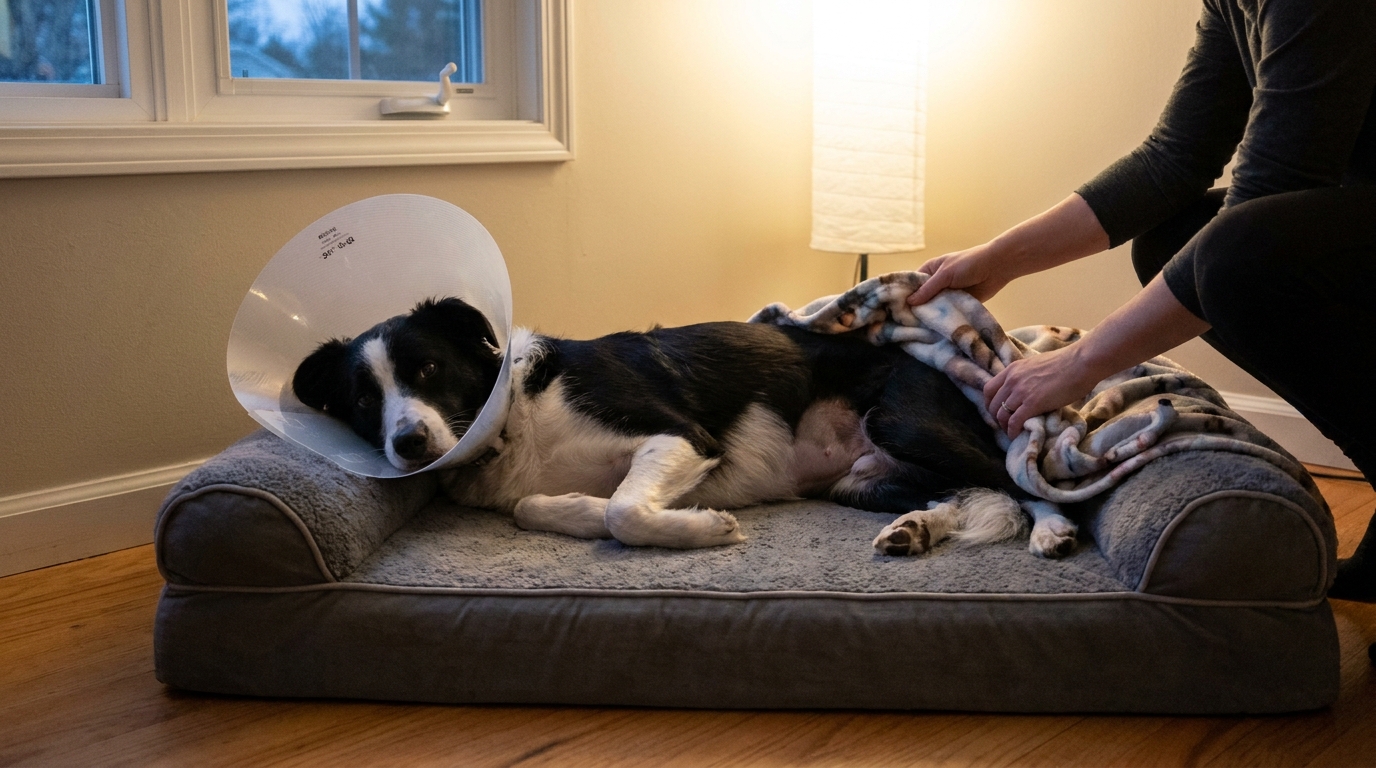
Shivering in the first hours after anesthesia can be normal. How to tell cold from pain or a drug effect, what helps at home, and when to go to the ER.
Quick answer: Shaking in the first hours after surgery is often anesthesia wearing off, low body temperature or pain, and should ease with warmth and rest. Call the surgical clinic the same day if it isn't easing, starts days later, or comes with a 103 F fever, a hot or leaking incision, or refusing food. Go to an ER now for collapse, pale or gray gums, labored breathing, seizures or a dog you can't wake.
This article is general information, not a diagnosis. If you think your pet is in danger, go to the nearest emergency animal hospital.
Emergency: Go to an ER now for collapse; pale, white, gray or blue gums; labored breathing at rest; any seizure, or a dog you can't wake or who doesn't know you; a swollen belly or cool ears and feet after belly surgery; a rectal temperature of 104 F or higher, or a bundled dog who feels hot and pants hard; shivering that stops while your dog gets duller; steady bleeding or a fast-swelling incision; straining with little or no urine; or repeated vomiting or diarrhea. For a suspected medicine mix-up or overdose, call the clinic, an ER, ASPCA Animal Poison Control (888) 426-4435 (a consultation fee may apply) or Pet Poison Helpline (855) 764-7661 (a per-incident fee applies).
Why is my dog shaking after surgery? The usual causes
PetMD says shaking after surgery can be normal in some cases but should be watched, and the ASPCA lists shivering among the signs of an abnormal recovery. The usual causes:
- Drugs wearing off. Clinician's Brief explains that anesthetic drugs hold back the shivering reflex and dull temperature control, so shivering can show up as they fade.
- Low body temperature. In a 2012 Veterinary Record study of 1,525 dogs, 32.1% were below 97.7 F at the end of the procedure, before recovery warming. Small dogs, sicker dogs and long procedures ran colder.
- Pain. Pain can cause trembling even in a warm dog. ACVS, the American College of Veterinary Surgeons, says skipped pain doses raise discomfort.
- A full bladder or a harsh room. A full bladder can make a dog restless and panting (Clinician's Brief), and a cold room, bright lights and noise add to discomfort after anesthesia (AAHA).
- Something serious. Seizures, internal bleeding, low blood sugar in tiny puppies and low calcium after certain surgeries can also come with shaking. These are emergencies.
Emergency signs: when shaking means the ER now, not a video call
Go to the nearest emergency animal hospital now if the shaking comes with any of these:
- Collapse, can't stand, or sudden weakness.
- Pale, white, gray, blue or muddy gums. A cold, shaking dog with pale gums may be in shock or bleeding inside, so don't let blankets delay the trip.
- Labored breathing at rest, or coughing or fast breathing after vomiting.
- Any seizure: jerking, paddling or stiffening, often with loss of awareness and sometimes loss of bladder or bowel control. PetMD says seizures after surgery need care right away, so don't wait to time it.
- A dog you can't wake easily, or who doesn't know you or respond to its name or touch.
- Shivering that stops while your dog gets duller. Texas A&M notes that a cold dog can stop shivering as it gets worse.
- Steady bleeding, a fast-swelling or gaping incision, tissue showing through the incision, straining with little or no urine, repeated vomiting or diarrhea, or wobbly walking after the first night.
- A rectal temperature of 104 F or higher, or a bundled dog who feels hot and pants hard. Take the blankets off and go.
- Hot, confused or uncoordinated after a new take-home medicine.
Call the surgical clinic the same day if the shaking isn't easing as your dog warms, starts days later, began after a new medicine, or comes with a 103 F temperature or incision pain or changes. Call right away if your dog vomits even once or has diarrhea, or if a dose was missed or came back up. Keep the discharge sheet and the clinic's after-hours number handy: the clinic has your dog's records, and some clinics cover complications only if you call them first.
Cold, pain, anesthesia or something else: a quick home check
Feel your dog, look at the gums, then find the closest row.
| What the shaking looks like | Likely cause | What to do |
|---|---|---|
| Shivers, feels cool, pink gums, first few hours | Low body temp | Blankets, quiet room; call if not easing |
| Trembles, flinches at the incision, won't lie down | Pain | Check med times, call the clinic |
| Shakes, pants, restless first night, still knows you | Drug effect, pain or full bladder | Dim room, potty trip, call if not easing |
| Shaking began after a new take-home medicine | Drug reaction | Call clinic; ER if hot or confused |
| New shaking days later, off food, hot or leaky incision | Fever or infection | Call the clinic today |
| Pale or gray gums, collapse, hard breathing, or cold and getting duller | Shock, bleeding or other crisis | ER now |
| Jerking, paddling, or doesn't know you during the shaking | Possible seizure | ER now |
The key home test: during the shaking, does your dog know you and respond to its name or touch? Purdue researchers (Veterinary Sciences, 2024) note that a dog with a tremor stays aware, and Cornell's Riney Canine Health Center notes that a dog having a full-body seizure is not, though a seizure in one part of the body doesn't always cause loss of consciousness. If your dog doesn't know you, go to the ER. Even if your dog knows you, face or leg twitching or worsening trembling means the ER.
How long shaking after anesthesia usually lasts
VCA says anesthetic drugs can take several hours to wear off, many dogs are sleepy for 12 to 24 hours, and behavior returns to normal over 24 to 48 hours. Shivering is different: it should ease steadily as the drugs wear off and your dog warms and rests. Don't wait it out: if it isn't easing on surgery day, call the clinic the same day.
| When | Often normal | Call the clinic if |
|---|---|---|
| First few hours | Groggy, shivery, a bit wobbly | Can't be woken: ER now |
| Night one | Restless, some trembling, more vocal | Shaking not easing with warmth |
| Day 1 to 2 | Tired, settling, eating again | Still shaking, very sluggish or not eating (wobbly: ER now) |
| Day 3 on | Close to normal | New shaking, fever or incision change |
Shaking that starts days later: fever, infection or the incision
New shaking that starts days after surgery isn't from anesthesia. It can point to fever, infection, an incision problem, pain or a reaction to a take-home medicine. Call the surgical clinic today.
Temperature. Normal rectal temperature is about 100 to 102.5 F (VCA gives 100.5 to 102.5 F; the Merck Veterinary Manual, 99.5 to 102.5 F). At 103 F, call the clinic today. At 104 F or higher, go to an ER. Skip the thermometer after rectal, anal-gland or perineal surgery, or if your groggy dog may bite.
Incision. VCA says an incision may look slightly redder in the first few days. Call right away for swelling, heavy redness, a bad smell, discharge, or seepage lasting more than 24 hours. The ASPCA also flags green, yellow or reddish discharge, warmth to the touch and a growing bump.
Shaking and panting together: dysphoria, pain or a drug effect
Some dogs have a rough wake-up called dysphoria, linked to opioid drugs. An anesthesiologist writing in Clinician's Brief describes vocalizing, restlessness, overheating, panting and not responding to people, and the North American Veterinary Anesthesia Society notes that comforting doesn't help. A dog in pain looks similar but may snap when the sore spot is touched.
Shaking isn't a listed dysphoria sign, so still run the cold, pain and bladder checks. Call the clinic if restlessness isn't easing. A dog who doesn't know you goes to the ER.
If it began after a new take-home medicine, call the clinic. VCA notes that trazodone given with other serotonin-affecting drugs can cause serotonin syndrome, with vomiting, overheating, confusion, loss of coordination and seizures. Hot, confused or uncoordinated means the ER.
Did the take-home medicine go in as directed?
A missed dose, a pill that came back up, or a dose you're not sure went in can leave a dog sore and shaky. Call the surgical clinic. Don't give an extra or early dose on your own.
Never add a human pain reliever. The FDA warns against giving two different NSAIDs, or an NSAID plus a steroid, and notes that surgery patients carry extra risk because anesthesia reduces blood flow to the kidneys. Acetaminophen mainly harms the liver in dogs. If the clinic sent home an NSAID, the FDA says to watch for vomiting, diarrhea, black or bloody stool, eating less or yellow gums or eyes; call the clinic if you see any of them. A 2019 ASPCA Animal Poison Control Center release warned that ibuprofen and naproxen can cause stomach ulcers and kidney failure in pets.
For prescribed combinations, see giving carprofen and gabapentin together and Galliprant vs carprofen. If something was given by mistake, call a poison line or an ER first, and don't make a groggy dog vomit at home (see when making a dog throw up helps and when it harms).
What you can safely do tonight
- Warm, never hot. VCA recommends a soft, clean bed in a quiet, draft-free room at 68 to 75 F (20 to 24 C). Add blankets over and under your dog.
- No heat devices. No heating pad, electric blanket, hot water bottle, microwaved pack, heat lamp, hair dryer or nearby space heater, and nothing warm on the incision. A groggy dog may not move away from heat, and VCA warns that heating pads can burn sleeping pets.
- Dim and quiet. Keep lights low and noise down.
- Potty trip. A short leash walk to pee, as VCA advises.
- Food and water. Follow the discharge sheet.
- Check gums, incision and breathing. Compare with how they looked at pickup. Our guide to a dog breathing fast while sleeping explains how to count resting breaths.
- Watch the trend. Shivering should ease as your dog warms. Not easing: call the clinic. Panting under blankets: uncover. Feels hot and pants hard: uncover and go to the ER. Shivering stops but your dog gets duller: go to the ER.
Spay, neuter, dental and orthopedic surgery: what is different
Neuter. Same rule: if shivering the first evening isn't easing as your dog warms and rests, call the clinic the same day. For scrotal swelling or an open incision, see swelling or an open incision after a neuter.
Spay and other belly surgery. PetMD warns that vessels closed off during belly surgery can open back up and bleed, and a dog can get worse fast. Fast breathing or heart rate, weakness, pale gums, cool ears, feet or tail, or a swollen belly mean the ER now.
Dental cleaning or orthopedic surgery. Both use full anesthesia, so the same timeline and red flags apply. If teeth were pulled, a sore mouth can show as trembling, pawing at the face or not eating: check whether a pain dose is due, and call the clinic if your dog won't eat by the next day. After bone or joint surgery, call the surgeon for trembling with flinching or guarding.
Thyroid or parathyroid surgery. The Merck Veterinary Manual lists low blood calcium after these surgeries. Face rubbing, ear or face twitching, a stiff gait or tremors mean the ER now.
Toy-breed or very young puppies. VCA and Merck both link toy breeds to low blood sugar, including from fasting. If a tiny puppy is weak, wobbly, trembling or dull after surgery, call the clinic or go to an ER now. Don't force food, sugar or syrup into a dull puppy's mouth; ask the clinic or ER what to do on the way.
Nursing mothers. VCA describes eclampsia as a life-threatening drop in blood calcium. A nursing mother, including one recovering from a C-section, who is restless, panting, stiff or twitching, with or without a fever, needs an ER now. Keep the puppies from nursing.
What RexVet's online vet can and cannot do
Go to an ER now, not a video call, for collapse, pale or gray gums, labored breathing, seizure-like jerking, or a dog who can't be roused or doesn't know you. For a suspected overdose or mix-up, call the clinic, an ER or a poison line listed at the top.
Otherwise, call the surgical clinic or its after-hours line first.
If that line is closed and your dog is warm again, alert, knows you, is breathing normally and has none of the ER signs above, a $64.99 live video visit with Dr. Tiffany Delacruz, DVM, can give you a second look if a slot is open. RexVet is a 501(c)(3) non-profit. Your pet must be located in Florida, New York or Virginia at the time of the visit. Slots run about 8 AM to 11 PM ET, with no same-day guarantee; outside those hours, or if no slot is open, an ER is the option.
On camera she can look at the shaking, gums and incision, go over the discharge sheet and medicine timing, and help you decide whether to watch tonight, call the surgeon in the morning or go in now. She cannot take a temperature or feel the belly. She won't change the pain plan your surgical clinic sent home, and she cannot start, refill or change gabapentin, tramadol or opioid pain medicine by video; those stay with the surgeon. No prescription is promised. RexVet is not a pharmacy: if she does prescribe, the prescription goes to an outside pharmacy and a pharmacy transfer fee applies (Terms 5.4). You can book a video visit here.
When to be seen in person in Florida, New York or Virginia
ER signs mean the nearest emergency animal hospital. Incision rechecks, temperature checks, belly checks and pain-plan changes belong with your surgical clinic, in person.
Video also has legal limits on pain medicine. Florida's s. 474.2021 limits a telehealth-only vet to FDA-approved animal drugs used as labeled, for up to 14 days (1 month for products labeled solely for fleas and ticks), with no renewal without an in-person exam and no human-labeled, controlled or compounded anti-infective drugs. Gabapentin, tramadol and trazodone are human-labeled. Federal rules (21 CFR 530) require an in-person exam or timely premises visits for extralabel use, which includes any human-labeled drug given to a dog. Virginia allows an electronic exam, but the federal limits still apply. New York's rules are unsettled.
Need an Expert Opinion on This Topic?
Book a video visit with a licensed vet, evenings and weekends included
See open timesFrequently Asked Questions
Is it normal for a dog to shake after surgery?
It can be, in the first hours, from anesthesia wearing off, low body temperature or pain. It should ease as your dog warms up and rests. Call the surgical clinic the same day if it isn't easing. Go to an ER now for collapse, pale or gray gums, labored breathing, a seizure, or a dog you can't wake.
How long does shaking last after anesthesia?
The drugs can take several hours to wear off, and many dogs are sleepy for 12 to 24 hours (VCA). Don't wait out shivering for a full day, though: if it isn't easing on surgery day, call the clinic. Wobbly walking after the first night needs an ER.
Why is my dog shaking 2-3 days after surgery?
New shaking days later is not from anesthesia. It can mean fever, infection, an incision problem, pain or a medicine reaction. Check the incision for heat, swelling, discharge, a bad smell or an opening. At 103 F, call the clinic today. At 104 F or higher, go to an ER.
Is my dog shaking from pain or from being cold?
A cold dog feels cool and settles once covered with blankets in a warm, draft-free room. A dog in pain may tremble even when warm, guard the incision, cry, or refuse to lie down. Check whether a pain dose is due, and call the clinic if pain seems worse. Shivering that stops while your dog gets duller is an ER sign.
Is shaking after a spay or neuter normal?
Grogginess the first evening is expected, and some dogs shiver as the drugs wear off. Call the clinic the same day if shivering isn't easing as your dog warms, and right away for any vomiting or diarrhea. After a spay, shaking with pale gums, cool ears or feet, fast breathing, weakness or a swollen belly can mean internal bleeding: go to an ER now.
Can an online vet help with my dog's shaking after surgery?
Only after you call the surgical clinic, and only when no ER sign applies. If the clinic is closed and your pet is in Florida, New York or Virginia, RexVet's Dr. Tiffany Delacruz, DVM, can look at the shaking, gums and incision by video when a slot is open (about 8 AM to 11 PM ET). She can't take a temperature, feel the belly, or start, refill or change pain medicine by video, and no prescription is promised.
FAQs
Is it normal for a dog to shake after surgery?
It can be, in the first hours, from anesthesia wearing off, low body temperature or pain. It should ease as your dog warms up and rests. Call the surgical clinic the same day if it isn't easing. Go to an ER now for collapse, pale or gray gums, labored breathing, a seizure, or a dog you can't wake.
How long does shaking last after anesthesia?
The drugs can take several hours to wear off, and many dogs are sleepy for 12 to 24 hours (VCA). Don't wait out shivering for a full day, though: if it isn't easing on surgery day, call the clinic. Wobbly walking after the first night needs an ER.
Why is my dog shaking 2-3 days after surgery?
New shaking days later is not from anesthesia. It can mean fever, infection, an incision problem, pain or a medicine reaction. Check the incision for heat, swelling, discharge, a bad smell or an opening. At 103 F, call the clinic today. At 104 F or higher, go to an ER.
Is my dog shaking from pain or from being cold?
A cold dog feels cool and settles once covered with blankets in a warm, draft-free room. A dog in pain may tremble even when warm, guard the incision, cry, or refuse to lie down. Check whether a pain dose is due, and call the clinic if pain seems worse. Shivering that stops while your dog gets duller is an ER sign.
Is shaking after a spay or neuter normal?
Grogginess the first evening is expected, and some dogs shiver as the drugs wear off. Call the clinic the same day if shivering isn't easing as your dog warms, and right away for any vomiting or diarrhea. After a spay, shaking with pale gums, cool ears or feet, fast breathing, weakness or a swollen belly can mean internal bleeding: go to an ER now.
Can an online vet help with my dog's shaking after surgery?
Only after you call the surgical clinic, and only when no ER sign applies. If the clinic is closed and your pet is in Florida, New York or Virginia, RexVet's Dr. Tiffany Delacruz, DVM, can look at the shaking, gums and incision by video when a slot is open (about 8 AM to 11 PM ET). She can't take a temperature, feel the belly, or start, refill or change pain medicine by video, and no prescription is promised.
Medically Reviewed
Reviewed by Dr. Tiffany Delacruz, DVM — licensed veterinarian and CEO of RexVet. Last reviewed October 28, 2026.
Content is for informational purposes and does not replace professional veterinary advice.
Chief Executive Officer · Licensed Veterinarian
Dr. Delacruz is a licensed Doctor of Veterinary Medicine specializing in preventive care and veterinary telehealth. She reviews all health content on RexVet to ensure accuracy and clinical relevance.
Sources & References
- · American Veterinary Medical Association — Telehealth Guidelines
- · AVMA — Pet Care Resources
- · U.S. FDA — Animal & Veterinary