
Dog Car Sickness: Signs, Causes and What Actually Helps
By RexVet Team | Reviewed by Dr. Tiffany Delacruz, DVM
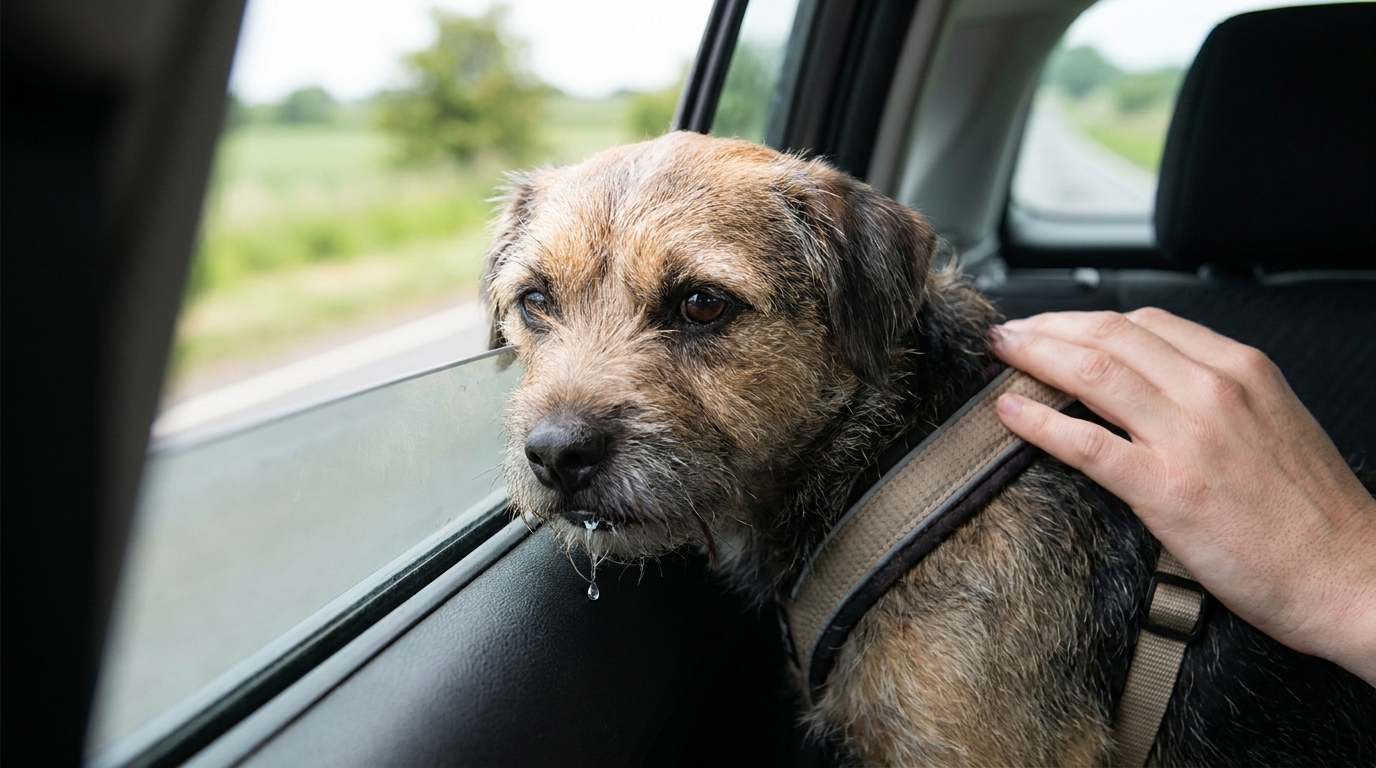
Drooling, whining or vomiting on drives? How to tell motion sickness from fear, a practice plan, safer medicine choices and when to go in.
Quick answer: Car sickness is common in dogs, and many puppies outgrow it by about their first birthday. Signs include drooling, lip licking, whining, restlessness and vomiting once the car moves. Short practice trips, a light meal well before the drive and a secured crate or harness help. Skip human motion pills unless a vet who examined your dog in person says otherwise. Vomiting that continues after the drive needs a vet.
This article is general information, not a diagnosis. If you think your pet is in danger, go to the nearest emergency animal hospital.
Signs of car sickness in dogs
Motion sickness comes mainly from the balance (vestibular) system in the inner ear. Merck and VCA Animal Hospitals list these nausea signs:
- Heavy drooling, and smacking or licking the lips
- Whining, pacing, panting or circling
- Lethargy, or going very still and quiet
- Throwing up in the car, in dogs that are badly affected
- Pooping in the car (VCA)
In typical car sickness, the signs start after the car begins to move and usually fade once it stops (Merck). Drooling in a parked car suggests fear is part of it, and vomiting long after the ride suggests something else.
When it is more than car sickness
Go to the nearest emergency vet now, not a video visit, for any of these:
- Repeated dry retching or unproductive vomiting, or a swollen or hard belly, especially in a large, deep-chested dog that ate before or during the drive (possible bloat). Merck lists drooling and restlessness as bloat signs too.
- Heavy, fast breathing, dry or sticky gums, odd gum color, weakness, confusion, collapse or a seizure after time in a hot or parked car. VCA calls hyperthermia an immediate medical emergency, and flat-faced and muzzled dogs are at higher risk. On the way, pour cool, not cold, water over your dog's head, belly, armpits and feet and run the AC; no ice packs, and don't cover your dog with wet towels, which can trap heat (VCA).
- Blood or coffee-ground material in the vomit, or collapse at any point during or after the trip.
- A toy-breed puppy that turns weak, wobbly, trembly or dull after a skipped meal. Merck notes that toy breeds can develop low blood sugar in the first 6 months of life.
- Swallowed medicine or a toxin: human motion pills, allergy or cold products, sleep aids, someone else's sedative, sugar-free gum or mints (xylitol), or antifreeze from a garage or a gas-station puddle. Call ASPCA Animal Poison Control at (888) 426-4435 (a consultation fee may apply) or the Pet Poison Helpline at (855) 764-7661 (per-incident fee), and head to an emergency vet.
See a vet in person right away, not after the trip, for:
- A head tilt, darting eyes, falling or circling to one side, or not being able to stand. VCA lists these as signs of vestibular disease, not motion sickness.
- A dog thrown during hard braking, one that jumped or fell from the car, or one that broke teeth or is bleeding from chewing at a crate, even if it seems fine.
- Vomiting that keeps going after the drive, or a dog that can't keep water down. See our guides to a dog throwing up clear liquid or water and to vomiting undigested food right after eating vs hours later.
- A young or unvaccinated puppy that keeps vomiting after a ride (risk of dehydration and infections such as parvo).
Book a hands-on visit soon if car sickness starts suddenly in an adult dog that used to ride well, especially with head shaking or ear scratching. Ear infections and vestibular disease can play a part (VCA).
Car sick or car anxious?
Nausea and fear look alike, and Merck notes that fear of the vehicle can add to motion sickness. The difference matters, because anti-nausea drugs help only with motion sickness, not anxiety (VCA).
A rough guide. Many dogs are both, and the signs overlap.
| Clue | Motion sickness | Fear or anxiety |
|---|---|---|
| Signs start in a parked car | Less likely | More likely |
| Signs ease once the car stops | Usually | Varies |
| Dog's age | More common under 1 year | Common in adults too |
| Drooling, lip licking, whining, pacing, vomiting | Can happen | Can happen |
| Car rides mostly end at the vet | Can add to it | Common trigger |
| What usually helps | Practice trips; ask about medicine | Slow practice; ask a vet |
Timing is the better clue: Merck and VCA list panting, pacing and whining as nausea signs too.
Why dogs get car sick
- A still-developing inner ear. Motion sickness is more common in young dogs, possibly because the balance parts of the inner ear aren't fully developed (VCA). Many puppies outgrow it by about their first birthday, though some dogs do not.
- Bad memories of the car. Dogs that ride only once or twice a year, usually to the vet, often link the car with stress, which alone can cause vomiting and diarrhea (VCA). A frightening first ride can do the same.
- Ear and balance problems. Middle or inner ear infections and vestibular disease can bring on nausea (VCA).
- Medicines. Some medicines cause vomiting on their own (VCA). If car sickness began around the time a new medicine did, tell your vet.
The practice plan before a holiday trip
To help stop car sickness over time, aim for a car your dog finds boring. VCA recommends gradual practice with praise and food rewards. If you are driving for Thanksgiving (Nov 26), start now.
An example plan based on VCA's steps. Expect several days to a few weeks. The "Move on when" cues are an editorial example.
| Step | What to do | Move on when |
|---|---|---|
| 1 | Sit in the parked car, engine on, for a few minutes; treats and praise | Dog stays relaxed |
| 2 | Next day, back out of the driveway and return | Dog stays calm |
| 3 | Drive around the block | Calm, no drooling |
| 4 | Short drives, a bit longer each time | Calm, no vomiting |
| 5 | Ride for 20-30 minutes | Calm the whole ride |
| Any step | Dog looks anxious: stop and try another day | Calm again |
Never run the engine in a garage, even with the door open (CDC). Keep sessions short, and drive somewhere your dog enjoys, such as a park, so the car stops meaning only the vet. If your dog still drools or vomits on every ride after steady practice, talk to a vet a week or more before the trip.
On travel day: food, air and a safe ride
- Food and water. Give a light meal well before you leave, or follow your vet's food timing, and don't feed in the moving car (ASPCA). Pack plenty of water and offer it whenever you can (ASPCA, VCA). Don't skip meals for a toy-breed puppy or a diabetic dog on insulin without asking your vet.
- Air and noise. Keep the car cool and quiet (VCA).
- A secured ride. The ASPCA calls a secured crate that can't slide or shift in a sudden stop the safest choice. Without one, keep your dog in the back seat in a harness attached to a secured seatbelt, head inside the window. Many products labeled crash-tested have not passed independent testing; look for CPS Certified.
- Breaks. Stop regularly. If your dog looks about to vomit, a short leashed walk may help for a while (VCA).
- A clear console. Sugar-free gum, mints, toothpaste and chewable vitamins can contain xylitol, which is toxic to dogs (Pet Poison Helpline). Clear them out of the console and door pockets before a road trip.
Never leave your dog alone in a parked car. A study in the journal Pediatrics found that a dark sedan parked on clear days of 72F to 96F warmed by about 40F within an hour, mostly in the first 30 minutes, and cracked windows did not slow the heating. Florida stays warm into November. In cold weather, the ASPCA warns, a parked car can act like a refrigerator, which matters on December trips in New York and Virginia; see how cold is too cold for dogs.
Medicines: what vets use and what to avoid
The right medicine depends on whether the problem is nausea, fear or both. Never use a dose you found online.
Maropitant (Cerenia). Maropitant, which since January 2026 also has an FDA-approved generic chewable version, is approved to prevent vomiting caused by motion sickness in dogs, and the Merck Veterinary Manual calls it the preferred drug. From the tablet label:
- It is prescription-only and is given before the trip as your vet directs.
- The motion-sickness use is labeled for dogs 4 months and older, so it is not for young puppies; ask a vet.
- It helps prevent vomiting but doesn't stop it in every dog: on a one-hour car ride, 7% of treated dogs vomited, compared with 55% on placebo.
- It is labeled for short-term use around a trip, so ask your vet about a multi-day drive.
- It doesn't treat fear, and Merck notes that nausea is harder to control than vomiting, so a dog on it may still drool.
- Tell the vet about every medicine your dog takes, including pain and behavior medicines, and about liver disease, pregnancy, nursing or breeding.
- Don't use leftover Cerenia for vomiting after a trip. The label says its safe use hasn't been tested in dogs with a gut blockage or dogs that swallowed a toxin, and the cause of the vomiting needs a vet.
Our page on Cerenia for dogs has more detail.
Human motion pills and Benadryl. Dimenhydrinate (the Dramamine-type drug), meclizine and diphenhydramine (Benadryl) are over-the-counter motion-sickness drugs labeled for people, not dogs. Giving one to a dog is extralabel use, which federal rules (21 CFR 530.3) allow only within a vet relationship that includes an examination. Vets do sometimes use these antihistamines (Merck), so give one only if a vet who examined your dog in person tells you to. Too much can cause sedation, agitation, a fast heart rate, tremors and possibly seizures (Merck). Many allergy, cold and sleep products also contain a decongestant, often marked "-D," or a pain reliever such as acetaminophen; see why human pain relievers are risky for dogs.
Anti-anxiety medicines. Merck describes gabapentin and trazodone as anti-anxiety medicines, and notes that they can cause incoordination and sedation in some dogs, more so in older or ill dogs. Both are human-labeled, so federal rules require an in-person exam first, and in Virginia, gabapentin is a state-controlled (Schedule V) drug.
Leftover pills and test runs. Never use leftover sedatives or someone else's prescription. Try any new medicine on a short ride at home before travel day, and if it makes your dog extremely sleepy, unable to stand or more agitated, call your vet now and don't travel until it's sorted out.
Flying or a long road trip? Paperwork and packing
The ASPCA suggests packing food, a bowl, a leash, waste bags, any medicines and plenty of water. For a car-sick dog, add towels, cleanup supplies and both poison line numbers saved in your phone.
Crossing state lines or flying may require a health certificate, which needs an in-person exam; Florida law bars vets from issuing one by telehealth. Check your airline's and destination's rules early.
When a video visit helps
Planning a holiday drive with a dog that drools or vomits in the car? A $64.99 live video visit with Dr. Tiffany Delacruz, DVM, can help you tell motion sickness from travel anxiety, set up a practice plan and talk through whether a medicine fits your dog. Book a video visit a week or more before the trip, for a day when your dog is still at home in Florida, New York or Virginia. The dog has to be in one of those states during the call itself, not just when you book. Live video slots run about 8 AM-11 PM ET. Holiday hours aren't confirmed, so don't count on a visit on Thanksgiving Day (Nov 26) or on travel day.
No prescription is promised. Whether any medicine fits depends on Dr. Delacruz's assessment, your dog's age, health and other medicines, and state rules. In every state, federal rules require an in-person exam before a dog gets a human-labeled drug such as trazodone or gabapentin, and Florida law also bars it after a video-only visit. In Florida, a video-only prescription is limited to FDA-approved animal drugs used as labeled, for up to 14 days, and can't be renewed without an in-person exam. New York rules are unsettled. RexVet is not a pharmacy: if she writes a prescription and you ask RexVet to send it to an outside pharmacy, a pharmacy transfer fee applies. A video visit also can't provide a health certificate for crossing state lines or flying. The one-time $120 Family Plan covers 4 visits over 12 months for every pet in the home and never auto-renews.
A video visit is not the right call for vomiting that keeps going after the drive, a dog that can't keep water down, dry retching that brings nothing up, blood, collapse, or heavy panting and weakness after time in a hot or parked car. Go to an emergency vet now.
Need an Expert Opinion on This Topic?
Book a video visit with a licensed vet, evenings and weekends included
See open timesFrequently Asked Questions
Will my puppy grow out of car sickness?
Often, yes. Car sickness is more common in young dogs, possibly because the inner ear is still developing, and many puppies outgrow it by about their first birthday (VCA). Some don't, especially after scary early rides, so calm practice trips still matter. A young or unvaccinated puppy that keeps vomiting after a ride needs an in-person vet right away, and a toy-breed puppy that turns weak, wobbly or dull needs an emergency vet now.
Can I give my dog Dramamine or Benadryl for car sickness?
Not on your own. Dramamine-type pills (dimenhydrinate or meclizine) and Benadryl (diphenhydramine) are human-labeled. Vets sometimes use them, but versions with a decongestant ("-D") or acetaminophen can be dangerous for dogs. Give one only if a vet who examined your dog in person tells you to. If your dog got into these pills, call an emergency vet, ASPCA Animal Poison Control at (888) 426-4435 (fee may apply) or the Pet Poison Helpline at (855) 764-7661 (per-incident fee).
Does ginger help dogs with car sickness?
Ginger is often suggested, but it hasn't been well studied for car sickness in dogs; the dog research is old lab work, not car rides. Ask your vet before giving any chew or supplement, and check labels for xylitol, which is toxic to dogs. Gradual practice trips come first (VCA).
Should I feed my dog before a car ride?
A light meal well before the drive, or the timing your vet recommends, is a sensible default. Avoid feeding in a moving car (ASPCA) and keep fresh water available (VCA). Don't skip meals for a toy-breed puppy or a diabetic dog without asking your vet, because young toy breeds can develop low blood sugar (Merck).
Why does my dog drool in the car?
Drooling and lip licking are classic nausea signs (Merck, VCA). If drooling starts before the car moves, fear is likely part of it (Merck). Drooling that continues after the ride needs a vet the same day. With nonstop vomiting, dry retching, or heavy panting or weakness (especially after time in a hot or parked car), go to an emergency vet now.
Is there a vet medicine for car sickness in dogs?
Yes. Maropitant (Cerenia tablets or an FDA-approved generic chewable) is labeled to help prevent motion-sickness vomiting in dogs 4 months and older, and Merck calls it the preferred drug. It is prescription-only, meant for short-term use around a trip, and not an anxiety medicine.
How far ahead should I talk to a vet before a holiday trip?
A week or more ahead. Getting a nervous dog used to the car can take several days or even weeks, and some prescription travel medicines work best when started several days to a couple of weeks before travel (VCA).
Can a video visit help with car sickness if my dog is in Florida, New York or Virginia?
Often, yes, for planning, as long as your dog is in Florida, New York or Virginia during the call. On camera, a vet licensed there can take the history, watch videos of car episodes, sort motion sickness from fear, build a practice plan and review current medicines. An in-person visit is needed for a head tilt or balance trouble, new car sickness in a dog that used to ride well, vomiting that won't stop, a puppy under 4 months that needs medicine, a human-labeled calming drug such as trazodone or gabapentin, and a travel health certificate. If medicine comes up, the vet decides whether a labeled anti-vomiting medicine fits, and no prescription is promised. In Florida, a video-only prescription is limited to FDA-approved animal drugs used as labeled, for up to 14 days, with no renewal without an in-person exam. In Virginia the exam may be electronic, but federal rules still require an in-person exam for human-labeled drugs. New York rules are unsettled.
FAQs
Will my puppy grow out of car sickness?
Often, yes. Car sickness is more common in young dogs, possibly because the inner ear is still developing, and many puppies outgrow it by about their first birthday (VCA). Some don't, especially after scary early rides, so calm practice trips still matter. A young or unvaccinated puppy that keeps vomiting after a ride needs an in-person vet right away, and a toy-breed puppy that turns weak, wobbly or dull needs an emergency vet now.
Can I give my dog Dramamine or Benadryl for car sickness?
Not on your own. Dramamine-type pills (dimenhydrinate or meclizine) and Benadryl (diphenhydramine) are human-labeled. Vets sometimes use them, but versions with a decongestant ("-D") or acetaminophen can be dangerous for dogs. Give one only if a vet who examined your dog in person tells you to. If your dog got into these pills, call an emergency vet, ASPCA Animal Poison Control at (888) 426-4435 (fee may apply) or the Pet Poison Helpline at (855) 764-7661 (per-incident fee).
Does ginger help dogs with car sickness?
Ginger is often suggested, but it hasn't been well studied for car sickness in dogs; the dog research is old lab work, not car rides. Ask your vet before giving any chew or supplement, and check labels for xylitol, which is toxic to dogs. Gradual practice trips come first (VCA).
Should I feed my dog before a car ride?
A light meal well before the drive, or the timing your vet recommends, is a sensible default. Avoid feeding in a moving car (ASPCA) and keep fresh water available (VCA). Don't skip meals for a toy-breed puppy or a diabetic dog without asking your vet, because young toy breeds can develop low blood sugar (Merck).
Why does my dog drool in the car?
Drooling and lip licking are classic nausea signs (Merck, VCA). If drooling starts before the car moves, fear is likely part of it (Merck). Drooling that continues after the ride needs a vet the same day. With nonstop vomiting, dry retching, or heavy panting or weakness (especially after time in a hot or parked car), go to an emergency vet now.
Is there a vet medicine for car sickness in dogs?
Yes. Maropitant (Cerenia tablets or an FDA-approved generic chewable) is labeled to help prevent motion-sickness vomiting in dogs 4 months and older, and Merck calls it the preferred drug. It is prescription-only, meant for short-term use around a trip, and not an anxiety medicine.
How far ahead should I talk to a vet before a holiday trip?
A week or more ahead. Getting a nervous dog used to the car can take several days or even weeks, and some prescription travel medicines work best when started several days to a couple of weeks before travel (VCA).
Can a video visit help with car sickness if my dog is in Florida, New York or Virginia?
Often, yes, for planning, as long as your dog is in Florida, New York or Virginia during the call. On camera, a vet licensed there can take the history, watch videos of car episodes, sort motion sickness from fear, build a practice plan and review current medicines. An in-person visit is needed for a head tilt or balance trouble, new car sickness in a dog that used to ride well, vomiting that won't stop, a puppy under 4 months that needs medicine, a human-labeled calming drug such as trazodone or gabapentin, and a travel health certificate. If medicine comes up, the vet decides whether a labeled anti-vomiting medicine fits, and no prescription is promised. In Florida, a video-only prescription is limited to FDA-approved animal drugs used as labeled, for up to 14 days, with no renewal without an in-person exam. In Virginia the exam may be electronic, but federal rules still require an in-person exam for human-labeled drugs. New York rules are unsettled.
Medically Reviewed
Reviewed by Dr. Tiffany Delacruz, DVM — licensed veterinarian and CEO of RexVet. Last reviewed October 30, 2026.
Content is for informational purposes and does not replace professional veterinary advice.
Chief Executive Officer · Licensed Veterinarian
Dr. Delacruz is a licensed Doctor of Veterinary Medicine specializing in preventive care and veterinary telehealth. She reviews all health content on RexVet to ensure accuracy and clinical relevance.
Sources & References
- · American Veterinary Medical Association — Telehealth Guidelines
- · AVMA — Pet Care Resources
- · U.S. FDA — Animal & Veterinary