
Dog Throwing Up Clear Liquid or Water: Causes and When to Worry
By RexVet Team | Reviewed by Dr. Tiffany Delacruz, DVM
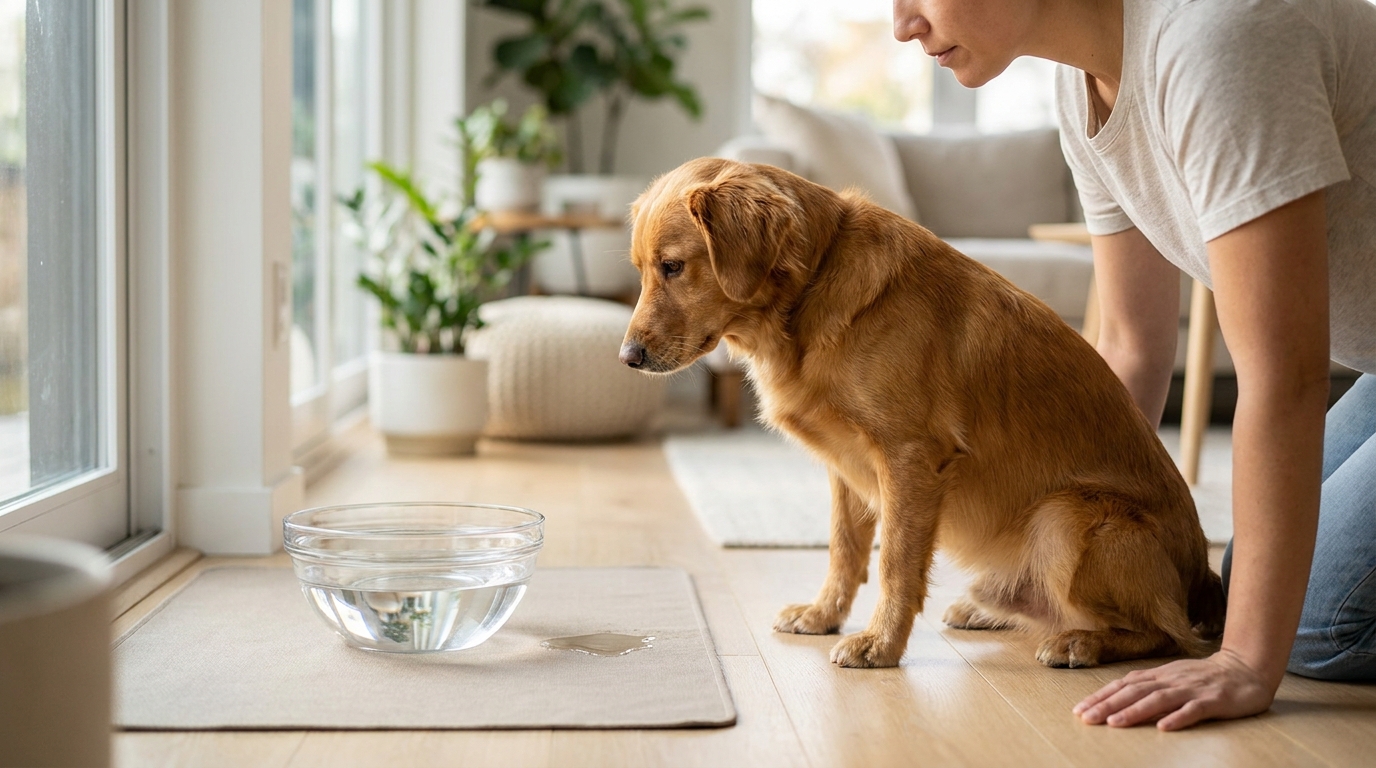
How to tell water, saliva, mucus and stomach fluid apart, which red flags mean go now, and when one episode can be watched at home.
Quick answer: Clear liquid is usually water, saliva or stomach fluid. One episode in a healthy adult that keeps sips down, acts normal and can't have swallowed a toxin or object can be watched at home. Puppies, seniors, diabetic dogs, or more than two episodes in 24 hours: see a vet in person within hours. Go to an ER now if even sips come back up, or for dry retching, a swollen belly, blood, lethargy or collapse.
This article is general information, not a diagnosis. If you think your pet is in danger, go to the nearest emergency animal hospital.
What clear vomit usually is: water, saliva, mucus or stomach fluid
Clear liquid is usually one of four things: water that came straight back up after a drink; saliva, which can build up and come back up when the esophagus (the food tube) doesn't move it along (Washington State University, or WSU); mucus from the airway after a coughing fit; or stomach fluid on an empty stomach. Clear doesn't mean safe: bloat, a blockage or a toxin can bring it up too.
Emergency signs: go to an ER now, not a video call
Go to the nearest emergency vet now, whatever the vomit looks like, for any of these:
- Retching that brings up nothing, or only drool, even if the belly doesn't look swollen yet (VCA, Merck). It's even more urgent with a tight or swollen belly, pacing, pale gums or weakness, and in a large, deep-chested dog such as a Great Dane or Standard Poodle (Cornell University). These are signs of bloat (GDV), which the American College of Veterinary Surgeons calls life-threatening. Don't wait to see if it passes.
- Even small sips of water come back up, at any age (VCA Animal Hospitals). Go to your vet now, or an ER if your vet can't see your dog right away.
- Blood, red or like coffee grounds.
- Vomiting over and over in a short time, or vomiting that won't stop, even if it's only clear fluid (Merck, VCA).
- Vomiting with lethargy, fever, belly pain, diarrhea, dehydration or refusing food (VCA).
- Pale, gray or blue gums, weakness or collapse.
- A suspected toxin: antifreeze, xylitol (sugar-free gum, candy and mints, a Halloween risk, plus some peanut butters and some liquid medicines; signs can be delayed for hours), grapes or raisins, chocolate or a cannabis edible. Call ASPCA Animal Poison Control at (888) 426-4435 (a consultation fee may apply) or Pet Poison Helpline at (855) 764-7661 (a per-incident fee applies), or go to an ER. After antifreeze, seeming better is not a reason to wait (Merck Veterinary Manual).
- A possible swallowed bone, chew, toy or sock.
- Fast, labored or noisy breathing after bringing up water.
- A puppy that can't keep water down, or a vomiting puppy that is lethargic or has diarrhea.
- Vomiting, weakness or collapse after heat, a beach day or pond water. After heat, start cooling your dog on the way (Cornell). Blue-green algae in ponds can cause liver damage within hours (Cornell). After a long swim or water play, also go to an ER for vomiting with a swollen belly or dullness, or for any wobbliness or seizures (ASPCA, Cornell).
- Straining to pee or no urine, especially in a male dog.
- Vomiting, facial swelling, hives or trouble breathing after a sting or bite: possibly a severe allergic reaction (Cornell).
See a vet in person the same day for more than two episodes in 24 hours in a bright dog keeping water down; vomiting past 6-12 hours (VCA), sooner for small or senior dogs; vomiting after fatty food; any vomiting in an unvaccinated puppy; water or saliva with a cough or fever; or clear fluid after recent anesthesia (call that clinic).
Vomiting or regurgitation? The 10-second check
Vomiting takes effort and comes from the stomach. Regurgitation is a passive backflow from the esophagus. Watch the few seconds before it comes up:
| What you see | Vomiting | Passive backflow |
|---|---|---|
| Before it comes up | Usually nausea, drooling and retching first (Merck) | No warning; it just comes up (Merck, Cornell) |
| Effort | Active: the belly contracts and heaves (VCA) | Passive: no belly heaving (Merck) |
| Timing | Varies | Often right after a drink or meal, but not always; can happen in sleep (VCA, WSU) |
| What comes up | May include yellow bile, froth, food or blood (Merck) | Plain water, saliva or undigested food; food may look tube-shaped (Merck) |
| Coughing afterward | Less common | More common (Merck) |
Yellow bile points toward vomiting but doesn't prove it. If you didn't see it happen or can't tell, use the red-flag list either way. Repeated backflow needs an in-person exam and chest X-rays.
Clear liquid by timing: what it usually points to
| When it happens | Most likely reason | What to do |
|---|---|---|
| Soon after a big drink, play or a pool swim | Water coming straight back up (VCA) | Once, then bright: small sips often. Repeats: book an exam. Swollen belly, dull, weak or wobbly: ER (ASPCA) |
| First thing in the morning or before meals | Empty-stomach pattern; clear or yellow-tinged (JAAHA) | Book a non-urgent exam; plan any meal timing with your vet |
| After eating grass | Plant eating is normal; most dogs don't regularly vomit after it | Once and bright: watch. Keeps happening, or seemed unwell first: see a vet |
| Clear slime after a coughing fit or gag | Often airway mucus, as with kennel cough (Merck) | Bright adult: call your vet. Puppy, fever or off food: same day. Labored breathing: ER |
| Every drink comes back up, even small sips | Fluids aren't staying down (VCA) | In-person care now; ER if your vet can't see your dog right away |
| With diarrhea, or in an unvaccinated puppy | Gut upset or infection; in puppies, parvo (Cornell) | Diarrhea: go now. Puppy: same day, call ahead. Lethargic or can't keep water down: ER |
| Retching with nothing, or only drool, coming up | Possible bloat, or GDV (Cornell) | ER now. More on gagging with nothing coming up |
| After a bone, rawhide or chew, with drooling and repeated swallowing | Something stuck in the esophagus (Merck) | In-person now for X-rays; no bread to push it down. See turkey bones |
| After a recent spay, neuter, dental or anesthesia | Reflux during anesthesia can irritate the esophagus (Merck) | Call the clinic that did it, the same day. See after-neuter warning signs |
Clear liquid vs white foam vs yellow: what the color adds
| Color | Usually is | Worry level |
|---|---|---|
| Clear, watery | Swallowed water, saliva or stomach fluid | Low if once and your dog is bright; rises with repeats or any red flag |
| White foam | Frothy fluid; can follow a coughing fit or retching | Same as clear. Foam or drool with dry retching, especially in a big dog: ER (bloat) |
| Yellow | Bile; points toward vomiting; often on an empty stomach (JAAHA) | Recurring: book an exam. Repeated in one day: same-day vet |
| Red, pink or coffee-ground | Blood; coffee-ground specks are digested blood (Cornell) | Go now (VCA) |
Common causes, from mild to serious
- Water coming straight back up after a big drink, often after play. A repeating pattern needs an exam.
- An empty stomach. A 2016 case series in the Journal of the American Animal Hospital Association (JAAHA) linked early-morning vomiting to intestinal fluid flowing back into the stomach, but 3 of its 20 dogs later had another diagnosis, such as liver disease.
- Grass. In an owner survey of 1,571 plant-eating dogs (Sueda, Hart and Cliff, 2008), only 22% often vomited afterward.
- Car rides: motion sickness is a recognized cause. If it keeps happening, book an exam.
- Pancreatitis. Eating things a dog shouldn't, such as fatty scraps, is a common risk factor (Merck). Vomiting after something fatty needs an in-person exam and blood tests the same day; belly pain or weakness means go now.
- A swallowed object: bones and chews in the esophagus, toys or socks in the intestine. Young, large-breed dogs are more likely to have an intestinal blockage from a swallowed object (Merck), but a dog of any size can get a bone stuck in the esophagus.
- Chronic kidney disease, which usually causes vomiting only in its late stages (Merck).
- Addison's disease: recurring vomiting and diarrhea with weight loss in young to middle-aged dogs (Merck).
- Parvo in unvaccinated puppies. Vomiting can start before the diarrhea does (Cornell).
Clear vomiting about once a week deserves a booked exam: Cornell notes that vomiting even once a week may indicate a disease. Go sooner for weight loss or a change in appetite or thirst.
Megaesophagus is a widened esophagus that doesn't move food and water along to the stomach normally; regurgitation is the main sign (Merck). WSU calls aspiration pneumonia the leading cause of death in these dogs, so contact a vet immediately for a cough, faster breathing or lethargy. Diagnosis needs chest X-rays.
Laryngeal paralysis mostly affects older large dogs, often Labradors (Cornell). Signs include noisy breathing, a hoarse or changed bark, coughing, gagging and bringing up water. It is often part of GOLPP (geriatric onset laryngeal paralysis and polyneuropathy), a nerve and muscle condition that raises the risk of inhaling water. A changed bark with gagging or bringing up water, in an otherwise well dog, needs an in-person vet within 24-48 hours. A cough, fever, lethargy or poor appetite means a vet right away, since these can signal aspiration pneumonia (Cornell). Loud, raspy or strained breathing, pale or blue gums, or collapse means ER now.
What to do at home after one episode
Only for a healthy adult dog that vomited once or twice, is bright, and shows no red flags:
- Offer small amounts of water often (VCA). Don't force it, and don't cut off water completely (Merck). If water comes straight back up without heaving, stop pushing extra sips and ask your vet that day how to offer it; with coughing, see a vet the same day.
- Take a short food break, as your vet advises, then offer a bland food in small, frequent portions (VCA). Never fast a puppy or a diabetic dog.
- Don't give hydrogen peroxide, salt or anything else to make a dog that's already throwing up vomit, and never use salt to make any dog vomit (Merck). Inhaled peroxide foam can cause severe pneumonia (Merck), so only try to make a dog vomit if a vet or poison-control line tells you to. Read when making a dog throw up helps and when it harms.
- Don't give human medicines, such as Pepto-Bismol or acid reducers, unless a vet who has examined your dog in person tells you to.
A diabetic dog on insulin gets no food break. Call the vet who manages the insulin before the next injection and follow their advice; don't decide on it yourself, because too much insulin in a dog that isn't eating can cause dangerously low blood sugar (Merck). If you can't reach that vet, go to an ER.
Puppies, seniors and small dogs: why the threshold is lower
Small dogs dehydrate faster (VCA), and toy-breed puppies can develop low blood sugar in their first 6 months (Merck), so never withhold food from a puppy without a vet's advice. Any vomiting in an unvaccinated or partly vaccinated puppy (about 6 weeks to 6 months) needs a same-day in-person visit, because the parvo test is done in the clinic; call ahead so staff can keep your puppy away from other dogs. Seniors, diabetic dogs and dogs with kidney or heart disease should be seen in person within hours, since some need IV fluids.
What a video vet visit can and cannot do
Go in person or to an ER now, not a video call, for any sign on the emergency list above: dry retching, a swollen belly, blood, collapse or pale gums, a suspected toxin or swallowed object, sips that won't stay down, or hard breathing. Anything on the same-day list, and vomiting in any puppy, senior, diabetic dog or dog with kidney or heart disease, means an in-person vet.
A video visit can't take X-rays, run bloodwork or a parvo test, feel the belly or give fluids, so it can't rule out a blockage, bloat, pancreatitis, parvo or a toxin. A dog that is actively vomiting usually needs in-clinic care. Whether any anti-nausea medicine fits is a vet's call after an exam; a visit may not end with medication, and no prescription is promised.
In Florida, a prescription after a video-only visit is limited to FDA-approved animal drugs used as labeled, for up to 14 days, with no renewal without an in-person exam; human-labeled drugs need an in-person exam. Virginia allows the exam to be electronic, but federal rules (21 CFR part 530) require an in-person exam or premises visit for extra-label or human-drug use. New York's vet telehealth rules are still unsettled. RexVet is not a pharmacy; a pharmacy transfer fee applies when RexVet sends a prescription to an outside pharmacy.
If it's before about 8 AM or after about 11 PM ET, no slot is open, or anything is getting worse, go to an emergency vet.
A video visit fits a healthy adult dog that brought up clear liquid once or twice, is keeping small sips down, and is bright, with a soft belly and normal breathing. RexVet is a 501(c)(3) nonprofit. Its vet, Dr. Tiffany Delacruz, DVM, is licensed in Florida, New York and Virginia, so a $64.99 live video visit is for dogs located in one of those states at the time of the visit. Slots run about 8 AM-11 PM ET, and a same-day slot is not guaranteed. During the visit you can show her a short phone clip of an episode. She can help you tell vomiting from regurgitation and decide whether home-watch is reasonable or your dog needs an in-person exam, and how soon. The one-time $120 Family Plan covers 4 visits over 12 months for every pet in the home and never auto-renews. Book a live video visit with Dr. Delacruz.
Need an Expert Opinion on This Topic?
Book a video visit with a licensed vet, evenings and weekends included
See open timesFrequently Asked Questions
Why does my dog throw up water right after drinking?
Water that comes straight back up soon after a drink, without heaving, is often regurgitation: it never reached the stomach. Once, in a bright dog, offer small amounts more often. If it keeps happening, don't push extra sips; ask your vet that day how to offer water, and book an in-person exam for chest X-rays, which can show an enlarged esophagus. A cough or fever means a same-day vet, since inhaled water can cause pneumonia; fast or labored breathing means ER now. If even small sips come back up, get in-person care now.
Is it normal for a dog to throw up clear liquid in the morning?
It's a recognized pattern, but not one to ignore. Early-morning vomiting on an empty stomach, clear or yellow-tinged, has been linked to intestinal fluid flowing back into the stomach (JAAHA, 2016), but some dogs in that study later had liver disease or stomach cancer. Book a non-urgent exam; set any meal-timing plan with your vet once other causes are ruled out.
Why is my dog throwing up clear liquid but acting normal?
One episode in a bright adult dog is often swallowed water, saliva or an empty stomach. Watch closely and offer small sips. Acting normal doesn't rule out a toxin or a swallowed bone, chew, toy or sock. If a toxin is possible, call a poison line or go to an ER now; if an object is possible, go in person now for X-rays. If clear vomiting keeps coming back, book an exam.
Should I take the water bowl away from a vomiting dog?
No, don't cut off water completely. The Merck Veterinary Manual says water should never be withheld unless a vet is giving your dog fluids, and VCA advises small amounts often. Don't force it. If even small sips come back up, get in-person care now. If water comes back up without heaving, don't push sips, since inhaled water can cause pneumonia; ask your vet how to offer it. With coughing, see a vet the same day.
My dog is throwing up water and not eating: how long can I wait?
Not long. VCA lists vomiting with loss of appetite as a reason to seek care immediately, so a dog that vomits and then won't eat should see a vet in person now, or an ER if your vet can't see your dog right away. Don't wait to see whether it eats the next meal, especially with a puppy, senior, small dog or diabetic dog. Lethargy, fever, belly pain, diarrhea or blood make it an emergency.
Can an online vet help with clear vomiting if I live in Florida, New York or Virginia?
Sometimes, for the right dog. RexVet offers live video visits with Dr. Tiffany Delacruz, DVM, who is licensed in Florida, New York and Virginia, so they are for dogs in one of those states at the time of the visit, in slots from about 8 AM-11 PM ET. A visit fits a bright adult dog that brought up clear liquid once or twice and keeps small sips down. It can't take X-rays or give fluids, and no prescription is promised. Any red flag on this page means an in-person or emergency vet.
FAQs
Why does my dog throw up water right after drinking?
Water that comes straight back up soon after a drink, without heaving, is often regurgitation: it never reached the stomach. Once, in a bright dog, offer small amounts more often. If it keeps happening, don't push extra sips; ask your vet that day how to offer water, and book an in-person exam for chest X-rays, which can show an enlarged esophagus. A cough or fever means a same-day vet, since inhaled water can cause pneumonia; fast or labored breathing means ER now. If even small sips come back up, get in-person care now.
Is it normal for a dog to throw up clear liquid in the morning?
It's a recognized pattern, but not one to ignore. Early-morning vomiting on an empty stomach, clear or yellow-tinged, has been linked to intestinal fluid flowing back into the stomach (JAAHA, 2016), but some dogs in that study later had liver disease or stomach cancer. Book a non-urgent exam; set any meal-timing plan with your vet once other causes are ruled out.
Why is my dog throwing up clear liquid but acting normal?
One episode in a bright adult dog is often swallowed water, saliva or an empty stomach. Watch closely and offer small sips. Acting normal doesn't rule out a toxin or a swallowed bone, chew, toy or sock. If a toxin is possible, call a poison line or go to an ER now; if an object is possible, go in person now for X-rays. If clear vomiting keeps coming back, book an exam.
Should I take the water bowl away from a vomiting dog?
No, don't cut off water completely. The Merck Veterinary Manual says water should never be withheld unless a vet is giving your dog fluids, and VCA advises small amounts often. Don't force it. If even small sips come back up, get in-person care now. If water comes back up without heaving, don't push sips, since inhaled water can cause pneumonia; ask your vet how to offer it. With coughing, see a vet the same day.
My dog is throwing up water and not eating: how long can I wait?
Not long. VCA lists vomiting with loss of appetite as a reason to seek care immediately, so a dog that vomits and then won't eat should see a vet in person now, or an ER if your vet can't see your dog right away. Don't wait to see whether it eats the next meal, especially with a puppy, senior, small dog or diabetic dog. Lethargy, fever, belly pain, diarrhea or blood make it an emergency.
Can an online vet help with clear vomiting if I live in Florida, New York or Virginia?
Sometimes, for the right dog. RexVet offers live video visits with Dr. Tiffany Delacruz, DVM, who is licensed in Florida, New York and Virginia, so they are for dogs in one of those states at the time of the visit, in slots from about 8 AM-11 PM ET. A visit fits a bright adult dog that brought up clear liquid once or twice and keeps small sips down. It can't take X-rays or give fluids, and no prescription is promised. Any red flag on this page means an in-person or emergency vet.
Medically Reviewed
Reviewed by Dr. Tiffany Delacruz, DVM — licensed veterinarian and CEO of RexVet. Last reviewed October 23, 2026.
Content is for informational purposes and does not replace professional veterinary advice.
Chief Executive Officer · Licensed Veterinarian
Dr. Delacruz is a licensed Doctor of Veterinary Medicine specializing in preventive care and veterinary telehealth. She reviews all health content on RexVet to ensure accuracy and clinical relevance.
Sources & References
- · American Veterinary Medical Association — Telehealth Guidelines
- · AVMA — Pet Care Resources
- · U.S. FDA — Animal & Veterinary