
How Cold Is Too Cold for Dogs? Temperature Chart by Size and Coat
By RexVet Team | Reviewed by Dr. Tiffany Delacruz, DVM
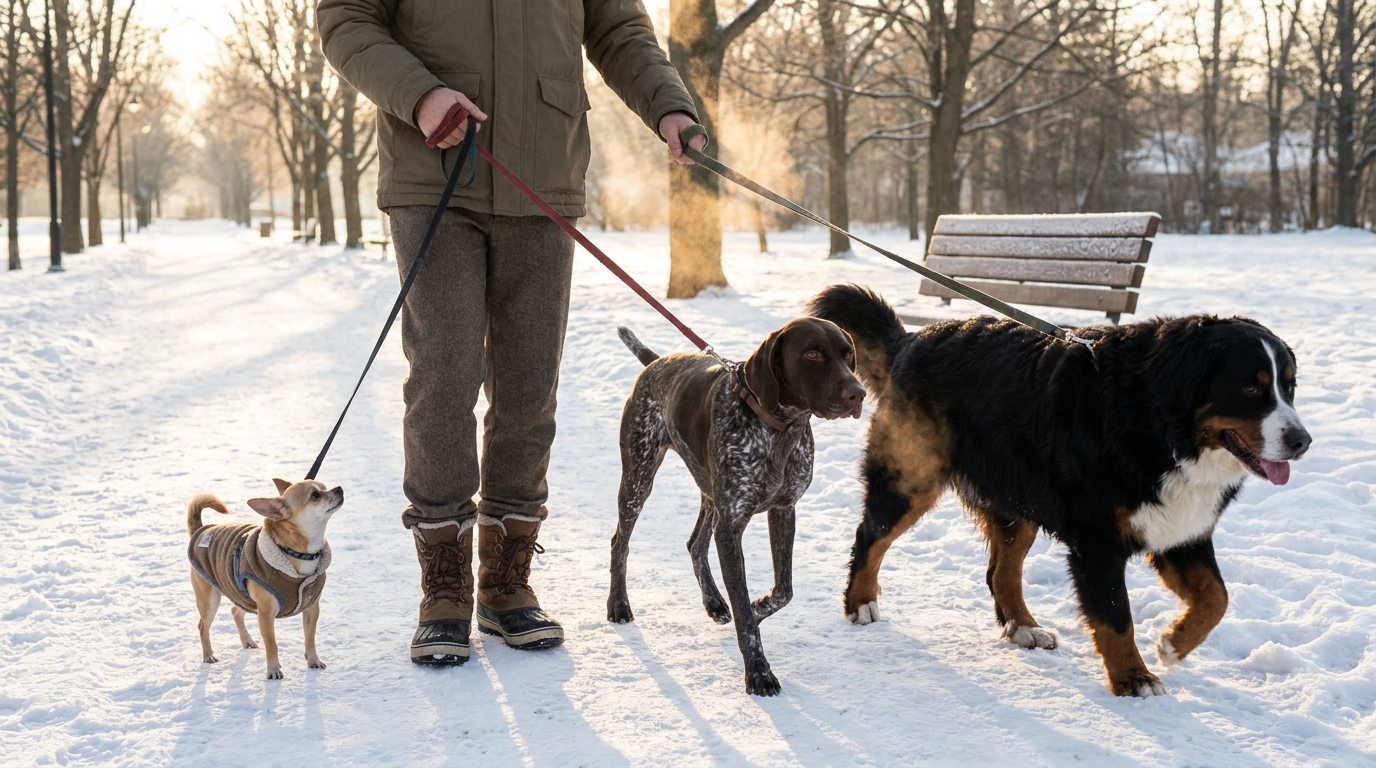
Feels-like temperature bands for small and large dogs, the early and late signs of cold stress, and when a chilled dog needs an ER now.
Quick answer: Below 45°F, small, short-coated, young, old and sick dogs chill fast. Below freezing (32°F), keep every dog's outings short and supervised. Below 20°F, limit those dogs to brief bathroom breaks and even hardy adults to about 30 minutes at most. Wind and wet fur make it feel colder. If your dog is weak, confused or breathing slowly, or stops shivering while still cold, wrap it in warm blankets and go to an emergency vet now.
This article is general information, not a diagnosis. If you think your pet is in danger, go to the nearest emergency animal hospital.
How cold is too cold for dogs: the answer by temperature
No single number fits every dog: Texas A&M's vet college says tolerance depends on fur and body mass, and the AVMA, as quoted by UW-Madison, adds age, body fat, activity and health. Read the chart by your dog's type and the feels-like temperature.
| Outdoor feels-like temperature | Small, thin-coated, puppy, senior or sick dog | Large, thick-coated, healthy adult dog |
|---|---|---|
| Above 45°F (7°C) | Low risk if dry and out of the wind; rain can still chill a toy dog or puppy | Lowest risk; watch wet, windy days |
| 32-45°F (0-7°C) | Chills fast; Purdue says puppies and short-haired dogs come in below 40°F (4°C) | Lower risk while active and dry; a dog not used to cold shouldn't stay out long |
| 20-32°F (-7 to 0°C) | Short, supervised outings; brief bathroom breaks, carried out if needed | No long periods outside; shorter, more frequent walks |
| Below 20°F (-7°C) | Brief bathroom breaks, then straight back in | Outdoor dogs come in (Purdue); outings about 30 minutes at most, less as it drops |
This is a guide, not a cutoff. Wind, a wet coat, age, illness and time outside all change the risk, and any dog showing signs of cold comes inside whatever the number.
The bands come from Texas A&M (45°F), Purdue University's College of Veterinary Medicine (40°F and 20°F), the AVMA via UW-Madison (no long periods below freezing), and Purdue University and AAHA (how long to stay out).
Wind, rain and snow: why the thermometer is not the whole story
The same 35°F morning can feel very different to two dogs:
- Wind. The Merck Veterinary Manual says frostbite is more likely in windy or wet weather and typically hits the ear tips, feet and tail.
- A wet coat. Rain, sleet or a swim soaks the fur, and Purdue notes that even a sweater insulates only while dry.
- Sitting still. A trotting dog makes its own heat; one waiting in the yard does not. The AVMA guidance quoted by UW-Madison lists activity level as a factor.
- Time. An hour at 25°F is far harder on a dog than ten minutes.
The Tufts TACC weather scale, a neglect-screening tool rather than a safety rating, works the same way: it adds risk for rain or sleet, toy size, and very young or elderly dogs, and lowers it for a heavy coat, good shelter and a dog used to cold.
Which dogs get cold fastest
Cornell's Riney Canine Health Center and the AVMA guidance quoted by UW-Madison point to the same dogs:
- Small, toy-size or short-legged dogs
- Puppies, which cannot properly regulate body temperature and have little body fat (Cornell)
- Short- or thin-coated dogs, or dogs clipped too short for winter (Cornell)
- Seniors and underweight dogs; some older dogs take medicines that affect temperature control (Texas A&M)
- Dogs with diabetes, heart or kidney disease, or a hormonal disease such as an underactive thyroid (AVMA via UW-Madison; Merck)
- Dogs not used to cold, including those caught by a sudden cold snap (Cornell)
Cornell says double-coated breeds such as Siberian Huskies and Malamutes handle cold better, but it gives no safe temperature for them.
How cold is too cold to walk a dog?
Brief bathroom trips are generally fine for most dogs, says the University of Illinois College of Veterinary Medicine. Below freezing (32°F), take shorter, more frequent walks; AAHA advises this in extreme cold. Below 20°F, keep outings to about half an hour at most, less as it drops (Purdue), whatever the dog wears (Illinois). Small, senior and short-coated dogs may need only brief bathroom breaks (AAHA). Keep your dog leashed and off frozen ponds (AAHA, Cornell).
For a dog's paws, the sidewalk is often a bigger problem than the cold itself. Ice and salt can crack or cut pads (Cornell), and dogs lick the salt off (Merck). After walks, wipe the paws, legs and belly with a warm, damp cloth and work out snowballs between the toes (AAHA, Cornell). Well-fitted booties help.
Pads that bleed, swell or cause limping need an in-person vet soon, ideally the same day. A pale, gray, cold or hard paw may be frostbitten; see a vet in person now. If your dog swallowed ice melt or rock salt, Cornell says to seek veterinary care immediately; pet-friendly de-icers are not safe to eat. Shovel a path for an arthritic dog, and book a check-up if its footing on ice worries you (Cornell). If an older dog's back legs suddenly give out, or it can't stand after time in the cold, go to an emergency vet now.
Signs your dog is too cold, from early to late
Early signs mean it is time to go inside (Cornell, Illinois): shivering, whining or barking, a tucked tail or hunched back, lifting paws off the ground, not wanting to walk, or sudden anxiety.
Late signs point to hypothermia, and any one of them means an emergency vet now (AAHA, Merck, Texas A&M, Illinois):
- Weakness, unusual sleepiness, clumsiness or confusion
- Stiff muscles
- Slow or shallow breathing, or a slow heartbeat
- Collapse
- Shivering that stops while the dog is still cold
Merck says shivering is not a reliable sign of hypothermia, and Texas A&M notes it can stop as hypothermia worsens, so a cold dog that stops shivering is worse, not better. Frostbite can take days to show (Cornell, VCA), so recheck the ears, tail and paws for a few days; new pale, dark or blistered skin needs a vet in person now.
Hypothermia and frostbite: when to go to an ER now
If your dog is weak, confused, breathing slowly or has stopped shivering while still cold, dry it, wrap it in warm blankets and go to an emergency vet now.
| What you see | What it can mean | What to do now |
|---|---|---|
| Shivering, lifting paws, tucked tail, whining | Your dog is too cold | Bring it into a warm, dry spot, dry the coat and watch closely |
| Weak, sleepy, clumsy or confused; slow breathing; stopped shivering while cold | Hypothermia, which can be fatal | Dry it, wrap it in warm blankets, give no food and go to an ER now |
| Ear tips, tail or paws pale, gray or bluish, cold, hard or swollen; limping | Possible frostbite | Warm the whole dog, never rub the spot, and see a vet in person now |
| Black, hard or blistered skin, or skin turning red and sore as it thaws | Frostbite with tissue damage | In-person vet now; damage can take days to show |
The Merck Veterinary Manual's table puts a dog's normal rectal temperature at 99.5-102.5°F (37.5-39.2°C). Texas A&M says vets grade hypothermia as mild at 90-99°F (32-37°C), moderate at 82-90°F (28-32°C) and severe below 82°F (28°C). Whatever the grade, a low reading or any late sign means an emergency vet now; never stop to measure before leaving with a weak or collapsed dog.
VCA Animal Hospitals lists pale, gray or bluish skin, cold or brittle areas, pain, swelling, blisters and blackened skin as frostbite signs, and Cornell says suspected frostbite or hypothermia should be seen by a vet immediately. If your dog was soaked in icy water and shows any of these signs, dry it, wrap it and go to an emergency vet now.
First aid for a cold dog: the first steps at home
For a chilled but alert dog, or on the way to the ER:
- Bring your dog into a warm room, and dry it first if it is wet (Merck).
- Wrap it in warm blankets or dryer-warmed towels, with towel-wrapped warm (not hot) water bottles against its body (AAHA, Illinois).
- Don't put a heating pad on the dog, and don't use a hair dryer or hot water (Texas A&M, VCA).
- Treat hypothermia first (VCA). Never rub frostbitten skin. Indoors, warm the spot gently with warm (never hot) water (AAHA), but not outdoors if it could freeze again (VCA).
- Give no food and no human medicine; Merck warns that human pain relievers can cause ulcers and kidney damage in pets.
- If your dog is alert with no ER sign, you can take a rectal temperature, the standard method (Merck), but never delay leaving to measure. Below about 99°F after cold exposure means an ER now.
- Even if your dog perks up, AAHA says to see a vet as soon as possible.
Sleeping outside, in a garage or in a doghouse
Indoors is best. Cornell says outdoor living is generally not recommended, Texas A&M says to bring pets in whenever it is cold enough to make people uncomfortable, and Purdue's vet college says outdoor dogs come in below 20°F. The table draws on Cornell, Illinois, Texas A&M and Humane World for Animals.
| Where | What to know |
|---|---|
| Indoors (best) | A warm bed off the floor, away from drafts; heaters behind a barrier |
| Indoor heat | No heating pad on the dog; no electric blanket under a chilled, senior or immobile dog |
| Garage | Antifreeze, salt and de-icers out of reach; no fire, carbon monoxide or shock risk |
| Garage bed | Insulated space, dry bed off the floor, unfrozen water; if you'd be cold, bring it in |
| Doghouse | Generally not advised (Cornell); only for a cold-used dog with a double coat |
| Doghouse build | Insulated, raised, wind-blocked, flap door; just room to stand, turn and lie down |
| Doghouse bedding | Dry straw or cedar shavings; no blankets or hay (they hold moisture) |
| Doghouse extras | No heaters or heat lamps; unfrozen water in a plastic bowl, checked often |
| Car | Never leave a dog alone in a cold car |
Antifreeze tastes sweet (Merck), so wipe up spills. If your dog swallowed, or may have swallowed, any antifreeze or coolant, even a propylene glycol type, don't wait for signs, and don't be reassured if your dog seems drunk and then improves. Go to an ER now, or call ASPCA Animal Poison Control at (888) 426-4435 (a consultation fee may apply) or Pet Poison Helpline at (855) 764-7661 (a per-incident fee applies). After antifreeze or de-icer, don't make your dog vomit at home unless a vet or a poison line says to. A burn from a heater or heating pad needs an in-person vet the same day; go to an ER now for a large or deep burn, a burn on the face, or a dog that chewed a cord or was shocked (Merck).
Do dogs need coats and booties?
Cornell says a jacket helps small, older and thin-coated dogs. AAHA says a coat should cover the chest and back, let the dog move freely and be introduced gradually, and that booties help if your dog tolerates them. Remove strings or attachments your dog could chew or get tangled in (Purdue), and don't leave a dressed dog alone. A coat does not extend Illinois's 30-minute limit in bitter cold.
Cold snaps in Florida, New York and Virginia
Florida: dogs not used to cold are at higher risk in a sudden cold snap (Cornell), so take a Florida freeze seriously. Florida has no statewide cold-weather rule; its cruelty law (Fla. Stat. 828.12) covers depriving an animal of necessary shelter. Check your county or city rules.
New York: Agriculture and Markets Law 353-b requires a dog left outdoors to have shelter suited to its breed, condition and the climate, with a waterproof roof, insulation and room to stand, turn and lie down, but sets no temperature number. Section 353-d bars confining a pet in a vehicle in extreme cold without proper protection when that puts it in imminent danger of death or serious injury.
Virginia: since 2020, Va. Code 3.2-6500 has called for a windbreak and enough bedding in cold weather. A tether alone is not adequate shelter when the "actual or effective outdoor temperature" is 32°F or lower or during a winter storm warning, unless animal control has found the dog safe. That is a shelter rule, not a ban on dogs outdoors. Laws change; this is general information, not legal advice.
What a RexVet video visit can and cannot do for a dog in the cold
A video call cannot warm your dog or treat frostbite. Go to an emergency vet in person now if your dog is weak, wobbly, confused or very sleepy, is breathing slowly, has stopped shivering while still cold, has a rectal temperature below about 99°F, or has pale, gray, hard, blistered or blackening skin, including an ear tip or paw that looked pale and has turned red. An icy-water soaking with any of these signs needs an ER, swallowed antifreeze or de-icer needs an ER or a poison line now, and a heater or heating-pad burn needs an in-person vet the same day (an ER now if it is large, deep or electrical); none of these fits a video visit.
RexVet is a 501(c)(3) non-profit with one vet. Dr. Tiffany Delacruz, DVM, licensed in Florida, New York and Virginia, sees dogs located in those states by live video for $64.99. Slots run about 8 AM-11 PM ET; if none is open, or it is late and you are worried, go to an ER instead of waiting.
A visit fits once your dog is indoors, warm and acting normally: cracked pads with no bleeding, swelling or limping; fitting a coat or booties; a senior who is stiffer in the cold but walking and eating (never give human pain relievers); or outdoor limits for a new puppy or a dog with heart or kidney disease, diabetes or a hormonal disease. Dr. Delacruz can review photos or video and make a plan with you. No prescription is promised; RexVet is not a pharmacy, and a pharmacy transfer fee applies if one is sent out. The one-time $120 Family Plan covers 4 visits over 12 months for every pet in the home and never auto-renews. For questions like these, book a live video visit.
Need an Expert Opinion on This Topic?
Book a video visit with a licensed vet, evenings and weekends included
See open timesFrequently Asked Questions
Is 40 degrees too cold for a dog?
It depends on the dog. Purdue's vet college says puppies and short-haired pets should come inside below 40°F, and Texas A&M says dogs not used to cold shouldn't be left out when the daily average is under 45°F. Wind and rain make 40°F feel colder.
Is 30 degrees too cold to walk a dog?
You can walk, but keep it short. The AVMA, as quoted by UW-Madison, advises against long periods outside below freezing. Take shorter, more frequent walks, put a coat on small or thin-coated dogs, and wipe the paws, legs and belly afterward.
How long can a dog be outside at 20°F?
Not long. Purdue University advises about half an hour at most below 20°F, less as it gets colder, and its vet school says outdoor dogs should come inside. Small, senior and short-coated dogs may do best with brief bathroom breaks, even carried out (AAHA).
Can dogs sleep in a garage in winter?
It beats outdoors, but the house is best. Texas A&M says a garage works only if antifreeze, salt and other chemicals are out of reach and any heater carries no fire, carbon monoxide or electrocution risk. Add a dry bed off the floor and unfrozen water.
How cold is too cold for a puppy?
Puppies cannot properly regulate body temperature and have little body fat (Cornell), and Purdue's vet school says they should come inside below 40°F. Keep potty trips short, dry the puppy afterward, and go to an emergency vet now if it turns weak or unusually sleepy, or still feels cold after you dry and warm it.
Can huskies stay outside in winter?
Huskies handle cold better than most dogs, but Cornell says outdoor living is generally not recommended, and names no safe temperature for them. One that lives outside must be used to cold, with unfrozen water and an insulated, wind-protected shelter with dry bedding raised off the ground. Purdue's vet school says outdoor dogs come in below 20°F, even cold-used ones.
My dog stopped shivering but still feels cold. Is that a good sign?
No. Merck says shivering is not a reliable sign of hypothermia, and Texas A&M notes it can stop as hypothermia worsens. Dry your dog, wrap it in warm blankets with towel-wrapped warm (not hot) water bottles, give no food, and go to an emergency vet now.
FAQs
Is 40 degrees too cold for a dog?
It depends on the dog. Purdue's vet college says puppies and short-haired pets should come inside below 40°F, and Texas A&M says dogs not used to cold shouldn't be left out when the daily average is under 45°F. Wind and rain make 40°F feel colder.
Is 30 degrees too cold to walk a dog?
You can walk, but keep it short. The AVMA, as quoted by UW-Madison, advises against long periods outside below freezing. Take shorter, more frequent walks, put a coat on small or thin-coated dogs, and wipe the paws, legs and belly afterward.
How long can a dog be outside at 20°F?
Not long. Purdue University advises about half an hour at most below 20°F, less as it gets colder, and its vet school says outdoor dogs should come inside. Small, senior and short-coated dogs may do best with brief bathroom breaks, even carried out (AAHA).
Can dogs sleep in a garage in winter?
It beats outdoors, but the house is best. Texas A&M says a garage works only if antifreeze, salt and other chemicals are out of reach and any heater carries no fire, carbon monoxide or electrocution risk. Add a dry bed off the floor and unfrozen water.
How cold is too cold for a puppy?
Puppies cannot properly regulate body temperature and have little body fat (Cornell), and Purdue's vet school says they should come inside below 40°F. Keep potty trips short, dry the puppy afterward, and go to an emergency vet now if it turns weak or unusually sleepy, or still feels cold after you dry and warm it.
Can huskies stay outside in winter?
Huskies handle cold better than most dogs, but Cornell says outdoor living is generally not recommended, and names no safe temperature for them. One that lives outside must be used to cold, with unfrozen water and an insulated, wind-protected shelter with dry bedding raised off the ground. Purdue's vet school says outdoor dogs come in below 20°F, even cold-used ones.
My dog stopped shivering but still feels cold. Is that a good sign?
No. Merck says shivering is not a reliable sign of hypothermia, and Texas A&M notes it can stop as hypothermia worsens. Dry your dog, wrap it in warm blankets with towel-wrapped warm (not hot) water bottles, give no food, and go to an emergency vet now.
Medically Reviewed
Reviewed by Dr. Tiffany Delacruz, DVM — licensed veterinarian and CEO of RexVet. Last reviewed October 23, 2026.
Content is for informational purposes and does not replace professional veterinary advice.
Chief Executive Officer · Licensed Veterinarian
Dr. Delacruz is a licensed Doctor of Veterinary Medicine specializing in preventive care and veterinary telehealth. She reviews all health content on RexVet to ensure accuracy and clinical relevance.
Sources & References
- · American Veterinary Medical Association — Telehealth Guidelines
- · AVMA — Pet Care Resources
- · U.S. FDA — Animal & Veterinary