
Dog Ate Salt Dough or Play Dough: Salt Poisoning Signs
By RexVet Team | Reviewed by Dr. Tiffany Delacruz, DVM
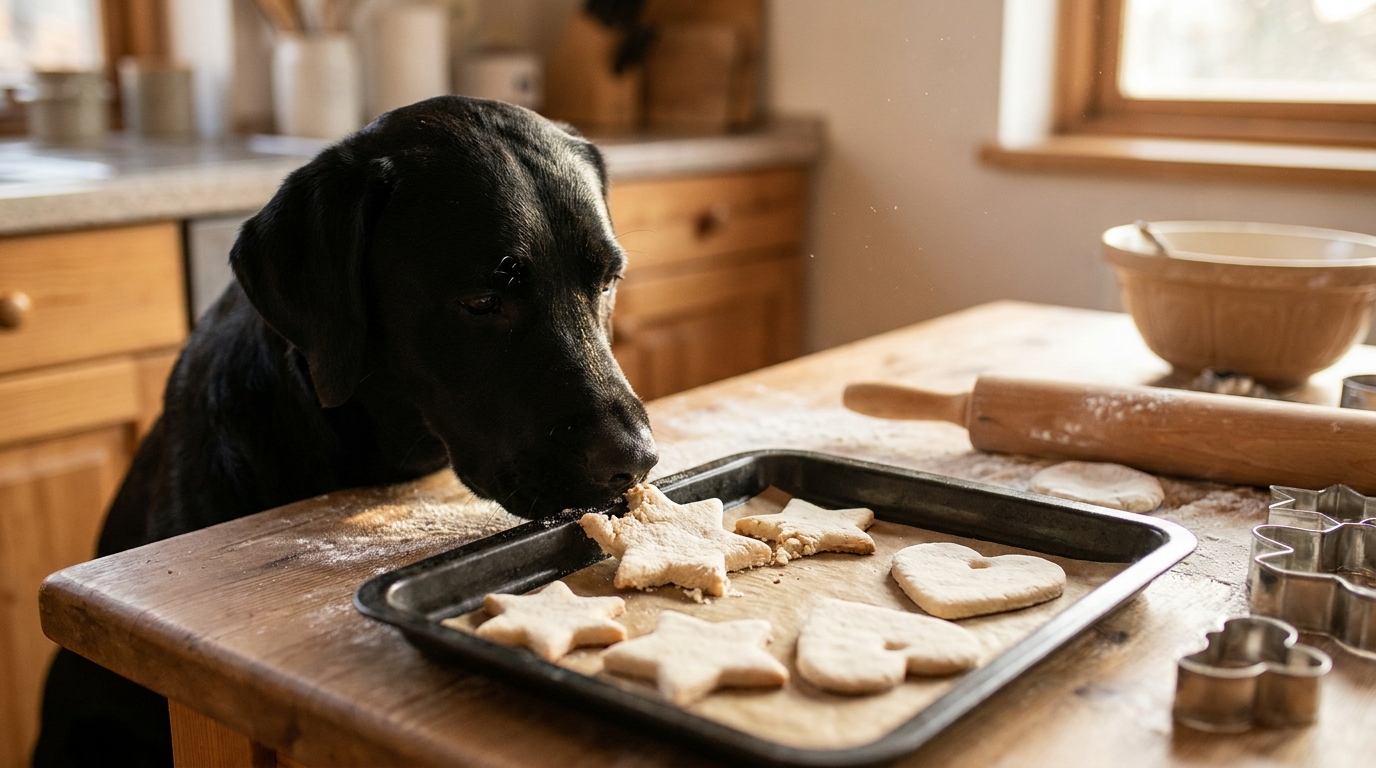
Salt dough ornaments, play dough, rock salt and ice melt can poison a dog. The signs to know, what to do first and when to go to an ER.
Quick answer: Salt dough ornaments, homemade or store-bought play dough, and rock salt or ice melt eaten from the bag can give a dog salt poisoning: vomiting, extreme thirst, diarrhea, wobbliness, tremors and seizures. Call a pet poison line now, even if your dog seems fine. If your dog is vomiting, wobbly, trembling or seizing, go to an emergency vet now. Never use salt to make a dog vomit.
This article is general information, not a diagnosis. If you think your pet is in danger, go to the nearest emergency animal hospital.
Dog ate salt dough or play dough: what to do now
A dog that ate salt dough, play dough, or rock salt or ice melt from the bag or a pile needs a call to a pet poison line right now, even if it seems fine: ASPCA Animal Poison Control, (888) 426-4435 (a consultation fee may apply), or Pet Poison Helpline, (855) 764-7661 (a per-incident fee applies). If your dog is already vomiting, wobbly, trembling, weak or seizing, go to the nearest emergency vet now and call the poison line on the way.
Do not wait for signs. Calling early matters because the Merck Veterinary Manual says a vet may make a dog vomit in the clinic when it has eaten salt recently and has no signs yet.
While you call:
- Have the recipe or label ready, plus how much is missing, when your dog ate it and your dog's weight.
- Let your dog drink if it is not vomiting, but don't force water.
- Do not make your dog vomit unless the poison line or a vet tells you to, and never use salt.
- Give no activated charcoal, enema or home remedy. ASPCApro, the ASPCA's site for veterinary professionals, says activated charcoal can itself raise sodium.
Go to an emergency vet now, calling a poison line on the way, if your dog:
- Vomits after eating any of these.
- Is wobbly, stumbling, confused, trembling, weak, collapsed or seizing.
- Can't keep water down, or drools without stopping after ice melt.
- Ate baked ornament pieces and vomits, retches, stops eating, strains to poop or has a swollen, painful belly (see the signs of intestinal blockage).
- Swallowed, or may have swallowed, an ornament's ribbon, string or hook, even with no signs. Never pull a strand; see what to do if a dog ate string or ribbon.
- Has brown or bluish gums, weakness or fast breathing after curing salt or brine.
- May have licked antifreeze, a different emergency from salt.
Signs of salt poisoning in dogs
Vomiting is usually the first sign of salt poisoning in a dog, and the Merck Veterinary Manual says it typically starts within several hours; diarrhea, extreme thirst, peeing a lot, weakness, wobbly walking, tremors, seizures and, in severe cases, coma can follow.
Pet Poison Helpline lists these signs of salt poisoning from homemade play dough:
- Vomiting and diarrhea
- Eating less than usual
- Low energy (lethargy)
- Poor coordination or wobbly walking
- Drinking or peeing much more than usual
- In severe cases, tremors, seizures, coma and even death
Use this list to tell the poison line or vet what you see, not as a reason to wait. Pet Poison Helpline also names stumbling and disorientation, so a dog that seems lost or confused in its own home needs an emergency vet now.
How much salt dough or play dough is dangerous for a dog?
There is no amount of salt dough, play dough, or rock salt or ice melt eaten from the bag to wait out at home: the ASPCA says even a small amount of salt dough could be dangerous, so call a poison line now.
Only a poison line or a vet can work out the risk, using the recipe or label, how much is missing and your dog's weight. Drying does not remove the salt: the ASPCA says to keep salt dough projects out of reach even when they are years old. Pet Poison Helpline says dogs with kidney disease, diabetes or other hormone problems are at higher risk of salt poisoning, so call right away if your dog has one of these conditions.
Some homemade play dough recipes add a second risk: cream of tartar. The ASPCA says tartaric acid is the suspected cause of kidney injury from grapes and raisins, and its poison center's records include dogs that developed kidney injury after eating cream of tartar, one of them from homemade play dough. A dog that seems fine a few hours after eating homemade play dough is not cleared.
Holiday and winter salt sources compared
Pet Poison Helpline says pets most often get too much salt from salt dough ornaments, homemade salt play dough, snow treated with salt de-icer and drinking a lot of ocean or salt water; the table below gives the first step for each holiday and winter source.
If more than one row fits, follow the most urgent. Vomiting, wobbly, trembling, weak or seizing after any row: emergency vet now.
| Source | Why it is risky | First step |
|---|---|---|
| Salt dough ornament | Very salty, looks like a treat | Poison line now |
| Homemade play dough | Salt, cream of tartar | Poison line now |
| Store play dough | Can still be salty | Vet or poison line now |
| Rock salt or ice melt from the bag | Salt and other salts | Poison line, vet now |
| Ice melt licked off paws | Mouth, stomach upset | Rinse paws, watch |
| Turkey brine | Very salty | Poison line now |
| Curing salt or ham liquid | Salt, nitrites | Poison line now |
| Ham, salty snacks | Salt and fat | Watch; wobbly: ER now |
Holiday kitchens add their own salt. See what to do if your dog drank turkey brine or got into the leftovers and how ham, ham bones and curing salt affect dogs; after a few bites of salty ham or snacks, call a vet if heavy thirst or diarrhea starts. A dog that got into very salty gravy or bouillon (see the Thanksgiving dish-by-dish chart) or drank a lot of ocean or salt water needs a poison line now too.
Why you should never use salt to make a dog vomit
Salt is never a safe way to make a dog vomit: Pet Poison Helpline says salt and salt water should never be used to induce vomiting, because of the high risk of causing salt poisoning.
The Merck Veterinary Manual lists salt given to make an animal vomit as a source of salt poisoning and calls the practice no longer recommended. The ASPCA says making a pet vomit at home can be dangerous, and that hydrogen peroxide should be used only under a veterinary professional's guidance. Call a poison line or vet first and let them decide whether your dog needs to vomit. If someone already gave your dog salt or salt water to make it throw up, call a poison line now. Read more about when making a dog throw up helps and when it harms.
What happens at the vet for salt poisoning
If your dog ate salt dough or play dough recently and has no signs yet, the vet may make it vomit in the clinic; treatment can also include bloodwork for sodium and kidney values, IV fluids, seizure control and X-rays if ornament pieces may be stuck.
The Merck Veterinary Manual warns that lowering sodium too quickly can cause severe brain swelling, so the veterinarian sets the pace of treatment and rechecks bloodwork along the way. Pet Poison Helpline says a severely affected pet may stay in the hospital overnight. For typical emergency price ranges, see the 2026 pet care cost index.
After treatment, or after a poison line has said your dog can be watched at home, call the vet or poison line back now if your dog starts vomiting, stops eating, has low energy, or drinks or pees more in the days that follow; wobbling, trembling, weakness or a seizure means an emergency vet now. Kidney signs from cream of tartar can show up later than salt signs.
Ice melt and rock salt on walks
A few licks of ice melt off the paws usually cause only drooling or a mild stomach upset (ASPCA), but a dog that ate ice melt or rock salt from the bag needs a poison-line call and a vet right away, even with no signs yet.
The ASPCA says no rules govern "pet safe" labels and pet-friendly ice melts can still upset the stomach; Pet Poison Helpline says every type of ice melt can be hazardous. The ASPCA adds that the other chloride salts in de-icers can irritate the gut even more than rock salt, sometimes causing bloody vomiting or diarrhea. Store bags out of reach, and rinse and dry your dog's paws after walks (see winter paw pad care). If your dog licked a little off its paws and is acting normal, watch it; any vomiting, drooling that won't stop, tremors, wobbling or weakness means an emergency vet now. Plowed and roadside snow can hold ice melt, so learn why dogs eat snow and which snow is risky. Antifreeze is a different emergency: any possible lick needs an emergency vet now, so know the signs and timeline of antifreeze poisoning.
Keeping salt dough and play dough safe this season
Hang salt dough ornaments high on a tall, sturdy branch, keep dogs out of the craft area, and remember that a dried or years-old ornament is still salty and still dangerous.
- Put drying ornaments up high, where dogs and cats can't reach them (Pet Poison Helpline).
- Run kids' craft time with your dog in another room, and sweep up dough crumbs before the dog comes back.
- Store homemade and store-bought play dough in sealed tubs, up high.
- Check ornament boxes from past years for old salt dough pieces before you decorate.
Pet Poison Helpline says baked ornaments can be very difficult to pass and can cause pain or a blockage, so hang them where a dog can't knock them down. Raw yeast bread dough is a different danger, with bloat and alcohol risks; see what to do if a dog ate bread dough. Homemade cinnamon or applesauce ornaments are not salt dough, but recipes vary, so call a poison line if your dog ate one.
When a video visit helps and when it does not
A dog that ate salt dough, play dough, rock salt or ice melt needs a pet poison line or an emergency vet first; a video visit fits only afterward, once they have said your dog can be watched at home. RexVet, a nonprofit online vet service, serves pets located in Florida, New York and Virginia by video visit, and every visit is with a veterinarian licensed in your pet's state. If your dog ate any of these, even if it seems fine, call ASPCA Animal Poison Control, (888) 426-4435 (a consultation fee may apply), or Pet Poison Helpline, (855) 764-7661 (a per-incident fee applies). If your dog is vomiting, wobbly, trembling, weak, collapsed or seizing, go to the nearest emergency vet now and call on the way. Salt poisoning itself is treated in person, with bloodwork to check sodium and kidney values, IV fluids, seizure control and X-rays if ornament pieces may be stuck.
Afterward, if a poison line or emergency vet has said your dog can be watched at home and your dog is in Florida, New York or Virginia during the visit, you can book a $64.99 live video visit with a licensed RexVet vet. Live video slots run about 8 AM to 11 PM ET; there are no overnight visits. 28% of RexVet video visits started between 6 PM and 11 PM in the pet owner's local time. The veterinarian goes over the plan you were given, watches your dog walk and breathe on camera, tells you what to watch for and when to go back in, can point you to in-person and emergency vets near you, and helps you keep ornaments, craft dough and ice melt out of reach this season.
No prescription is promised; any medicine is the veterinarian's decision after the visit. Florida s.474.2021 limits telehealth-only prescribing to FDA-approved animal drugs used on-label, for up to 14 days (1 month for products labeled only for fleas and ticks), with no renewal without an in-person exam and no human-labeled, controlled or compounded anti-infective drugs; federal rules require an in-person veterinarian-client-patient relationship for extralabel or human-drug use. Virginia allows the exam to be electronic; New York's telehealth prescribing rules are not settled. RexVet is not a pharmacy; a pharmacy transfer fee applies if a prescription is sent to an outside pharmacy.
Need an Expert Opinion on This Topic?
Book a video visit with a licensed vet, evenings and weekends included
See open timesFrequently Asked Questions
Is store-bought play dough toxic to dogs?
It can be: Pet Poison Helpline says even store-bought play dough can be toxic to pets, so call a vet or poison line now. It also says a dog that ate regular play dough rather than salt dough can still have symptoms, and that every type of play dough is a choking risk. Vomiting, wobbly walking, trembling or a seizure means an emergency vet now.
My dog ate homemade play dough but seems fine. Do I still need to call someone?
Yes. Call a poison line now, even if your dog seems fine, because homemade play dough is often very salty and may contain cream of tartar. The ASPCA links cream of tartar to kidney injury in dogs, so a dog that looks normal a few hours later is not cleared. Have the recipe ready; the vet may check kidney values as well as sodium.
Are salt dough ornaments toxic to cats?
Yes. Salt dough ornaments can give a cat salt poisoning too; call a pet poison line or go to an emergency vet now. A cat that is vomiting, wobbly, trembling, weak or seizing needs an emergency vet now. Never try to make a cat vomit at home, and never give a cat hydrogen peroxide. Keep salt dough, play dough and drying ornaments where a cat can't reach them.
How long after eating salt does a dog get sick?
Call a poison line now; don't wait for signs. The Merck Veterinary Manual says a dog that eats too much salt usually vomits within several hours, and signs can progress to weakness, diarrhea, tremors and seizures. Homemade play dough with cream of tartar can also harm the kidneys later, so a dog that seems fine hours after eating it is not in the clear. Vomiting, wobbliness, trembling or a seizure means an emergency vet now.
Is pet-safe ice melt really safe for dogs?
No, not risk-free: the ASPCA says no rules govern "pet safe" labels, and Pet Poison Helpline says every type of ice melt can be hazardous. ASPCApro says urea, a common pet-friendly ingredient, is the least irritating, which is not the same as safe to eat. A dog that ate any ice melt or rock salt from the bag needs a poison-line call and a vet right away, even with no signs yet.
Can a dog recover from salt poisoning?
Yes, many dogs recover with prompt treatment, but severe salt poisoning can be fatal, so get your dog to a vet quickly. Pet Poison Helpline says the sooner a pet gets medical care, the better its chances, and warns that salt dough ornaments have caused deaths. A badly affected dog may need to stay in the hospital while the veterinary team brings its sodium back to normal under close monitoring.
Can an online vet help after my dog ate salt dough in Florida, New York or Virginia?
Not first: a dog that ate salt dough, play dough or ice melt needs a poison line or emergency vet before any video visit. Once one of them has said your dog can be watched at home, and your dog is in Florida, New York or Virginia during the visit, a veterinarian licensed in your pet's state can go over that plan by video, watch your dog walk and breathe on camera, and tell you when to go back in. Bloodwork, IV fluids, X-rays, vomiting induced in the clinic and seizure care all need an in-person or emergency vet. No prescription is promised; if medicine comes up, it is the veterinarian's decision. Florida limits telehealth-only prescriptions to FDA-approved animal drugs used on-label for up to 14 days (1 month for flea- and tick-only products), with no renewal without an in-person exam and no human-labeled, controlled or compounded anti-infective drugs. Federal rules require an in-person relationship for extralabel or human-drug use, Virginia allows the exam to be electronic, and New York's rules are not settled.
FAQs
Is store-bought play dough toxic to dogs?
It can be: Pet Poison Helpline says even store-bought play dough can be toxic to pets, so call a vet or poison line now. It also says a dog that ate regular play dough rather than salt dough can still have symptoms, and that every type of play dough is a choking risk. Vomiting, wobbly walking, trembling or a seizure means an emergency vet now.
My dog ate homemade play dough but seems fine. Do I still need to call someone?
Yes. Call a poison line now, even if your dog seems fine, because homemade play dough is often very salty and may contain cream of tartar. The ASPCA links cream of tartar to kidney injury in dogs, so a dog that looks normal a few hours later is not cleared. Have the recipe ready; the vet may check kidney values as well as sodium.
Are salt dough ornaments toxic to cats?
Yes. Salt dough ornaments can give a cat salt poisoning too; call a pet poison line or go to an emergency vet now. A cat that is vomiting, wobbly, trembling, weak or seizing needs an emergency vet now. Never try to make a cat vomit at home, and never give a cat hydrogen peroxide. Keep salt dough, play dough and drying ornaments where a cat can't reach them.
How long after eating salt does a dog get sick?
Call a poison line now; don't wait for signs. The Merck Veterinary Manual says a dog that eats too much salt usually vomits within several hours, and signs can progress to weakness, diarrhea, tremors and seizures. Homemade play dough with cream of tartar can also harm the kidneys later, so a dog that seems fine hours after eating it is not in the clear. Vomiting, wobbliness, trembling or a seizure means an emergency vet now.
Is pet-safe ice melt really safe for dogs?
No, not risk-free: the ASPCA says no rules govern "pet safe" labels, and Pet Poison Helpline says every type of ice melt can be hazardous. ASPCApro says urea, a common pet-friendly ingredient, is the least irritating, which is not the same as safe to eat. A dog that ate any ice melt or rock salt from the bag needs a poison-line call and a vet right away, even with no signs yet.
Can a dog recover from salt poisoning?
Yes, many dogs recover with prompt treatment, but severe salt poisoning can be fatal, so get your dog to a vet quickly. Pet Poison Helpline says the sooner a pet gets medical care, the better its chances, and warns that salt dough ornaments have caused deaths. A badly affected dog may need to stay in the hospital while the veterinary team brings its sodium back to normal under close monitoring.
Can an online vet help after my dog ate salt dough in Florida, New York or Virginia?
Not first: a dog that ate salt dough, play dough or ice melt needs a poison line or emergency vet before any video visit. Once one of them has said your dog can be watched at home, and your dog is in Florida, New York or Virginia during the visit, a veterinarian licensed in your pet's state can go over that plan by video, watch your dog walk and breathe on camera, and tell you when to go back in. Bloodwork, IV fluids, X-rays, vomiting induced in the clinic and seizure care all need an in-person or emergency vet. No prescription is promised; if medicine comes up, it is the veterinarian's decision. Florida limits telehealth-only prescriptions to FDA-approved animal drugs used on-label for up to 14 days (1 month for flea- and tick-only products), with no renewal without an in-person exam and no human-labeled, controlled or compounded anti-infective drugs. Federal rules require an in-person relationship for extralabel or human-drug use, Virginia allows the exam to be electronic, and New York's rules are not settled.
Medically Reviewed
Reviewed by Dr. Tiffany Delacruz, DVM — licensed veterinarian and CEO of RexVet. Last reviewed November 4, 2026.
Content is for informational purposes and does not replace professional veterinary advice.
Chief Executive Officer · Licensed Veterinarian
Dr. Delacruz is a licensed Doctor of Veterinary Medicine specializing in preventive care and veterinary telehealth. She reviews all health content on RexVet to ensure accuracy and clinical relevance.
Sources & References
- · American Veterinary Medical Association — Telehealth Guidelines
- · AVMA — Pet Care Resources
- · U.S. FDA — Animal & Veterinary