
Dog Ate Bread Dough: Bloat, Alcohol and What to Do Now
By RexVet Team | Reviewed by Dr. Tiffany Delacruz, DVM
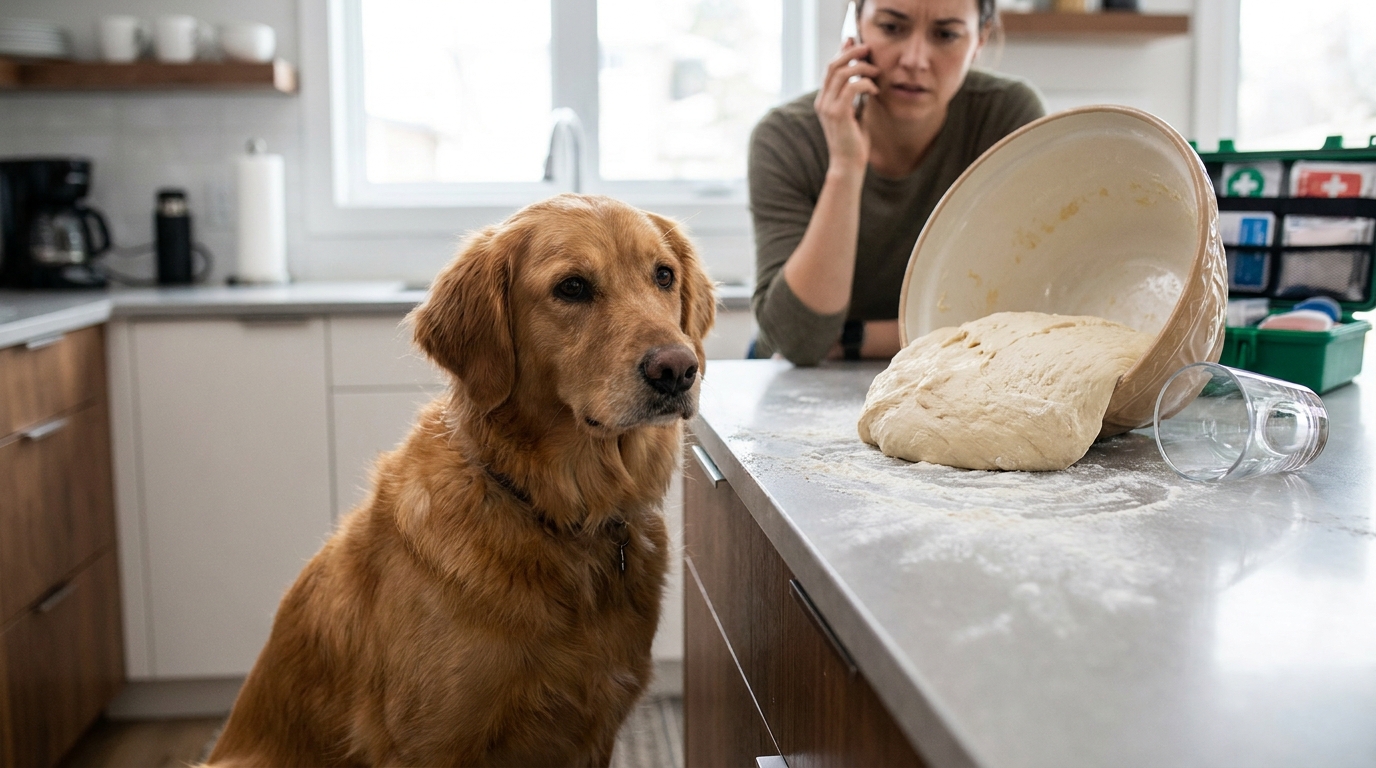
Raw yeast dough keeps rising in a dog's stomach while its yeast makes alcohol. What to do now, which doughs count, and what baked bread means.
Quick answer: Pet Poison Helpline says a dog that eats any amount of raw yeast dough needs a vet immediately, even if the dog seems fine. The dough keeps rising in the stomach and can bloat it, and the yeast makes alcohol that can cause stumbling, low blood sugar, seizures or coma. Go to an emergency vet now, even if hours have passed, and call a poison line on the way.
This article is general information, not a diagnosis. If you think your pet is in danger, go to the nearest emergency animal hospital.
Is raw bread dough dangerous for dogs?
Raw yeast dough is dangerous to dogs in any amount, because it swells the stomach as it rises and the yeast makes alcohol that poisons the dog, so a dog that eats any needs an emergency vet now.
In the warm stomach, the yeast ferments the dough's sugar into carbon dioxide, which makes the dough grow, and ethanol, which the Merck Veterinary Manual says passes into the bloodstream. Pet Poison Helpline says any amount of raw yeast dough needs veterinary attention right away, and the ASPCA says every second counts.
Go to an emergency vet now if any of these apply
A dog that ate any amount of raw yeast dough, or has a swollen belly, retching, wobbliness or weakness after any dough or bread, needs an emergency vet now; call a poison line on the way.
Leave for the nearest emergency animal hospital if your dog:
- Ate any raw yeast dough (bread, rolls, bagels, cinnamon rolls, pizza dough, unbaked sourdough or starter), even if your dog seems fine or hours have passed
- Vomited some dough up at home, or ate bread you are not sure was fully baked
- Ate raw dough that also contained raisins, chocolate, xylitol or another sugar-free sweetener, garlic, onion or macadamia nuts
- Has a swollen, tight or hard belly, especially with restlessness or drooling
- Is retching with nothing coming up, or is vomiting
- Is wobbly, stumbling, acting drunk, very sleepy, weak or unable to stand
- Has trouble breathing, or breathing that is fast and labored or very slow
- Feels cold to the touch, has tremors or a seizure, cries or whines oddly, or seems not to see
- Collapses or stops responding
Call a poison line on the way: ASPCA Animal Poison Control, (888) 426-4435 (a consultation fee may apply), and Pet Poison Helpline, (855) 764-7661 (a per-incident fee applies). A cat that ate raw dough needs the same trip.
What raw dough does inside a dog's stomach
Raw yeast dough keeps rising in a dog's warm stomach while the yeast turns sugar into alcohol, so a dog can be bloated and drunk at the same time and needs an emergency vet now.
The Merck Veterinary Manual says death in these cases is usually caused by the alcohol, not by the swelling; the ethanol causes drunkenness and metabolic acidosis, a dangerous acid shift in the blood. VCA Animal Hospitals says a large amount of dough can block the gut and its gas can cause a painful bloat, and Merck says enough stretching can make breathing hard.
Dough can bloat a dog of any size; twisting (GDV) is mainly a risk in large or deep-chested dogs, and Pet Poison Helpline says it is the less common outcome. Know the signs of bloat (GDV) in dogs, but do not wait to see them after raw dough.
Signs and timing after a dog eats raw dough
A dog that ate raw yeast dough can get sick quickly or not show signs for hours (the ASPCA says onset is much more variable with yeast dough than with alcoholic drinks), so a dog that seems fine still needs an emergency vet now.
The Merck Veterinary Manual says early signs may include retching with nothing coming up, a swollen belly and unusual tiredness, then wobbliness and confusion as alcohol builds. Later signs include deep depression, weakness, not getting up, low blood sugar, low body temperature, seizures and coma; VCA adds trouble breathing, blindness and a slow heart rate.
Signs to act on:
| Sign | Likely cause | Action |
|---|---|---|
| Swollen, tight belly | Dough rising | ER now |
| Retching, nothing up | Possible bloat | ER now |
| Fast or labored breaths | Bloat or alcohol | ER now |
| Stumbling, acting drunk | Alcohol | ER now |
| Very sleepy or weak | Alcohol, low sugar | ER now |
| Cold to the touch | Alcohol | ER now |
| Tremors or seizure | Alcohol, low sugar | ER now |
| Collapse, no response | Severe poisoning | ER now |
| Vomited some dough | Alcohol still forms | ER now |
| No signs yet | Signs can lag | ER now |
Which doughs count, and is baked bread safe?
Every unbaked dough made with active yeast is dangerous to a dog, including bread, rolls, pizza dough, bagels, cinnamon rolls and sourdough starter, and means an emergency vet now; the ASPCA says fully baked bread that is not raisin bread is safe as an occasional treat.
The ASPCA says a packet of dry yeast eaten before any ingredients are mixed is not a danger, because yeast needs sugar to ferment; if your dog also ate flour, sugar or dough, treat it as raw dough and go now, and if you are unsure, call a poison line. Cookie dough without yeast lacks the alcohol risk but can contain chocolate, xylitol, raisins or macadamia nuts, so call a poison line about it.
Raw dough vs baked bread:
| Food | Risk | What to do |
|---|---|---|
| Raw bread dough | High | ER now |
| Raw rolls or buns | High | ER now |
| Pizza dough | High | ER now |
| Sourdough starter | High | ER now |
| Raw dough with raisins | Very high | ER now |
| Not sure if baked | Treat as raw | ER now |
| Sugar-free bake | High | Poison line on way to ER |
| Bread with raisins | High | Poison line, get seen now |
| Garlic bread or knots | Depends | Poison line now |
| Cookie dough, no yeast | Depends | Poison line |
| Baked plain bread | Low | Check label |
What to do right now, and what not to do
If a dog ate raw yeast dough, take the dog to an emergency vet now, however long ago it happened, bring the recipe or package, and do not make the dog vomit at home.
If your dog is seen early, ideally within the first hour, the vet may be able to remove the dough. Go just the same if hours have passed or signs have started, because hospital care still treats the bloat and the alcohol. RexVet's guide on when making a dog throw up helps and when it harms agrees: never make a dog vomit at home unless a poison line or a vet tells you to. With raw dough, make that call on the way, and note when your dog ate the dough and roughly how much is missing.
What not to do:
- Do not try to make your dog throw up at home: the ASPCA says alcohol disables the muscles that close the epiglottis (the flap guarding the airway), so inhaling vomit is a high risk.
- Give nothing by mouth unless a veterinarian says to (VCA Animal Hospitals): no water, ice, milk, food, sugar, syrup or coffee.
- Skip activated charcoal; the ASPCA says it does not bind alcohol.
- Do not wait for your dog to "sleep it off", and do not walk your dog or rub the belly to move the gas.
- Still go if your dog vomited some dough up at home: Pet Poison Helpline says alcohol keeps forming and being absorbed.
How a vet treats bread dough poisoning
Bread dough poisoning in a dog is treated in an animal hospital, where the vet may try to remove the dough if the dog is seen early with no signs, then keeps blood sugar, body temperature and hydration normal while the alcohol clears (Merck Veterinary Manual).
VCA Animal Hospitals says a vet may recommend an X-ray and a blood sugar test first. Merck says sticky dough can be hard to bring up and that a dog already showing alcohol signs is stabilized first; the ASPCA says the stomach can be pumped (gastric lavage) if vomiting is not an option. Care then means IV fluids, monitoring and correcting acid balance, with surgery in rare cases.
The ASPCA says most pets recover within 12 to 24 hours with prompt supportive veterinary care; without treatment, VCA says bread dough ingestion can be fatal.
My dog ate a whole loaf of baked bread
A dog that ate a whole loaf of fully baked plain bread is not at raw-dough risk (the ASPCA calls fully baked bread safe as an occasional treat, and a whole loaf is far more than a treat), but check the ingredients and whether the bag or twist tie was swallowed, and go to an emergency vet now for a swollen belly or retching.
Read the label or recipe:
- Raisins: call a poison line or go to an emergency vet now, and get your dog seen in person even if it seems fine (why any amount of grapes or raisins is an emergency).
- Xylitol or another sugar-free sweetener: call a poison line on the way to an emergency vet, even if your dog seems fine; the ASPCA says xylitol can cause low blood sugar and possible liver damage.
- Chocolate, garlic or onion (garlic bread, garlic knots, garlic-butter rolls): call a poison line now, even if your dog seems fine (onion and garlic toxicity in dogs).
- Macadamia nuts: call a poison line or a vet now.
- A swollen or tight belly, or retching with nothing coming up: emergency vet now (possible bloat).
- A missing bag, twist tie or plastic clip, with no signs: see a vet in person the same day and bring the packaging. Vomiting, retching or a swollen belly means an emergency vet now.
Otherwise, call your regular vet with questions; any checklist sign means an emergency vet now.
Holiday baking: keep rising dough out of reach
Let bread dough rise where a dog cannot reach it, such as a closed oven or microwave, because Pet Poison Helpline warns that dogs and cats can get onto countertops.
VCA Animal Hospitals also suggests a proofing drawer.
- Holiday rolls and breads: proof the bowl in the switched-off oven, with a note on the door so nobody preheats it.
- Pizza night and sourdough: keep dough covered and back from the counter edge, and keep the starter jar sealed and up high.
- Scraps and trash: wrap dough scraps and use a lidded or outdoor bin.
- Guests: ask them not to share rolls, and keep pets out of the kitchen during holiday cooking, as the ASPCA advises.
For the rest of the holiday table, RexVet's Thanksgiving foods chart for dogs goes dish by dish.
When a video visit fits, and when it does not
A video visit is not the right first step when a dog eats any amount of raw yeast dough or sourdough starter: go to an emergency vet now, even if your dog seems fine, and call a poison line on the way. The dough may need to be removed, and blood sugar, body temperature and the alcohol's effects need in-person care. Over video, a vet cannot feel your dog's belly, take X-rays or blood tests, make your dog vomit or give fluids, and a licensed RexVet vet will not direct home vomiting.
RexVet is a 501(c)(3) non-profit. A $64.99 live video visit with a licensed RexVet vet is for pets that are in Florida, New York or Virginia at the time of the visit, with live slots about 8 AM to 11 PM ET. Holiday availability isn't confirmed, so check open slots. It fits the calmer cases:
- Your dog ate fully baked plain bread (no raisins, garlic, onion, nuts, chocolate, xylitol or another sugar-free sweetener), shows no checklist sign, and you want help deciding what to watch for. If you are not sure it was fully baked, treat it as raw dough and go to the ER.
- Your dog is home from the ER after dough treatment and you have appetite or stool questions while you follow the discharge plan. If retching, a swollen belly, wobbliness, weakness or a cold body come back, return to the ER, not a video visit. Recheck tests and any discharge medicine stay with the hospital that treated your dog.
- You want to plan holiday kitchen safety for a dog that steals from counters.
Out of state for the holidays? Use a local vet, or a local emergency vet for any raw dough or checklist sign. The veterinarian decides what is appropriate and will tell you when your dog needs to be seen in person.
No prescription is promised; any medicine is the veterinarian's decision after the visit. Florida s.474.2021 limits telehealth-only prescribing to FDA-approved animal drugs used as labeled, for up to 14 days (1 month for products labeled only for fleas and ticks), with no renewal without an in-person exam, and it rules out human-labeled drugs, controlled substances and compounded anti-infective drugs. Virginia allows the exam to be electronic; New York's rules are not settled. In every state, federal rules (21 CFR 530.3) require an in-person relationship before a vet uses a drug off-label or prescribes a human drug. If a prescription is sent to an outside pharmacy at your request, a pharmacy transfer fee applies (RexVet is not a pharmacy).
Need an Expert Opinion on This Topic?
Book a video visit with a licensed vet, evenings and weekends included
See open timesFrequently Asked Questions
Can cats get sick from raw bread dough?
Yes. A cat that eats raw yeast dough needs an emergency vet now and should never be made to vomit at home; VCA Animal Hospitals says trying that can be fatal. VCA says a cat with signs is hospitalized for IV fluids, monitoring, bloodwork and X-rays, with surgery if the dough blocks the stomach or intestines.
How much bread dough is toxic to a dog?
Any amount: Pet Poison Helpline says a dog that eats any raw yeast dough needs a vet immediately, even if the dog seems fine. The ASPCA says the amount affects how severe the signs get, but no veterinary source lists a safe amount or a size cutoff. Tell the emergency team roughly how much is missing.
Will my dog be OK after eating bread dough?
Usually, if treated promptly: the ASPCA says most pets recover within 12 to 24 hours with prompt supportive veterinary care. VCA Animal Hospitals says recovery chances are excellent when it is caught quickly and treated, but untreated it can be fatal.
Should I make my dog throw up after eating dough?
No. Go to an emergency vet now and let the vet decide whether to remove the dough. VCA Animal Hospitals says not to induce vomiting or give anything by mouth unless a veterinarian tells you to, and the ASPCA warns that alcohol raises the risk of inhaling vomit. If your dog already vomited some dough, still go.
Is sourdough starter dangerous to dogs?
Yes. A dog that eats sourdough starter or unbaked sourdough needs an emergency vet now. Pet Poison Helpline toxicologist Dr. Ahna Brutlag says the yeast in starter and raw dough can cause stomach bloat and alcohol poisoning in cats or dogs, and either can be life-threatening. Plain, fully baked sourdough bread in a small amount may not cause a problem, Pet Poison Helpline adds.
Can dogs eat cooked pizza crust?
Plain, fully baked crust is low risk; garlic or onion toppings mean calling a poison line now, and raw dough means the ER now. The ASPCA says fully baked bread is safe as an occasional treat if it is not raisin bread. Not sure it was fully baked? Treat it as raw dough.
Can a vet help over video if my dog in Florida, New York or Virginia ate bread dough?
No: any raw yeast dough means an emergency vet now. For a pet located in Florida, New York or Virginia at the time of the visit, a licensed RexVet vet can watch breathing, walking and belly shape on camera, which fits fully baked plain bread with no signs, or questions after ER care. The vet cannot feel the belly, run tests or give fluids over video, and will not direct home vomiting. If medicine comes up, no prescription is promised: Florida limits telehealth-only prescribing to FDA-approved animal drugs used as labeled, for up to 14 days (1 month for products labeled only for fleas and ticks), with no renewal without an in-person exam, and rules out human-labeled drugs, controlled substances and compounded anti-infective drugs. Virginia allows the exam to be electronic, and New York's rules are not settled. In every state, federal rules (21 CFR 530.3) require an in-person exam before off-label or human-drug use.
FAQs
Can cats get sick from raw bread dough?
Yes. A cat that eats raw yeast dough needs an emergency vet now and should never be made to vomit at home; VCA Animal Hospitals says trying that can be fatal. VCA says a cat with signs is hospitalized for IV fluids, monitoring, bloodwork and X-rays, with surgery if the dough blocks the stomach or intestines.
How much bread dough is toxic to a dog?
Any amount: Pet Poison Helpline says a dog that eats any raw yeast dough needs a vet immediately, even if the dog seems fine. The ASPCA says the amount affects how severe the signs get, but no veterinary source lists a safe amount or a size cutoff. Tell the emergency team roughly how much is missing.
Will my dog be OK after eating bread dough?
Usually, if treated promptly: the ASPCA says most pets recover within 12 to 24 hours with prompt supportive veterinary care. VCA Animal Hospitals says recovery chances are excellent when it is caught quickly and treated, but untreated it can be fatal.
Should I make my dog throw up after eating dough?
No. Go to an emergency vet now and let the vet decide whether to remove the dough. VCA Animal Hospitals says not to induce vomiting or give anything by mouth unless a veterinarian tells you to, and the ASPCA warns that alcohol raises the risk of inhaling vomit. If your dog already vomited some dough, still go.
Is sourdough starter dangerous to dogs?
Yes. A dog that eats sourdough starter or unbaked sourdough needs an emergency vet now. Pet Poison Helpline toxicologist Dr. Ahna Brutlag says the yeast in starter and raw dough can cause stomach bloat and alcohol poisoning in cats or dogs, and either can be life-threatening. Plain, fully baked sourdough bread in a small amount may not cause a problem, Pet Poison Helpline adds.
Can dogs eat cooked pizza crust?
Plain, fully baked crust is low risk; garlic or onion toppings mean calling a poison line now, and raw dough means the ER now. The ASPCA says fully baked bread is safe as an occasional treat if it is not raisin bread. Not sure it was fully baked? Treat it as raw dough.
Can a vet help over video if my dog in Florida, New York or Virginia ate bread dough?
No: any raw yeast dough means an emergency vet now. For a pet located in Florida, New York or Virginia at the time of the visit, a licensed RexVet vet can watch breathing, walking and belly shape on camera, which fits fully baked plain bread with no signs, or questions after ER care. The vet cannot feel the belly, run tests or give fluids over video, and will not direct home vomiting. If medicine comes up, no prescription is promised: Florida limits telehealth-only prescribing to FDA-approved animal drugs used as labeled, for up to 14 days (1 month for products labeled only for fleas and ticks), with no renewal without an in-person exam, and rules out human-labeled drugs, controlled substances and compounded anti-infective drugs. Virginia allows the exam to be electronic, and New York's rules are not settled. In every state, federal rules (21 CFR 530.3) require an in-person exam before off-label or human-drug use.
Medically Reviewed
Reviewed by Dr. Tiffany Delacruz, DVM — licensed veterinarian and CEO of RexVet. Last reviewed November 1, 2026.
Content is for informational purposes and does not replace professional veterinary advice.
Chief Executive Officer · Licensed Veterinarian
Dr. Delacruz is a licensed Doctor of Veterinary Medicine specializing in preventive care and veterinary telehealth. She reviews all health content on RexVet to ensure accuracy and clinical relevance.
Sources & References
- · American Veterinary Medical Association — Telehealth Guidelines
- · AVMA — Pet Care Resources
- · U.S. FDA — Animal & Veterinary