
Can Dogs Eat Ham? Ham Bones, Salt and What to Do if Your Dog Ate It
By RexVet Team | Reviewed by Dr. Tiffany Delacruz, DVM
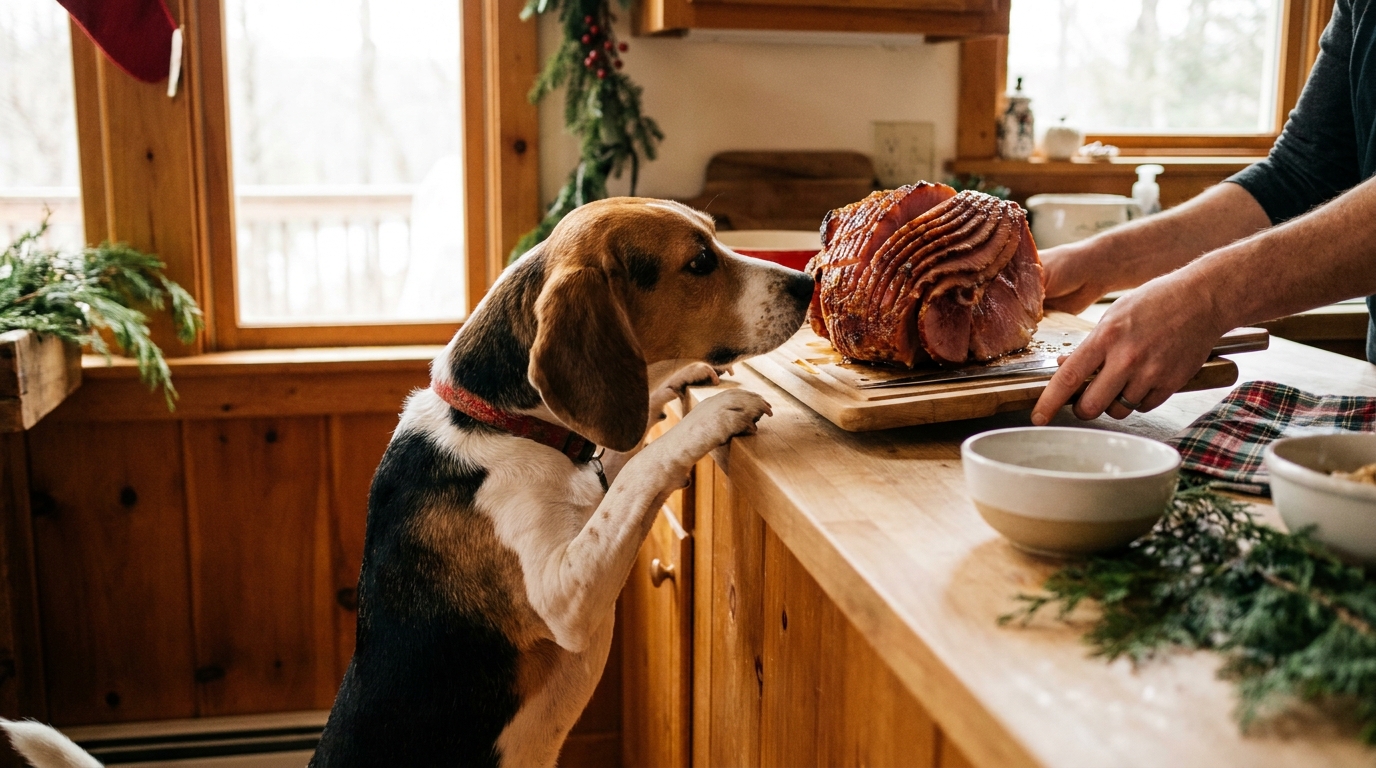
Ham isn't poisonous to dogs, but its salt, fat, glaze and bones can make them sick. Here's what to watch and who to call if yours already ate some.
Quick answer: Ham isn't toxic to dogs, but it's salty, fatty and often glazed. A bite of plain, lean, boneless cooked ham is usually fine for a healthy dog. After fat scraps or several slices, watch 4 days for vomiting, diarrhea, not eating or low energy. A swallowed ham bone needs a vet call today; an onion or garlic glaze means a poison line now. Repeated vomiting, a painful belly or retching means an emergency vet now.
This article is general information, not a diagnosis. If you think your pet is in danger, go to the nearest emergency animal hospital.
Go to an emergency vet now if you see these signs
Any one of these is enough:
- Choking, struggling to breathe, pawing at the mouth, or a bone wedged in the mouth or jaw.
- After a ham bone or hock: gagging, heavy drooling, retching, trouble swallowing, swallowing over and over, bringing food back up, or keeping water down but not food. Bones are the most common object stuck in a dog's esophagus (Merck Veterinary Manual).
- Vomiting more than once, blood in the vomit, not keeping water down, or vomiting with extreme thirst.
- Belly pain, a hunched back, the "prayer position" (front legs down, rear end up), or a swollen, tight belly. Many dogs with pancreatitis don't hunch, so don't wait for it.
- A large, deep-chested dog that is dry-retching (trying to vomit with nothing coming up), drooling, restless, breathing fast or swollen in the belly, especially after eating most of a ham. Merck lists these as possible signs of bloat (GDV).
- Straining with nothing coming out, or black, tarry or bloody stool.
- Wobbliness, trembling, confusion, a seizure, collapse or sudden weakness. Salt can cause these, and so can moldy food from the trash.
- String, twine or ham netting under the tongue or hanging from the rear. Don't pull it or cut it.
- Pale or yellow gums, weakness, fast breathing or dark red-brown urine in the days after onion or garlic.
- Brown or bluish gums, weakness or fast breathing after curing salt or brine.
- Ate moldy or spoiled ham or leftovers, even with no signs yet: go to a clinic now, before tremors start.
Call a poison line now, even if your dog seems fine, for onion or garlic (including powder) in the glaze, rub or broth; a sugar-free glaze or syrup that lists xylitol or birch sugar; raisin sauce or any glaze or side with raisins, currants or grapes (grapes and raisins guide); or curing salt, brine or ham-soaking liquid. ASPCA Animal Poison Control: (888) 426-4435 (a consultation fee may apply). Pet Poison Helpline: (855) 764-7661 (a per-incident fee applies). Both answer 24 hours a day. Have ready what and how much your dog ate, when, your dog's weight and a photo of what's missing.
Is ham bad for dogs? Salt, fat and glaze explained
Salt. USDA FoodData Central shows cured ham has many times the salt of plain roast pork. The ASPCA says too much salt causes thirst, and salt poisoning can bring vomiting, diarrhea, tremors, seizures and even death, depending on the amount. Pet Poison Helpline says signs can start about 30 minutes to 4 hours after eating. The Merck Veterinary Manual notes salt poisoning is unlikely in a dog that has fresh water, so keep the bowl filled as usual and don't force your dog to drink.
Fat. Trimmed lean ham is fairly low in fat, but a slice with its fat edge has several times the fat of the lean, and the fat cap, rind, skin and drippings are the fattiest parts. That fat is what can turn a ham dinner into pancreatitis, an inflamed pancreas. Pet Poison Helpline warns that fatty meat scraps carry a real pancreatitis risk, and the FDA says not to feed fat trimmings or roasted skin. Merck lists vomiting, not eating and weakness as common pancreatitis signs. Call a vet if your dog vomits once, has diarrhea or stops eating after a fatty meal; repeated vomiting, belly pain or weakness means an emergency vet now.
Glaze. A glaze, rub or broth may be seasoned with onion or garlic. Merck says both are toxic raw, cooked, dried or powdered, and that damage to red blood cells begins within a day, though the cells typically break down 3 to 5 days later, so a dog that seems fine still needs a poison line call. If a sugar-free syrup went into the glaze, check its label for xylitol, also listed as birch sugar (FDA); Pet Poison Helpline warns it can cause life-threatening low blood sugar and liver failure.
Home-cured ham. Merck says curing brines contain nitrites, which can keep the blood from carrying oxygen. Keep curing salt and brine away from your dog.
Which ham is riskiest: deli, honey-baked, spiral, country ham and prosciutto
| Ham type | Main problem | Verdict |
|---|---|---|
| Plain baked ham, lean, trimmed of fat and skin | Cured, so salty | A bite or two now and then for a healthy dog |
| Deli or lunch-meat ham, including deli honey ham | Salty; sometimes seasoned | A small piece at most; not a daily pill pocket |
| Honey-baked or spiral glazed ham | Sugary glaze, fat edge and rind; check the glaze for onion, garlic or xylitol | Skip the glaze, fat and skin; onion, garlic or xylitol: poison line now |
| Ham steak | Salty; fat rim; often a center bone | Lean, boneless bite only; remove the bone and fat rim |
| Country ham or prosciutto | Dry-cured; among the saltiest hams | Skip |
| Ham hock or leftover cooked ham bone | Splinters, choking, blockage, gut tears | Never; if swallowed, call a vet the same day |
| Store-bought smoked "ham bone" chew | Among the bone treats in FDA's 2017 illness reports | Skip |
| Ham-bone broth, ham and bean or split-pea soup | Salty; bone pieces; may contain onion or garlic | Skip; onion or garlic: poison line now |
| Raw fresh ham or uncooked country ham | Salmonella and E. coli risk (ASPCA) | Never feed raw |
Can dogs eat ham bones?
No, whether raw or cooked, from your table or a pet store. Raw bones still risk choking and blockages, and the ASPCA warns raw meat can carry Salmonella and E. coli.
Cooked bones and hocks. The FDA warns that bones can lodge in the esophagus, stomach or windpipe, and sharp pieces can injure the gut. The ASPCA says swallowed bones may need surgery, and Merck names sharp bones among objects that tear the rectum, causing straining and bleeding.
Smoked "ham bone" chews. In a 2017 consumer update, FDA said it had received about 68 reports of illness, involving about 90 dogs, linked to store-bought smoked or baked bone treats sold under names like "Ham Bones"; about 15 dogs reportedly died. FDA also warned that bones from the kitchen table can injure dogs.
If your dog swallowed one. Don't make your dog vomit; a sharp bone can do more damage coming back up. Call a vet the same day, even if your dog seems fine; many vets will want X-rays. The FDA says signs can take hours to days, so watch until stools are normal. Gagging, drooling, retching or vomiting can mean the bone is stuck, and Merck says a stuck bone should come out promptly: go to an emergency vet now. The turkey guide covers the same steps for a swallowed cooked bone.
My dog ate ham: what to watch over the next few days
If more than one row fits, follow the most urgent one.
| What your dog ate | What to watch | When to act |
|---|---|---|
| One or two plain, lean, boneless bites | Usually nothing | Normal routine; keep fresh water out as usual |
| Several slices, fat edge, trimmings, rind, skin or drippings | For 4 days: vomiting, diarrhea, not eating, low energy, belly pain | One vomit, diarrhea, not eating or low energy: call a vet. Repeated vomiting, belly pain or weakness: ER now |
| A big glazed or seasoned ham | Thirst, vomiting, diarrhea, then wobbliness or tremors | Onion, garlic, xylitol or raisins: poison line now (onion guide). Wobbly or shaky: ER now |
| A cooked ham bone, hock or a piece of a smoked bone chew | Hours to days: gagging, drooling, retching, vomiting, not eating, straining, no stool, black or bloody stool | Don't make your dog vomit. Call a vet today, even if fine. Any of these signs: ER now |
| Ham netting, string or twine | String at the mouth or rear; vomiting | ER now; don't pull or cut it |
| Foil, oven bag, pad, glaze packet, skewers or a plastic bone cap | Vomiting, not eating, straining | Get seen in person the same day; bring the packaging |
| Most of a whole ham (large, deep-chested dog) | Dry retching, restlessness, fast breathing, swollen belly | Possible bloat: ER now |
| Curing salt, brine or ham-soaking liquid | Brown or bluish gums, weakness, fast breathing | Poison line now; any of those signs: ER now |
| Moldy ham, or a trash-bin or carcass raid | Tremors, vomiting, not eating, belly pain | Moldy: clinic now, before tremors. Bin raid: call a vet or poison line today, even if fine |
How long to watch. Pet Poison Helpline says signs can appear up to 4 days after a dog eats fatty food, so keep watching for 4 days after each fatty meal. That window is for fat only, not bones or onion. Don't wait it out once signs start, and call the same day for a higher-risk dog (next table), even if it seems fine.
What not to do. Don't make your dog vomit unless a vet or poison line says to; Merck calls salt, mustard, dish soap, raw eggs, hot sauce, syrup of ipecac and fingers down the throat inappropriate ways to do it. Here's when making a dog throw up helps and when it harms. Don't give human medicines for vomiting or diarrhea unless a vet tells you to.
Dogs that should skip ham entirely
| Dog | Why to skip ham entirely |
|---|---|
| Has had pancreatitis, or eats a low-fat prescription diet | Merck: usually kept on low-fat food and treats. Ate ham fat? Call a vet the same day |
| Miniature Schnauzers, Yorkshire Terriers, Cocker Spaniels, Dachshunds, Poodles | Merck names them as more prone to pancreatitis |
| Dogs with high blood fats or Cushing's disease | Merck lists both as pancreatitis risk factors |
| Dogs with heart disease | In heart failure, ACVIM advises limiting salt from treats, table food and foods used to give pills |
| Dogs with kidney disease | Ham doesn't fit a kidney diet. Vomits or stops drinking after ham? Call a vet the same day |
| Overweight dogs | Keep treats within 10% of daily calories (AAHA); extra weight is linked to pancreatitis |
| Sensitive stomach, IBD, or a diet trial | A diet trial means no treats of any kind (Merck) |
Any dog that eats enough fat can still get pancreatitis (Pet Poison Helpline). If you hide heart pills in ham, ask your vet for a lower-salt option.
How much ham is too much?
There's no ham "serving size." AAHA advises that treats, table scraps included, make up no more than 10% of a pet's daily calories, and the same slice is a far bigger share of a toy dog's day than a Labrador's. A small dog that ate a lot of country ham or prosciutto needs a same-day vet call, even if it seems fine.
A ham bone is never a chew at any age. If you share with a healthy adult dog, keep it to a bite or two of plain, lean, boneless ham with no fat or glaze.
Holiday ham season: Thanksgiving, Christmas and Easter
- Counter-surfing. Push a resting ham to the back of the counter and keep your dog out of the kitchen.
- Guests. Ask guests not to slip your dog fat, rind or the bone.
- The trash. The FDA notes that dogs raid the trash for bones and warns that string can cause serious gut damage. A ham in the bin means bone, fat, netting and foil at once, so take it out after dinner.
Turkey brings the same problems; see Can Dogs Eat Turkey? Skin, Bones and Thanksgiving Leftovers. Before the holiday, save both poison line numbers and look up the nearest overnight emergency hospital.
Ate a few slices of ham, vomited once, and is still bright, keeping water down, eating and not sore in the belly?
Onion, garlic, xylitol, raisins or curing salt means a poison line now, even if your dog seems normal: ASPCA Animal Poison Control, (888) 426-4435 (a consultation fee may apply), or Pet Poison Helpline, (855) 764-7661 (a per-incident fee applies). Both answer 24 hours a day; RexVet's video visits do not. A swallowed ham bone, even if your dog seems fine, means a same-day call to a vet who can take X-rays; don't make your dog vomit. Retching, gagging or drooling after a bone, vomiting more than once, not keeping water down, a hunched, painful or swollen belly, straining with no stool, black or bloody stool, tremors, seizures, or a dog that seems weak or wobbly means an emergency vet now, not a video call.
If none of that applies and your dog ate plain or sugar-glazed ham with no bone, netting or packaging, a video visit can help you decide whether your dog needs to be seen in person and what to watch for over the next 4 days. It can't X-ray for a bone, run pancreatitis blood tests or examine the belly in person; Dr. Tiffany Delacruz, DVM, won't direct home vomiting over video, and no prescription is promised. RexVet is not a pharmacy; if a prescription is sent to an outside pharmacy, a pharmacy transfer fee applies.
RexVet is a 501(c)(3) non-profit. Its vet, Dr. Delacruz, is licensed in Florida, New York and Virginia, so your dog must be in one of those states during the call. In New York, the rules for veterinary video care are still unsettled, so a visit may cover less. Slots usually run between about 8 AM and 11 PM ET. Holiday availability isn't confirmed, so check open slots; if you're away, use a local vet. When the plan fits, you can book a $64.99 live video visit.
Need an Expert Opinion on This Topic?
Book a video visit with a licensed vet, evenings and weekends included
See open timesFrequently Asked Questions
Is ham toxic to dogs?
No, but it's a poor treat: it's salty, and the fat edge and rind are very fatty. A bite of plain, lean, boneless cooked ham is usually fine for a healthy dog. A glaze or rub with onion or garlic means a poison line now, even if your dog seems fine.
Can dogs eat ham lunch meat, honey-baked or spiral ham?
A small piece of plain deli ham is unlikely to hurt a healthy dog, but it's salty, so don't make it a daily pill pocket, especially for a dog with heart disease. With honey-baked or spiral ham, skip the glaze, fat edge and skin, and keep the bone, netting and plastic bone cap out of reach. A glaze with onion, garlic, xylitol (birch sugar) or raisins means a poison line now.
Can dogs have ham bones, ham bone broth or ham and beans?
Not the bones. Cooked ham bones and hocks can splinter, lodge or tear the gut; if your dog swallowed one, don't make it vomit; call a vet the same day, or an emergency vet now if it gags, retches or vomits. Ham-bone broth and bean or split-pea soup are salty and may hold bone pieces; if it had onion or garlic, call a poison line now.
How long after eating ham would a dog get sick?
Salt signs such as vomiting, heavy thirst or wobbliness usually start within hours. Pancreatitis signs can appear up to 4 days after a fatty meal (Pet Poison Helpline), bone signs can take hours to days (FDA), and the red blood cell breakdown from onion or garlic typically shows up 3 to 5 days later (Merck). Once signs start, call a vet; repeated vomiting, belly pain, wobbliness or weakness means an emergency vet now.
Can a dog with pancreatitis, kidney disease or heart disease have ham?
It's best to skip it. Dogs that have had pancreatitis are usually kept on low-fat food and treats (Merck), ham doesn't fit a kidney diet, and ACVIM advises heart-failure dogs to limit salt from treats. If one ate ham fat or a lot of ham, call your vet the same day.
Can cats eat ham?
Not as a treat. Ham is just as salty and fatty for cats, and cats are more sensitive than dogs to onion and garlic (ASPCA, Merck Veterinary Manual), so an onion or garlic glaze means a poison line now. For the holiday bird, see can cats eat turkey.
Can I talk to a vet online if my dog ate ham over the holidays?
Sometimes. If your dog ate plain or sugar-glazed ham with no bone, netting, packaging, onion, garlic, xylitol, raisins or curing salt, vomited once and is still bright, keeping water down, eating and not sore in the belly, a video visit can help you decide whether your dog needs to be seen in person. No prescription is promised. RexVet's vet, Dr. Tiffany Delacruz, DVM, is licensed in Florida, New York and Virginia, so a $64.99 live video visit is for dogs in one of those states at the time of the call; New York's rules are still unsettled. Holiday availability isn't confirmed. If your dog vomits again, has belly pain or seems weak, go to an emergency vet now.
FAQs
Is ham toxic to dogs?
No, but it's a poor treat: it's salty, and the fat edge and rind are very fatty. A bite of plain, lean, boneless cooked ham is usually fine for a healthy dog. A glaze or rub with onion or garlic means a poison line now, even if your dog seems fine.
Can dogs eat ham lunch meat, honey-baked or spiral ham?
A small piece of plain deli ham is unlikely to hurt a healthy dog, but it's salty, so don't make it a daily pill pocket, especially for a dog with heart disease. With honey-baked or spiral ham, skip the glaze, fat edge and skin, and keep the bone, netting and plastic bone cap out of reach. A glaze with onion, garlic, xylitol (birch sugar) or raisins means a poison line now.
Can dogs have ham bones, ham bone broth or ham and beans?
Not the bones. Cooked ham bones and hocks can splinter, lodge or tear the gut; if your dog swallowed one, don't make it vomit; call a vet the same day, or an emergency vet now if it gags, retches or vomits. Ham-bone broth and bean or split-pea soup are salty and may hold bone pieces; if it had onion or garlic, call a poison line now.
How long after eating ham would a dog get sick?
Salt signs such as vomiting, heavy thirst or wobbliness usually start within hours. Pancreatitis signs can appear up to 4 days after a fatty meal (Pet Poison Helpline), bone signs can take hours to days (FDA), and the red blood cell breakdown from onion or garlic typically shows up 3 to 5 days later (Merck). Once signs start, call a vet; repeated vomiting, belly pain, wobbliness or weakness means an emergency vet now.
Can a dog with pancreatitis, kidney disease or heart disease have ham?
It's best to skip it. Dogs that have had pancreatitis are usually kept on low-fat food and treats (Merck), ham doesn't fit a kidney diet, and ACVIM advises heart-failure dogs to limit salt from treats. If one ate ham fat or a lot of ham, call your vet the same day.
Can cats eat ham?
Not as a treat. Ham is just as salty and fatty for cats, and cats are more sensitive than dogs to onion and garlic (ASPCA, Merck Veterinary Manual), so an onion or garlic glaze means a poison line now. For the holiday bird, see can cats eat turkey.
Can I talk to a vet online if my dog ate ham over the holidays?
Sometimes. If your dog ate plain or sugar-glazed ham with no bone, netting, packaging, onion, garlic, xylitol, raisins or curing salt, vomited once and is still bright, keeping water down, eating and not sore in the belly, a video visit can help you decide whether your dog needs to be seen in person. No prescription is promised. RexVet's vet, Dr. Tiffany Delacruz, DVM, is licensed in Florida, New York and Virginia, so a $64.99 live video visit is for dogs in one of those states at the time of the call; New York's rules are still unsettled. Holiday availability isn't confirmed. If your dog vomits again, has belly pain or seems weak, go to an emergency vet now.
Medically Reviewed
Reviewed by Dr. Tiffany Delacruz, DVM — licensed veterinarian and CEO of RexVet. Last reviewed October 23, 2026.
Content is for informational purposes and does not replace professional veterinary advice.
Chief Executive Officer · Licensed Veterinarian
Dr. Delacruz is a licensed Doctor of Veterinary Medicine specializing in preventive care and veterinary telehealth. She reviews all health content on RexVet to ensure accuracy and clinical relevance.
Sources & References
- · American Veterinary Medical Association — Telehealth Guidelines
- · AVMA — Pet Care Resources
- · U.S. FDA — Animal & Veterinary