
Cracked Dog Paw Pads: Winter Care and When to See a Vet
By RexVet Team | Reviewed by Dr. Tiffany Delacruz, DVM
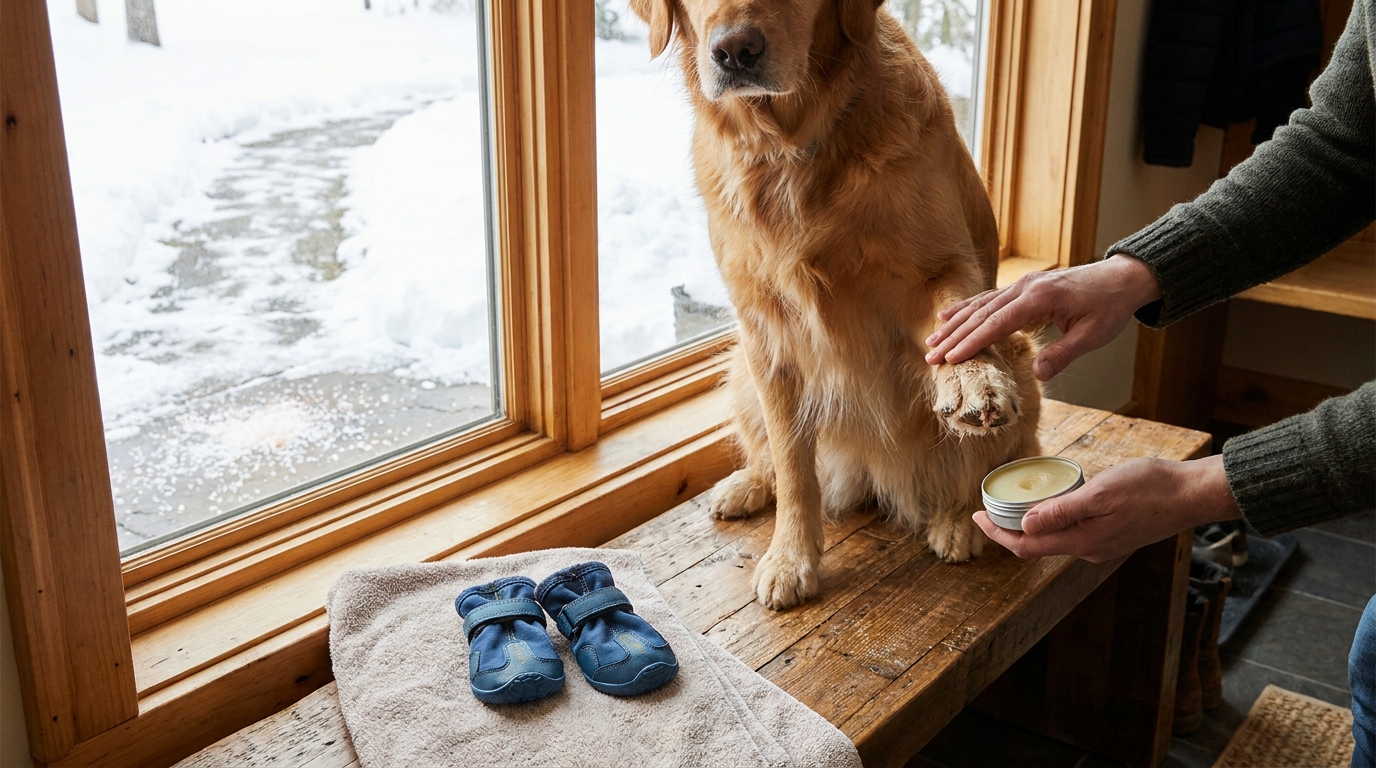
What makes paw pads crack in winter, what to put on them, and which signs need a vet visit or an ER.
Quick answer: Dry, cracked dog paw pads that are not bleeding usually come from cold, dry air, ice and road salt. Rinse the paws in lukewarm water after walks, dry well between the toes, apply a balm made for dogs and stop the licking. A crack that bleeds, a swollen paw or a limp needs an in-person vet the same day; bleeding past 10 to 15 minutes of pressure is an emergency.
This article is general information, not a diagnosis. If you think your pet is in danger, go to the nearest emergency animal hospital.
Why dog paw pads crack in winter
A dog's paw pads crack in winter mainly because cold, dry air, ice and road salt dry out and irritate the tough pad skin, and Cornell's Riney Canine Health Center says ice and road salt can crack or cut paws. VCA Animal Hospitals adds that snow and ice can dry pads out, leaving them chapped or cracked.
Cornell says salt and other de-icers can irritate paws and, if swallowed, the mouth and digestive tract, and PetMD says ice melt can burn pads. Pet Poison Helpline warns that every type of ice melt can be hazardous, even products labeled pet-safe, so wipe the feet, legs and belly after winter walks, as the AVMA advises. A dog that swallowed ice melt or rock salt needs veterinary care immediately, even with no symptoms yet: go to an emergency vet or call a pet poison line, and do not make your dog vomit unless a vet or a poison line tells you to. Antifreeze, coolant or windshield de-icer walked through or licked off the paws also means an ER or a poison line now, even with no signs yet; see antifreeze poisoning signs and timeline.
Dry, cracked or bleeding: how serious is it?
Dry dog paw pads and shallow cracks with no bleeding, swelling or limp can be cared for at home; a crack that bleeds, a swollen paw or a limp needs an in-person vet the same day; and a deep split or bleeding that lasts past 10 to 15 minutes of firm pressure is an emergency.
| What you see | Likely means | Next step |
|---|---|---|
| Dry, rough pads | Mild dryness | Home care |
| Shallow cracks, no blood | Mild cracks | Rinse, balm, booties |
| Not better in a few days | Needs a look | Vet check |
| Crack bleeds | Open wound | In-person, same day |
| Swollen paw or limping | Pain or injury | In-person, same day |
| Deep split or loose flap | Deep wound | ER now |
| Spurts, or bleeds past 10-15 min | Heavy bleed | ER now |
| Pale, gray, cold or hard pad | Frostbite? | In-person now |
| Thick, crusty or peeling pads | Skin disease? | Vet exam |
| Crusts on nose or ears too | Pemphigus? | Vet exam |
VCA Animal Hospitals says bleeding that cannot be stopped within 10 to 15 minutes is an emergency. Other urgent signs:
- Possible frostbite: a pale, gray, bluish or black pad, or one that feels cold or hard, needs a vet in person now. Treat hypothermia first; never rub the paw or use a heating pad, hair dryer or hot water, and warm it only indoors, where it cannot refreeze, with warm (never hot) water. Cornell says frostbite can take a few days to show, so recheck the paws; new pale, dark or blistered skin, or skin that turns red and sore as it thaws, needs a vet in person now.
- Hypothermia: weakness, confusion, slow breathing or having stopped shivering while still cold means an ER now; dry the dog, wrap it in warm blankets and go.
- Burn or infection: a discolored, blistered or raw pad after a walk on treated pavement, or swollen toes, a foul odor or a moist discharge (which VCA says may mean infection), needs an in-person vet the same day; exposed tissue under the pad means an ER now.
- Sick after a salted walk: repeated vomiting, stumbling, trembling, seizures or collapse means an ER now.
How to care for cracked paw pads tonight
To care for a dog's cracked paw pads tonight, rinse the paws in lukewarm water, dry well between the toes, apply a balm made for dogs and stop the licking.
- Rinse the paws in lukewarm water to wash off salt, as VCA suggests, then towel-dry.
- Dry well between the toes, as the ASPCA advises, and check there for ice balls, salt, burs or small cuts.
- Rub in a balm made for dogs after cleaning, as PetMD advises, but not on an open, raw or bleeding crack.
- Cover the paw with a clean sock or a waterproof bootie only while you can watch, so your dog cannot chew it off and swallow it, and never wrap a paw tightly.
- Use a recovery cone if the licking will not stop, and use no human medicine.
What can I put on my dog's cracked paws?
A balm made for dogs is the safest thing to put on a dog's cracked paws, because a dog licks off and swallows whatever goes on its pads.
Sources split on petroleum jelly: the ASPCA lists it as a protectant to rub into the pads before going outside and Cornell's Riney Canine Health Center says it may help prevent cracking, while PetMD advises against it because licking it off can upset the stomach. PetMD also says to skip coconut oil, because eating it can cause stomach upset or pancreatitis (see fat and pancreatitis signs to watch).
| Product | Verdict | Why |
|---|---|---|
| Dog paw balm | Best choice | Made for dogs |
| Petroleum jelly | Intact pads only | Sources split |
| Coconut oil | Skip | Stomach upset |
| Human lotion | Skip | Not for dogs |
| Medicated human cream | Skip | Vet decides |
| Zinc cream | Avoid | Harmful if licked |
| Tea tree oil | Avoid | Toxic to dogs |
Pick a dog balm whose label lists no tea tree or other essential oils, and put nothing, not even a dog balm, on an open, raw or bleeding crack. The Merck Veterinary Manual says tea tree oil is the essential oil most often reported as poisoning pets, and that a single swallow of zinc oxide cream usually causes vomiting and diarrhea, while cream licked off the skin over days to weeks can destroy red blood cells. If your dog licked or ate zinc oxide or diaper cream, or had tea tree or another essential oil on its paws, call ASPCA Animal Poison Control at (888) 426-4435 (a consultation fee may apply) or Pet Poison Helpline at (855) 764-7661 (a per-incident fee applies) now, even with no signs yet, and do not make your dog vomit unless a vet or a poison line tells you to. Drooling, vomiting, stumbling, weakness, trembling or pale gums mean an ER now.
When a cracked pad bleeds
Press a clean cloth firmly on a dog's bleeding paw pad, and if it is still bleeding after 10 to 15 minutes, go to an emergency vet now; VCA Animal Hospitals calls that an emergency.
The AVMA says to press for at least three minutes before checking, and to add towels on top if blood soaks through instead of lifting the first one. Keep pressing on the way to the vet. A crack that stops bleeding with pressure still needs an in-person vet the same day, with no human cream, ointment or medicine on it.
Go to an emergency vet now, without waiting, for heavy bleeding that soaks through cloth after cloth, blood that spurts or pulses, a deep split or a flap of pad that hangs loose, glass or another object stuck deep (leave it in), bone or tendon showing, no weight at all on the foot or a leg that may be broken, or pale or white gums, fast breathing, weakness or collapse.
Thick, crusty or recurring pads: when it is not just winter
Paw pads that stay thick, crusted, peeling at the edges or cracked all year can point to an underlying condition, such as hyperkeratosis, pemphigus or liver disease, that needs an in-person vet exam.
- Hyperkeratosis: pad thickening that PetMD says is common in senior dogs, can be managed but not cured, and may need a biopsy; only a vet should remove horn-like overgrowth. The Merck Veterinary Manual reports an inherited form in Irish Terriers and Dogues de Bordeaux.
- Pemphigus foliaceus: the University of Minnesota's dermatology handbook calls it the most common autoimmune skin disease of dogs, with thick, cracked, crusted pads and crusts on the muzzle and ear flaps.
- Zinc-responsive skin disease: Merck says it affects Alaskan Malamutes, Siberian Huskies and German Shorthaired Pointers, with crusted, thickened skin on the face and feet. Never give zinc at home.
- Liver-related skin disease: Merck says it severely affects the footpads of aged dogs. An older dog whose pads will not heal needs a vet exam soon, especially if it is also losing weight but still eating.
- Distemper "hard pad": distemper is a vaccine-preventable virus. A young or unvaccinated dog with a hard nose and pads plus eye or nose discharge, a cough, vomiting or twitching needs an in-person vet now (call ahead, as it may be contagious); seizures mean an ER.
- Other causes: PetMD also lists allergies, hypothyroidism and Cushing's disease.
Most of these need cytology, a biopsy or bloodwork at an in-person clinic.
How to protect paw pads for the rest of winter
Well-fitting booties, a paw balm or protectant before walks, and a rinse and dry after every salted walk are the winter steps the ASPCA and Cornell recommend for dog paws.
- Booties: the ASPCA says they keep sand and salt from lodging between the toes, and the AVMA says they must fit properly.
- Balm before, rinse after: Cornell's College of Veterinary Medicine suggests balm before each walk, a lukewarm washcloth afterward and another layer of balm.
- Trim the hair between the pads to cut down ice balls, as Cornell and the AVMA advise, but do not clip winter fur too short.
- Use pet-safe ice melt at home, and still wipe the paws.
- Check the paws often, as the AVMA advises, and keep walks short on salted or icy days.
Check how cold is too cold for dogs by size and coat before long outings, and for stiff older dogs, see dog arthritis that gets worse in cold weather.
Winter paw risks in Florida, New York and Virginia
Winter paw risks differ by state: New York's state road crews spread salt through the snow and ice season, VDOT pre-treats Virginia's interstates and major roads with salt brine before snow and ice storms, and Florida dogs can pick up sand and burs between the toes.
| State | Winter risk | Tip |
|---|---|---|
| New York | Road salt, snow | Rinse after walks |
| Virginia | Ice, salt brine | Booties, rinse |
| Florida | Sand, burs | Check toes |
UF/IFAS Extension says Florida sandspurs form burs from June through November, so check the toes after sandy walks in any season.
Can a video vet visit help with cracked paw pads?
A video visit with RexVet, a nonprofit online vet service for pets located in Florida, New York and Virginia, can help when a dog's cracked pads are not bleeding, swollen or causing a limp but you are unsure what the cracks mean. RexVet is a 501(c)(3) nonprofit. Good fits for a video visit:
- Cracks seen for the first time, or cracks that keep coming back after home care.
- A dog that will not stop licking its paws.
- A thick, crusted or peeling pad, or crusts on the nose or ears too, in a dog that is otherwise well, as a first look (the veterinarian decides whether in-person tests are needed).
- Not knowing whether it is salt irritation, a small cut or something else, or choosing a balm or booties.
A veterinarian licensed in your pet's state sees your dog on a $64.99 live video visit, with live slots about 8 AM to 11 PM ET. Book a live video visit if your dog's pads fit the list above.
On the call, the veterinarian asks you to show each pad under bright light and between the toes, watches your dog walk, and asks about salt, de-icers, cleaners, licking, diet, age and products used. They then tell you whether home care is enough or the paw needs hands-on care at an in-person clinic, such as a closer exam, skin cytology, a biopsy or bloodwork. In Florida, the veterinarian must also give you contact details for at least one physical clinic near your pet.
Go to an emergency vet now, not a video visit, for bleeding that continues after 10 to 15 minutes of firm pressure, blood that spurts or pulses, a deep split or a flap of pad that hangs loose, glass or another object stuck deep, bone or tendon showing, no weight at all on the foot, or pale or white gums, fast breathing, weakness or collapse. A pad that looks pale, gray, bluish or black, or feels cold or hard, may be frostbitten: see a vet in person now and do not rub it. A crack that bleeds (even if pressure stops it), a swollen paw or a limp needs an in-person vet the same day.
If your dog swallowed ice melt or rock salt, or got antifreeze or coolant on its paws, get veterinary care immediately: call an emergency vet, ASPCA Animal Poison Control at (888) 426-4435 (a consultation fee may apply) or Pet Poison Helpline at (855) 764-7661 (a per-incident fee applies). Do not make your dog vomit unless a vet or a poison line tells you to.
No prescription is promised; any medicine is the veterinarian's decision after the visit, and most paw balms do not need one. Florida law (s.474.2021) limits telehealth-only prescribing to FDA-approved animal drugs used as labeled, for up to 14 days (1 month for products labeled only for fleas and ticks), with no renewal without an in-person exam and no human-labeled, controlled or compounded anti-infective drugs. In any state, federal rules require an in-person exam before a veterinarian uses a drug off-label or a human medicine. Virginia allows the exam to be electronic; New York's telehealth prescribing rules are not settled. RexVet is not a pharmacy, and a pharmacy transfer fee applies if a prescription is sent to an outside pharmacy.
Need an Expert Opinion on This Topic?
Book a video visit with a licensed vet, evenings and weekends included
See open timesFrequently Asked Questions
Can I put petroleum jelly on my dog's cracked paws?
Only on intact, unbroken pads before a walk, and a balm made for dogs is the safer choice. The ASPCA lists petroleum jelly as a pre-walk protectant and Cornell says it may help prevent cracking; PetMD advises against it because licking it off can upset the stomach. Never put it on an open, raw or bleeding crack.
Is coconut oil safe to put on my dog's paws?
No, skip coconut oil on cracked pads. PetMD warns that a dog that licks it off can get an upset stomach or pancreatitis, and that it can cause an allergic reaction that makes dry pads worse.
How long do cracked paw pads take to heal on a dog?
No set time: mild dry cracks should look clearly better within a few days of home care; if not, have a vet check them. PetMD advises a vet visit the first time you notice cracks, and as soon as possible for bleeding, swelling, limping or heavy licking.
Should I let my dog lick its cracked paws?
No: discourage it, because a dog licks off and swallows whatever is on its pads, and heavy licking is a reason to see a vet. Use a clean sock or bootie while you can watch, or a recovery cone, and never wrap a paw tightly.
Why are my senior dog's paw pads thick and cracked?
Often hyperkeratosis, a thickening of the pad skin that PetMD says is common in senior dogs, but a vet should rule out other causes. The Merck Veterinary Manual lists pemphigus and a liver-related skin disease among them, and PetMD adds hypothyroidism and Cushing's disease; these need bloodwork or a biopsy in person. Do not trim or file thick pads at home.
Do dog booties really help with cracked paws in winter?
Yes, if they fit well: the ASPCA says booties keep sand and salt from lodging between a dog's toes. PetMD says waterproof booties also protect cracked pads while they heal.
Can a vet check my dog's cracked paw pads on a video call?
Yes, for a pet located in Florida, New York or Virginia, if the pads are not bleeding, swollen or causing a limp. On a live video call, a veterinarian licensed in the pet's state can look at each pad, watch the dog walk and say whether home care is enough; a crack that bleeds, a swollen paw or a limp needs an in-person vet the same day, a possibly frostbitten pad needs one now, and bleeding that will not stop after 10 to 15 minutes of firm pressure needs an emergency vet now. No prescription is promised. If medicine comes up, Florida law (s.474.2021) limits telehealth-only prescriptions to FDA-approved animal drugs used as labeled, for up to 14 days (1 month for products labeled only for fleas and ticks), with no renewal without an in-person exam and no human-labeled, controlled or compounded anti-infective drugs; Virginia allows the exam to be electronic, and New York's telehealth prescribing rules are not settled.
FAQs
Can I put petroleum jelly on my dog's cracked paws?
Only on intact, unbroken pads before a walk, and a balm made for dogs is the safer choice. The ASPCA lists petroleum jelly as a pre-walk protectant and Cornell says it may help prevent cracking; PetMD advises against it because licking it off can upset the stomach. Never put it on an open, raw or bleeding crack.
Is coconut oil safe to put on my dog's paws?
No, skip coconut oil on cracked pads. PetMD warns that a dog that licks it off can get an upset stomach or pancreatitis, and that it can cause an allergic reaction that makes dry pads worse.
How long do cracked paw pads take to heal on a dog?
No set time: mild dry cracks should look clearly better within a few days of home care; if not, have a vet check them. PetMD advises a vet visit the first time you notice cracks, and as soon as possible for bleeding, swelling, limping or heavy licking.
Should I let my dog lick its cracked paws?
No: discourage it, because a dog licks off and swallows whatever is on its pads, and heavy licking is a reason to see a vet. Use a clean sock or bootie while you can watch, or a recovery cone, and never wrap a paw tightly.
Why are my senior dog's paw pads thick and cracked?
Often hyperkeratosis, a thickening of the pad skin that PetMD says is common in senior dogs, but a vet should rule out other causes. The Merck Veterinary Manual lists pemphigus and a liver-related skin disease among them, and PetMD adds hypothyroidism and Cushing's disease; these need bloodwork or a biopsy in person. Do not trim or file thick pads at home.
Do dog booties really help with cracked paws in winter?
Yes, if they fit well: the ASPCA says booties keep sand and salt from lodging between a dog's toes. PetMD says waterproof booties also protect cracked pads while they heal.
Can a vet check my dog's cracked paw pads on a video call?
Yes, for a pet located in Florida, New York or Virginia, if the pads are not bleeding, swollen or causing a limp. On a live video call, a veterinarian licensed in the pet's state can look at each pad, watch the dog walk and say whether home care is enough; a crack that bleeds, a swollen paw or a limp needs an in-person vet the same day, a possibly frostbitten pad needs one now, and bleeding that will not stop after 10 to 15 minutes of firm pressure needs an emergency vet now. No prescription is promised. If medicine comes up, Florida law (s.474.2021) limits telehealth-only prescriptions to FDA-approved animal drugs used as labeled, for up to 14 days (1 month for products labeled only for fleas and ticks), with no renewal without an in-person exam and no human-labeled, controlled or compounded anti-infective drugs; Virginia allows the exam to be electronic, and New York's telehealth prescribing rules are not settled.
Medically Reviewed
Reviewed by Dr. Tiffany Delacruz, DVM — licensed veterinarian and CEO of RexVet. Last reviewed November 3, 2026.
Content is for informational purposes and does not replace professional veterinary advice.
Chief Executive Officer · Licensed Veterinarian
Dr. Delacruz is a licensed Doctor of Veterinary Medicine specializing in preventive care and veterinary telehealth. She reviews all health content on RexVet to ensure accuracy and clinical relevance.
Sources & References
- · American Veterinary Medical Association — Telehealth Guidelines
- · AVMA — Pet Care Resources
- · U.S. FDA — Animal & Veterinary