
Cat Travel Anxiety: How to Calm a Cat in the Car or Plane
By RexVet Team | Reviewed by Dr. Tiffany Delacruz, DVM
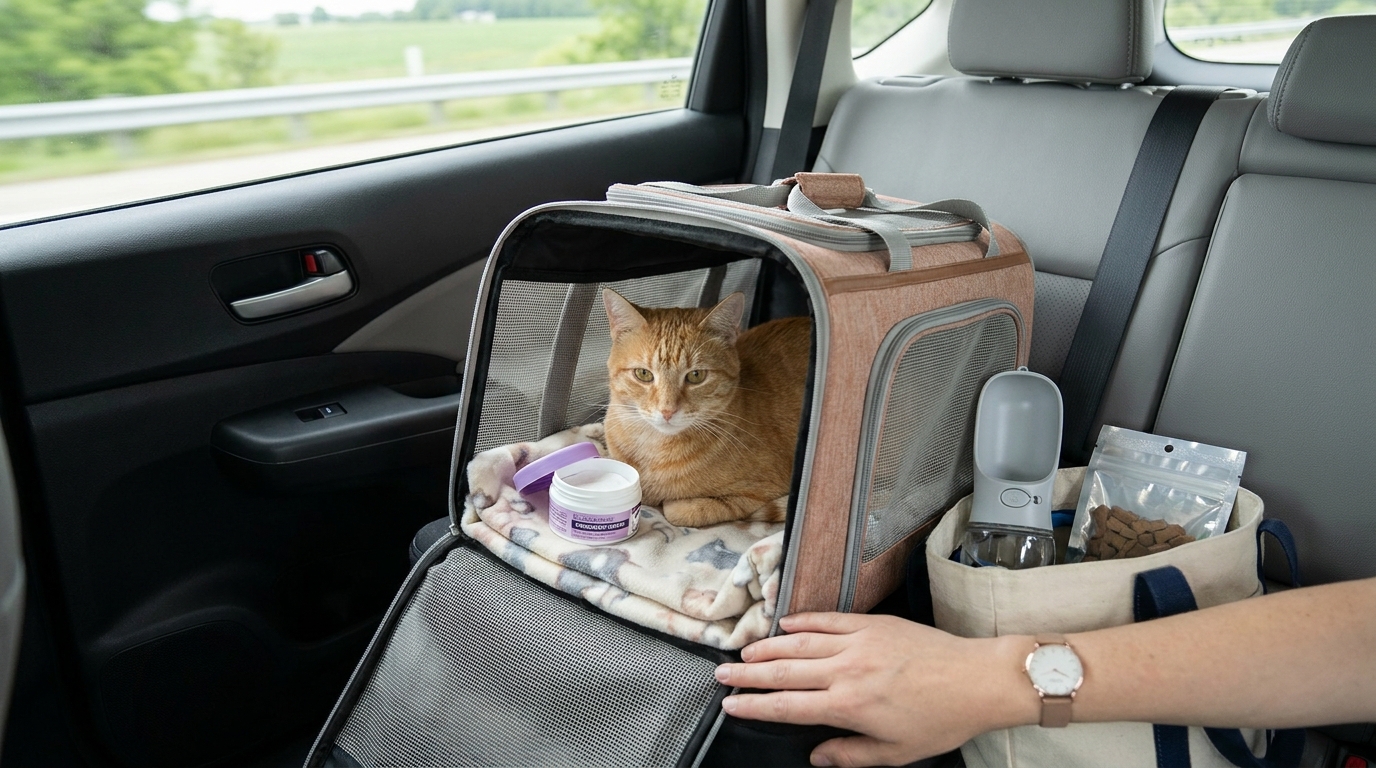
Crying, drooling or vomiting in the carrier? How to tell fear from car sickness, practice before a holiday trip, fly safely and spot an emergency.
Quick answer: Crying, drooling, brief panting or one vomit are common signs of travel stress or car sickness in cats. Start carrier and short-drive practice 1 to 2 weeks ahead, and give a light meal 3 to 4 hours before leaving. Go to an emergency vet if open-mouth breathing lasts over a few minutes after the car stops, or a cat strains with little or no urine.
This article is general information, not a diagnosis. If you think your pet is in danger, go to the nearest emergency animal hospital.
Travel anxiety or car sickness?
A cat's travel fear usually starts the moment the carrier comes out (crying, panting, hiding, accidents), while car sickness builds once the car moves (drooling, lip licking, vomiting), and many cats have both. The Merck Veterinary Manual says fear of the vehicle can add to motion sickness in cats and that signs may appear even in a car that is not moving. VCA Animal Hospitals says most motion sickness in cats comes from travel stress.
A rough guide: the signs overlap.
| Sign | Fear | Car sick |
|---|---|---|
| Starts when parked | Likely | Less likely |
| Crying | Common | Sometimes |
| Drooling | Sometimes | Common |
| Lip licking | Sometimes | Common |
| Vomiting | Sometimes | Common |
| Panting | Brief | Less often |
| Accidents | Common | Sometimes |
Traveling with a dog too? See dog car sickness.
Emergency signs: when it is not just travel stress
A cat with open-mouth breathing that does not settle within a few minutes of the car stopping, blue, gray or very pale gums, collapse, or straining with little or no urine (especially a male) needs an emergency vet now. Cornell Feline Health Center says any doubt about whether a cat is breathing comfortably means a vet right away.
Also go to an emergency vet now, not a video visit, for:
- Straining or repeated litter-box trips with little or no urine, or a male cat that vomits with any litter-box change. The Merck Veterinary Manual notes owners sometimes mistake this straining for constipation, which is easy to blame on travel. Any cat can block, males most often; Cornell calls a urethral obstruction "an absolute emergency" that may kill in less than 24 to 48 hours.
- Heatstroke after a hot car or a carrier in the sun: panting, red or dry gums, weakness, or 104F or higher. Wet the fur with cool, not cold, water on the way, with no draped wet towel, ice or rubbing alcohol (see cat fever signs).
- A cat that is cold to the touch and limp, sluggish or breathing slowly after a cold car, or that reads below 99F.
- Repeated vomiting with lethargy, or red or coffee-ground vomit.
- Swallowed or missing tinsel or string (never pull or cut it).
- A diabetic cat on insulin that is wobbly, trembling, very sleepy, seizing or unresponsive (possible low blood sugar). Put nothing in its mouth if it is drowsy or seizing, and never give extra insulin.
- Lilies, antifreeze (the antidote works best within about 3 hours in cats), aspirin-treated tree water, human medicine or a dog-only permethrin flea product. Call ASPCA Animal Poison Control, (888) 426-4435 (a consultation fee may apply), or Pet Poison Helpline, (855) 764-7661 (a per-incident fee applies), on the way, not instead of going.
Follow the most urgent row that fits.
| Sign | Action |
|---|---|
| Panting stops within a few minutes | Watch |
| Panting keeps going | ER now |
| Blue, gray or pale gums | ER now |
| Straining, little urine | ER now |
| Hot car, panting, weak | ER now |
| Lily, antifreeze, meds | ER now |
| Male vomits, litter change | ER now |
| One vomit, then normal | Watch 24 hours |
| Vomits twice in a day | Vet today |
| No food 24 hours | Vet today |
| No urine 24 hours | Call a vet; male sooner |
| Diabetic skips meal | Call vet before insulin |
How to calm a cat in the car: a 2-week carrier plan
Most cats ride calmer when the carrier is ordinary furniture before it is transport, so leave it out at home with familiar bedding and treats 1 to 2 weeks before a trip. The FelineVMA (formerly the AAFP) favors hard-sided carriers that open from the top and front and come apart in the middle, so a fearful cat can stay in the bottom half.
VCA says getting a cat used to the car may take several days or even weeks; stop at visible anxiety and try another day. The steps follow VCA; the "Move on when" cues are our suggestions. Never run the engine in a garage.
| Step | What to do | Move on when |
|---|---|---|
| 1 | Carrier left out with bedding, treats | Cat naps in it |
| 2 | Parked car, engine on, a few minutes | Stays relaxed |
| 3 | Back out of the driveway, return | Stays calm |
| 4 | Drive around the block | No crying |
| 5 | Short drives, a bit longer each time | No drooling |
| 6 | Ride 20 to 30 minutes | Calm all ride |
A synthetic facial pheromone spray may help some cats: a 2022 trial found it reduced stress on short trips in the most stressed cats, though a 2010 JAVMA review found too little evidence in 11 of 14 reports. Spray the carrier at least 30 minutes ahead, never the cat.
Travel day: food, water, litter and the carrier
On travel day, give a cat a light meal 3 to 4 hours before leaving, as the ASPCA advises, wedge the carrier on the floor behind a front seat, and offer water and litter at stops on long drives.
- Don't feed in the moving car (ASPCA), and never withhold water. Kittens and diabetic cats keep their meals unless the vet says otherwise (see cat diabetes emergencies).
- Per the FelineVMA's 2025 position statement, use a seat belt only with a crash-test-certified carrier (look for CPS Certified).
- Keep the carrier partly covered, ventilated and out of the sun, and skip essential-oil diffusers: the ASPCA says cats are especially sensitive to essential oils.
- Practice the harness at home and put it on before the carrier is ever opened at a stop. IATA advises a microchip plus two collar IDs.
- VCA says to have litter available if travel time is over 6 or 8 hours. Use your cat's usual litter, doors closed.
Never leave a cat in a parked car. A study in Pediatrics found a dark sedan on clear 72F to 96F days warmed by about 40F within an hour, even with windows cracked. In cold weather, the ASPCA warns, a car can act like a refrigerator; see how cold is too cold for cats.
Flying with a cat: cabin, carrier and paperwork
Rules for flying with a cat depend on the airline and the destination, so confirm the in-cabin carrier size, the pet fee and any health certificate before you book.
- IATA says an in-cabin carrier must fit under the seat in front and let the cat stand, turn around and lie down.
- The TSA has you take your cat out just before screening and send the empty carrier through the X-ray, never the cat; you can ask for a private screening room.
- Some airlines, such as Alaska Airlines, refuse flat-faced breeds like Persians and Himalayans in cargo; check your airline.
- A health certificate needs an in-person exam. Official interstate certificates come from a USDA-accredited vet who inspected the cat within 10 days before issue, and Florida s.474.2021(4)(h) bars issuing one by telehealth. Check your airline's and destination's window.
- USDA APHIS says the destination state sets the rules for pets moving in. Hawaii takes months: FAVN rabies results can take 1 to 2 months, and a cat that misses a requirement can be quarantined for up to 120 days.
Medicines a vet may use for travel stress
Only a veterinarian who has assessed your cat should choose a travel medicine, and most cat travel-calming drugs need an in-person exam because they are controlled or human-labeled.
- Bonqat (pregabalin oral solution) is FDA-approved, by prescription only, to ease acute anxiety and fear linked to car trips and vet visits in cats. In the FDA's field study, 77% of treated cats showed less fear and anxiety across two vet exams, compared with 46% on placebo; side effects include mild sedation, wobbly walking and lethargy. Pregabalin is Schedule V federally and in Florida, New York and Virginia.
- Gabapentin and trazodone are human-labeled drugs used off-label in cats (Merck); gabapentin is also a Schedule V controlled drug in Virginia (not federally). In every state, federal rules require an in-person exam before a cat gets a human-labeled drug such as gabapentin or trazodone.
- Anti-nausea medicine is the veterinarian's choice and usually needs an in-person exam.
Merck says antihistamines don't work for motion sickness in cats, so ask a vet before giving Benadryl or Dramamine, and never give a cat a human sleep aid, acetaminophen or someone else's pills.
The Merck Veterinary Manual advises trying a calming medicine in advance, because cats respond differently. If your cat then cannot stand, is very hard to wake or grows more agitated, call the prescribing vet and don't travel yet; unresponsive or slow breathing means the ER now. Never add another sedative on your own.
Names only, no doses; the veterinarian decides, and most of these need an in-person exam.
| Option | Used for | Rx needed |
|---|---|---|
| Bonqat | Fear | Yes |
| Gabapentin | Fear | Yes |
| Trazodone | Fear | Yes |
| Anti-nausea | Nausea | Yes |
| Pheromones | May calm | No |
| Benadryl | Not effective | Ask a vet |
Senior or sick cats: should they travel at all?
A cat with heart, kidney or breathing problems, diabetes, a past urinary blockage or a recent illness may do better with a trusted sitter at home than on a long trip, and needs a vet check before any travel medicine.
- A cat that pants on every ride, or pants with only mild stress, needs an in-person heart and lung check first, whatever its age.
- Zoetis, Bonqat's US marketer, advises caution in cats with heart, blood pressure or kidney disease, and safe use has not been evaluated in pregnant or nursing cats or cats under 7 months. A 2022 Ohio State study found higher gabapentin blood levels in cats with chronic kidney disease, so the vet may want bloodwork first.
- A cat on insulin that misses a meal needs the vet's missed-meal plan or a call to the vet before the next injection. If a cat on Bexacat or Senvelgo eats less or seems unusually tired, stop the drug and call the prescribing vet now; ER if it is weak or vomiting, or the vet can't be reached.
Settling in at the holiday destination
A cat arriving at a holiday home does best with one quiet room holding its litter box, food, water and carrier, and may hide for a day or so. Hiding is normal only while the cat eats, drinks, pees and poops (see hiding in a new home). Call a vet the same day if an adult cat eats nothing for about 24 hours (sooner if senior, overweight or diabetic) or a kitten refuses food, or if there is no urine in 24 hours (sooner for a male).
Check the house first. Any lily contact, pollen and vase water included, means the ER now; the FDA warns lilies can cause fatal kidney failure in cats. Aspirin-treated tree water also means the ER now, and for other additives, call a poison line with the label. Never pull or cut tinsel (see the cat Christmas tree guide). Put away guests' pills, keep your cat off a dog treated with a dog-only permethrin flea product, and keep it out of garages with antifreeze. Poinsettias are milder, the ASPCA says.
Watch the litter box for several days after the trip, since Cornell says changes in routine raise the risk of urinary trouble. If a cat at home hisses at the returning one, the FelineVMA suggests a separate room with food, water and a litter box for at least 24 hours; call a vet if the tension persists.
When a video visit helps before the trip
A video visit with a licensed RexVet vet 1 to 2 weeks before a trip can help plan a cat's travel, but it cannot provide a health certificate, and calming medicine usually needs an in-person exam. RexVet is a 501(c)(3) non-profit. If your cat is at home in Florida, New York or Virginia, book a $64.99 live video visit early, leaving time for an in-person exam if needed. Your cat has to be in one of those states during the call itself, not just when you book, and the visit is with a veterinarian licensed in your cat's state. Live video slots run about 8 AM to 11 PM ET. Holiday hours aren't confirmed, so don't count on a visit on Thanksgiving Day (Nov 26) or on travel day.
On camera, the veterinarian can review past trips and car videos, sort fear from car sickness, review medicines, help decide whether a senior or sick cat should travel and whether an in-person check is needed first, and build a carrier, drive and destination plan with you.
No prescription is promised. Pregabalin, the drug in Bonqat, is a federal Schedule V controlled substance. RexVet does not prescribe controlled substances by video, and Florida requires an in-person exam within the past year. Gabapentin and trazodone are human-labeled, so federal rules require an in-person exam; if medicine makes sense, the veterinarian will tell you to see a vet in person. RexVet is not a pharmacy; a pharmacy transfer fee applies if a prescription goes to an outside pharmacy.
A video visit is not the right call for breathing that doesn't settle within a few minutes of stopping, blue, gray or very pale gums, collapse, straining with little or no urine, or lilies, antifreeze, aspirin-treated tree water or human medicine: go to the nearest emergency vet now, and for a toxin, call a poison line on the way, not instead of going.
Need an Expert Opinion on This Topic?
Book a video visit with a licensed vet, evenings and weekends included
See open timesFrequently Asked Questions
Can I give my cat Benadryl for travel?
No, not without a vet's advice. The Merck Veterinary Manual says antihistamines such as diphenhydramine (Benadryl) don't work for motion sickness in cats. The ASPCA warns that too much can cause agitation, a fast heart rate and tremors. Ask a vet before giving Benadryl or Dramamine, and never give a cat a human sleep aid or acetaminophen.
Should I sedate my cat for a flight?
No. IATA advises against sedating pets for flights, a view it says the AVMA endorses, and the ASPCA warns tranquilizers can hamper breathing. The Australian Veterinary Association notes that anti-anxiety or anti-nausea drugs without sedative effects may suit some cats; that is the veterinarian's call, usually after an in-person exam. Ask the vet about a test run at home before the trip, and tell the airline.
How long can a cat go without the litter box in the car?
No safe number of hours is known, so offer litter at stops. VCA says to have litter available if travel time is over 6 or 8 hours. Call a vet if your cat passes no urine in 24 hours, and don't wait that long with a male, who may be straining out of sight. Straining with little or no urine means an emergency vet now.
Why does my cat cry in the car?
Usually fear. VCA lists loud meowing or howling as a motion-sickness sign in cats and says most cases come from travel stress. Don't scold; go back a step in the practice plan and partly cover the carrier. Crying with open-mouth breathing that doesn't settle within a few minutes of stopping, or in the litter box with little or no urine, means an emergency vet now.
Do cats get car sick?
Yes. Cats can get motion sickness, and the Merck Veterinary Manual says fear of the vehicle can add to it; getting used to travel helps some cats. One vomit in a cat that then acts normal means watching closely for 24 hours. Vomiting more than once in a day needs an in-person vet the same day, and a male cat vomiting with any litter-box change needs the ER now.
Can a video vet prescribe travel medicine for my cat in Florida, New York or Virginia?
Usually not: travel-calming medicine for a cat generally needs an in-person exam, and no prescription is promised. Your cat has to be in Florida, New York or Virginia during the call, and on camera a licensed RexVet vet can help plan the trip, sort fear from car sickness and review medicines. A health certificate, Bonqat (a federal Schedule V controlled drug that RexVet does not prescribe by video), gabapentin and trazodone (human-labeled, so federal rules require an in-person exam) and anti-nausea medicine need an in-person visit. In Florida, a vet who has only seen your cat on video generally cannot prescribe travel-calming medicine: s.474.2021 limits video-only prescribing to FDA-approved animal drugs used as labeled, for up to 14 days (1 month for products labeled only for fleas and ticks), with no renewal without an in-person exam and no human-labeled, controlled or compounded anti-infective drugs. Virginia allows an electronic exam, but federal rules still apply and gabapentin is controlled there. New York rules are unsettled.
FAQs
Can I give my cat Benadryl for travel?
No, not without a vet's advice. The Merck Veterinary Manual says antihistamines such as diphenhydramine (Benadryl) don't work for motion sickness in cats. The ASPCA warns that too much can cause agitation, a fast heart rate and tremors. Ask a vet before giving Benadryl or Dramamine, and never give a cat a human sleep aid or acetaminophen.
Should I sedate my cat for a flight?
No. IATA advises against sedating pets for flights, a view it says the AVMA endorses, and the ASPCA warns tranquilizers can hamper breathing. The Australian Veterinary Association notes that anti-anxiety or anti-nausea drugs without sedative effects may suit some cats; that is the veterinarian's call, usually after an in-person exam. Ask the vet about a test run at home before the trip, and tell the airline.
How long can a cat go without the litter box in the car?
No safe number of hours is known, so offer litter at stops. VCA says to have litter available if travel time is over 6 or 8 hours. Call a vet if your cat passes no urine in 24 hours, and don't wait that long with a male, who may be straining out of sight. Straining with little or no urine means an emergency vet now.
Why does my cat cry in the car?
Usually fear. VCA lists loud meowing or howling as a motion-sickness sign in cats and says most cases come from travel stress. Don't scold; go back a step in the practice plan and partly cover the carrier. Crying with open-mouth breathing that doesn't settle within a few minutes of stopping, or in the litter box with little or no urine, means an emergency vet now.
Do cats get car sick?
Yes. Cats can get motion sickness, and the Merck Veterinary Manual says fear of the vehicle can add to it; getting used to travel helps some cats. One vomit in a cat that then acts normal means watching closely for 24 hours. Vomiting more than once in a day needs an in-person vet the same day, and a male cat vomiting with any litter-box change needs the ER now.
Can a video vet prescribe travel medicine for my cat in Florida, New York or Virginia?
Usually not: travel-calming medicine for a cat generally needs an in-person exam, and no prescription is promised. Your cat has to be in Florida, New York or Virginia during the call, and on camera a licensed RexVet vet can help plan the trip, sort fear from car sickness and review medicines. A health certificate, Bonqat (a federal Schedule V controlled drug that RexVet does not prescribe by video), gabapentin and trazodone (human-labeled, so federal rules require an in-person exam) and anti-nausea medicine need an in-person visit. In Florida, a vet who has only seen your cat on video generally cannot prescribe travel-calming medicine: s.474.2021 limits video-only prescribing to FDA-approved animal drugs used as labeled, for up to 14 days (1 month for products labeled only for fleas and ticks), with no renewal without an in-person exam and no human-labeled, controlled or compounded anti-infective drugs. Virginia allows an electronic exam, but federal rules still apply and gabapentin is controlled there. New York rules are unsettled.
Medically Reviewed
Reviewed by Dr. Tiffany Delacruz, DVM — licensed veterinarian and CEO of RexVet. Last reviewed November 1, 2026.
Content is for informational purposes and does not replace professional veterinary advice.
Chief Executive Officer · Licensed Veterinarian
Dr. Delacruz is a licensed Doctor of Veterinary Medicine specializing in preventive care and veterinary telehealth. She reviews all health content on RexVet to ensure accuracy and clinical relevance.
Sources & References
- · American Veterinary Medical Association — Telehealth Guidelines
- · AVMA — Pet Care Resources
- · U.S. FDA — Animal & Veterinary