
Does My Cat Have a Fever? Normal Temp and When to Worry
By RexVet Team | Reviewed by Dr. Tiffany Delacruz, DVM
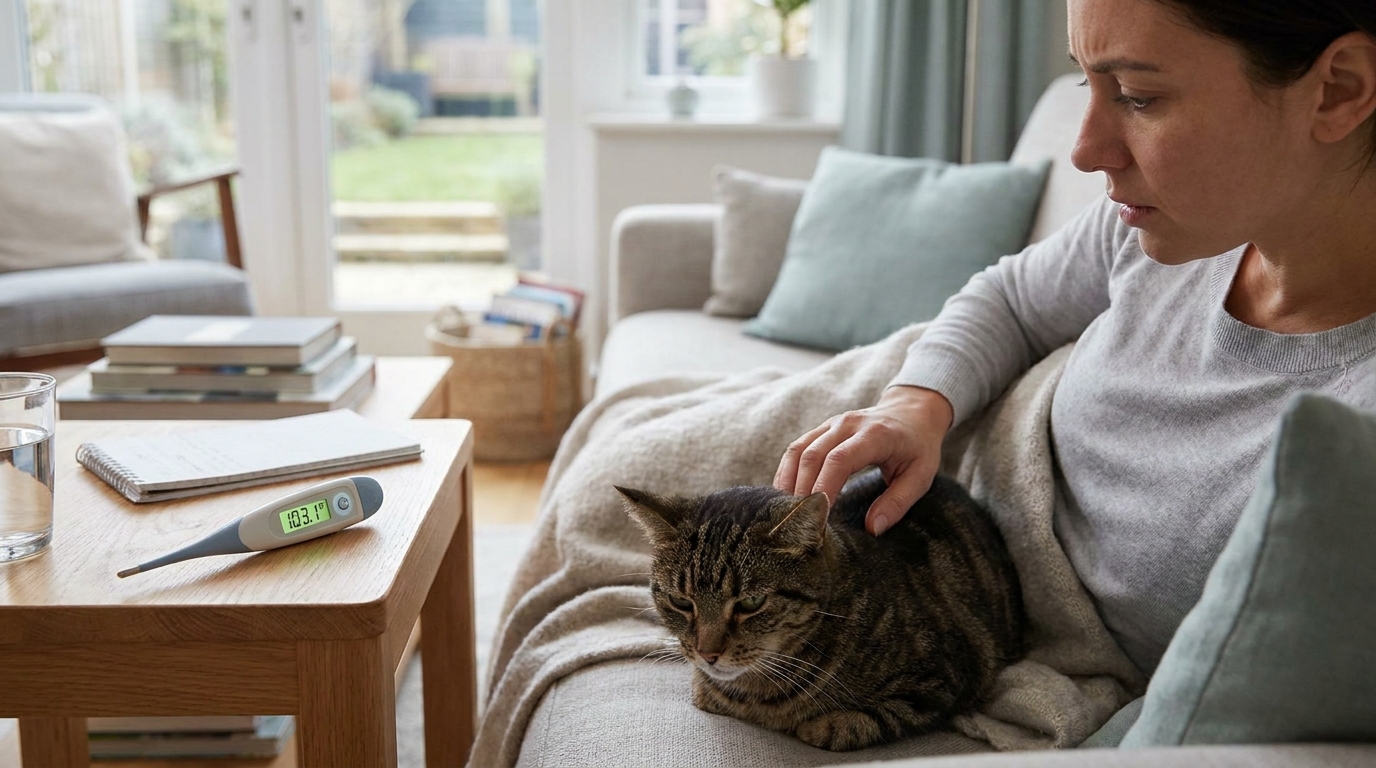
The normal cat temperature range, how to take a reading safely, and which numbers and signs mean a vet today or the ER now.
Quick answer: A cat's normal rectal temperature is about 100.5-102.5F. A true fever usually reads 103F or higher: call a vet today. A cat that has barely eaten for a day needs a vet today at any reading. Go to an emergency vet now for 104F or higher, below 99F in a cat acting unwell, open-mouth breathing, collapse or pale gums. Never give human pain or fever medicine.
This article is general information, not a diagnosis. If you think your pet is in danger, go to the nearest emergency animal hospital.
Cat Temperature Chart: Normal vs Fever
The Merck Veterinary Manual puts a cat's normal rectal temperature at 100.5-102.5F (38.1-39.2C). Anything higher is above normal, and Merck says most true fevers read 103-106F. Follow the most urgent row that fits.
| Reading (F) | What it means | What to do |
|---|---|---|
| Below 99 | Too low; can mean serious illness | Unwell, kitten or senior: ER now. Bright and eating: retake; still low: call a vet now |
| 99-100.4 | Slightly low | Retake; acting sick: go by the signs |
| 100.5-102.5 | Normal | Watch other signs; no food for a day: vet today |
| 102.6-102.9 | Slightly high | Recheck after 10 calm minutes; not eating or lethargic: vet today |
| 103-103.9 | Fever | Call a vet today |
| 104-105.9 | High fever | ER now |
| 106 or more | Very high; heatstroke or severe infection | ER now |
| Any reading | A normal or low number does not rule out illness | Acting sick: go by the signs |
Armpit and pet ear readings often run lower than the real temperature, especially in a hot or heavy cat, so treat them as a minimum and go by the signs too.
VCA Animal Hospitals notes that struggling can push a reading falsely high, so let your cat rest about 10 minutes and recheck a borderline number. VCA calls a reading above 104F or below 99F an emergency. The 103F line is a cautious rule of thumb, not a published cutoff.
Fever Red Flags: ER Now vs Vet Today
Go to the nearest emergency vet now for any of these:
- A reading of 104F or higher, or below 99F in a cat acting unwell, a kitten or a senior.
- Fast, labored or open-mouth breathing at rest, or any panting. Our guide to a cat breathing fast while sleeping shows how to count breaths.
- Collapse, a seizure, wobbliness or not responding to you; pale, gray, blue, brown or yellow gums; or yellow skin or whites of the eyes.
- A fever with a swollen face, paws or legs.
- A hot kitten that will not eat, or an unvaccinated kitten or newly adopted cat with a fever plus vomiting or diarrhea. Keep it away from other cats.
- Vomiting, diarrhea, itching, hives, a swollen face, trouble breathing or collapse within hours of a vaccine.
- An outdoor cat with a sudden high fever, especially in tick season (see bobcat fever below).
- A male cat straining to pee or passing little or no urine.
If your cat swallowed any human medicine or a leftover pet drug, call ASPCA Animal Poison Control at (888) 426-4435 (a consultation fee may apply) or Pet Poison Helpline at (855) 764-7661 (a per-incident fee applies), or go straight to an ER. Do not try to make your cat vomit.
See an in-person vet today, or an ER if your clinic cannot fit your cat in, for:
- A calm recheck that still reads 103-103.9F.
- An adult cat that has eaten little or nothing for about a day, at any reading. The Cornell Feline Health Center says not eating can harm an adult cat after as little as 24 hours, and 12 hours without food can be life-threatening for a kitten under six weeks. Go sooner for a kitten, senior, overweight or diabetic cat (see cat diabetes symptoms).
- A fever lasting more than 48 hours. VCA calls a persistent high fever lasting more than 48 hours serious and potentially life-threatening.
- A fever after recent surgery. Call the clinic that did it first.
- A fever in a cat on chemo or steroids, with diabetes or kidney disease, in a nursing mother cat, or in an unspayed female with vaginal discharge.
- A fever with limping or a warm, swollen sore after a fight. The fever can show before the swelling. Do not squeeze it.
A low reading is not good news. In a 2000 Journal of the American Veterinary Medical Association study, 29 cats with severe sepsis often had lethargy, pale gums, fast breathing and a low temperature. In a bright, eating adult, a low number may come from technique: VCA says a thermometer not in far enough, or in stool, reads low. Retake it; if it is still below 99F, call a vet now. Wrap a cold cat in a warm towel for the trip, not a heating pad, which can burn.
Do Warm Ears or a Dry Nose Mean a Fever?
Warm ears can be a hint, but only a thermometer can confirm a fever. VCA says you cannot tell whether a pet is too hot or too cold by looking at it, and the same goes for a warm or dry nose. Very sick cats can also run cold. Judge behavior instead: eating, grooming, greeting you, breathing calmly. Shivering can mean a fever or a low temperature; with no appetite, it means a vet today.
How to Check Your Cat's Temperature at Home Safely
A digital rectal thermometer gives the most reliable home reading. VCA advises against glass and mercury thermometers. A cat breathing hard needs an ER, not a thermometer.
- Wrap your cat snugly in a towel with the tail end out, and have a helper hug it.
- Coat the thermometer tip with a lubricant such as petroleum jelly.
- Lift the tail and insert the thermometer only until the metal tip is fully inside (VCA). Never force it if your cat clamps down.
- Wait for the beep, read the number, and clean the thermometer.
Stop if your cat fights or tries to bite, and go by the signs instead. In a 2015 Journal of Feline Medicine and Surgery study of 150 cats, only 53% of awake cats tolerated a rectal reading.
Armpit and pet ear readings were easier on the cats but less accurate: armpit readings landed within about 1F of rectal in 78% of cats and ear readings in only 51.3%. An armpit 103.5F can mean a rectal 104F or higher.
Cat Fever Symptoms Without a Thermometer
Many owners cannot get a reading. Use these signs instead, and if more than one fits, act on the most urgent.
| Sign | What it can mean | How soon |
|---|---|---|
| Warm ears only | A hint, not proof | Recheck; watch eating |
| Hiding or sleeping more | Feeling unwell | Watch closely today |
| Stopped grooming | Feeling unwell | Vet today if not eating |
| Little food for a day | Can turn serious fast | Vet today |
| Shivering and not eating | Fever or low temp | Vet today |
| Kitten hot and not eating | Can worsen fast | ER now |
| Fast or open-mouth breathing | Chest infection or heat | ER now |
| Pale, gray, blue or brown gums | Low oxygen, sepsis or poison | ER now |
| Swollen face, paws or legs | Reaction, poison or virus | ER now |
What Usually Causes a Fever in Cats
Merck says that in cats, infections are the most common cause of fever. Conditions that weaken the immune system, such as FeLV and FIV, can leave a cat more open to infection.
| Cause | Typical clues | Next step |
|---|---|---|
| Bite abscess | Outdoor cat, fight, warm swollen sore, limping | Vet today; do not squeeze it |
| Respiratory virus | Sneezing, eye or nose discharge, mouth sores | Vet today if not eating |
| After vaccines | Sleepy, sore, eats less for a short time | Call if past 48 hours; hives or face swelling: ER now |
| Kidney infection | Fever, sore sides, unwell | Vet today |
| FIP | Cat under 2, fever comes and goes, swollen belly | Vet this week; swollen belly: today |
| Bobcat fever | Outdoor cat, tick areas like FL or VA, Apr-Sep, high fever, then weak, cold or crying | ER now |
| Feline parvo | Kitten not vaccinated, vomiting or diarrhea | ER now; keep away from other cats |
Respiratory virus. The Cornell Feline Health Center lists fever as a sign of feline herpesvirus, and notes a severe form of calicivirus often swells the head and limbs, which is why a fever with a swollen face or legs means the ER. Our guide to a newly adopted cat that is sneezing or not eating also covers the kitten signs of feline parvo.
Kidney, not bladder. Merck lists fever, pain in the sides and feeling unwell with a kidney infection. A simple bladder infection usually does not cause a fever. If an older cat is also drinking more, see old cat drinking a lot of water.
FIP. Cornell says about 70% of feline infectious peritonitis cases are in cats under 1.5 years old, and young cats with a fever that does not respond to antibiotics are often presumed to have FIP. See a vet this week for a fever that comes and goes in a young cat (sooner if eating less), today for a swollen belly, and an ER for labored breathing. For the full list of signs, see FIP in cats and its wet vs dry signs.
Bobcat fever in Florida and Virginia. Cytauxzoonosis, or bobcat fever, is caused by a blood parasite spread mainly by the lone star tick. Merck says it is typically diagnosed April through September, though infection can occur earlier or later depending on the climate, and Florida and Virginia are among the states with reported cases. The temperature can reach 106F, and near the end cats often turn cold and short of breath, so a falling reading is not improvement. Without treatment, death typically follows within 2-3 days of the peak. The Cornell Wildlife Health Lab says the parasite is not yet confirmed in New York.
Fever vs Heatstroke vs a Cat That Is Too Cold
Merck notes that heatstroke and seizures raise body temperature without resetting the brain's thermostat, so they are not true fevers, and the temperature can climb to 106F or higher. A review in the Journal of Veterinary Emergency and Critical Care describes heatstroke as a body temperature over 104F after confinement in a hot or humid space, with panting, red or dry gums and weakness. For cats, that usually means a car, a closed room, a dryer or a carrier in the sun. An overheated cat needs an ER now. Before you leave, move it somewhere cool with moving air and gently wet its fur with cool, not cold, water (Cornell). Do not drape a wet towel over it, which VCA says can block cooling, and use no ice or rubbing alcohol. Keep cooling in the car instead of waiting for the number to drop.
A cat that is too cold may be lethargic, less alert and shivering (VCA). Below 99F in a cat acting unwell is an emergency too.
What Not to Give a Cat With a Fever
Never give a cat a human fever or pain medicine. VCA calls aspirin and acetaminophen (Tylenol) extremely toxic to cats, and Merck says cats are more sensitive than dogs to acetaminophen, ibuprofen and naproxen. The ASPCA explains that cats cannot break down acetaminophen the way people do; it damages red blood cells so they cannot carry oxygen, and signs include brown or blue gums and trouble breathing. Even a small amount is dangerous.
Skip leftover medicines from another pet or a person, including antibiotics, and essential oils. This page names no "safe" fever reducer: even some pet pain medicines carry FDA safety warnings for cats. Keep your cat in a quiet room, offer water and food, and recheck.
What a Video Visit Can and Cannot Do
Not sure it can wait? If a calm recheck still reads 102.6-102.9F, or you cannot get a reading, and your cat is breathing normally and still eating (even if it is eating less, hiding or sneezing), consider a $64.99 live video visit with Dr. Tiffany Delacruz, DVM, through RexVet, a 501(c)(3) non-profit. She can help you judge what the signs could mean and how urgent they look, whether it can wait for your regular vet, which in-person tests to ask about, and what to watch for until then. She can also point you to a nearby in-person clinic. Your cat must be in Florida, New York or Virginia, and video slots run about 8 AM-11 PM ET. Book a live video visit with Dr. Delacruz.
A video visit cannot take a temperature, run blood tests, drain an abscess, or confirm FIP, bobcat fever or a kidney infection. See an in-person vet today, or an ER if your clinic cannot fit you in, if a calm recheck still reads 103-103.9F, an adult cat has eaten little or nothing for about a day (sooner for a kitten, senior, overweight or diabetic cat) or a fever has lasted more than 48 hours. Go to an emergency vet now for 104F or higher, below 99F in a cat acting unwell, fast, labored or open-mouth breathing, collapse, pale, blue or brown gums, or a kitten that is feverish and not eating.
Whether any medicine is appropriate is Dr. Delacruz's decision after the visit; no prescription is promised. Florida limits video-only prescriptions to FDA-approved animal drugs used as labeled, for up to 14 days (1 month for flea and tick products), with no renewal without an in-person exam; human-labeled and compounded anti-infective drugs need an in-person exam first. Federal rules require a recent in-person exam for any off-label or human-drug use. Virginia otherwise allows the exam to be electronic; New York's telehealth prescribing rules are not settled. RexVet is not a pharmacy; a pharmacy transfer fee applies when RexVet sends a prescription to an outside pharmacy.
Need an Expert Opinion on This Topic?
Book a video visit with a licensed vet, evenings and weekends included
See open timesFrequently Asked Questions
Is 103 a fever for a cat?
Yes. A cat's normal rectal temperature is about 100.5-102.5F (Merck Veterinary Manual), and most true fevers read 103F or higher. Struggling can push a reading up, so let your cat rest 10 calm minutes and recheck (VCA). If it still reads 103-103.9F, call a vet today. At 104F or higher, go to an emergency vet now.
Can I tell if my cat has a fever without a thermometer?
Not for sure; VCA says you cannot tell by looking. Low energy, hiding, eating less, not grooming and shivering often come with a fever; fast breathing at rest means an ER now. An adult cat that has eaten little or nothing for about a day needs a vet today.
Should my cat's ears feel warm?
Ears can feel warm after a nap, time in the sun or a stressful car ride, so warm ears alone do not prove a fever. They can be a hint, but only a thermometer confirms one. If your cat is also hiding or not eating, take a temperature or go by those signs; fast breathing at rest means an ER now.
How long does a cat fever last?
It depends on the cause; call a vet today for a calm 103F, or an ER at 104F or higher. VCA calls a high fever lasting more than 48 hours serious and potentially life-threatening, so see a vet in person by then, even if your cat seems OK. A fever that comes and goes in a cat under 2 needs a vet this week.
What can I give my cat for a fever at home?
Nothing from your medicine cabinet. Acetaminophen (Tylenol), aspirin, ibuprofen and naproxen can poison cats, and even a small amount of acetaminophen can be deadly. If your cat swallowed a human medicine, call ASPCA Animal Poison Control, (888) 426-4435 (a consultation fee may apply), or Pet Poison Helpline, (855) 764-7661 (a per-incident fee applies), or go to an ER.
Is a fever after vaccines normal for a cat?
The 2020 AAHA/AAFP Feline Vaccination Guidelines say a mild, short-lived fever with sleepiness or a poor appetite can follow vaccines. As a cautious rule, call a vet if it lasts past 48 hours or your cat eats nothing for 24 hours. Vomiting, diarrhea, itching or scratching, hives, a swollen face, trouble breathing or collapse within hours of a shot means an emergency vet now.
Can RexVet help with a cat fever if I live in Florida, New York or Virginia?
Yes, if your cat is in one of those states, is breathing normally, is still eating, has no emergency signs, and a calm recheck reads under 103F (or you cannot get a reading). Dr. Tiffany Delacruz, DVM, is licensed in all three and sees cats by live video, with slots about 8 AM-11 PM ET. She can help you judge how urgent the signs look. A video visit cannot take a temperature or run blood tests, and no prescription is promised. A calm recheck of 103-103.9F needs an in-person vet today. A reading of 104F or higher, below 99F in a cat acting unwell, or trouble breathing means an emergency vet now.
FAQs
Is 103 a fever for a cat?
Yes. A cat's normal rectal temperature is about 100.5-102.5F (Merck Veterinary Manual), and most true fevers read 103F or higher. Struggling can push a reading up, so let your cat rest 10 calm minutes and recheck (VCA). If it still reads 103-103.9F, call a vet today. At 104F or higher, go to an emergency vet now.
Can I tell if my cat has a fever without a thermometer?
Not for sure; VCA says you cannot tell by looking. Low energy, hiding, eating less, not grooming and shivering often come with a fever; fast breathing at rest means an ER now. An adult cat that has eaten little or nothing for about a day needs a vet today.
Should my cat's ears feel warm?
Ears can feel warm after a nap, time in the sun or a stressful car ride, so warm ears alone do not prove a fever. They can be a hint, but only a thermometer confirms one. If your cat is also hiding or not eating, take a temperature or go by those signs; fast breathing at rest means an ER now.
How long does a cat fever last?
It depends on the cause; call a vet today for a calm 103F, or an ER at 104F or higher. VCA calls a high fever lasting more than 48 hours serious and potentially life-threatening, so see a vet in person by then, even if your cat seems OK. A fever that comes and goes in a cat under 2 needs a vet this week.
What can I give my cat for a fever at home?
Nothing from your medicine cabinet. Acetaminophen (Tylenol), aspirin, ibuprofen and naproxen can poison cats, and even a small amount of acetaminophen can be deadly. If your cat swallowed a human medicine, call ASPCA Animal Poison Control, (888) 426-4435 (a consultation fee may apply), or Pet Poison Helpline, (855) 764-7661 (a per-incident fee applies), or go to an ER.
Is a fever after vaccines normal for a cat?
The 2020 AAHA/AAFP Feline Vaccination Guidelines say a mild, short-lived fever with sleepiness or a poor appetite can follow vaccines. As a cautious rule, call a vet if it lasts past 48 hours or your cat eats nothing for 24 hours. Vomiting, diarrhea, itching or scratching, hives, a swollen face, trouble breathing or collapse within hours of a shot means an emergency vet now.
Can RexVet help with a cat fever if I live in Florida, New York or Virginia?
Yes, if your cat is in one of those states, is breathing normally, is still eating, has no emergency signs, and a calm recheck reads under 103F (or you cannot get a reading). Dr. Tiffany Delacruz, DVM, is licensed in all three and sees cats by live video, with slots about 8 AM-11 PM ET. She can help you judge how urgent the signs look. A video visit cannot take a temperature or run blood tests, and no prescription is promised. A calm recheck of 103-103.9F needs an in-person vet today. A reading of 104F or higher, below 99F in a cat acting unwell, or trouble breathing means an emergency vet now.
Medically Reviewed
Reviewed by Dr. Tiffany Delacruz, DVM — licensed veterinarian and CEO of RexVet. Last reviewed October 28, 2026.
Content is for informational purposes and does not replace professional veterinary advice.
Chief Executive Officer · Licensed Veterinarian
Dr. Delacruz is a licensed Doctor of Veterinary Medicine specializing in preventive care and veterinary telehealth. She reviews all health content on RexVet to ensure accuracy and clinical relevance.
Sources & References
- · American Veterinary Medical Association — Telehealth Guidelines
- · AVMA — Pet Care Resources
- · U.S. FDA — Animal & Veterinary