
Are Christmas Trees Toxic to Cats? Water, Tinsel, Lights
By RexVet Team | Reviewed by Dr. Tiffany Delacruz, DVM
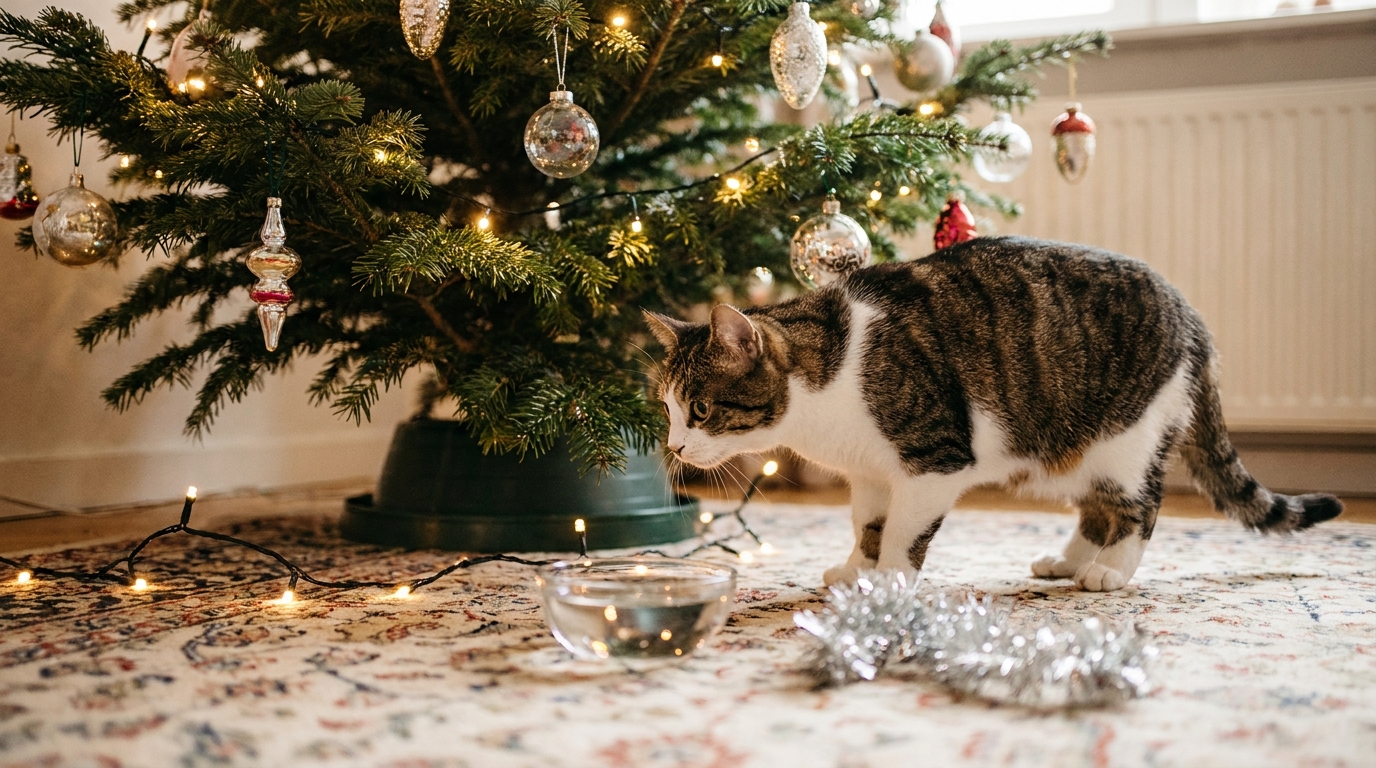
Chewed needles usually mean a mild upset. Tinsel, a bitten cord, a battery, snow-globe fluid or aspirin water is an emergency. Here is what to do.
Quick answer: Real Christmas trees are mildly toxic to cats, PetMD says: chewed needles usually cause drooling, vomiting or diarrhea. Go to an ER now if a cat may have swallowed tinsel or ribbon (never pull or cut it), bit a plugged-in cord or battery, touched snow-globe fluid, drank aspirin-treated tree water, or vomits repeatedly with lethargy. Vomiting more than once in a day means an in-person vet the same day.
This article is general information, not a diagnosis. If you think your pet is in danger, go to the nearest emergency animal hospital.
Are pine needles and sap toxic to cats?
Pine, fir and spruce needles from a real Christmas tree are mildly toxic to cats, PetMD says, mainly because of their oils and sap: chewing them usually causes only drooling, vomiting or diarrhea, so if your cat vomited no more than once and is otherwise eating, playing and breathing normally, block off the tree and watch closely for 24 hours.
No safe number of pine needles is known. The ASPCA calls Christmas trees "not particularly toxic." Pet Poison Helpline adds that needles don't digest well, so a large amount can block the gut and possibly puncture it.
Pet Poison Helpline also says cats are very sensitive to pine oils. Wash sap off the fur right away, before your cat grooms it off and swallows it, and never use solvents, turpentine, nail-polish remover, pine-oil cleaners or essential oils to get it off.
Christmas tree hazards: what to do right now
When a cat gets into a Christmas tree, any of these means an emergency vet now: possibly swallowed or missing string, a bitten plugged-in cord, a bitten or swallowed battery, broken glass, snow-globe fluid or aspirin water.
If more than one row fits, follow the most urgent one. Never make a cat vomit at home: the ASPCA says hydrogen peroxide should not be given to cats.
| Hazard | Main risk | What to do now |
|---|---|---|
| Chewed needles, acting normal | Mouth and stomach upset | Block it off; watch closely for 24 hours |
| Drank plain tree water | Mild vomiting or diarrhea | Cover the stand; watch at home |
| Drank water with plant food or another additive | Usually mild stomach upset | Call a poison line now; have the label |
| Drank water with aspirin in it | Stomach ulcers, organ damage | ER now; call a poison line on the way |
| Tinsel, ribbon or string seen, or missing | String caught in the gut | ER now; never pull or cut it |
| Bit a plugged-in light cord | Mouth burns, fluid in the lungs | Unplug first; ER now, even if fine |
| Broken glass ornament or swallowed hook | Cuts, blockage | ER now |
| Broken snow globe, fluid on fur or licked | Some contain antifreeze | Wipe fur and paws; ER now |
| Bit or swallowed a battery | Mouth and throat burns | ER now; never make it vomit |
| Tree fell on the cat | Injury, glass in paws | ER now if hurt or breathing hard |
The poison lines are ASPCA Animal Poison Control, (888) 426-4435 (a consultation fee may apply), and Pet Poison Helpline, (855) 764-7661 (a per-incident fee applies). For an ER-now row, call on the way, not instead of going.
Christmas tree water: plain water vs additives
Plain Christmas tree water usually gives a cat only mild vomiting or diarrhea, but tree water with aspirin added is an emergency, and any other additive means calling a poison line with the label.
The ASPCA says tree water is a breeding ground for bacteria that could cause nausea, diarrhea or stomach upset. The National Capital Poison Center says commercial tree preservatives usually contain fertilizer, sugar and perhaps fungicides, and Pet Poison Helpline says they usually cause only a mildly upset stomach. Call anyway, because the label decides.
Homemade tree-water recipes can include aspirin, the National Capital Poison Center notes, and Pet Poison Helpline says cats lack an enzyme that breaks aspirin down, so it can cause stomach ulcers, bloody vomit, black tarry stool, tremors, seizures and death. Go to an emergency vet now and bring the recipe.
The National Christmas Tree Association recommends plain water only. Cover the stand so your cat can't drink from it.
Tinsel, ribbon and garland: why string is an emergency in cats
Tinsel, ribbon or string that a cat may have swallowed is an emergency: go to an emergency vet now, even if the cat seems fine, and never pull or cut string at the mouth or bottom.
Vets call this a linear foreign body. The Merck Veterinary Manual says the string usually anchors at the base of the tongue or in the stomach, that these blockages carry a higher risk of intestinal perforation, and that string in the mouth "must never be pulled." VCA gives the same warning for ribbon or tinsel at a cat's bottom.
Pet Poison Helpline calls tinsel a common cause of bowel obstruction in cats, warns swallowed ribbon acts "like a saw" against the intestine, and notes these cats may keep eating and drinking for some time.
Missing tinsel counts: if strands, curling ribbon or a hair tie are missing and your cat could have eaten them, treat it as swallowed string.
Lights and cords: unplug before you touch your cat
Switch off the power before touching a cat that bit a plugged-in light cord, then take the cat to an emergency vet now, even if it seems fine.
MSPCA-Angell gives the order: disconnect the electricity, then get veterinary care immediately, however the cat is acting, because fluid in the lungs "can be delayed up to 12-36 hours." It says mouth burns may look pale yellow, tan or gray.
After the visit, watch your cat's breathing for several days. Go back now for coughing, white or pink foam from the mouth or nose, labored breathing, or blue or gray gums.
Ornaments, hooks, batteries and snow globes
A broken snow globe, a bitten battery or swallowed ornament glass means an emergency vet now for a cat, because some snow globes, especially imported ones, have been found to contain antifreeze, and batteries can burn the mouth and throat.
Snow globes. Pet Poison Helpline says some imported globes were found to contain antifreeze (ethylene glycol). Quickly wipe the fluid off your cat's fur and paws (or wrap your cat in a towel; don't let cleaning delay leaving), bring every pet that could have reached it, and call a poison line on the way. The antidote works best within about 3 hours in cats, but go even if more time has passed; see the antifreeze poisoning guide.
Batteries. Pet Poison Helpline says batteries can cause corrosive, electrical or heat burns in the esophagus or intestines, and mouth ulcers may not show for hours. Never make your cat vomit.
Ornaments. The ASPCA says broken ornament shards can damage the mouth and digestive tract, and that salt-dough ornaments, even dry ones, can cause life-threatening electrolyte imbalances. Swallowed glass, hooks, ornament pieces or salt dough mean an emergency vet now.
Signs to watch over the next few days
After a cat gets into the Christmas tree, vomiting more than once in a day, or about 24 hours without food, means an in-person vet the same day.
In this table, "same day" means an in-person exam today. Never hold back food from a cat on purpose.
| Sign | What it can mean | How fast |
|---|---|---|
| Vomits more than once in a day, or can't keep water down | Stomach upset or blockage | Same day, in person |
| Repeated vomiting with lethargy, or a swollen, painful belly | Blockage | ER now |
| No food for about 24 hours | Blockage; fatty liver risk | Same day; sooner for a kitten, senior, overweight or diabetic cat |
| Drooling, gagging or pawing at the mouth | String under the tongue, or a burn | Same day; ER now if string is seen, or a cord or battery was bitten |
| Coughing, pink or white foam, labored or open-mouth breathing, pale, blue or gray gums | Shock, fluid in the lungs | ER now |
| Red vomit, vomit like coffee grounds, or black, tarry stool | Bleeding in the gut | ER now |
| Wobbly, tremors, seizures or collapse | A toxin such as aspirin or antifreeze | ER now |
| Hiding, hunched or low energy but alert | Pain or early blockage | Same day; ER if weak |
| Straining in the litter box, little or nothing passing | Blockage; in a male cat, a blocked bladder | Same day; ER now for a male cat |
| Diabetic cat on insulin vomits | Low blood sugar risk | Call the prescribing vet before the next dose; ER if weak or wobbly |
One vomit in an otherwise normal cat means watching closely for 24 hours, but a male cat vomiting with any litter-box change needs the ER now; see this vomiting triage guide for cats.
Real or artificial: which tree is safer for a cat
An artificial Christmas tree is safer for a cat than a real one because it has no sap, oils or stand water, but tinsel, lights, ornaments and tipping carry the same risk on both.
Pet Poison Helpline says chewed artificial tree material can still irritate the gut and possibly cause a blockage if enough is eaten. For artificial snow, PDSA, a UK veterinary charity, says small amounts may cause mild stomach upset and a large amount may cause a blockage.
| Risk | Real tree | Artificial tree |
|---|---|---|
| Oils and sap | Yes, mildly toxic | None |
| Needles | Sharp; can irritate or block the gut | Plastic bits can irritate or block the gut |
| Water in the stand | Yes: bacteria, possible additives | None |
| Flocking or fake snow | Small amounts: mild upset | Same |
| Tinsel, lights, ornaments, tipping | Same risk | Same risk |
How to cat-proof a Christmas tree
The safest Christmas tree for a cat is anchored so it can't tip, has no tinsel, and keeps cords and breakable ornaments out of reach.
- Anchor it. Dr. Lori Teller of Texas A&M's Pet Talk says to anchor the tree securely, and Pet Poison Helpline says to secure it at the top and bottom.
- Cover the stand and skip tinsel. Keep ribbon-wrapped gifts out from under the tree.
- Hang glass ornaments high and keep salt-dough ornaments off the tree.
- Tame the cords with low-voltage LED lights or battery lights with the battery pack hidden out of reach, cord protectors, or cords taped down or hidden under rugs.
- Use a baby gate when no one is watching.
- No scent deterrents. VCA says citrus, pine, peppermint and tea tree oils are poisonous to cats, and liquid potpourri can burn the mouth, so skip scented sprays, diffusers, citrus peels, cayenne and mothballs. If your cat licked liquid potpourri, a simmer pot or a scented oil or spray, or got it on its fur, wash it off with dish soap and water and call a poison line now.
If your cat chewed mistletoe, holly berries, amaryllis or an unknown plant, call a poison line now; see the guides to poinsettias, mistletoe and holly, amaryllis and paperwhites and Christmas cactus. Lilies can't wait: the ASPCA says many lilies in holiday bouquets can cause kidney failure in cats, so any contact (a bitten leaf, pollen or vase water) means an emergency vet now, even with no signs. See string, lilies and antifreeze in cats.
When a video visit helps and when to go in person
A video visit can help a cat that chewed on some needles, sipped plain tree water or vomited once and is otherwise eating, playing and breathing normally.
RexVet is a 501(c)(3) non-profit. If your cat is in Florida, New York or Virginia during the visit, you can book a $64.99 live video visit with Dr. Tiffany Delacruz, DVM, when a slot is open (usually about 8 AM to 11 PM ET; holiday hours may differ). On camera she can look at the tree, the stand and any vomit; watch your cat's breathing, gum color and energy; help you decide whether home monitoring is enough or your cat needs an in-person exam; and point you to clinics nearby. A video visit can't look properly under the tongue, feel the belly, X-ray for tinsel or treat a shock, so it can't rule out swallowed string.
Anti-nausea medicine can't be promised, because the tablets commonly used for cats are off-label and need an in-person exam. In Florida, video-only prescriptions are limited to FDA-approved animal drugs used as labeled for up to 14 days, with no renewal without an in-person exam. If a prescription goes to an outside pharmacy, a pharmacy transfer fee applies; RexVet is not a pharmacy.
Go to an emergency vet now, not a video visit, for possible swallowed string or missing tinsel, a bitten plugged-in cord, a battery, ornament glass or a hook, snow-globe fluid, aspirin water, any lily contact, breathing trouble, wobbliness, collapse, repeated vomiting with lethargy or blood in the vomit. For other tree-water additives, call a poison line now with the label (numbers above). Both poison lines answer 24 hours a day, 365 days a year; RexVet's video visits do not.
Need an Expert Opinion on This Topic?
Book a video visit with a licensed vet, evenings and weekends included
See open timesFrequently Asked Questions
Is Christmas tree water poisonous to cats?
No, plain tree water usually causes only mild vomiting or diarrhea. Water with aspirin added is an emergency: go to an emergency vet now. For plant food, a commercial preservative or an unknown additive, call a poison line now with the label.
Will my cat pass tinsel on its own?
Don't wait to find out: a cat that may have swallowed tinsel or ribbon needs an emergency vet now, even if it seems fine. Some strands do pass, but only a vet with X-rays or ultrasound can tell, and some cats need surgery. The Merck Veterinary Manual says string anchored in the mouth must never be pulled, so never pull or cut string at the mouth or bottom. Don't give bread, pumpkin, oil, petroleum jelly or hairball paste to help it pass, and never try to make your cat vomit.
My cat chewed the Christmas tree and threw up once. What now?
If your cat vomited once and is eating, playing and breathing normally, block off the tree and watch closely for 24 hours. Missing tinsel, ribbon or hooks, a broken ornament or bite marks on a cord mean an emergency vet now. Wash sap off the fur and keep food and water available. A second vomit in a day, not keeping water down, or about 24 hours without food means an in-person vet the same day. Vomiting with lethargy or a swollen, painful belly means the ER now.
Are artificial Christmas trees safe for cats?
Safer, not risk-free: an artificial tree has no sap or stand water, but chewed plastic can irritate the gut or cause a blockage. Tinsel, lights, ornaments and tipping carry the same risk on any tree.
Is fake snow or flocking toxic to cats?
Mostly no: a little flocking or fake snow usually causes only mild stomach upset, but a large amount can block the gut. The National Capital Poison Center says artificial snow is unlikely to poison, but a dry powder that swells when wet can block the intestines. Keep the package and call a poison line if your cat ate a lot or ate a dry powder.
My cat bit the light cord but seems fine. Do I still need to go in?
Yes: unplug the cord or switch off the power first, then take your cat to an emergency vet now, even if it seems fine. MSPCA-Angell says fluid in the lungs "can be delayed up to 12-36 hours," so keep watching breathing for several days after the visit. Go back now for coughing, white or pink foam from the mouth or nose, labored breathing, or blue or gray gums.
Is a Christmas tree dangerous for dogs too?
Yes, the same hazards apply to dogs: tree-water additives, tinsel, cords, ornaments and batteries. Swallowed needles can also irritate or block a dog's gut. A dog that swallowed tinsel, ribbon or string needs an emergency vet now; see what to do about string and twine in dogs. Vomiting thresholds differ for dogs.
Can a video vet help if my cat got into the Christmas tree?
Sometimes: a video visit fits a cat that only chewed needles, sipped plain tree water or vomited once and is acting normally. If your cat is in Florida, New York or Virginia during the visit, Dr. Tiffany Delacruz, DVM, can check its breathing, gums and energy on camera, look at the stand and any vomit, and help you decide whether to keep watching or go in. Looking properly under the tongue, feeling the belly, X-rays for tinsel and treating a cord burn need an in-person visit, so video can't rule out swallowed string; string, cord bites, batteries, glass, snow-globe fluid and aspirin water go to an emergency vet now. No prescription is promised. Florida limits video-only prescriptions to FDA-approved animal drugs used as labeled, for up to 14 days (1 month for products labeled only for fleas and ticks), with no renewal without an in-person exam; human-labeled drugs, controlled drugs and compounded anti-infectives need an in-person exam first. Federal rules require a recent in-person exam for any off-label or human-drug use, which includes the anti-nausea tablets commonly used for cats. Virginia otherwise allows the exam to be electronic; New York's telehealth prescribing rules are not settled.
FAQs
Is Christmas tree water poisonous to cats?
No, plain tree water usually causes only mild vomiting or diarrhea. Water with aspirin added is an emergency: go to an emergency vet now. For plant food, a commercial preservative or an unknown additive, call a poison line now with the label.
Will my cat pass tinsel on its own?
Don't wait to find out: a cat that may have swallowed tinsel or ribbon needs an emergency vet now, even if it seems fine. Some strands do pass, but only a vet with X-rays or ultrasound can tell, and some cats need surgery. The Merck Veterinary Manual says string anchored in the mouth must never be pulled, so never pull or cut string at the mouth or bottom. Don't give bread, pumpkin, oil, petroleum jelly or hairball paste to help it pass, and never try to make your cat vomit.
My cat chewed the Christmas tree and threw up once. What now?
If your cat vomited once and is eating, playing and breathing normally, block off the tree and watch closely for 24 hours. Missing tinsel, ribbon or hooks, a broken ornament or bite marks on a cord mean an emergency vet now. Wash sap off the fur and keep food and water available. A second vomit in a day, not keeping water down, or about 24 hours without food means an in-person vet the same day. Vomiting with lethargy or a swollen, painful belly means the ER now.
Are artificial Christmas trees safe for cats?
Safer, not risk-free: an artificial tree has no sap or stand water, but chewed plastic can irritate the gut or cause a blockage. Tinsel, lights, ornaments and tipping carry the same risk on any tree.
Is fake snow or flocking toxic to cats?
Mostly no: a little flocking or fake snow usually causes only mild stomach upset, but a large amount can block the gut. The National Capital Poison Center says artificial snow is unlikely to poison, but a dry powder that swells when wet can block the intestines. Keep the package and call a poison line if your cat ate a lot or ate a dry powder.
My cat bit the light cord but seems fine. Do I still need to go in?
Yes: unplug the cord or switch off the power first, then take your cat to an emergency vet now, even if it seems fine. MSPCA-Angell says fluid in the lungs "can be delayed up to 12-36 hours," so keep watching breathing for several days after the visit. Go back now for coughing, white or pink foam from the mouth or nose, labored breathing, or blue or gray gums.
Is a Christmas tree dangerous for dogs too?
Yes, the same hazards apply to dogs: tree-water additives, tinsel, cords, ornaments and batteries. Swallowed needles can also irritate or block a dog's gut. A dog that swallowed tinsel, ribbon or string needs an emergency vet now; see what to do about string and twine in dogs. Vomiting thresholds differ for dogs.
Can a video vet help if my cat got into the Christmas tree?
Sometimes: a video visit fits a cat that only chewed needles, sipped plain tree water or vomited once and is acting normally. If your cat is in Florida, New York or Virginia during the visit, Dr. Tiffany Delacruz, DVM, can check its breathing, gums and energy on camera, look at the stand and any vomit, and help you decide whether to keep watching or go in. Looking properly under the tongue, feeling the belly, X-rays for tinsel and treating a cord burn need an in-person visit, so video can't rule out swallowed string; string, cord bites, batteries, glass, snow-globe fluid and aspirin water go to an emergency vet now. No prescription is promised. Florida limits video-only prescriptions to FDA-approved animal drugs used as labeled, for up to 14 days (1 month for products labeled only for fleas and ticks), with no renewal without an in-person exam; human-labeled drugs, controlled drugs and compounded anti-infectives need an in-person exam first. Federal rules require a recent in-person exam for any off-label or human-drug use, which includes the anti-nausea tablets commonly used for cats. Virginia otherwise allows the exam to be electronic; New York's telehealth prescribing rules are not settled.
Medically Reviewed
Reviewed by Dr. Tiffany Delacruz, DVM — licensed veterinarian and CEO of RexVet. Last reviewed October 31, 2026.
Content is for informational purposes and does not replace professional veterinary advice.
Chief Executive Officer · Licensed Veterinarian
Dr. Delacruz is a licensed Doctor of Veterinary Medicine specializing in preventive care and veterinary telehealth. She reviews all health content on RexVet to ensure accuracy and clinical relevance.
Sources & References
- · American Veterinary Medical Association — Telehealth Guidelines
- · AVMA — Pet Care Resources
- · U.S. FDA — Animal & Veterinary