
Newly Adopted Cat Not Eating, Hiding or Sneezing? Normal vs. Not
By RexVet Team | Reviewed by Dr. Tiffany Delacruz, DVM
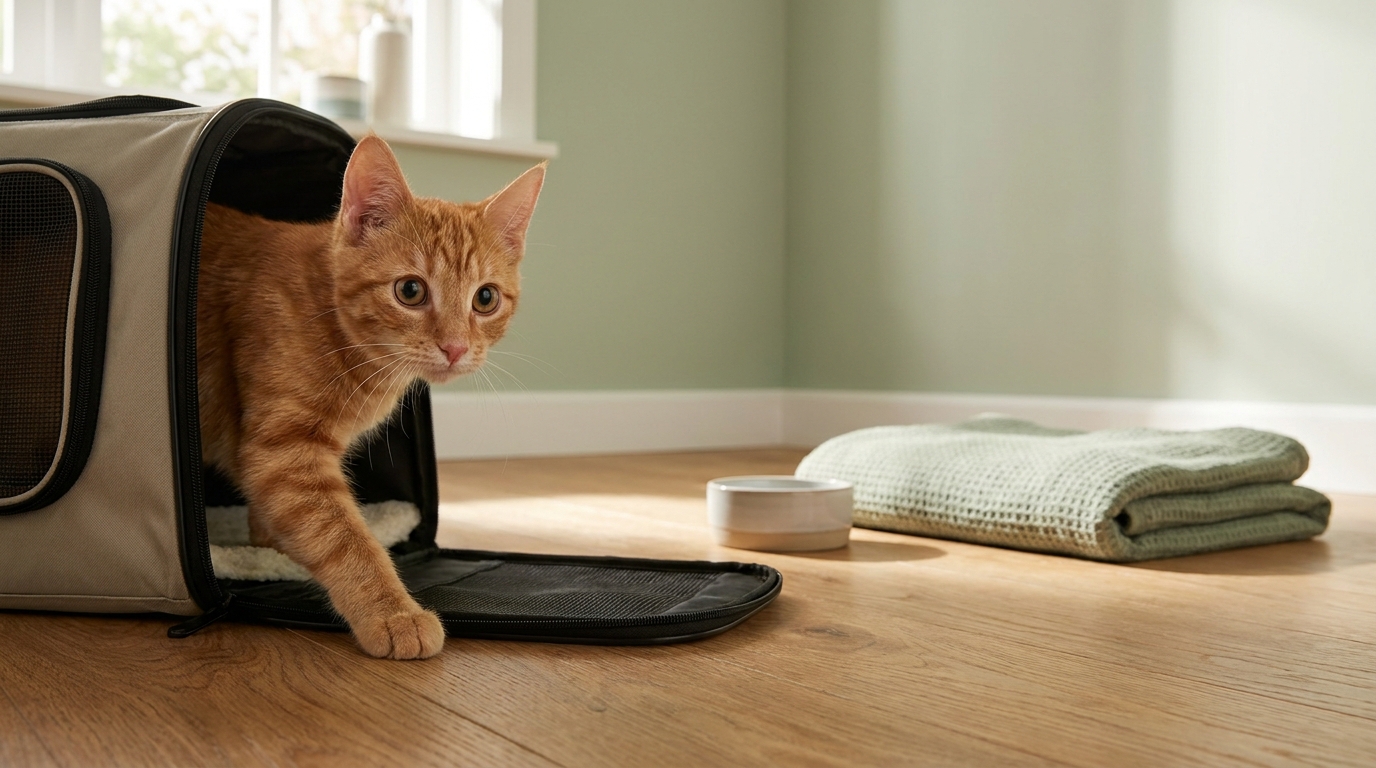
Hiding and sneezing are common in a new cat's first two weeks. Not eating for 24 hours isn't. A day-by-day guide to stress vs. sickness.
Quick answer: In the first 14 days, hiding is normal and mild sneezing is common while your new cat still eats, drinks, pees and poops. Call a vet if an adult cat eats nothing for 24 hours, or the same day if a kitten refuses food. Go to an emergency vet now for open-mouth or labored breathing, straining with little or no urine, or a kitten that is vomiting and lethargic.
This article is general information, not a diagnosis. If you think your cat is in danger, go to the nearest emergency animal hospital.
Emergency Red Flags: When to Seek Immediate Care
Don't wait for the shelter's callback hours, a booked appointment or a video visit if your new cat or kitten has any of these. Go to an emergency vet now and call on the way.
- Trouble breathing: open-mouth breathing, panting, a heaving belly, the neck stretched out to breathe, or blue, gray or white gums. Cornell advises getting a cat to a vet right away whenever there is any doubt about its ability to breathe comfortably.
- Straining to pee: repeated trips to the litter box or crying while passing little or no urine, especially in a male cat. It is easy to mistake for constipation. A blockage can kill in under 24 to 48 hours, and Cornell notes that the stress of a move can raise the risk of urinary problems.
- A sick kitten: a kitten under 5 months that is vomiting or has diarrhea, especially bloody, together with lethargy, fever or not eating. This can be panleukopenia, which Merck warns can kill with little or no warning. Keep the kitten away from other cats on the way.
- A very young kitten: a kitten under 4 weeks old that won't nurse or eat, or is weak, cold to the touch or having seizures.
- Lilies: any contact with true lilies or daylilies, including pollen licked off fur or the water in a vase. Treatment delayed 18 hours or more generally means permanent kidney failure, and welcome-home bouquets are a real risk. See what to do if your cat touched a lily.
- Dog flea products: a dog-only flea treatment (permethrin) put on your cat, or your cat grooming a freshly treated dog. Go even if your cat seems fine, because tremors, twitching, drooling or seizures can start within hours.
- Human medicines: any human medicine your cat swallowed or was given, including pain relievers and cold medicines, even if it seems fine.
- Collapse or seizures in any cat.
- Severe signs in a sneezing cat: swelling of the face or legs, sores on the paws or nose, yellow skin or bleeding.
The 3-3-3 Rule: How New Cats Adjust
Many shelters hand out the "3-3-3 rule": about 3 days to decompress, 3 weeks to learn the routine and 3 months to feel at home. It's a helpful rule of thumb, not research, and every cat adjusts at its own pace.
Hiding is one of the most common things newly adopted cats do. Some come out within a few hours; others take a few days or even a couple of weeks. Adults usually take longer than kittens. In a small follow-up study from a New Zealand shelter, spending most of the time hiding was the most common behavior problem in adult cats, and one month after adoption 95% of kittens but only 75% of adults had settled well.
The one rule that matters more than any timeline: hiding is normal only while your cat is eating, drinking, peeing and pooping. Some shelter guides say a new cat may not want to eat or drink for the first few days. Eating less is common; eating nothing for 24 hours is not. Cornell lists hiding among the signs of fatty liver disease, which almost always follows or comes with not eating, so a cat that hides and doesn't eat isn't simply adjusting. More on hiding in our guide to why cats hide.
Give your new cat one quiet room with its own litter box, food, water, a hiding spot and somewhere high to sit. Keep the shelter's food for now, and let the cat come to you.
Day by Day: What to Expect in the First Two Weeks
Each table below assumes your cat is eating, drinking, peeing and pooping. If you see any emergency sign above, skip the tables and go.
Hiding
| Days | Usually OK | Call a vet |
|---|---|---|
| 0-3 | Hides most of the day, comes out at night | Adult eats nothing for 24 hours; kitten skips meals (same day) |
| 4-7 | Short trips out, explores the room | Hiding with lethargy, drooling or yellow gums (same day) |
| 8-14 | Many adults still shy; kittens settle faster | No progress at all by about 2 weeks (behavior check) |
Appetite
| Days | Usually OK | Call a vet |
|---|---|---|
| 0-3 | Eats less than usual, often at night | Adult: nothing for 24 hours. Kitten: refuses food (same day) |
| 4-7 | Appetite climbing back on the shelter food | Still eating very little; any weight loss in a kitten |
| 8-14 | Eating normally; a slow food switch can start | A new drop in appetite, especially with sneezing |
Sneezing and runny eyes or nose
| Days | Usually OK | Call a vet |
|---|---|---|
| 0-3 | A few sneezes, clear discharge, eating well | Green or yellow discharge; mouth ulcers or drooling; not eating |
| 4-7 | Mild signs often start now | Squinting or a cloudy eye (same day, in person); much less active |
| 8-14 | Mild cases improving, often within 1-2 weeks | No better after a week of home care, or getting worse |
Diarrhea
| Days | Usually OK | Call a vet |
|---|---|---|
| 0-3 | Slightly soft stool; cat bright and eating | Adult: lasts over 24 hours. Kitten: same day; emergency vet if also vomiting, lethargic or not eating |
| 4-7 | Firming up on the same food | Blood in the stool, weight loss, still loose |
| 8-14 | Normal stool | Comes back or never settled: ask for a fecal test |
Worms and parasites
| Days | Usually OK | Call a vet |
|---|---|---|
| 0-3 | Dewormer dates on the shelter paperwork | No dates? Bring a fresh stool sample to the first vet visit |
| 4-7 | First vet exam and fecal test | Worms in stool or vomit; a pot belly in a kitten |
| 8-14 | Repeat deworming on your vet's schedule | Diarrhea despite deworming |
More on when to call a vet
Not eating. UC Davis shelter medicine guidance says to contact a vet if a cat has eaten nothing for more than 24 hours. Kittens and overweight cats shouldn't wait even that long. A cat that stops eating can develop hepatic lipidosis (fatty liver), the most common serious liver disease in cats; overweight cats are at the highest risk, and the stress of a new home can be what stops them eating. Feline specialists aim to start assisted feeding no later than day 3 without food, counting days already missed at home, so the vet visit needs to come well before that. Don't force-feed, and don't switch foods while your cat is barely eating. If your cat isn't eating and you see yellow gums or ear skin or drooling, get it seen in person the same day. Extreme weakness with the head hanging down means an emergency vet now.
Sneezing. Sneezing that starts a few days after a cat comes home is common. Respiratory viruses take about 2 to 10 days to show signs, and up to 97% of cats are exposed to feline herpesvirus, which stays in the body for life and can flare when a cat is stressed. A move is one of the triggers. Mild cases with clear discharge in a cat that is eating often get better in 1 to 2 weeks. Signs are most common in kittens 8 to 12 weeks old, and young kittens fare worst, so call a vet sooner for them. A squinting, shut or cloudy eye needs a same-day in-person exam, because herpes can cause corneal ulcers, and leftover or over-the-counter eye drops can make things worse. For more, see our guide to upper respiratory infections in cats.
Diarrhea and worms. Most shelter animals arrive with at least one intestinal parasite, and shelters routinely deworm at intake and hand follow-up to your vet. A routine dewormer doesn't cover every parasite. Coccidia (found in 3% to 36% of cats in North America, most often young ones) and Giardia need a fecal test and different treatment. That's why diarrhea that persists after deworming is a reason to test, not a sign anyone made a mistake. Our guides to kitten diarrhea and worms in cats go deeper.
Stress or Sick? When a Video Visit Is the Right First Step
This section is for a cat with none of the emergency signs above, when you can't tell stress from sickness. If you are still inside the shelter's post-adoption medical window, call the shelter first for non-emergencies, because using another clinic can void that coverage.
Otherwise, a live video visit is a reasonable first step. For $64.99, a RexVet veterinarian licensed in Florida, New York or Virginia can watch your cat breathe, move and eat on camera, look at photos of its eyes, nose and stool, and go through the shelter paperwork, including vaccine, deworming and FeLV/FIV test dates. The vet can help you build a food and introduction plan, tell you whether your cat needs an in-person exam today or whether your first-week vet visit is soon enough, and point you to nearby in-person and emergency clinics. If medication might help, the vet will tell you whether it can be prescribed after a video visit under your state's rules or whether your cat needs to be seen in person first.
Adopted two cats, or expecting follow-up questions? The $120 Family Plan is a one-time payment for 4 visits over 12 months, which you can use for any pet in your home. There is no subscription. RexVet is a 501(c)(3) nonprofit. A video visit does not replace your cat's first in-person exam, vaccines, FeLV/FIV testing or fecal tests.
Book a live video visit, or read more about seeing an online vet for your cat.
Where to Go: Emergency, Same Day or Home
| Sign | Where | When |
|---|---|---|
| Open-mouth or labored breathing; blue, gray or white gums | Emergency vet | Now |
| Straining with little or no urine | Emergency vet | Now |
| Kitten vomiting or with diarrhea, and lethargic, feverish or not eating | Emergency vet | Now |
| Kitten under 4 weeks not nursing, weak or cold | Emergency vet | Now |
| Lily contact, a dog flea product on the cat, or any human medicine swallowed | Emergency vet | Now |
| Collapse or seizures; face or leg swelling, paw or nose sores, yellow skin or bleeding in a sneezing cat | Emergency vet | Now |
| Not eating with extreme weakness or a hanging head | Emergency vet | Now |
| Not eating with yellow gums or drooling | In-person vet | Same day |
| Adult has eaten nothing for 24 hours (sooner if overweight) | Vet (a video visit can triage) | Same day |
| Kitten refusing food but alert | Vet | Same day |
| Squinting, cloudy or shut eye | In-person vet | Same day |
| Green or yellow discharge, cat still bright | Shelter clinic or vet | Within 24 hours |
| Hiding but eating and using the box | Home | Keep watching |
| Every new cat | First vet exam | Within a week |
A few more signs deserve a call: no urine in the litter box in 24 hours (don't wait that long with a male cat, who may be straining out of sight), repeated vomiting, not drinking on top of not eating, sticky or dry gums, resting breathing above 35 breaths a minute or a cough that won't stop, mouth ulcers or drooling that stop your cat eating, a kitten that is losing weight or not gaining (weigh young kittens daily on a kitchen scale), and a kitten or cat that may have swallowed string, ribbon, hair ties or small objects. If string is hanging from the mouth or under the tail, don't pull it, and if the cat is also vomiting or not eating, go to an emergency vet.
Shelter History vs. Your Ongoing Care Responsibilities
Shelters do a lot of medical work before a cat goes home, and they hand the next steps to you and your vet. The CDC advises taking a new cat or kitten to a vet within a few days to a week after adoption. Bring the shelter paperwork and check it for these:
| Item | Look for | Still on you |
|---|---|---|
| Vaccines | First combo doses and dates | Kittens: boosters every 3-4 weeks until 16-20 weeks |
| Deworming | Dewormer and date | Fecal tests (kittens 4+ in year one), repeat doses |
| FeLV/FIV test | Result and date | Test soon if not done; your vet may advise a retest |
| Exam, spay or neuter | Intake exam notes | Your own vet's exam within a week |
| Medical window | Days covered, which clinic | Call the shelter first for non-emergencies |
Many shelters offer a post-adoption medical window; the examples we found run 10 to 14 days and often cover respiratory infections, infectious diarrhea and parasites at the shelter's clinic. Terms vary, they often exclude emergencies and after-hours care, and seeing another clinic first can void them, so read yours. For an emergency, go to the nearest emergency vet regardless.
Vaccines, FeLV/FIV tests and fecal tests all happen in person. The kitten vaccine series continues every 3 to 4 weeks until 16 to 20 weeks of age, and cats first vaccinated after 16 weeks need one or two doses, depending on the vaccine. If your cat may have been exposed recently, a negative test may need repeating: after 30 days for FeLV or 60 days for FIV. A kitten under 6 months can test FIV-positive from its mother's antibodies without being infected, so ask your vet about retesting before drawing conclusions. Our kitten care guide covers the first year.
Safe Room Setup, Introductions and Hygiene
Keep the new cat in its own room with its own litter box and bowls, at least until its FeLV/FIV results are back. If you have resident cats, the ABCD guidelines suggest about three weeks before introducing a new cat to a household free of calicivirus. Once the new cat is healthy, with no sneezing or diarrhea, and its test results are back, swap bedding so the cats learn each other's scent before they meet. Until then, keep bedding, bowls and toys separate and wash your hands between cats. Separation lowers the risk but can't guarantee anything, because many cats carry herpesvirus for life. If your older cat stops eating when the newcomer arrives, see what to do when an older cat stops eating after a new kitten.
A few infections can pass from cats to people, including roundworms, hookworms, ringworm (a fungus, not a worm) and cat scratch disease. The CDC's advice is simple:
- Wash your hands with soap and running water after handling your cat, its bowls or the litter box.
- Pregnant people and anyone with a weakened immune system should avoid cleaning the litter box if possible.
- Avoid rough play, especially with kittens, and wash any scratch right away.
- Use only cat-safe flea control from your vet. Never use dog flea products containing permethrin on a cat.
- If you get a fever or tender, swollen lymph nodes 1 to 3 weeks after a scratch, or any other symptom you're worried about, see your own doctor.
Cat-proof the safe room too: put away string, ribbon, hair ties and small objects, keep lilies out of the house entirely, and keep human medicines out of reach. Adopted a dog as well? See our guide to a newly adopted dog that isn't eating.
Frequently Asked Questions
How long is it normal for a newly adopted cat to hide?
Anywhere from a few hours to a couple of weeks is common, and adult cats usually take longer than kittens. In one small shelter follow-up study, only 75% of adults had settled well after a month, compared with 95% of kittens. Hiding is normal only while your cat is eating, drinking, peeing and pooping. Hiding plus not eating needs a vet call, because hiding is also a sign of fatty liver disease.
How long can a new cat go without eating before I should worry?
Eating less for the first few days is common; eating nothing is not. Call a vet if an adult cat has eaten nothing for 24 hours. If a kitten refuses food, call the same day, and a kitten under 4 weeks that won't nurse or eat is an emergency. Overweight cats are at the highest risk of fatty liver disease, so don't wait the full 24 hours with one. Don't force-feed, and don't switch foods while your cat is barely eating.
My new cat started sneezing a few days after I brought it home. Is that normal?
It's common. Many cats carry feline herpesvirus for life, and the stress of a move can reactivate it. Respiratory viruses also take about 2 to 10 days to show signs, so sneezing often starts a few days after a cat comes home. Mild sneezing with clear discharge in a cat that is eating often gets better in 1 to 2 weeks. Call a vet for green or yellow discharge, 24 hours without eating, mouth ulcers or no improvement after a week, and get a squinting or cloudy eye seen in person the same day. Open-mouth or labored breathing means the emergency vet, now.
Should I call the shelter or my own vet first?
For a non-emergency inside the shelter's post-adoption medical window, call the shelter first, because seeing another clinic can void that coverage. These plans usually exclude emergencies, so for breathing trouble, straining to urinate or a vomiting, lethargic kitten, go straight to the nearest emergency vet. Either way, book a first exam with your own vet within a week of adoption, as the CDC advises.
How long should I keep my new cat away from my other cats?
At least until the new cat's FeLV/FIV test results are back, in its own room with its own litter box and bowls. The ABCD guidelines suggest about three weeks before introducing a new cat to a household free of calicivirus. Wash your hands between cats. Separation lowers the risk but can't guarantee anything.
Does lysine help a new cat's sneezing?
No. A 2015 systematic review found no evidence that lysine prevents or treats feline herpesvirus, and some studies reported more infection and worse disease in cats given it. Cornell notes it may worsen symptoms. Never give a cat human cold or allergy medicines, and check with your vet before starting any supplement.
Can I catch anything from my new cat?
Some infections can pass from cats to people, including roundworms, hookworms, ringworm and cat scratch disease. Wash your hands after handling the cat, its bowls or the litter box, and pregnant people and anyone with a weakened immune system should avoid the litter box if possible. If you develop symptoms, including a fever or swollen lymph nodes after a scratch, see your own doctor.
Can a vet video visit help with a newly adopted cat?
Yes, when there are no emergency signs and you can't tell stress from sickness. A RexVet vet licensed in Florida, New York or Virginia can watch your cat breathe and eat on camera, review photos and shelter paperwork, help plan food changes and introductions, and tell you whether your cat needs an in-person exam today. Visits are $64.99, or $120 one-time for the Family Plan (4 visits over 12 months, no subscription). A video visit doesn't replace the first in-person exam, vaccines, FeLV/FIV testing or fecal tests, and any medication is the vet's decision under state law. If you're still in the shelter's post-adoption window, call the shelter first.
FAQs
How long is it normal for a newly adopted cat to hide?
Anywhere from a few hours to a couple of weeks is common, and adult cats usually take longer than kittens. In one small shelter follow-up study, only 75% of adults had settled well after a month, compared with 95% of kittens. Hiding is normal only while your cat is eating, drinking, peeing and pooping. Hiding plus not eating needs a vet call, because hiding is also a sign of fatty liver disease.
How long can a new cat go without eating before I should worry?
Eating less for the first few days is common; eating nothing is not. Call a vet if an adult cat has eaten nothing for 24 hours. If a kitten refuses food, call the same day, and a kitten under 4 weeks that won't nurse or eat is an emergency. Overweight cats are at the highest risk of fatty liver disease, so don't wait the full 24 hours with one. Don't force-feed, and don't switch foods while your cat is barely eating.
My new cat started sneezing a few days after I brought it home. Is that normal?
It's common. Many cats carry feline herpesvirus for life, and the stress of a move can reactivate it. Respiratory viruses also take about 2 to 10 days to show signs, so sneezing often starts a few days after a cat comes home. Mild sneezing with clear discharge in a cat that is eating often gets better in 1 to 2 weeks. Call a vet for green or yellow discharge, 24 hours without eating, mouth ulcers or no improvement after a week, and get a squinting or cloudy eye seen in person the same day. Open-mouth or labored breathing means the emergency vet, now.
Should I call the shelter or my own vet first?
For a non-emergency inside the shelter's post-adoption medical window, call the shelter first, because seeing another clinic can void that coverage. These plans usually exclude emergencies, so for breathing trouble, straining to urinate or a vomiting, lethargic kitten, go straight to the nearest emergency vet. Either way, book a first exam with your own vet within a week of adoption, as the CDC advises.
How long should I keep my new cat away from my other cats?
At least until the new cat's FeLV/FIV test results are back, in its own room with its own litter box and bowls. The ABCD guidelines suggest about three weeks before introducing a new cat to a household free of calicivirus. Wash your hands between cats. Separation lowers the risk but can't guarantee anything.
Does lysine help a new cat's sneezing?
No. A 2015 systematic review found no evidence that lysine prevents or treats feline herpesvirus, and some studies reported more infection and worse disease in cats given it. Cornell notes it may worsen symptoms. Never give a cat human cold or allergy medicines, and check with your vet before starting any supplement.
Can I catch anything from my new cat?
Some infections can pass from cats to people, including roundworms, hookworms, ringworm and cat scratch disease. Wash your hands after handling the cat, its bowls or the litter box, and pregnant people and anyone with a weakened immune system should avoid the litter box if possible. If you develop symptoms, including a fever or swollen lymph nodes after a scratch, see your own doctor.
Can a vet video visit help with a newly adopted cat?
Yes, when there are no emergency signs and you can't tell stress from sickness. A RexVet vet licensed in Florida, New York or Virginia can watch your cat breathe and eat on camera, review photos and shelter paperwork, help plan food changes and introductions, and tell you whether your cat needs an in-person exam today. Visits are $64.99, or $120 one-time for the Family Plan (4 visits over 12 months, no subscription). A video visit doesn't replace the first in-person exam, vaccines, FeLV/FIV testing or fecal tests, and any medication is the vet's decision under state law. If you're still in the shelter's post-adoption window, call the shelter first.
Medically Reviewed
Reviewed by Dr. Tiffany Delacruz, DVM — licensed veterinarian and CEO of RexVet. Last reviewed October 12, 2026.
Content is for informational purposes and does not replace professional veterinary advice.
Chief Executive Officer · Licensed Veterinarian
Dr. Delacruz is a licensed Doctor of Veterinary Medicine specializing in preventive care and veterinary telehealth. She reviews all health content on RexVet to ensure accuracy and clinical relevance.
Sources & References
- · American Veterinary Medical Association — Telehealth Guidelines
- · AVMA — Pet Care Resources
- · U.S. FDA — Animal & Veterinary
Need an Expert Opinion on This Topic?
Connect with a certified vet via video call in minutes
Talk to Vet Now