
Cat Scared of Fireworks on New Years Eve: How to Help
By RexVet Team | Reviewed by Dr. Tiffany Delacruz, DVM
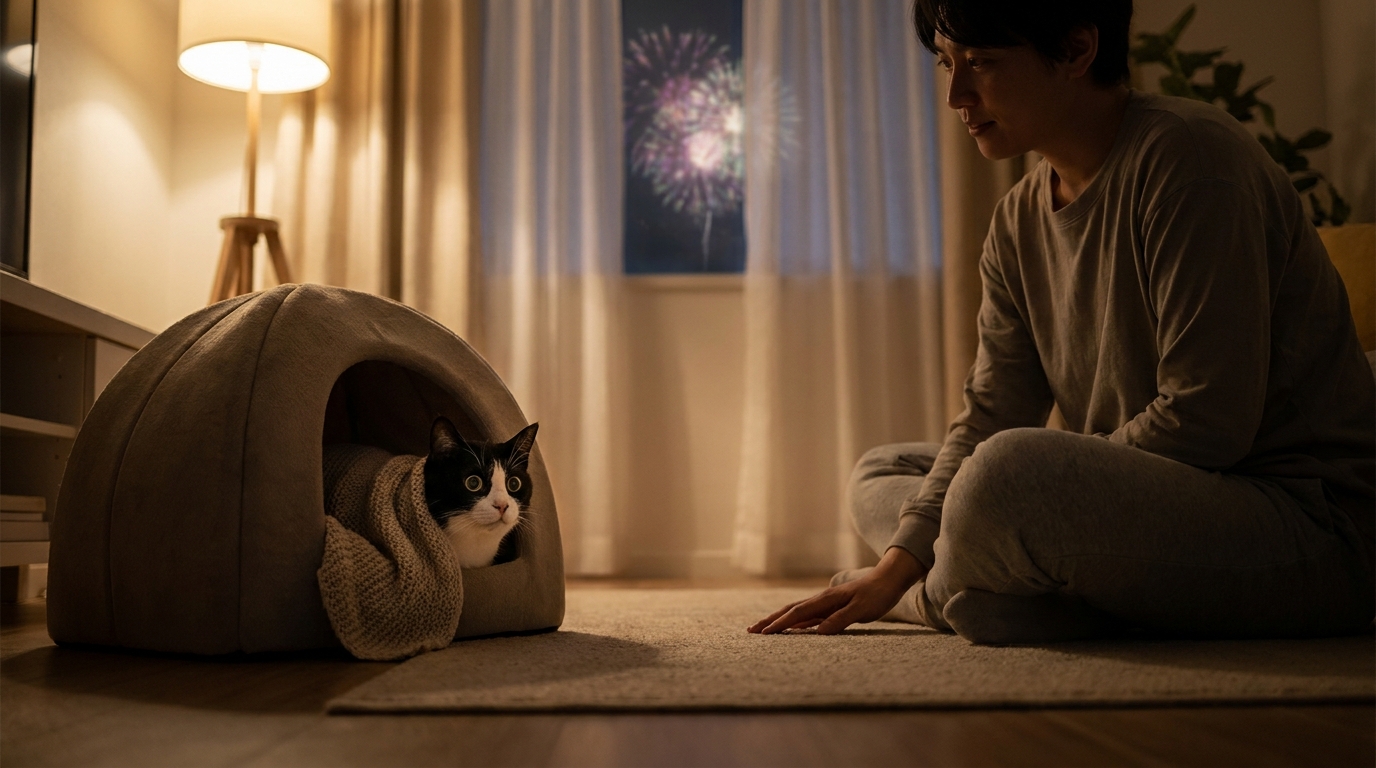
A New Year's Eve plan for a frightened cat: a safe room, what to skip on the night, calming medicine limits and the signs that mean an ER.
Quick answer: Most cats cope with New Year's Eve fireworks best when they can hide: keep your cat indoors, close windows, curtains and pet doors, and set up a quiet room with litter, water, food and a hiding spot days ahead. Go to an emergency vet now if your cat is injured, keeps open-mouth breathing for more than a few minutes, even during fireworks, or strains to pee with little or no urine.
This article is general information, not a diagnosis. If you think your pet is in danger, go to the nearest emergency animal hospital.
Emergency signs during or after fireworks
A cat that was hurt while bolting, was burned by a sparkler or firework, has an eye injury or fell from a window or balcony needs an emergency vet now, even if it seems fine. So does a cat that keeps open-mouth breathing for more than a few minutes, even while fireworks are still going off (or starts again at rest), or strains in the litter box with little or no urine (especially a male). Cornell's Feline Health Center says a blocked cat can die in less than 24 to 48 hours. Blue, gray or pale gums, collapse, back legs that suddenly drag, cold or pale paws (a possible blood clot) or a seizure also mean go now. A cat that pants or open-mouth breathes every time it is frightened, or with only mild stress, needs an in-person heart and lung check before the holiday.
| Sign | Do this |
|---|---|
| Hides, still eats and pees | Let it hide |
| Open-mouth breathing stops within a few minutes | Watch closely |
| Open-mouth breathing keeps going | ER now |
| Blue, gray or pale gums | ER now |
| Back legs suddenly drag | ER now |
| Hurt, bleeding or fell | ER now |
| Straining, little or no urine | ER now |
| Lily, oils, alcohol or pills | ER now |
| Ate fireworks | ER now |
| Swallowed ribbon or string | ER now |
| No urine in 24 hours | Male: ER now; others: vet today |
| Adult eats nothing for 24 hours | Vet today |
| Many trips, small pees | Male: ER now; others: vet today |
"ER now" for a toxin means go, and call a poison line on the way: ASPCA Animal Poison Control, (888) 426-4435 (a consultation fee may apply), or Pet Poison Helpline, (855) 764-7661 (a per-incident fee applies). Many regular vet clinics are closed on Jan 1; if yours is, "vet today" means the nearest emergency vet.
Why fireworks scare cats
Fireworks scare cats because they bring sudden, unpredictable bangs, high-pitched whistles a cat hears well, flashes and smoke smell, so fear is a normal reaction, not bad behavior. A cat hears much higher pitches than a person: a classic Heffner and Heffner study measured cat hearing from 48 Hz up to 85,000 Hz at a loud test level, one of the broadest hearing ranges among mammals. The Merck Veterinary Manual lists fireworks and thunder among noises that frighten cats, and says a frightened cat often withdraws and hides.
One finding from RexVet's visit data study: Anxiety visits spiked around the Fourth of July: 15% of RexVet visits from June 28 to July 8 named anxiety, compared with 9% during the rest of the summer. Those figures cover dogs and cats together.
Before the night: set up a safe room
A cat's New Year's Eve safe room should be an interior room with litter, water, food and a covered bed or box up high, set up days before December 31. The AAFP and ISFM guidelines call a safe place a cat's first essential: a private spot, often up high, such as a box on its side or an open carrier that smells familiar. Leave the carrier open there (see carrier training for an anxious cat), and block risky spots such as the dryer and gaps behind appliances.
Check that your cat's microchip registry has your current phone number; in a 2009 JAVMA study of 53 shelters, a wrong or disconnected number was the top reason owners of microchipped pets could not be reached.
On the night: what helps
On New Year's Eve, keep your cat indoors, shut it in its safe room before dark and before guests arrive, close windows, curtains and pet doors, play quiet music, stay home if you can, and let your cat hide. The ASPCA advises keeping cats indoors during the height of the fireworks. Fireworks often go off over several nights around Dec 31 and Jan 1; for local timing and a dog in the same home, see helping a dog through New Year's Eve fireworks. Ask guests to keep outside doors shut (see keeping holiday guest visits calm).
Lock away fireworks, matches, glow sticks and drinks: the ASPCA says the liquid in glow jewelry is not highly toxic but can cause heavy drooling and stomach upset, swallowed plastic pieces can block the gut, and alcohol can cause weakness and coma. Call a poison line or a vet if your cat bit a glow stick or glow jewelry and keeps drooling or vomiting, or may have swallowed plastic pieces. A cat that drank alcohol, or chewed or ate any fireworks, including snake fireworks, needs an emergency vet now; call a poison line on the way. Any contact with true lilies or daylilies, or swallowed ribbon, string or tinsel, means an emergency vet now, even if your cat seems fine; never pull or cut string at the mouth or bottom.
What not to do
Do not pull a cat out of hiding, pick it up or hold it, punish accidents, or try a new medicine or supplement for the first time on New Year's Eve. International Cat Care says picking a cat up more than it is comfortable with, and punishing it, raise stress and damage trust, so let the cat choose when to make contact. If your cat comes to you, quiet petting is fine.
Calming products and medicine for cats
Pheromone diffusers may help some cats, and any calming medicine should be chosen by a veterinarian who has examined your cat and tested at home on a quiet day well before December 31. The evidence on pheromones is mixed: a 2010 JAVMA review covering cats and dogs found too little evidence in 11 of 14 reports. The FDA says there is no "dietary supplement" regulatory classification for animal food substances and products, so calming chews and supplements are not FDA-approved medicines. Skip essential-oil diffusers, sprays, plug-ins and potpourri: the ASPCA says cats are especially sensitive to essential oils (see essential oils and potpourri around cats). A cat that licked a concentrated essential oil or liquid potpourri, or got it on its fur, needs an emergency vet now, even if it seems fine; call a poison line on the way.
Bonqat (pregabalin oral solution) is FDA-approved, by prescription only, to ease acute anxiety and fear linked to car trips and vet visits in cats; fireworks are not on its label, so using it for New Year's Eve is an off-label decision for a veterinarian who has examined your cat. Vets also use gabapentin, a human-labeled drug, off-label in cats. The Merck Veterinary Manual advises trying a calming medicine in advance, because cats respond differently. Pregabalin is a federal Schedule V controlled drug, and gabapentin is a Schedule V controlled drug in Virginia (it is not federally controlled).
Never give a cat a human sleep aid, a "PM" or cold and flu product, acetaminophen (Tylenol), a dog's calming product or someone else's pills; if your cat swallowed one, go to an emergency vet now and call a poison line on the way.
After the fireworks: hiding, not eating and litter box changes
Hiding after fireworks is normal while a cat still eats, drinks, pees and poops, but an adult cat that eats nothing for about 24 hours, or a female cat that pees often in small amounts, needs a vet the same day; a male cat that pees often in small amounts needs an emergency vet now. Call sooner for a senior, overweight or diabetic cat, and the same day if a kitten refuses food; the Merck Veterinary Manual says not eating sets the stage for fatty liver disease in overweight cats. Keep food, water and litter near the hiding spot, as for a newly adopted cat that hides. A cat, especially a male, that strains with little or no urine needs an emergency vet now.
Multi-cat homes: fights after the noise
A cat frightened by fireworks can redirect its aggression onto another cat in the home, so separate cats that fight into different rooms with the doors closed and reintroduce them slowly, starting with scent. Never reach between fighting cats or touch a cat that is hissing or growling, because a frightened cat can turn its aggression on a person; use a large towel, blanket or sheet of cardboard. The AAFP's 2024 intercat tension guidelines say to keep cats apart until both are calm and back to normal routines, which can take a few hours to a couple of days. If fighting keeps up, call a vet or a board-certified veterinary behaviorist.
If your cat gets out
Search close to home first: an escaped indoor cat usually hides nearby, under a porch, deck or car, so search slowly at night with a flashlight, ask neighbors to check sheds and garages, and alert local shelters. In a study of 1,210 missing cats in the journal Animals, 75% of the indoor-only cats that were found were within about 450 feet of where they got out. Shelters often hold strays for only a few business days, so visit early. A cat found outside that is cold to the touch and sluggish, limp or breathing slowly, or reads below 99F after time in the cold, needs an emergency vet now (see how cold is too cold for cats).
When a video visit helps
RexVet, a nonprofit online vet service, serves pets located in Florida, New York and Virginia by video visit, and booking by mid-December leaves time for any in-person exam the veterinarian recommends and for testing anything new at home before New Year's Eve. If your cat panics, hides without eating or has had litter-box trouble with loud noises, book a $64.99 live video visit with a licensed RexVet vet, a veterinarian licensed in your pet's state; your cat must be in one of those states during the visit.
The veterinarian goes over past reactions, home videos, your setup and other pets, helps plan the night, and tells you whether your cat needs an in-person exam, for example for urinary trouble. RexVet does not prescribe controlled substances by video. No prescription is promised; any medicine is the veterinarian's decision after the visit. In every state, federal rules require an in-person exam before a cat gets a human-labeled drug such as gabapentin, or an approved drug such as Bonqat used off its label. RexVet is not a pharmacy; a pharmacy transfer fee applies if a prescription is sent to one.
Live video slots run about 8 AM to 11 PM ET and midnight on New Year's Eve falls outside that window; there are no overnight visits. Holiday availability isn't confirmed, so book ahead. The one-time $120 Family Plan covers 4 visits over 12 months for every pet in the home and never auto-renews.
Video is not for emergencies: an injury, open-mouth breathing that does not settle within a few minutes, blue, gray or pale gums, collapse, or straining with little or no urine needs an emergency vet now. If no video slot is open, or it is late and you are worried, go to the nearest emergency vet instead of waiting.
Need an Expert Opinion on This Topic?
Book a video visit with a licensed vet, evenings and weekends included
See open timesFrequently Asked Questions
Are fireworks bad for my cat's ears?
Usually the bigger risk is fear, not deafness. The Merck Veterinary Manual lists noise trauma among causes of permanent hearing loss in animals, so keep your cat indoors and away from launch sites. If your cat seems not to respond to sounds after the holiday, ask a vet to check.
Should I stay home with my cat on New Year's Eve?
Yes, stay home if you can, check on your cat quietly and let it hide. The ASPCA advises keeping cats indoors during the height of the fireworks, checking in on them and playing quiet music. Shut your cat in its safe room before guests arrive and before dark, and if it stays hidden, leave it there.
Can I give my cat Benadryl or melatonin for fireworks?
No, not without a vet's advice: Benadryl is only a mild sedative and can make some cats excited instead. VCA notes its use in pets is off-label. Melatonin needs a vet's OK too: vets sometimes use melatonin off-label in cats, but research in cats is limited. Never use slow-release melatonin or one that lists xylitol, birch sugar, wood sugar or 5-HTP. Never give a cat a human sleep aid, a "PM" or cold and flu product, acetaminophen (Tylenol) or someone else's pills; if your cat swallowed one, go to an emergency vet now and call a poison line on the way.
How long will my cat hide after fireworks?
There is no set time: hiding is normal as long as your cat still eats, drinks, pees and poops. Call a vet the same day if an adult cat eats nothing for about 24 hours (sooner if senior, overweight or diabetic) or a kitten refuses food.
My cat peed on the bed after the fireworks. Why would it do that?
One accident during fireworks can be fear, but stress can also trigger a painful bladder flare, so watch the litter box for several days. International Cat Care says a stressful event can trigger feline idiopathic cystitis, and that cats with it have no bacterial infection, so never give antibiotics on your own. Call a vet the same day for blood in the urine, or for a female cat that makes repeated trips to the box, passes small amounts or has no urine in 24 hours. A male cat making repeated trips with small amounts, a male cat with no urine in 24 hours, or any cat, especially a male, that strains with little or no urine needs an emergency vet now. Do not punish the accident.
Can an online vet prescribe calming medicine for my cat in Florida, New York or Virginia?
Usually not by video alone: cat calming medicines for fireworks are controlled, off-label or human-labeled, so they need an in-person exam first. RexVet does not prescribe controlled substances by video, and no prescription is promised. On a video visit for a cat located in Florida, New York or Virginia, the veterinarian can review past reactions, check the safe-room setup and help sort fear from signs of illness; calming prescriptions, bloodwork, urine tests and injuries need an in-person visit, and breathing trouble or straining to pee means an emergency vet now. In every state, federal rules require an in-person exam before a cat gets a human-labeled drug such as gabapentin, or an approved drug such as Bonqat used off its label. In Florida, a vet who has only seen your cat on video generally cannot prescribe calming medicine for fireworks: Florida law (s. 474.2021) limits telehealth-only prescriptions to FDA-approved animal drugs used on-label, for up to 14 days, and bars human-labeled and controlled drugs without an in-person exam. In Virginia the exam may be electronic, but federal rules still require an in-person exam for off-label or human-labeled calming drugs, and both pregabalin and gabapentin are controlled there. New York rules for video-only prescribing are still unsettled.
My cat ran away during the fireworks. Where should I look first?
Look close to home first: a frightened indoor cat usually hides nearby, under a porch, deck or car. Search slowly at night with a flashlight, ask neighbors to check their sheds and garages, and visit local shelters and animal control in person early with your cat's microchip number, because shelters often hold strays for only a few business days. A cat found outside that is cold to the touch and sluggish, limp or breathing slowly needs an emergency vet now.
FAQs
Are fireworks bad for my cat's ears?
Usually the bigger risk is fear, not deafness. The Merck Veterinary Manual lists noise trauma among causes of permanent hearing loss in animals, so keep your cat indoors and away from launch sites. If your cat seems not to respond to sounds after the holiday, ask a vet to check.
Should I stay home with my cat on New Year's Eve?
Yes, stay home if you can, check on your cat quietly and let it hide. The ASPCA advises keeping cats indoors during the height of the fireworks, checking in on them and playing quiet music. Shut your cat in its safe room before guests arrive and before dark, and if it stays hidden, leave it there.
Can I give my cat Benadryl or melatonin for fireworks?
No, not without a vet's advice: Benadryl is only a mild sedative and can make some cats excited instead. VCA notes its use in pets is off-label. Melatonin needs a vet's OK too: vets sometimes use melatonin off-label in cats, but research in cats is limited. Never use slow-release melatonin or one that lists xylitol, birch sugar, wood sugar or 5-HTP. Never give a cat a human sleep aid, a "PM" or cold and flu product, acetaminophen (Tylenol) or someone else's pills; if your cat swallowed one, go to an emergency vet now and call a poison line on the way.
How long will my cat hide after fireworks?
There is no set time: hiding is normal as long as your cat still eats, drinks, pees and poops. Call a vet the same day if an adult cat eats nothing for about 24 hours (sooner if senior, overweight or diabetic) or a kitten refuses food.
My cat peed on the bed after the fireworks. Why would it do that?
One accident during fireworks can be fear, but stress can also trigger a painful bladder flare, so watch the litter box for several days. International Cat Care says a stressful event can trigger feline idiopathic cystitis, and that cats with it have no bacterial infection, so never give antibiotics on your own. Call a vet the same day for blood in the urine, or for a female cat that makes repeated trips to the box, passes small amounts or has no urine in 24 hours. A male cat making repeated trips with small amounts, a male cat with no urine in 24 hours, or any cat, especially a male, that strains with little or no urine needs an emergency vet now. Do not punish the accident.
Can an online vet prescribe calming medicine for my cat in Florida, New York or Virginia?
Usually not by video alone: cat calming medicines for fireworks are controlled, off-label or human-labeled, so they need an in-person exam first. RexVet does not prescribe controlled substances by video, and no prescription is promised. On a video visit for a cat located in Florida, New York or Virginia, the veterinarian can review past reactions, check the safe-room setup and help sort fear from signs of illness; calming prescriptions, bloodwork, urine tests and injuries need an in-person visit, and breathing trouble or straining to pee means an emergency vet now. In every state, federal rules require an in-person exam before a cat gets a human-labeled drug such as gabapentin, or an approved drug such as Bonqat used off its label. In Florida, a vet who has only seen your cat on video generally cannot prescribe calming medicine for fireworks: Florida law (s. 474.2021) limits telehealth-only prescriptions to FDA-approved animal drugs used on-label, for up to 14 days, and bars human-labeled and controlled drugs without an in-person exam. In Virginia the exam may be electronic, but federal rules still require an in-person exam for off-label or human-labeled calming drugs, and both pregabalin and gabapentin are controlled there. New York rules for video-only prescribing are still unsettled.
My cat ran away during the fireworks. Where should I look first?
Look close to home first: a frightened indoor cat usually hides nearby, under a porch, deck or car. Search slowly at night with a flashlight, ask neighbors to check their sheds and garages, and visit local shelters and animal control in person early with your cat's microchip number, because shelters often hold strays for only a few business days. A cat found outside that is cold to the touch and sluggish, limp or breathing slowly needs an emergency vet now.
Medically Reviewed
Reviewed by Dr. Tiffany Delacruz, DVM — licensed veterinarian and CEO of RexVet. Last reviewed November 4, 2026.
Content is for informational purposes and does not replace professional veterinary advice.
Chief Executive Officer · Licensed Veterinarian
Dr. Delacruz is a licensed Doctor of Veterinary Medicine specializing in preventive care and veterinary telehealth. She reviews all health content on RexVet to ensure accuracy and clinical relevance.
Sources & References
- · American Veterinary Medical Association — Telehealth Guidelines
- · AVMA — Pet Care Resources
- · U.S. FDA — Animal & Veterinary