
Dog Anxiety With Holiday Guests: How to Keep Visits Calm
By RexVet Team | Reviewed by Dr. Tiffany Delacruz, DVM
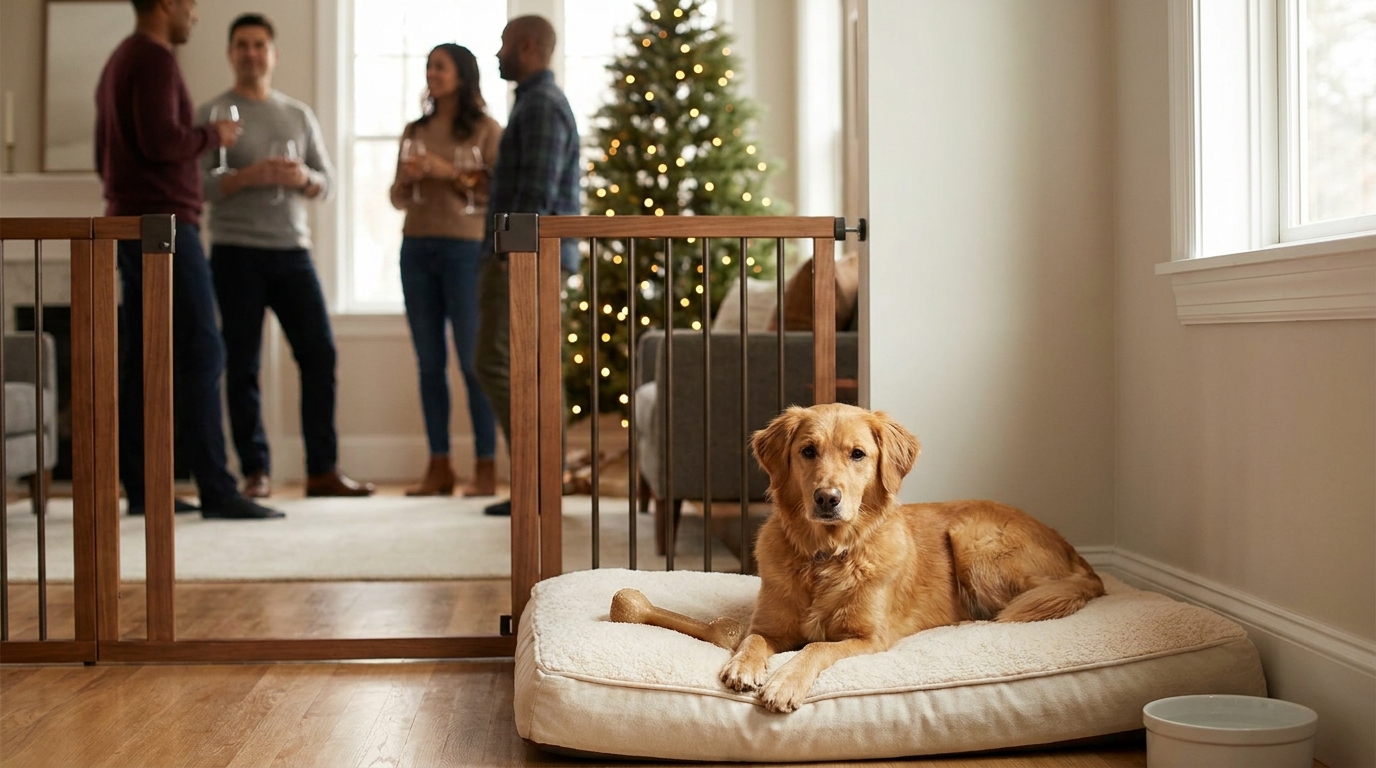
A visit-day plan for dogs that bark, hide or growl at guests: stress signs, door and food rules, and when to call a vet.
Quick answer: Most dogs handle holiday guests better with a plan: a long walk before people arrive, a quiet room with a chew, a leash or gate at the door, and guests who let the dog come to them. Lip licking, yawning, a tucked tail or freezing mean a dog needs space. If a dog ate a guest's pills, call a poison line now; sugar-free gum means the ER now.
This article is general information, not a diagnosis. If you think your pet is in danger, go to the nearest emergency animal hospital.
Emergencies on a guest day
If a dog swallowed a guest's medicine, chocolate or beer, wine or eggnog, call a pet poison line now; sugar-free gum, nicotine gum, liquor, swallowed string or being hit by a car means the ER now, even if the dog seems fine.
| What happened | Do this |
|---|---|
| Ate a guest's pills | Poison line now |
| Sugar-free gum or mints | ER now |
| Ate chocolate | Call now |
| Grapes or raisins | Call, get seen |
| Beer, wine or eggnog | Call now |
| Liquor or liqueur | ER now |
| Ate a THC edible | Call now |
| Nicotine gum | ER now |
| Vape liquid or pouch | Poison line now |
| Swallowed string | ER now |
| Hit by a car | ER now |
| Bitten, skin broken | In-person vet today |
| Bite to neck, chest or belly | ER now |
Go to the ER now for any sign after pills, a drink, nicotine or an edible; a puppy or small dog that got a drink or an edible; or an edible of unknown amount, a concentrate or cannabutter, or one with chocolate, raisins or xylitol. Grapes or raisins mean call now and get seen in person, even if your dog seems fine. Call ASPCA Animal Poison Control at (888) 426-4435 (a consultation fee may apply) or Pet Poison Helpline at (855) 764-7661 (a per-incident fee applies); both poison lines take calls every day, including holidays.
A dog hit by a car needs the ER even if it seems fine, because the Merck Veterinary Manual notes that many internal injuries are not apparent for hours or sometimes days after trauma. If your dog swallowed a guest's pain reliever, call a poison line now; RexVet's page on human pain pills explains the risks.
Signs your dog is stressed by visitors
Lip licking, yawning, turning away, showing the whites of the eyes, a tucked tail, pacing and panting are early stress signals in a dog; freezing, growling or snapping usually come after those signals are missed.
The AAHA 2015 behavior guidelines also list trembling and hiding, and the ASPCA calls the white around a tense dog's eyes "whale eye".
| Sign | What it means | Do this |
|---|---|---|
| Lip lick, yawn | Mild stress | Give space |
| Whale eye | Tense | Give space |
| Hides | Wants distance | Leave it be |
| Pacing, panting | Rising stress | Quiet room |
| Freezes, stares | High stress | Guest steps back |
| Growls | A warning | Never punish |
| Retching, swollen belly | Not stress | ER now |
| Wobbly after food | Possible toxin | ER now |
The last two rows are not anxiety: retching that brings nothing up or a swollen, tight belly can be bloat, and tremors or wobbliness after a dog reached food, drinks or a guest's bag can be a toxin (also call a poison line).
Anxiety visits spiked around the Fourth of July: 15% of RexVet visits from June 28 to July 8 named anxiety, compared with 9% during the rest of the summer.
A holiday visit plan, step by step
Plan a dog's guest day before anyone arrives: a long walk or play session, a quiet room set up with water, a bed and a long-lasting chew, a leash or gate at the door, and one adult in charge of the dog.
- Before guests arrive: walk or play, then let your dog settle in its room. The ASPCA notes that more people in the home can overwhelm pets and advises a quiet place to retreat.
- Arrivals: leash on or gate closed before the doorbell rings, then toss treats away from the door as people come in.
- The meal: your dog rests in its room or on a mat with a long-lasting chew.
- Every hour or two: a short, quiet break outside.
- Departures: back to its room or on leash before coats come out.
Rules to give guests, especially children
Ask guests to ignore the dog at first, let it come to them, never hug it or reach over its head, and leave it alone when it is eating, resting or in its room.
The CDC advises letting a dog approach you first and not disturbing a dog that is eating or sleeping, and the ASPCA lists hugging, kissing and reaching over a dog among common triggers for aggression. The CDC also says to always supervise young children around dogs, even trusted family pets. Rules for children: no chasing, no hugging, and the dog's room is off limits.
Doors, coats and escapes
Arrivals and departures are when dogs slip out, so use a closed room, a gate or a leash at the door, and make sure the ID tag and microchip registration have your current phone number.
Shut coats away, because pockets can hold pills and gum. A loose dog also faces the cold: RexVet's cold-weather guide says small, short-coated, young, old and sick dogs chill fast below 45°F. A limp after an indoor escape attempt needs a same-day, in-person check; a dog hurt while loose needs the ER now.
Food, trash and guests' bags
Holiday food and guests' bags are a real medical risk for a dog on a visit day, so keep plates, trash, purses and coats out of reach and ask guests not to feed the dog.
The ASPCA advises asking houseguests to keep medication in a closed cabinet, not a bag or suitcase, and emptying the trash through the day. Bags also hold hand sanitizer (spilled or chewed means the ER now) and nicotine gum, pouches and vape liquid; Pet Poison Helpline notes that some nicotine products may also contain xylitol, and nicotine can cause drooling, tremors and agitation that look like anxiety. For a pouch or vape liquid, call a poison line now; nicotine gum, any sign or a product that may contain xylitol means the ER now.
RexVet's Thanksgiving food chart covers each dish. If your dog got scraps anyway:
- Fatty scraps: watch for 4 days for pancreatitis signs. One vomit in a bright dog that is still eating means call a vet today; refusing food means an in-person vet today; vomiting more than once, belly pain, weakness or collapse means the ER now.
- Diarrhea after table food: with a vomit, refusing food or in any puppy, see a vet in person today; repeated vomiting, belly pain, black stool or weakness means an emergency vet now.
- Turkey twine or string: ER now, even if your dog seems fine; never pull a strand, and do not try to make your dog vomit at home. See RexVet's guide to a swallowed string, tinsel or ribbon.
Overnight guests, visiting dogs and long visits
When guests stay for several days, keep a dog's walks, meals and bedtime on the usual schedule and give it a room the guests do not use, because days of disruption add up.
Check these thresholds before blaming stress for skipped meals, diarrhea or accidents. A dog that has eaten nothing for 24 hours needs a same-day call to a vet, and puppies, seniors and diabetic dogs should be seen within hours. Vomiting and refusing food together for more than 12 hours means an in-person vet visit, and retching that brings nothing up or a swollen, tight belly means the ER now. Diarrhea in a bright adult dog that lasts past 2 days needs a call (toy breeds and seniors: today). Blood in the urine of a dog that is peeing normal amounts, eating and acting normally needs a vet within 24 hours for a urine test; straining with little or no urine, clots, dark red urine, weakness, pale gums or repeated vomiting means an emergency vet now.
If guests bring a dog, feed the dogs apart, pick up chews and toys, and never reach between fighting dogs. A bite that broke your dog's skin needs an in-person vet today. A bite to the neck, chest or belly, a small dog shaken by a bigger dog, bleeding that will not stop, trouble breathing, pale or blue gums, weakness, crying, limping or collapse means the ER now.
Is it anxiety, pain or illness?
A dog that is newly grumpy with visitors, snaps when touched, hides more or cannot settle may be in pain or unwell, so a sudden change in a dog's behavior needs a vet check, not just training.
The Merck Veterinary Manual says pain should be ruled out because it can lower a dog's threshold for fear and aggression, and the ASPCA advises seeing a veterinarian first when a dog shows aggression. An older dog with sore joints may snap when a child leans on it.
Calming aids and medicine for visit days
Pheromone diffusers, snug wraps and long-lasting chews help some dogs, and any calming medicine for visit days needs an in-person vet exam first and a trial at home days before guests arrive.
Pheromone evidence is mixed: a 2010 JAVMA review of pheromone studies in cats and dogs found too little evidence in 11 of 14 reports, while the Merck Veterinary Manual says several studies support pheromone therapy. Try a wrap on calm days first, and skip it if your dog freezes or struggles.
No dog medicine is FDA-labeled for anxiety around visitors (Sileo's label is noise aversion), so calming medicine for guests is off-label use, and federal rules require an in-person exam first. For dogs whose fear of visitors is severe, a veterinarian who has examined your dog in person may consider situational medicine such as trazodone; it is a human drug, and any trial should happen days before guests arrive.
Never give your dog your own or a guest's anxiety, sleeping or PM pill; if your dog swallowed one, call a poison line now. Melatonin is generally considered low risk for dogs, but ask a vet first and never use a slow-release product or one that lists xylitol, birch sugar, wood sugar or 5-HTP. If loud bangs are the bigger problem, see RexVet's plan for New Year's Eve fireworks.
Cats and holiday guests
Most cats cope best with holiday guests in a closed room that has their litter box, food, water and a hiding place for the whole visit.
Cornell Feline Health Center says stress and changes in routine may raise a cat's risk of urinary tract signs, and a blocked male cat is an absolute emergency.
| Cat sign | Do this |
|---|---|
| Straining, little urine | ER now |
| Male vomits, litter change | ER now |
| Lily, pollen, vase water | ER now |
| No food 24 hours | Vet today; sooner if senior, overweight or diabetic |
| Kitten won't eat | Vet today |
| No urine 24 hours | Male: ER now; others: vet today |
Keep guests' bouquets away: any contact with a true lily or daylily, including pollen or vase water, means the ER now. For trips, see the cat travel anxiety guide.
When a video visit helps
A video visit helps a dog that gets anxious, barks, hides or growls around visitors when the holidays are coming and nothing urgent has happened. RexVet, a nonprofit online vet service, serves pets located in Florida, New York and Virginia by video visit. Your dog must be in one of those states during the visit, so if you travel for the holidays, book before you leave or after you return.
Book a $64.99 live video visit with a licensed RexVet vet one to two weeks before guests arrive. Live video slots run about 8 AM to 11 PM ET, and there are no overnight visits; holiday hours may differ. The veterinarian watches your dog on the live video call, and you can show a short phone clip of your dog with past guests during the call. They ask how past guest visits went, ask about and look for signs of pain or illness behind new grumpiness, and tell you if an in-person exam is needed to rule them out. Together you build a visit-day plan: room setup, the door routine, rules for guests and children, and whether a diffuser or a wrap is worth trying at home first, and whether medicine is worth an in-person exam. The one-time $120 Family Plan includes 4 visits over 12 months that any pet in the home can use, and it never auto-renews, which suits a check-in after Thanksgiving before the December visits.
Calming medicine for guest visits is always off-label, so federal rules require an in-person exam before a veterinarian can prescribe it, in every state; book early enough to try any medicine at home. No prescription is promised; any medicine is the veterinarian's decision. Florida s.474.2021 limits telehealth-only prescribing to FDA-approved animal drugs used on-label, for up to 14 days (1 month for products labeled only for fleas and ticks), with no renewal without an in-person exam and no human-labeled, controlled or compounded anti-infective drugs. Virginia allows the exam to be electronic, but the federal in-person rule for off-label and human-labeled drugs still applies. New York's rules for video-only prescribing are still being settled. RexVet is not a pharmacy; a pharmacy transfer fee applies if a prescription is sent to an outside pharmacy.
Video is not for emergencies. A car accident or an injury while loose, xylitol or nicotine gum, liquor or swallowed string means the ER now, and so does a fight that leaves a bite to the neck, chest or belly, a small dog shaken by a bigger dog, bleeding that will not stop, trouble breathing, pale or blue gums, weakness, limping or collapse; any other bite that broke your dog's skin needs an in-person vet today. A guest's medicine, chocolate, beer, wine, eggnog, a nicotine pouch, vape liquid or an edible means a poison line now, and any sign after pills, a drink, nicotine or an edible means the ER now. Grapes or raisins mean call now and get seen in person, even if your dog seems fine. If your dog bit a person, wash the wound with soap and water. The CDC says the person should see a healthcare provider if the wound is deep or serious or becomes infected, if you are not sure your dog is vaccinated against rabies, or if their last tetanus shot was more than 5 years ago, and to call 911 if the bleeding will not stop or the person feels faint or weak. The CDC also says to report dog bites to local animal control or the police, and local rules may apply to your dog.
Need an Expert Opinion on This Topic?
Book a video visit with a licensed vet, evenings and weekends included
See open timesFrequently Asked Questions
Should I crate my dog when guests come over?
Only if your dog already rests calmly in its crate; otherwise use a closed, quiet room or a baby gate. The Merck Veterinary Manual says crates belong where a dog can rest undisturbed. Never crate a dog for the first time on a busy day, because a panicking dog can hurt itself trying to get out.
How do I stop my dog barking at guests?
Keep your dog behind a closed door, gate or leash before guests knock, and toss treats away from the door as they come in. The Merck Veterinary Manual advises a gate or leash for a dog that is wary of strangers, and teaching it to stay quiet on a mat when visitors arrive. If barking comes with growling or snapping, talk to a vet before the next visit.
Can I give my dog Benadryl before guests arrive?
Ask a vet first; do not give Benadryl or any allergy product on your own. Pet Poison Helpline says a "-D" after an allergy medicine's name means it also contains a decongestant, and a decongestant overdose can cause dangerously high blood pressure and stroke in pets. Never give a dog a guest's anxiety, sleeping or PM pill.
My dog growled at a guest. What should I do?
Calmly call your dog to its quiet room without grabbing its collar, and do not punish the growl, because a growl is a warning. The ASPCA says dogs rarely bite without some warning first, and the AAHA behavior guidelines say punishment can suppress those warnings, which makes a dog more dangerous. Keep your dog apart from guests for the rest of the visit, and have a vet check for pain or illness before the next one.
How can I keep my dog calm on Thanksgiving?
Walk or play with your dog before guests arrive, then give it a quiet room with water and a long-lasting chew during the meal. Use a leash or gate at the door, ask guests not to feed the dog, and keep plates, trash and bags out of reach. After fatty scraps, watch for 4 days: one vomit in a bright dog that is still eating means call a vet today, refusing food means an in-person vet today, and vomiting more than once, belly pain, weakness or collapse means the ER now.
Can an online vet help with my dog's anxiety in Florida, New York or Virginia?
Yes, for a plan: a veterinarian licensed in your pet's state can help by video, but calming medicine for guests needs an in-person exam. On camera, the veterinarian can watch your dog's body language, hear how past visits went, plan the room, door routine and guest rules with you, and look for signs of pain or illness. Calming medicine, a pain workup and bite injuries need an in-person visit; federal rules require an in-person exam before off-label use. Florida limits telehealth-only prescribing to FDA-approved animal drugs used on-label, for up to 14 days for most drugs, with no human-labeled or controlled drugs. Virginia allows an electronic exam, but the federal rule still applies; New York's rules are still being settled. No prescription is promised; a pharmacy transfer fee applies if one is sent to an outside pharmacy.
FAQs
Should I crate my dog when guests come over?
Only if your dog already rests calmly in its crate; otherwise use a closed, quiet room or a baby gate. The Merck Veterinary Manual says crates belong where a dog can rest undisturbed. Never crate a dog for the first time on a busy day, because a panicking dog can hurt itself trying to get out.
How do I stop my dog barking at guests?
Keep your dog behind a closed door, gate or leash before guests knock, and toss treats away from the door as they come in. The Merck Veterinary Manual advises a gate or leash for a dog that is wary of strangers, and teaching it to stay quiet on a mat when visitors arrive. If barking comes with growling or snapping, talk to a vet before the next visit.
Can I give my dog Benadryl before guests arrive?
Ask a vet first; do not give Benadryl or any allergy product on your own. Pet Poison Helpline says a "-D" after an allergy medicine's name means it also contains a decongestant, and a decongestant overdose can cause dangerously high blood pressure and stroke in pets. Never give a dog a guest's anxiety, sleeping or PM pill.
My dog growled at a guest. What should I do?
Calmly call your dog to its quiet room without grabbing its collar, and do not punish the growl, because a growl is a warning. The ASPCA says dogs rarely bite without some warning first, and the AAHA behavior guidelines say punishment can suppress those warnings, which makes a dog more dangerous. Keep your dog apart from guests for the rest of the visit, and have a vet check for pain or illness before the next one.
How can I keep my dog calm on Thanksgiving?
Walk or play with your dog before guests arrive, then give it a quiet room with water and a long-lasting chew during the meal. Use a leash or gate at the door, ask guests not to feed the dog, and keep plates, trash and bags out of reach. After fatty scraps, watch for 4 days: one vomit in a bright dog that is still eating means call a vet today, refusing food means an in-person vet today, and vomiting more than once, belly pain, weakness or collapse means the ER now.
Can an online vet help with my dog's anxiety in Florida, New York or Virginia?
Yes, for a plan: a veterinarian licensed in your pet's state can help by video, but calming medicine for guests needs an in-person exam. On camera, the veterinarian can watch your dog's body language, hear how past visits went, plan the room, door routine and guest rules with you, and look for signs of pain or illness. Calming medicine, a pain workup and bite injuries need an in-person visit; federal rules require an in-person exam before off-label use. Florida limits telehealth-only prescribing to FDA-approved animal drugs used on-label, for up to 14 days for most drugs, with no human-labeled or controlled drugs. Virginia allows an electronic exam, but the federal rule still applies; New York's rules are still being settled. No prescription is promised; a pharmacy transfer fee applies if one is sent to an outside pharmacy.
Medically Reviewed
Reviewed by Dr. Tiffany Delacruz, DVM — licensed veterinarian and CEO of RexVet. Last reviewed November 4, 2026.
Content is for informational purposes and does not replace professional veterinary advice.
Chief Executive Officer · Licensed Veterinarian
Dr. Delacruz is a licensed Doctor of Veterinary Medicine specializing in preventive care and veterinary telehealth. She reviews all health content on RexVet to ensure accuracy and clinical relevance.
Sources & References
- · American Veterinary Medical Association — Telehealth Guidelines
- · AVMA — Pet Care Resources
- · U.S. FDA — Animal & Veterinary