
Essential Oils Toxic to Cats: Diffusers, Potpourri, Candles
By RexVet Team | Reviewed by Dr. Tiffany Delacruz, DVM
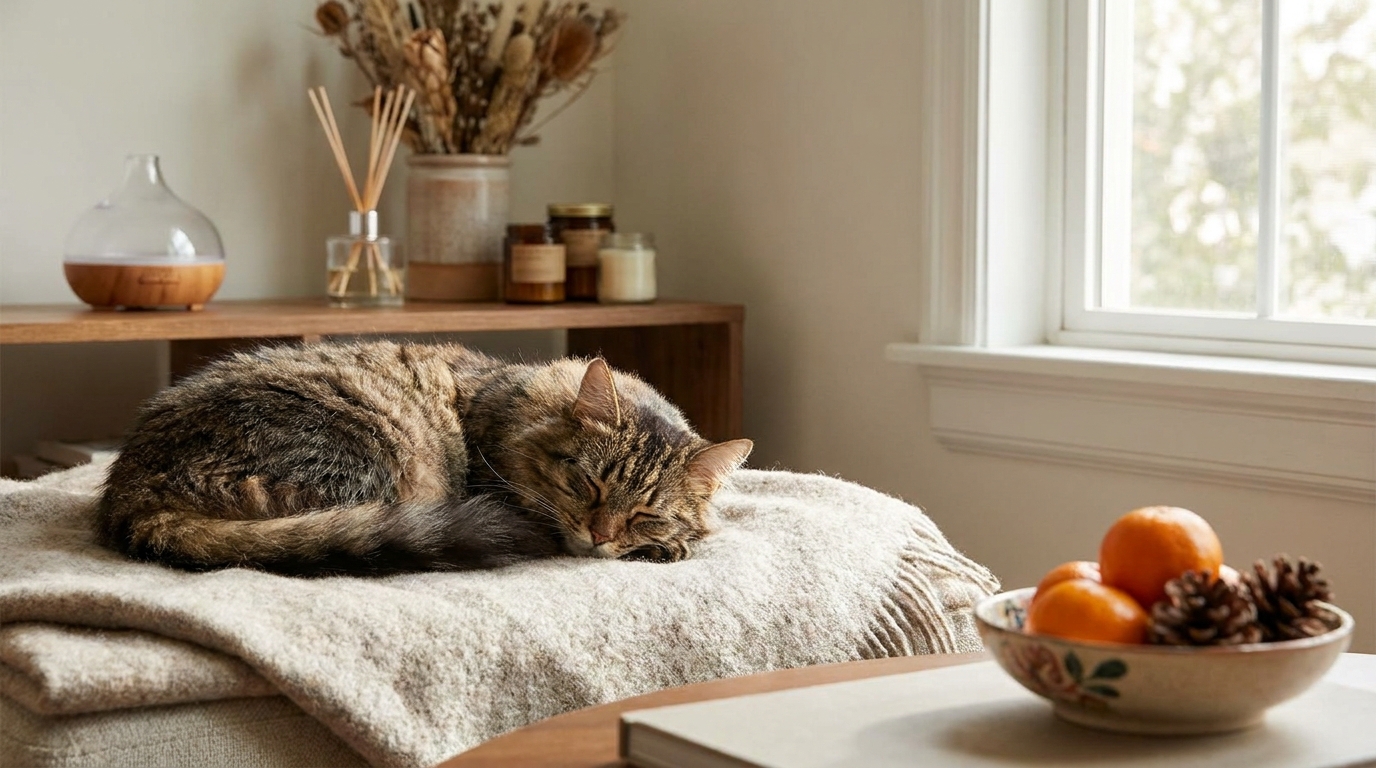
Closed windows and holiday candles raise the risk in winter. See which oils poison cats, which scent products are riskiest and when to go to an ER.
Quick answer: Pet Poison Helpline lists tea tree, eucalyptus, peppermint, citrus, pine, wintergreen and cinnamon as essential oils known to poison cats. If a cat licked a concentrated oil or liquid potpourri, or got it on its fur, go to an emergency vet now, even if it seems fine, and call a poison line on the way. Drooling, wobbling, tremors or labored breathing after diffuser use also mean an ER now.
This article is general information, not a diagnosis. If you think your pet is in danger, go to the nearest emergency animal hospital.
Are essential oil diffusers safe for cats?
No essential oil diffuser is risk-free for a cat: the Merck Veterinary Manual says ultrasonic and nebulizing diffusers release oil droplets that settle on fur and are swallowed during grooming, while reed diffusers and candles mainly irritate the airways unless one is tipped over.
Winter raises the stakes, because windows stay shut while holiday candles, simmer pots and plug-ins pile up indoors.
Which essential oils are toxic to cats?
Pet Poison Helpline lists tea tree, wintergreen, sweet birch, pine, peppermint, citrus (limonene), cinnamon, clove, eucalyptus, pennyroyal and ylang ylang as essential oils known to poison cats.
VCA Animal Hospitals names most of the same oils. Hill's Pet Nutrition, in an article reviewed by its veterinary experts, says there aren't any safe essential oils for cats; the cat-toxic list it cites adds lavender, bergamot, lemon, lime, orange, rosemary and spearmint.
Essential oils veterinary sources name as toxic to cats
| Oil | Main concern | Named by |
|---|---|---|
| Tea tree | Wobbly, tremors, liver | Pet Poison Helpline, Merck |
| Wintergreen or birch | Seizures, salicylates | Merck |
| Pennyroyal | Liver, seizures | Merck |
| Pine | Gut injury, seizures | Pet Poison Helpline |
| Peppermint | Vomiting, liver | ACVP |
| Eucalyptus | Seizures | Merck |
| Cinnamon | Liver injury | Merck |
The Merck Veterinary Manual says tea tree oil is the most commonly reported essential-oil poison in pets, and that wintergreen and birch oils are high in methyl salicylate, an aspirin-like compound. The American College of Veterinary Pharmacists (ACVP) says peppermint oil, sometimes labeled menthol, is toxic to cats whether swallowed or breathed in.
A label that says pure, natural or pet-safe does not make an oil safe for a cat. Merck and Pet Poison Helpline say the higher the concentration, the greater the risk, and concentrated oils should never be put on a pet. Merck also names "natural" flea and tick repellents as one source of exposure.
Why are cats more sensitive to essential oils than dogs?
The Merck Veterinary Manual says cats are more sensitive to essential oils than dogs because they are deficient in the liver enzyme glucuronyl transferase, which makes them very sensitive to the phenols some oils contain; grooming adds to the risk.
Kittens and cats with liver disease are even more sensitive, VCA says. Merck adds that oils are absorbed readily through the gut, skin and lungs, and grooming turns oil on the coat into oil in the stomach. Merck says birds are at high risk too, because their airways are especially sensitive to fragrances.
Potpourri, simmer pots, candles, wax melts and plug-ins: which is riskiest?
Liquid or simmering potpourri is the riskiest home fragrance for a cat: Pet Poison Helpline warns that even a few licks can cause severe chemical burns in the mouth, so any lick means an emergency vet now.
The warning also lists fever, trouble breathing and tremors. Some liquid potpourri and diffuser liquids contain cationic detergents that can burn a cat's mouth and food pipe, the ASPCA says, and you can't tell which. A 2006 ASPCA Animal Poison Control Center review of its most common cat cases included liquid potpourri.
Home fragrance products and cats: main danger and what to do
| Product | Main danger | Do this |
|---|---|---|
| Liquid potpourri | Mouth burns | Licked: ER now |
| Simmer pot | Burns if licked | Never unattended |
| Dry potpourri | Gut upset, blockage | Call a vet |
| Wax melts | Hot wax, oils | Store high |
| Candles | Burns, fire, smoke | Never unattended |
| Plug-ins | Airway, refill oil | Skip if asthma |
| Reed diffuser | Spills, chewed reeds | Out of reach |
| Ultrasonic or nebulizer | Oil on fur | Keep cat out |
A chewed reed stick or plug-in refill, or a cat that walked through a spill, counts as a concentrated-oil exposure: go to an ER now, washing oily paws first only if your cat is alert and acting normally.
For dry potpourri, Lort Smith, a veterinary hospital in Melbourne, says the rough dried pieces can irritate the gut and a vet may need an X-ray to rule out a blockage, so call a vet if your cat ate any.
For candles and wax warmers, Pet Poison Helpline says the main dangers are burns from the flame or hot wax and fire from a knocked-over candle. Call a poison line if your cat chews a wax melt. A small burn needs an in-person vet the same day; a large or deep burn needs an ER now; put no ointment or ice on it. For other seasonal risks, see poinsettias, mistletoe and holly and Christmas tree water, tinsel and lights.
What are the signs of essential oil poisoning in cats?
Drooling, pawing at the mouth, vomiting, a wobbly walk, tremors and labored or open-mouth breathing are the main signs of essential oil poisoning in a cat, and the Merck Veterinary Manual says they can start soon after exposure or hours later.
- Swallowed or on the skin: vomiting that may smell of oil, drooling, low energy, a wobbly walk and not eating, plus tremors, seizures, low body temperature, back-leg paralysis, or liver or kidney failure.
- Breathed in: watery eyes, a runny nose, drooling, vomiting, fast or labored breathing, coughing and wheezing.
- Mouth or skin contact: pawing at the mouth or face, red or burned lips, gums, tongue or skin, and an oil smell on the coat or breath (VCA).
Pet Poison Helpline says owners often mistake coughing for a hairball: a coughing cat crouches low with little belly movement, and no hairball comes up. VCA says there is no antidote, and the veterinarian may run bloodwork to check the liver and kidneys, so a lick or fur exposure means an emergency vet now, even if your cat looks normal.
What to do right now if your cat was exposed to essential oils
If a cat licked an essential oil or got it on its fur, go to an emergency vet now, calling a poison line on the way, even if the cat seems fine; wash oily fur with dish soap first only if the cat is alert and acting normally.
- Stop the source. Turn off the diffuser, unplug warmers, put out candles and take the simmer pot off the heat.
- Get fresh air. Move your cat out of the scented room. Pet Poison Helpline says a pet with any breathing problem needs fresh air at once; labored or open-mouth breathing, coughing or wheezing still means an ER now.
- Wash only a stable cat. If your cat is alert and acting normally, wash oily fur or paws with dish soap and water (VCA), then dry your cat well and keep it warm. Skip the bath and go straight to an ER if your cat is sluggish, weak, wobbly, trembling, drooling heavily, cold to the touch or breathing hard. Never use more oil, a solvent or a tea tree shampoo.
- Bring the label. Seal the bottle or packaging in a bag and take it with you (VCA).
- Call on the way. The poison lines are ASPCA Animal Poison Control, (888) 426-4435 (a consultation fee may apply), and Pet Poison Helpline, (855) 764-7661 (a per-incident fee applies). For an ER-now sign, call on the way, not instead of going.
Do not make your cat vomit or give activated charcoal, which VCA says may worsen your cat's condition; Merck warns vomiting risks oil being breathed into the lungs. Skip milk, oil, salt and home remedies.
Check every cat that grooms or sleeps with the exposed cat, because Pet Poison Helpline says animals swallow oil while grooming each other. An eye splash means an ER or vet now, after gently flushing it with lukewarm water: the 2006 ASPCA review notes cationic detergents can cause severe corneal ulcers. Shut your cat away while you wipe up a spill.
Emergency now or watch at home?
Any breathing effort, coughing, tremors, wobbling, seizures, collapse, drooling or a lick of oil or liquid potpourri means an emergency vet now for a cat; a sneeze fit or watery eyes from scented air that clear quickly in fresh air, in a cat that touched nothing, can be watched at home.
The "Sneezing" and "Watery eyes" rows below apply only to a cat that breathed scented air, touched nothing and has no oil smell on its coat or breath. Oil from an ultrasonic or nebulizing diffuser can settle on the fur of a pet in the same room, Pet Poison Helpline says, so an oil-scented coat counts as oil on fur. If you are not sure what your cat touched, call a poison line now. The Cornell Feline Health Center says a cat's normally pink lips and nose turn blue when asthma reaches its life-threatening stage; blue lips or pale, blue or gray gums mean an ER now.
Signs after a scent, oil or potpourri exposure: what to do
| Sign | What to do |
|---|---|
| Open-mouth or labored breathing | ER now |
| Coughing or wheezing | ER now |
| Pale, blue or gray gums | ER now |
| Wobbly, tremors or seizure | ER now |
| Weak or dragging back legs | ER now |
| Sluggish or low energy | In person, same day |
| Collapse or cold to touch | ER now |
| Drooling, pawing at mouth | ER now |
| Licked oil or potpourri | ER now, even if fine |
| Oil on fur or paws | ER now; wash first only if alert |
| Splash in an eye | ER or vet now |
| Bloody vomit | ER now |
| Vomiting, even once | ER now |
| Not eating about 24 hours | In person, same day |
| Sneezing, now normal | Watch closely |
| Watery eyes only | Fresh air; ER if not clearing |
If more than one row fits, follow the most urgent. For an ER-now row, call a poison line on the way, not instead of going. For vomiting with no scent exposure, see when a cat throwing up white foam is an emergency.
Can you use any scents in a home with cats?
The safest choice is not to diffuse essential oils where a cat lives or sleeps; the Merck Veterinary Manual says to keep pets out of the room while a diffuser runs and to air the room out afterward.
Fresh air is the lower-risk choice. Keep oils, refills and liquid potpourri in a closed cabinet, never leave open oils or simmering potpourri unattended (VCA), and never put an oil on a cat's skin or fur.
Cats with asthma and winter indoor air
A cat with asthma or airway allergies should live in a home without diffusers, plug-ins, air fresheners, candles or incense, as Merck (for essential oils) and Hill's (reviewed by veterinary specialists) advise.
The Cornell Feline Health Center lists smoke from fireplaces and candles, aerosol sprays and cleaner vapors among suspected asthma triggers and advises getting veterinary advice early, because breathing trouble can progress quickly. Open-mouth, fast or labored breathing in a cat means an ER now. For space heaters and cold-weather signs, see how cold is too cold for cats.
When a video visit helps and when to go in
A video visit fits an essential-oil or potpourri exposure in a cat only after a poison line or ER has said home monitoring is OK, or for airborne-only signs, like a sneeze fit or watery eyes, that cleared in fresh air.
Go to an emergency vet now, and call a poison line on the way, not instead of going, if your cat licked or swallowed an essential oil, a spill or liquid potpourri; got any on its fur, skin, paws or eyes; or has drooling, pawing at the mouth, burned gums, vomiting, tremors, a wobbly walk, seizures, labored or open-mouth breathing, or collapse. Go even if your cat seems fine after a lick, because effects can be delayed.
RexVet, a nonprofit online vet service, serves pets located in Florida, New York and Virginia by video visit. A $64.99 live video visit with a licensed RexVet vet, with live slots about 8 AM to 11 PM ET, fits when a poison line or ER has already said home monitoring is OK and you want a follow-up look; when your cat had a brief sneeze fit or watery eyes near a diffuser or candle, touched nothing, and was back to normal in fresh air; or when you want to go room by room through which candles, plug-ins, wax melts and diffusers to remove, especially for a cat with asthma whose breathing is normal right now. The veterinarian can watch your cat breathe and move on camera, look at its gums, lips and skin, read the product label, and tell you whether your cat needs an in-person exam, including liver and kidney bloodwork. They cannot listen to the lungs, run bloodwork, give IV fluids or treat poisoning over video. No prescription is promised; any medicine is the veterinarian's decision after the visit, within the state limits in the FAQ below. Book a live video visit
Need an Expert Opinion on This Topic?
Book a video visit with a licensed vet, evenings and weekends included
See open timesFrequently Asked Questions
Is lavender oil safe for cats?
No. Hill's says there aren't any safe essential oils for cats, and the cat-toxic list it cites includes lavender. The ASPCA also lists the lavender plant as toxic to cats. Don't diffuse it where your cat lives or put it on your cat.
Is peppermint oil safe for cats to smell?
No. The American College of Veterinary Pharmacists says peppermint oil, sometimes listed as menthol, is toxic to cats when swallowed or breathed in, with a risk of liver failure and no established toxic threshold. Turn the diffuser off and move your cat to fresh air; breathing effort, drooling, wobbling or vomiting means an ER now.
Is it safe to run an essential oil diffuser in another room with the door shut?
It is lower risk, not risk-free: the ASPCA says a short run in a secured area your cat can't reach is unlikely to cause problems. Air the room out afterward, as the Merck Veterinary Manual advises. For a cat with any history of breathing problems, the ASPCA says it may be best to avoid diffusers altogether.
Are wax warmers and wax melts safe for cats?
No, not where a cat can reach them: hot wax can burn a cat, and scented melts may contain essential oils. Never leave a warmer on with your cat alone in the room.
Are plug-in air fresheners safe for cats?
No plug-in air freshener is risk-free for a cat: Pet Poison Helpline says strong scents can cause watery eyes, coughing or wheezing. Hill's (reviewed by veterinary specialists) advises skipping them for a cat with asthma. Coughing, wheezing or a chewed refill means an ER now.
Can I use a tea tree oil shampoo on my cat?
Skip it. Cornell University Hospital for Animals lists tea tree oil as highly toxic on the skin and by mouth, especially to cats. Use only a shampoo labeled for cats. If concentrated tea tree oil or a tea tree product made for dogs was used on your cat, go to an ER now, calling a poison line on the way; wash it off with dish soap first only if your cat is alert and acting normally.
My dog is fine around the diffuser, so why is my cat getting sick?
Cats are deficient in the liver enzyme glucuronyl transferase, the Merck Veterinary Manual says, so phenols in some oils hit cats harder than dogs. Cats also swallow oil droplets while grooming, though Merck says dogs are still at risk. Turn the diffuser off and go to an ER now for breathing effort, drooling, wobbling, tremors or vomiting.
Can a vet help on a video visit after my cat's essential oil exposure in Florida, New York or Virginia?
Partly: for a cat located in Florida, New York or Virginia, video can review airborne signs that cleared; a suspected poisoning needs an ER now. On camera, a licensed RexVet vet can watch your cat breathe, check its gums and read the label, then say whether it needs an in-person exam. Bloodwork and poisoning treatment need in-person care. No prescription is promised. For a pet in Florida, state law (s.474.2021) limits video-only prescriptions to FDA-approved animal drugs used as labeled, for up to 14 days (1 month for products labeled only for fleas and ticks); they cannot be renewed without an in-person exam, and human-labeled, controlled and compounded anti-infective drugs need an in-person exam. In every state, federal rules (21 CFR 530.3) require a veterinarian who has examined the pet before a human drug or an off-label animal drug is used. Virginia allows the veterinary exam to be electronic, but that federal rule still applies. New York's rules for prescribing after a video-only visit are not settled; a bill (A1782) is still in committee. RexVet is not a pharmacy; if the veterinarian prescribes, the prescription goes to an outside pharmacy and a pharmacy transfer fee applies.
FAQs
Is lavender oil safe for cats?
No. Hill's says there aren't any safe essential oils for cats, and the cat-toxic list it cites includes lavender. The ASPCA also lists the lavender plant as toxic to cats. Don't diffuse it where your cat lives or put it on your cat.
Is peppermint oil safe for cats to smell?
No. The American College of Veterinary Pharmacists says peppermint oil, sometimes listed as menthol, is toxic to cats when swallowed or breathed in, with a risk of liver failure and no established toxic threshold. Turn the diffuser off and move your cat to fresh air; breathing effort, drooling, wobbling or vomiting means an ER now.
Is it safe to run an essential oil diffuser in another room with the door shut?
It is lower risk, not risk-free: the ASPCA says a short run in a secured area your cat can't reach is unlikely to cause problems. Air the room out afterward, as the Merck Veterinary Manual advises. For a cat with any history of breathing problems, the ASPCA says it may be best to avoid diffusers altogether.
Are wax warmers and wax melts safe for cats?
No, not where a cat can reach them: hot wax can burn a cat, and scented melts may contain essential oils. Never leave a warmer on with your cat alone in the room.
Are plug-in air fresheners safe for cats?
No plug-in air freshener is risk-free for a cat: Pet Poison Helpline says strong scents can cause watery eyes, coughing or wheezing. Hill's (reviewed by veterinary specialists) advises skipping them for a cat with asthma. Coughing, wheezing or a chewed refill means an ER now.
Can I use a tea tree oil shampoo on my cat?
Skip it. Cornell University Hospital for Animals lists tea tree oil as highly toxic on the skin and by mouth, especially to cats. Use only a shampoo labeled for cats. If concentrated tea tree oil or a tea tree product made for dogs was used on your cat, go to an ER now, calling a poison line on the way; wash it off with dish soap first only if your cat is alert and acting normally.
My dog is fine around the diffuser, so why is my cat getting sick?
Cats are deficient in the liver enzyme glucuronyl transferase, the Merck Veterinary Manual says, so phenols in some oils hit cats harder than dogs. Cats also swallow oil droplets while grooming, though Merck says dogs are still at risk. Turn the diffuser off and go to an ER now for breathing effort, drooling, wobbling, tremors or vomiting.
Can a vet help on a video visit after my cat's essential oil exposure in Florida, New York or Virginia?
Partly: for a cat located in Florida, New York or Virginia, video can review airborne signs that cleared; a suspected poisoning needs an ER now. On camera, a licensed RexVet vet can watch your cat breathe, check its gums and read the label, then say whether it needs an in-person exam. Bloodwork and poisoning treatment need in-person care. No prescription is promised. For a pet in Florida, state law (s.474.2021) limits video-only prescriptions to FDA-approved animal drugs used as labeled, for up to 14 days (1 month for products labeled only for fleas and ticks); they cannot be renewed without an in-person exam, and human-labeled, controlled and compounded anti-infective drugs need an in-person exam. In every state, federal rules (21 CFR 530.3) require a veterinarian who has examined the pet before a human drug or an off-label animal drug is used. Virginia allows the veterinary exam to be electronic, but that federal rule still applies. New York's rules for prescribing after a video-only visit are not settled; a bill (A1782) is still in committee. RexVet is not a pharmacy; if the veterinarian prescribes, the prescription goes to an outside pharmacy and a pharmacy transfer fee applies.
Medically Reviewed
Reviewed by Dr. Tiffany Delacruz, DVM — licensed veterinarian and CEO of RexVet. Last reviewed November 3, 2026.
Content is for informational purposes and does not replace professional veterinary advice.
Chief Executive Officer · Licensed Veterinarian
Dr. Delacruz is a licensed Doctor of Veterinary Medicine specializing in preventive care and veterinary telehealth. She reviews all health content on RexVet to ensure accuracy and clinical relevance.
Sources & References
- · American Veterinary Medical Association — Telehealth Guidelines
- · AVMA — Pet Care Resources
- · U.S. FDA — Animal & Veterinary