
Dog Scared of Fireworks on New Years Eve: What Helps
By RexVet Team | Reviewed by Dr. Tiffany Delacruz, DVM
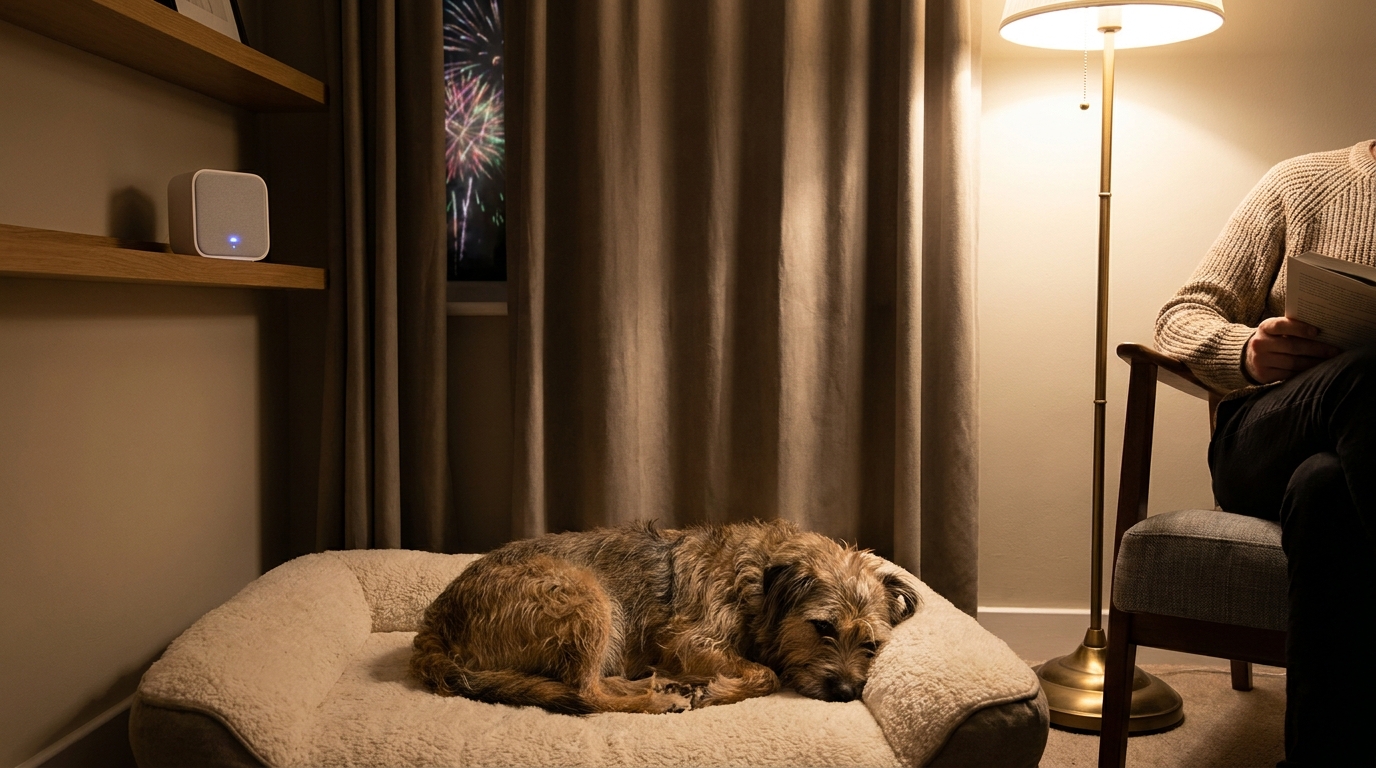
How to set up a safe room before New Year's Eve, what makes fireworks fear worse, the party hazards to watch, and which signs mean the ER.
Quick answer: A dog scared of New Year's Eve fireworks needs a plan before the night: an interior room with curtains closed, a fan or white noise, a snug harness with ID, and a calm person home. Comforting your dog does not make fear worse. Injury, collapse, a seizure, trouble breathing or a swallowed toxin means an emergency clinic now. Ask a vet about medication by mid-December.
This article is general information, not a diagnosis. If you think your pet is in danger, go to the nearest emergency animal hospital.
Why New Year's Eve is harder on scared dogs
New Year's Eve fireworks often go off over several nights around Dec 31 and Jan 1, not only at midnight, and they come with guests, open doors and party food, so plan for several loud evenings, not one.
- Florida: Florida law allows consumer fireworks on New Year's Eve and New Year's Day, though local rules may apply and a recorded HOA covenant can still ban them.
- New York: New York City bans all consumer fireworks, including sparklers; elsewhere in the state only sparkling devices are legal, and some counties ban those too.
- Virginia: Virginia allows only state-approved items that don't explode or fly, such as sparklers, fountains and crackling devices, and many localities ban even those.
Legal limits don't stop public displays or illegal fireworks. A dog that bolts in December also faces the cold; see how cold is too cold for dogs.
Is it fear or panic?
A dog with mild fear hides or stays close but still takes treats and responds to you; a dog in panic shakes, tries frantically to escape, pants nonstop and refuses food. In an owner survey of 1,225 dogs (Riemer, PLOS ONE, 2019), 52% were at least partly afraid of fireworks.
| Sign | Mild fear | Panic |
|---|---|---|
| Panting | Light, stops soon | Heavy, nonstop |
| Body | Tense, hides | Shaking, frantic |
| Escape | Seeks you | Claws doors |
| Food | Takes treats | Refuses food |
A panicking dog that is otherwise well (no injury, normal gums, no struggling breathing, no vomiting, retching or swollen belly, no wobbliness, not very hot or cold) does not need the ER. Panic is a reason to plan with a vet before the night: a 2023 review in Animals (Riemer) notes that a dog refusing even high-value food during the noise may need anti-anxiety medication.
ER now or a vet visit later?
A dog that is injured, collapses, has a seizure, has gray or blue gums with trouble breathing, or swallowed a toxin needs an emergency clinic tonight; a dog that is scared but otherwise well can wait for a scheduled vet visit. Find your nearest emergency animal hospital before Dec 31.
| Situation | Go to |
|---|---|
| Hurt or bleeding | ER now |
| Hit by a car | ER now |
| Collapse, seizure | ER now |
| Gray, blue gums | ER now |
| Ate xylitol | ER now |
| Ate a toxin | Poison line, ER |
| Ran away | Shelters, chip |
| Scared, eating | Vet visit |
| Fear plan, meds | Vet visit |
"Hurt" includes burns from a lit firework or sparkler (Pet Poison Helpline), being hit by a car even if your dog seems fine, a torn nail, a bleeding mouth from chewing a crate, and any eye injury. Also go now for loud or struggling breathing with pale gums or weakness (higher risk in flat-faced breeds and dogs with heart or airway disease), vomiting or wobbliness with heavy panting, retching that brings nothing up or a swollen, tight belly (possible bloat), or a body that feels very hot or very cold.
A limp after a night of trying to escape needs a same-day, in-person check. Book a vet visit in early to mid-December for a dog that panics or refuses treats during noise, a dog with a seizure history or heart disease (it needs its vet's plan, not a new product on the night), or an older dog with new noise fear.
How to keep a dog calm on New Year's Eve
The best help for a dog scared of fireworks is a quiet interior room with curtains closed, steady background noise such as a fan or white noise, and a calm person staying close.
- The room: Board-certified veterinary behaviorists Horwitz and Landsberg, writing for VCA Animal Hospitals, advise a well-curtained or blacked-out room and a fan, white noise or music with constant drum beats to mask outside noise.
- A crate: Use a covered crate only if your dog already treats it as a safe spot, the door stays open and air still flows (VCA; Riemer, 2023).
- Company and comfort: Have a calm person home rather than leaving your dog alone (VCA), and pet your dog if it comes to you (Riemer, 2023).
- Something to do: Offer a long-lasting chew or food puzzle; in Riemer's 2020 survey, feeding or play during fireworks was linked to improvement.
- Pressure wrap: A snug wrap helps some dogs (44% of owners in one survey called it effective); put it on during calm days first, and skip it if your dog freezes or struggles.
- Before dark: Give a long walk and a potty break before dusk, and leash every trip outside after dark, even in a fenced yard.
- ID and doors: Keep a snug harness and a collar with ID on, confirm the microchip registry has your current phone number, and gate the safe room before guests arrive.
What makes fireworks fear worse
Punishing a scared dog, forcing it to watch fireworks, shutting it in a closed crate or room you can't see, or trying a new medicine or supplement for the first time on the night all make things worse. The VCA behaviorists note that punishment only confirms to a dog that there is something to fear.
Never give a dog your own anxiety or sleeping pill, or a combination cold, flu, allergy or "PM" product: Pet Poison Helpline warns that the decongestants in some of them can cause dangerously high blood pressure and stroke in pets; if your dog swallowed one, call a pet poison line or emergency vet now. Ask a vet before giving Benadryl, too.
What can I give my dog for fireworks anxiety?
Prescription medicines for noise fear in dogs exist, but a veterinarian has to choose them, and anything new should be tested on a quiet day well before Dec 31, so talk to a vet by mid-December.
The FDA has approved prescription medicines for noise aversion in dogs, though not all are sold in the US yet. Sileo (dexmedetomidine gel), FDA-approved in 2015, is prescription-only, and its label rules it out for dogs with severe heart, breathing, liver or kidney disease, in shock, severely debilitated, or stressed by extreme heat, cold or fatigue. In a placebo-controlled study run by its sponsor, about 7 in 10 owners rated its effect good to excellent during New Year fireworks (cited in Riemer's 2023 review). Tessie (tasipimidine), FDA-approved in May 2026, is not expected in US clinics until mid-2027.
- Timing: Give any prescribed medicine at the time the veterinarian sets, after a quiet-day trial, because dogs react very differently to calming drugs (Riemer, 2023).
- Legal limits: Many common calming drugs are human-labeled, and federal rules require an in-person exam in every state before a vet prescribes one.
Melatonin is generally considered low risk, but alone it is often not enough for a dog that panics; ask a vet first and read the dog melatonin safety guide for its xylitol and slow-release warnings.
Party hazards that bring dogs to the ER on Jan 1
Alcohol, grapes and raisins, chocolate, xylitol in sugar-free gum or candy, THC edibles and fireworks debris are the big New Year's party hazards for dogs, and each one needs a pet poison line or emergency vet right away; xylitol means the ER now, even if your dog seems fine, because the FDA warns it can drop a dog's blood sugar within 10 to 60 minutes and serious effects can take 12 to 24 hours to show.
| Hazard | Risk | Do this |
|---|---|---|
| Alcohol | Low sugar, coma | Call now |
| Grapes, raisins | Kidney harm | Call, get seen |
| Chocolate | Heart, seizure | Call now |
| Sugar-free gum | Xylitol | ER now |
| THC edible | Poisoning | Call now |
| Sleep or PM pill | Human drug | Call now |
| Ribbon, string | Gut cuts | ER now |
| Cork, balloon | Blockage | Go in now |
| Firework eaten | Burns, toxins | Call now |
| Open doors | Escape | Gate, leash |
"Call now" means a pet poison line or emergency vet right away, even if your dog seems fine: ASPCA Animal Poison Control (888) 426-4435 (a consultation fee may apply) or Pet Poison Helpline (855) 764-7661 (a fee may apply). Do not make your dog vomit unless a vet or poison line tells you to.
- Alcohol: Wobbling, vomiting, trembling, very slow breathing, a cold body or collapse means the ER now; so does liquor, an unknown amount, or any alcohol in a puppy or small dog. See what to do if your dog drank alcohol.
- Grapes and raisins: Even one means a call now and an in-person exam, because kidney failure can develop silently within 24 to 72 hours. See why any amount of grapes or raisins is an emergency.
- Chocolate and edibles: Tremors, seizures, collapse or a racing heart after chocolate means the ER now, as does an edible eaten by a puppy or small dog, an unknown amount, an edible that held chocolate, raisins or xylitol, or a dog that can't stand or is hard to wake.
- Ribbon, string and corks: Swallowed ribbon, string, tinsel or a champagne cork's wire cage means the ER now, even if your dog seems fine; never pull a strand. A swallowed cork or balloon piece means an in-person visit now for X-rays. See what to do if your dog ate string or ribbon.
- Fireworks: Pet Poison Helpline says eaten fireworks can cause organ injury and seizures. Bring the packaging when you call, and clear the yard before the first walk on Jan 1.
When a dog is still scared after fireworks
Most dogs scared by fireworks are back to normal by the next morning, but about 1 in 4 are not, and a few take weeks or even months to recover (Riemer, PLOS ONE, 2019). Keep the normal routine and walk on a leash at quiet times.
- Call a vet the same day if your dog has eaten nothing for 24 hours, and go in if vomiting and refusing food go on together for more than 12 hours, but go now for retching that brings nothing up or a swollen, tight belly. If vomiting may be from a toxin, call a poison line now. Puppies, seniors and diabetic dogs should be seen within hours.
- New fear in an older dog can be a sign of pain, so have a vet check. A small 2018 study in Frontiers in Veterinary Science linked joint or muscle pain to noise sensitivity that starts later in life.
Fear of fireworks can get worse from year to year, but in the 2019 survey more fearful dogs improved (about 39%) than got worse (about 26%), and teaching a puppy or calm adult dog to link the noise with good things was highly effective. Start sound training now or in January: play firework recordings very quietly while your dog eats or plays, and raise the volume only while your dog stays relaxed. Use the same plan again before July 4.
How a video visit fits before New Year's Eve
RexVet, a nonprofit online vet service, helps most with a dog that is scared of fireworks through a video visit in early to mid-December, because live video slots run about 8 AM to 11 PM ET and midnight on New Year's Eve falls outside that window. RexVet serves pets located in Florida, New York and Virginia by video visit. A $64.99 live video visit is with a licensed RexVet vet, a veterinarian licensed in your pet's state. Holiday availability isn't confirmed, so book ahead.
A dog that is injured, collapses, has a seizure, has gray or blue gums with trouble breathing, or feels very hot needs a local emergency clinic now. A dog that ate xylitol needs an emergency vet now, and one that ate alcohol, grapes or raisins, chocolate, a THC edible or fireworks debris needs a pet poison line or emergency vet first. A dog that is still scared but otherwise well can wait for a scheduled visit.
Many common calming medicines are human-labeled, and in every state federal rules require an in-person exam before a vet prescribes a human-labeled drug or uses an animal drug off-label. In Florida, a vet may prescribe only FDA-approved animal drugs, used as labeled, from a video visit alone, for up to 14 days with no renewal without an in-person exam, and never human-labeled, controlled or compounded anti-infective drugs; a test day and Dec 31 would both have to fit inside that window (so in Florida, a visit where medicine is prescribed may need to fall later in December than a planning visit), and next July 4 would need an in-person exam. Virginia lets the exam be electronic, but the federal in-person rule for off-label and human drugs still applies. New York's rules for video-only prescribing are still being settled. RexVet does not prescribe controlled substances by video. No prescription is promised; any medicine is the veterinarian's decision after the visit, and the veterinarian may still want your dog examined in person first. A pharmacy transfer fee applies if a prescription is sent to an outside pharmacy.
In the visit, the veterinarian reviews your dog's history and triggers, watches on camera for signs of pain behind new or worsening fear, and says when pain needs an in-person check. They also advise on melatonin (sold over the counter, so you get advice, not a prescription), talk through whether medicine is worth considering, and help build the safe-room and sound-training plan.
If your dog is scared of fireworks but otherwise well, book a video visit by mid-December.
Need an Expert Opinion on This Topic?
Book a video visit with a licensed vet, evenings and weekends included
See open timesFrequently Asked Questions
Can I give my dog Benadryl for fireworks anxiety?
Ask a vet first: Benadryl (diphenhydramine) is a mild sedative, and board-certified veterinary behaviorists writing for VCA note that sedatives do not reduce fear. VCA urges caution in dogs with heart disease, high blood pressure or glaucoma, in senior and pregnant dogs, and with other sedating medicines. Never use a combination cold, flu, allergy or "PM" product. Whether to use Benadryl, and how much, is the veterinarian's decision.
Should I comfort my dog during fireworks, or does that make the fear worse?
Yes, comfort your dog if it comes to you: comforting does not make fear worse, because fear is an emotion, not a trick. In Riemer's 2020 owner survey, petting and talking to a dog during bangs was not linked to worse fear. Don't hold or restrain your dog, because unwanted handling can raise stress.
Can an online vet help with my dog's fireworks fear or prescribe medicine for it?
Yes for planning, sometimes for medicine: a video visit can build a fear plan, but many calming drugs legally need an in-person exam first. For a dog located in Florida, New York or Virginia, a veterinarian licensed in that state can review the fear history, watch on camera for signs of pain and decide whether medicine is worth considering. Injuries, poisoning and a hands-on pain check need an in-person vet. Florida limits video-only prescriptions to FDA-approved animal drugs used as labeled, for up to 14 days, renewable only after an in-person exam, and never human-labeled or controlled drugs. Virginia lets the exam be electronic, but federal rules still require an in-person exam for human-labeled or off-label drugs. New York's rules for video-only prescribing are still being settled. Any prescription is the veterinarian's decision, never a guarantee.
What should I do if my dog runs away during New Year's Eve fireworks?
Act right away: call local shelters and animal control, alert your microchip registry, and search close to home. In a JAVMA study of 53 shelters (Lord, 2009), owners were found for 74.1% of microchipped stray dogs, and the top reason an owner wasn't found was a wrong or disconnected phone number, so update yours before Dec 31. If your dog was hit by a car, go to an emergency vet even if it seems fine.
Do calming chews, CBD or pheromone collars work for a dog scared of fireworks?
Not reliably: owner-reported success with calming chews, pheromones and herbal products falls in the range expected from a placebo. Riemer's 2023 review in Animals reports owner success rates of about 27% for nutraceuticals, 28.8% for pheromones and about 31 to 35% for herbal and homeopathic products, and a study found no evidence that CBD eased the fear. Check any product label for xylitol, which may also be listed as birch sugar or wood sugar.
Are cats scared of fireworks too, and how can I help my cat on New Year's Eve?
Yes, fireworks can frighten cats too: keep cats indoors, as the ASPCA advises, close windows and curtains, and leave a high or covered hiding spot they can choose. Never use essential-oil diffusers, plug-ins or potpourri as calming aids around cats, because many oils are toxic to them, and never give a cat a dog product or a human medicine. Stress can trigger bladder trouble in cats: a cat, especially a male, that strains in the litter box and passes little or no urine needs an emergency vet now. If your cat stops eating after the holiday, call a vet.
FAQs
Can I give my dog Benadryl for fireworks anxiety?
Ask a vet first: Benadryl (diphenhydramine) is a mild sedative, and board-certified veterinary behaviorists writing for VCA note that sedatives do not reduce fear. VCA urges caution in dogs with heart disease, high blood pressure or glaucoma, in senior and pregnant dogs, and with other sedating medicines. Never use a combination cold, flu, allergy or "PM" product. Whether to use Benadryl, and how much, is the veterinarian's decision.
Should I comfort my dog during fireworks, or does that make the fear worse?
Yes, comfort your dog if it comes to you: comforting does not make fear worse, because fear is an emotion, not a trick. In Riemer's 2020 owner survey, petting and talking to a dog during bangs was not linked to worse fear. Don't hold or restrain your dog, because unwanted handling can raise stress.
Can an online vet help with my dog's fireworks fear or prescribe medicine for it?
Yes for planning, sometimes for medicine: a video visit can build a fear plan, but many calming drugs legally need an in-person exam first. For a dog located in Florida, New York or Virginia, a veterinarian licensed in that state can review the fear history, watch on camera for signs of pain and decide whether medicine is worth considering. Injuries, poisoning and a hands-on pain check need an in-person vet. Florida limits video-only prescriptions to FDA-approved animal drugs used as labeled, for up to 14 days, renewable only after an in-person exam, and never human-labeled or controlled drugs. Virginia lets the exam be electronic, but federal rules still require an in-person exam for human-labeled or off-label drugs. New York's rules for video-only prescribing are still being settled. Any prescription is the veterinarian's decision, never a guarantee.
What should I do if my dog runs away during New Year's Eve fireworks?
Act right away: call local shelters and animal control, alert your microchip registry, and search close to home. In a JAVMA study of 53 shelters (Lord, 2009), owners were found for 74.1% of microchipped stray dogs, and the top reason an owner wasn't found was a wrong or disconnected phone number, so update yours before Dec 31. If your dog was hit by a car, go to an emergency vet even if it seems fine.
Do calming chews, CBD or pheromone collars work for a dog scared of fireworks?
Not reliably: owner-reported success with calming chews, pheromones and herbal products falls in the range expected from a placebo. Riemer's 2023 review in Animals reports owner success rates of about 27% for nutraceuticals, 28.8% for pheromones and about 31 to 35% for herbal and homeopathic products, and a study found no evidence that CBD eased the fear. Check any product label for xylitol, which may also be listed as birch sugar or wood sugar.
Are cats scared of fireworks too, and how can I help my cat on New Year's Eve?
Yes, fireworks can frighten cats too: keep cats indoors, as the ASPCA advises, close windows and curtains, and leave a high or covered hiding spot they can choose. Never use essential-oil diffusers, plug-ins or potpourri as calming aids around cats, because many oils are toxic to them, and never give a cat a dog product or a human medicine. Stress can trigger bladder trouble in cats: a cat, especially a male, that strains in the litter box and passes little or no urine needs an emergency vet now. If your cat stops eating after the holiday, call a vet.
Medically Reviewed
Reviewed by Dr. Tiffany Delacruz, DVM — licensed veterinarian and CEO of RexVet. Last reviewed November 3, 2026.
Content is for informational purposes and does not replace professional veterinary advice.
Chief Executive Officer · Licensed Veterinarian
Dr. Delacruz is a licensed Doctor of Veterinary Medicine specializing in preventive care and veterinary telehealth. She reviews all health content on RexVet to ensure accuracy and clinical relevance.
Sources & References
- · American Veterinary Medical Association — Telehealth Guidelines
- · AVMA — Pet Care Resources
- · U.S. FDA — Animal & Veterinary