
Is Amaryllis Toxic to Cats and Dogs? Bulbs and Paperwhites
By RexVet Team | Reviewed by Dr. Tiffany Delacruz, DVM
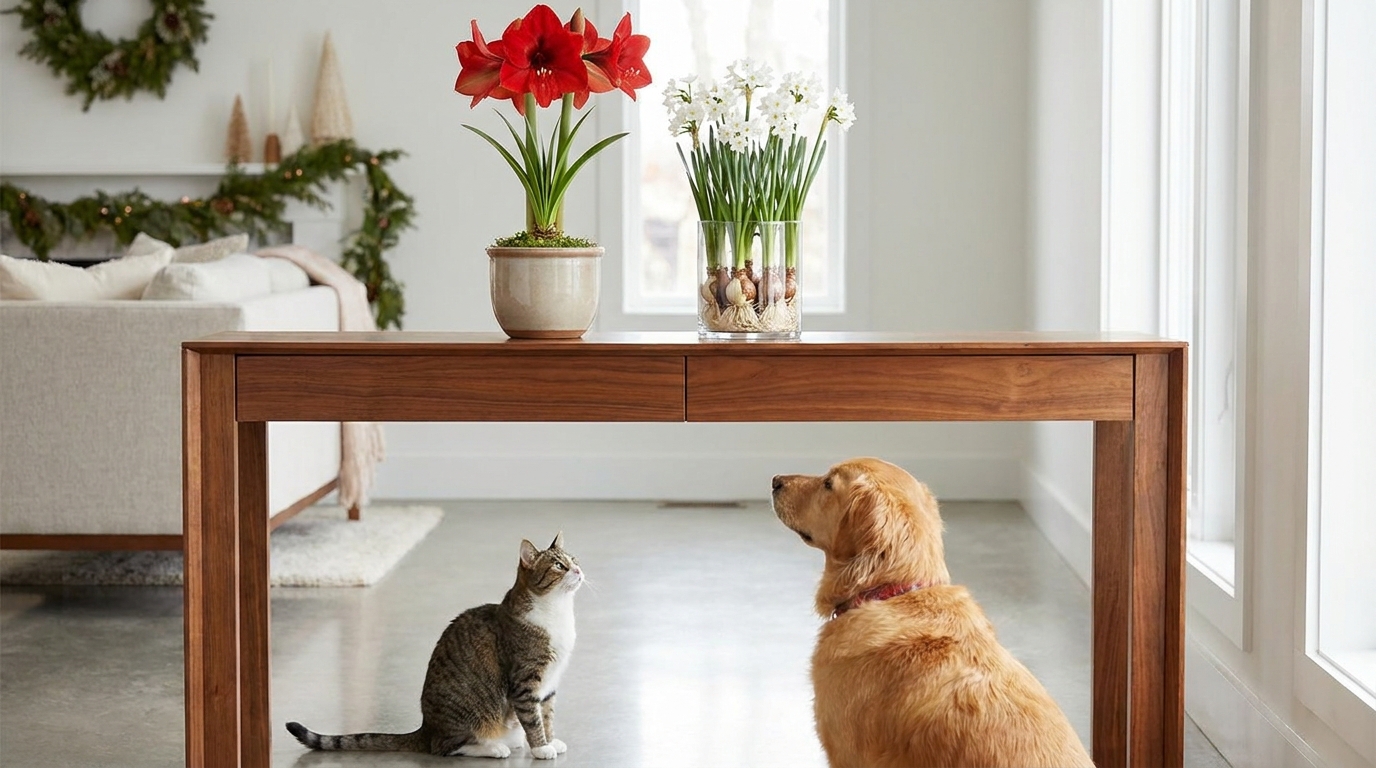
The bulb is the riskiest part, paperwhites and daffodils carry the same toxin, and amaryllis is not a true lily. What to do if your pet chewed one.
Quick answer: Yes. Amaryllis is toxic to cats and dogs, and so are its relatives, paperwhites and daffodils. The bulb is the most poisonous part, but leaves and flowers can still cause drooling, vomiting and diarrhea. Call a pet poison line now for any bite. Go to an emergency vet now for tremors, weakness, collapse or repeated vomiting. Unlike true lilies, amaryllis is not linked to kidney failure in cats.
This article is general information, not a diagnosis. If you think your pet is in danger, go to the nearest emergency animal hospital.
Where to go: ER, same-day vet or poison line
Every bite calls for a pet poison line, and some signs mean you go straight to an emergency vet. Find your pet's row.
| Sign | Where to go | Why |
|---|---|---|
| Tremors, seizures, weakness or collapse | ER now | Nerve and heart effects |
| Pale gums, cold ears or paws | ER now | Signs of shock |
| Very slow or uneven heartbeat | ER now | Heart rhythm effects |
| Slow, shallow or labored breathing | ER now | Breathing can slow down |
| Blood in vomit, or black stool | ER now | Stomach or gut bleeding |
| Whole bulb swallowed | ER now | Can block the gut |
| Cat chewed a plant that may be a true lily, or one you can't name | ER now, even if fine | Lily kidney failure |
| Repeated vomiting, or no water kept down | ER now | Dehydration and shock |
| Tired, not eating, retching, belly pain, straining or no stool in the days after | Same-day vet, in person | Illness or blockage can build |
| Wire or stand piece missing | Same-day vet, X-ray | Metal can lodge inside |
| Pet with a seizure history | Poison line now; expect to go in | Higher seizure risk |
| Any bulb chewed, no signs yet | Poison line now | Early care works best |
| Leaf or flower nibble, pet bright | Poison line now; watch 24 hours | Signs can be delayed |
| Poison line says watch at home | Video check if you want help | Help with the watch plan |
Daffodil and paperwhite signs can start 15 minutes to 24 hours after eating. The sources cited here give no onset time for amaryllis, so don't wait for signs before you call.
Poison lines: ASPCA Animal Poison Control, (888) 426-4435 (a consultation fee may apply), and Pet Poison Helpline, (855) 764-7661 (a per-incident fee applies). Both answer 24 hours a day, 365 days a year.
My pet chewed amaryllis or paperwhites: what to do right now
- Clear the mouth. If you can do it without being bitten, take plant pieces out of your pet's mouth and move all pets away from the plant.
- Keep the evidence. Keep the plant, tag or pot, and take a photo. Note which part (bulb, leaf, stem or flower), roughly how much, and when. On a waxed bulb, check for missing wax or wire.
- Call a poison line now, even if your pet seems fine, and write down the case number.
- Don't make your pet vomit on your own. Pet Poison Helpline says there is no safe way to make a cat vomit at home. Make a dog vomit only if a vet or poison line tells you to, and never if it is already vomiting, drowsy, shaking or seizing. See when making a dog throw up helps and when it harms.
- Skip home remedies. Give no milk, oil, salt, food, hairball remedy or activated charcoal.
- Follow the plan. If the poison line says go in, go now with the plant or photo and your case number. If it says to watch at home, watch closely for 24 hours, then check appetite, energy and warmth for several days.
Bulb vs leaves vs flowers: which part is the real danger
The ASPCA's entries for holiday amaryllis (listed as Barbados lily), paperwhites and daffodils all name the bulb as the most poisonous part, and Pet Poison Helpline says amaryllis bulbs hold more of the raphide oxalate crystals that cause drooling and belly discomfort. UF/IFAS Extension advises keeping half to two-thirds of a potted amaryllis bulb above the soil line, within reach of a pet chewing at the pot. A 2002 toxicology brief in the journal Veterinary Medicine adds that a whole bulb can block the gut, and that dogs may be more likely than other pets to eat bulbs.
Leaves and flowers are lower risk, not safe. The same brief says Narcissus alkaloids are also in leaves and flowers, and veterinary case reports describe daffodil poisoning after pets ate the flowers or leaves, not just the bulb. No one knows how much plant it takes to cause tremors or seizures, so don't judge the amount yourself.
Which part did they eat?
| Part | Risk | What to do |
|---|---|---|
| Bulb, chewed | Highest; most toxic part | Poison line now; ER if any signs |
| Whole bulb swallowed | Toxin plus gut blockage | ER now; call the poison line on the way |
| Leaves or stem | Lower, still toxic | Poison line now; watch 24 hours |
| Flower or petal | Lower, still toxic | Poison line now; watch 24 hours |
| Waxed bulb, wax or wire | Bulb inside is toxic | Poison line now; vet in person if wire is missing |
| Dried, dead or stored plant | Still toxic | Poison line now |
The short rule for any part: poison line now; ER for tremors, weakness or seizures.
Amaryllis, paperwhites and daffodils: one family, one toxin
Several plants are sold as amaryllis, and many have "lily" in their names:
- Holiday amaryllis (Hippeastrum) is the big winter bulb sold in boxes and pots. The ASPCA lists it under Barbados lily as toxic to dogs and cats. Pet Poison Helpline says some types are called Aztec lily or orchid lily.
- Belladonna lily (Amaryllis belladonna) belongs to the genus Amaryllis itself. The ASPCA also lists it as Saint Joseph lily and Cape belladonna, toxic to dogs, cats and horses.
- Paperwhites and daffodils (Narcissus) are in the same family, Amaryllidaceae, and the ASPCA lists both as toxic to dogs, cats and horses.
One nickname needs a warning. Belladonna lily is sometimes called "naked lady," but Pet Poison Helpline also uses that name for autumn crocus (Colchicum autumnale), whose colchicine causes severe poisoning, fresh or dried. If your plant was called a naked lady and you aren't sure which one it is, call a poison line now and say so.
Same family, same toxin. The ASPCA names lycorine and related alkaloids for the first four plants. The last row is a different emergency.
| Plant | Toxic to | Riskiest part |
|---|---|---|
| Holiday amaryllis, Hippeastrum | Dogs, cats | Bulb |
| Belladonna lily, Amaryllis belladonna | Dogs, cats | Bulb |
| Paperwhite, Narcissus | Dogs, cats | Bulb |
| Daffodil, Narcissus | Dogs, cats | Bulb |
| True lily: Lilium or daylily | Cats: kidney failure | Every part, even pollen and vase water |
Is amaryllis as dangerous as a lily for cats?
No, but it isn't safe either. The Merck Veterinary Manual says only Lilium species and Hemerocallis (daylilies) are true lilies, the ones that damage cats' kidneys. Holiday amaryllis is on Merck's list of "imposter" lilies, alongside lily of the valley, which affects the heart. Imposter means no true-lily kidney injury. It does not mean harmless.
True lilies are the bigger emergency. Pet Poison Helpline says any amount of a Lilium lily's leaf, stem, flower, pollen or vase water can cause kidney failure in cats, and early treatment is vital. If your cat chewed a mixed bouquet, licked pollen, drank vase water or chewed any plant that might be a true lily or daylily, go to an emergency vet now, even with no signs. Don't book or wait for a video visit.
Symptoms and when they show up
For amaryllis, the ASPCA lists vomiting, low energy, diarrhea, belly pain, drooling, loss of appetite and tremors. With larger amounts, the ASPCA, Pet Poison Helpline and Merck add convulsions, low blood pressure, heart rhythm problems, slowed breathing, and vomiting severe enough to cause dehydration, electrolyte imbalance and shock. Pale gums, cold ears or paws and a weak pulse are signs of shock, recorded in a cat poisoned by daffodils. Go to an emergency vet now.
Timing is known only for Narcissus. In animal daffodil cases summarized in a 2004 Canadian Veterinary Journal report, signs started 15 minutes to 24 hours after eating and included lethargy, collapse, low body temperature and a slow heart rate. Of four severe cases reported to the UK Veterinary Poisons Information Service, one animal died and one was euthanized.
Signs can also build quietly. In a 2004 Canadian Veterinary Journal case, a cat chewed dried daffodil stalks pulled up for the trash, and its owners blamed hairballs. After three days of vomiting and lethargy, it was very cold, with a slow heartbeat, low blood pressure and pale gums, and it needed hospital warming, IV fluids, heart medicine and overnight emergency care. If your pet is tired, hiding or not eating in the days after an exposure, don't blame hairballs; see a vet in person the same day. If it feels cold, go to an emergency vet now.
The 2002 brief says Narcissus signs generally last hours to a day. That is not a promise: mild cases often settle within a day; severe cases can need several days in hospital. Pets with a seizure history face a higher risk of severe seizures, so call now and expect to go in. As a precaution, go in sooner for puppies, kittens, small dogs, senior pets and pets with heart disease.
Holiday traps: bulb kits, waxed bulbs, pebble jars and vase water
The 2002 brief calls bulbs a year-round threat, including bulbs grown in pots indoors. The holidays add new ways in:
- Pebble jars and forcing kits. A bare paperwhite bulb sits on top of the pebbles, often at nose height. Keep kits where pets can't climb, or in a closed room.
- Waxed amaryllis. Iowa State University Extension says these wax-coated bulbs need no water or soil and are meant to be thrown away after flowering. The bulb inside is still the most poisonous part. Many have a coiled wire or metal stand set into the wax base. If any of the wire or metal stand is missing, see a vet in person; an X-ray can find it.
- Vase and forcing water. Poison-control entries don't say whether this water is toxic. Keep it out of reach, and call a poison line if your pet drinks it. For cats, if the vase ever held a true lily or daylily, go to an emergency vet now.
- Stored and spent bulbs. Bulbs in a garage, shed or fridge, and dried or discarded stalks, are still toxic. Keep bulbs in a closed, labeled container (people have mistaken Narcissus bulbs for onions), and put dead plants in a closed outdoor bin. If bulbs share a shelf with car fluids, see the antifreeze signs and timeline too.
- Garden beds. Dogs dig up bulbs. UF/IFAS Extension says amaryllis can grow outdoors year-round in Florida, where bulbs planted from September to January usually bloom in spring. It notes that amaryllis contains toxic alkaloids. Cover new plantings, and daffodil beds in spring.
For the other Christmas plants, see poinsettia, mistletoe and holly: what's toxic.
How vets treat amaryllis and paperwhite poisoning
Treatment happens in person and works best early. The 2002 brief says vets aim to clear the toxin before signs appear, such as by emptying the stomach; in the Canadian case, vets couldn't do that because more than 48 hours had passed. The Merck Veterinary Manual describes rehydration, anti-nausea medicine and electrolyte replacement. A cold pet, or one with a slow heartbeat, may need warming, IV fluids and overnight care.
Pet-safe holiday swaps
The ASPCA rates these plants non-toxic to both dogs and cats:
- Christmas cactus (Schlumbergera)
- Moth orchid (Phalaenopsis)
- Christmas orchid (Cattleya)
- African violet
- Spider plant
- Parlor palm
- Rosemary
- Prayer plant (Calathea)
Non-toxic doesn't mean harmless to eat: chewing any plant can still upset the stomach. The Christmas cactus guide has a look-alike table. Leave kalanchoe, Christmas rose (hellebore) and cyclamen off the list; the ASPCA rates them toxic. The other Christmas plants are in the poinsettia, mistletoe and holly guide.
When a video visit helps and when to go in person
Call a poison line first for any amaryllis, paperwhite or daffodil bite, even a single leaf or petal; a video visit never replaces that call. Both poison lines answer 24 hours a day, 365 days a year; RexVet's video visits do not. Go to an emergency vet now, without booking or waiting, for any ER sign in the first table, a swallowed whole bulb, or a cat that chewed any plant that could be a true lily or daylily. Outside video hours, call a poison line or go to an emergency vet that's open now.
RexVet is a 501(c)(3) non-profit. A video visit fits after a poison line has said it's OK to watch your pet at home, when nothing was eaten and you want help telling plants apart or choosing swaps, or for follow-up questions after an in-person visit. If your pet is in Florida, New York or Virginia during the visit, you can book a $64.99 live video visit with Dr. Tiffany Delacruz, DVM, when a slot is open (usually about 8 AM to 11 PM ET; holiday hours may differ). On camera she can help identify the plant from photos of its leaves, flowers, tag and pot, look at your pet's gums, drooling, breathing and behavior, help set up a watch plan, and tell you whether your pet needs an in-person exam.
A video visit can't make your pet vomit, give fluids, run bloodwork or treat a poisoning. It can't measure heart rate, blood pressure or temperature, feel the belly, or rule out a blockage from a swallowed bulb, wax or wire stand. This article is general information, not a diagnosis.
Need an Expert Opinion on This Topic?
Book a video visit with a licensed vet, evenings and weekends included
See open timesFrequently Asked Questions
Are amaryllis leaves toxic to cats?
Yes. Leaves, stems and bulbs all contain alkaloids that cause drooling, vomiting and diarrhea; the bulb holds the most. Amaryllis isn't a true lily, so it isn't linked to lily kidney failure, but call a poison line now. If the plant might have been a true lily or daylily, take your cat to an emergency vet now.
My dog ate only the flower. Is that an emergency?
Call a poison line now instead of waiting. Flowers carry less toxin than the bulb, but daffodil poisoning has been reported after pets ate the flowers or leaves, not just the bulb. If the poison line clears home care, watch closely for 24 hours; go to an emergency vet for tremors, weakness, collapse, repeated vomiting, pale gums or slow breathing.
Are paperwhites toxic to cats and dogs?
Yes. Paperwhites are Narcissus, like daffodils, and the ASPCA lists them as toxic to cats and dogs. Their lycorine causes vomiting, drooling and diarrhea, and larger amounts can cause tremors and convulsions. The bulb is the most poisonous part. Call a poison line now, and never try to make a cat vomit at home.
Are daffodils poisonous to dogs?
Yes. Daffodils carry lycorine and related alkaloids in every part, most of all the bulb. The vomiting can be severe enough to cause dehydration, weakness and shock, and deaths have been reported. Call a poison line now, and go to an emergency vet for a swallowed bulb, tremors, weakness or collapse.
Is amaryllis a lily?
No. Amaryllis shares a plant family with daffodils, and Merck lists it as an "imposter" lily, so it doesn't cause true-lily kidney failure in cats. It is still toxic to cats and dogs. "Naked lady" is also a name for autumn crocus, which is far more dangerous. If you can't name the plant for sure, call a poison line now; if a cat chewed a plant you can't name, go to an emergency vet now.
My dog or cat chewed an amaryllis bulb but seems fine. Do I still need to call?
Yes, call a poison line now. Emptying the stomach only helps early, and daffodil and paperwhite signs can start 15 minutes to 24 hours after eating. One cat that chewed dried daffodil stalks was thought to have hairballs and needed hospital care days later.
Can an online vet in Florida, New York or Virginia help if my pet chewed amaryllis?
Only after a poison line call, and only for a pet that is acting normally. If the poison line says it's OK to watch your pet at home, and your pet is in Florida, New York or Virginia during the visit, Dr. Tiffany Delacruz, DVM, can see your pet on live video when a slot is open (usually about 8 AM to 11 PM ET; holiday hours may differ). She can help identify the plant and tell you whether your pet needs an in-person exam, but she can't treat a poisoning or rule out a blockage on video.
FAQs
Are amaryllis leaves toxic to cats?
Yes. Leaves, stems and bulbs all contain alkaloids that cause drooling, vomiting and diarrhea; the bulb holds the most. Amaryllis isn't a true lily, so it isn't linked to lily kidney failure, but call a poison line now. If the plant might have been a true lily or daylily, take your cat to an emergency vet now.
My dog ate only the flower. Is that an emergency?
Call a poison line now instead of waiting. Flowers carry less toxin than the bulb, but daffodil poisoning has been reported after pets ate the flowers or leaves, not just the bulb. If the poison line clears home care, watch closely for 24 hours; go to an emergency vet for tremors, weakness, collapse, repeated vomiting, pale gums or slow breathing.
Are paperwhites toxic to cats and dogs?
Yes. Paperwhites are Narcissus, like daffodils, and the ASPCA lists them as toxic to cats and dogs. Their lycorine causes vomiting, drooling and diarrhea, and larger amounts can cause tremors and convulsions. The bulb is the most poisonous part. Call a poison line now, and never try to make a cat vomit at home.
Are daffodils poisonous to dogs?
Yes. Daffodils carry lycorine and related alkaloids in every part, most of all the bulb. The vomiting can be severe enough to cause dehydration, weakness and shock, and deaths have been reported. Call a poison line now, and go to an emergency vet for a swallowed bulb, tremors, weakness or collapse.
Is amaryllis a lily?
No. Amaryllis shares a plant family with daffodils, and Merck lists it as an "imposter" lily, so it doesn't cause true-lily kidney failure in cats. It is still toxic to cats and dogs. "Naked lady" is also a name for autumn crocus, which is far more dangerous. If you can't name the plant for sure, call a poison line now; if a cat chewed a plant you can't name, go to an emergency vet now.
My dog or cat chewed an amaryllis bulb but seems fine. Do I still need to call?
Yes, call a poison line now. Emptying the stomach only helps early, and daffodil and paperwhite signs can start 15 minutes to 24 hours after eating. One cat that chewed dried daffodil stalks was thought to have hairballs and needed hospital care days later.
Can an online vet in Florida, New York or Virginia help if my pet chewed amaryllis?
Only after a poison line call, and only for a pet that is acting normally. If the poison line says it's OK to watch your pet at home, and your pet is in Florida, New York or Virginia during the visit, Dr. Tiffany Delacruz, DVM, can see your pet on live video when a slot is open (usually about 8 AM to 11 PM ET; holiday hours may differ). She can help identify the plant and tell you whether your pet needs an in-person exam, but she can't treat a poisoning or rule out a blockage on video.
Medically Reviewed
Reviewed by Dr. Tiffany Delacruz, DVM — licensed veterinarian and CEO of RexVet. Last reviewed October 28, 2026.
Content is for informational purposes and does not replace professional veterinary advice.
Chief Executive Officer · Licensed Veterinarian
Dr. Delacruz is a licensed Doctor of Veterinary Medicine specializing in preventive care and veterinary telehealth. She reviews all health content on RexVet to ensure accuracy and clinical relevance.
Sources & References
- · American Veterinary Medical Association — Telehealth Guidelines
- · AVMA — Pet Care Resources
- · U.S. FDA — Animal & Veterinary