
Are Poinsettias Toxic to Cats and Dogs? Mistletoe and Holly
By RexVet Team | Reviewed by Dr. Tiffany Delacruz, DVM
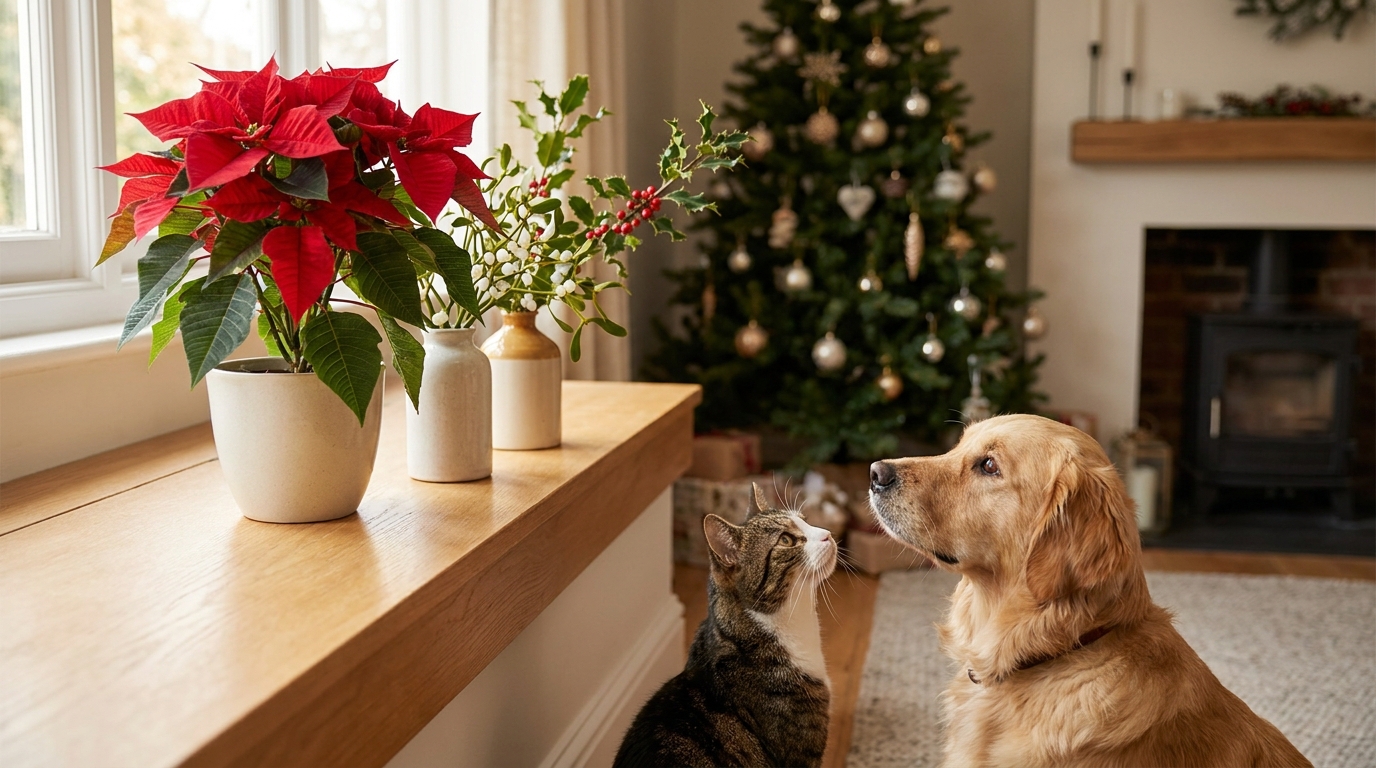
Poinsettia is mild, holly is low to moderate and mistletoe is the one to take seriously. What each plant does and when to call or go in.
Quick answer: Poinsettias are mildly toxic to cats and dogs: the milky sap can cause drooling, lip licking or one vomit; signs usually pass on their own. If your pet vomits more than once in a day, see a vet in person that day. For holly berries, call a poison line. Mistletoe is the riskiest: if eaten, call a poison line now; go to an ER for weakness, stumbling or collapse.
This article is general information, not a diagnosis. If you think your pet is in danger, go to the nearest emergency animal hospital.
Poinsettia, mistletoe and holly at a glance
The three Christmas classics are not equally risky: poinsettia irritates, holly adds spiky leaves and berries, and mistletoe can affect the heart. "Same day" here means an in-person exam.
| Plant | Risk and common signs | What to do |
|---|---|---|
| Poinsettia | Mild: drooling, lip licking, a vomit; sap can irritate skin and eyes | Wipe the mouth and watch; same-day vet if vomiting repeats or an eye squints |
| Holly | Low to moderate: vomiting, diarrhea, head shaking; spiky leaves can cut the mouth | Poison line if berries were eaten; same-day vet if vomiting repeats or the mouth bleeds |
| Mistletoe | Highest of the three: stomach upset; large amounts can slow the heart and cause stumbling | Poison line now, even with no signs; ER for weakness, stumbling, breathing changes or a slow heartbeat |
Go to an emergency vet now for any of these, and call a poison line on the way, not instead of going:
- Weakness, stumbling, tremors, collapse, fainting or seizures
- Trouble breathing, pale gums, or a very slow, racing or uneven heartbeat
- Blood in vomit or stool, coffee-ground vomit or black, tarry stool, or repeated vomiting with lethargy
- A swollen or painful belly, or vomiting or not eating after swallowing plastic berries, foil, cellophane or artificial greenery
- Ribbon, string or tinsel at the mouth or bottom, or possibly swallowed (never pull it)
- Any chance a cat touched a lily, even if it seems fine
Are poinsettias toxic to cats?
Yes, but mildly. The ASPCA lists poinsettia (Euphorbia pulcherrima) as toxic to dogs, cats and horses because its sap irritates the mouth and stomach, sometimes causing vomiting, but calls it "generally over-rated in toxicity." Pet Poison Helpline rates it "Mild" for cats and dogs and lists drooling, lip licking, vomiting, rare diarrhea, and skin or eye irritation where sap touches.
Pet Poison Helpline says the signs are generally self-limiting and usually need no treatment unless severe and persistent; there is no antidote. A 2002 toxicology brief by Petra Volmer, DVM, in Veterinary Medicine says reports of this plant's toxicity "have been greatly exaggerated," and the signs most often reported to the ASPCA's poison center settled with little treatment.
Tox Info Suisse, the Swiss national poison centre, rates poinsettia no more than slightly toxic but notes serious and even fatal cases with bloody diarrhea in dogs and cats, mainly after large amounts. So serious poisoning is rare and death is very unlikely, but blood in vomit or stool, or repeated vomiting with lethargy, needs a vet now.
If sap gets on your cat's fur or paws, wash it off with mild soap and water and keep your cat from licking the spot. Keep offering food and water; never hold back food from a cat.
Are poinsettias poisonous to dogs?
They are mildly toxic to dogs too, with the same signs. But dogs, puppies especially, tend to eat more, and they often swallow the decorations too:
- The foil sleeve. The ASPCA warns that swallowed foil or cellophane can cause an intestinal blockage. Take it off the pot.
- Plastic picks and berries. Pet Poison Helpline warns that swallowed plastic berries can block the intestines.
- A tipped pot. Clean up scattered leaves, soil and broken pieces before your dog does.
Pet Poison Helpline says the amount eaten and the animal's size decide toxicity, so call a poison line if a puppy or small dog ate a lot. See a vet in person the same day if your dog vomits more than once in a day, can't keep water down, or goes about 24 hours without eating (sooner for puppies, seniors and small or diabetic dogs).
My cat or dog ate a poinsettia: what to do right now
If you are sure it was a poinsettia and your pet is bright and breathing normally:
- Separate them. Move the plant to a closed room and pick up fallen leaves.
- Clear the mouth if it's safe. Pick out plant pieces only if your pet stays calm and lets you.
- Wipe, don't rinse. Wipe the lips with a damp cloth; never squirt water toward the throat. Keep fresh water available.
- Wash sap off skin and fur with mild soap and water.
- Flush an eye gently with lukewarm water. Knight's veterinary plant guide says sap from this plant family can, at worst, cause a corneal ulcer. A squinting eye needs a stain test that only a clinic can do. Squinting or tearing means a same-day, in-person visit; a cloudy, shut, bulging or worsening eye means go now.
- Do not make your pet vomit. Home methods can cause harm. Read when making a dog throw up helps and when it harms, and why you should never make a cat vomit at home.
- Skip home remedies: no milk, oil, salt, activated charcoal, or human medicines or creams.
- Photograph the plant and keep the tag, and note the time and rough amount. Volmer notes that naming a plant from a phone description is often unreliable.
Call a poison line if you can't name the plant, if it may have been mistletoe, holly berries, a bulb or a Christmas rose, or if a small or young pet ate a lot: ASPCA Animal Poison Control, (888) 426-4435 (a consultation fee may apply), or Pet Poison Helpline, (855) 764-7661 (a per-incident fee applies).
Is mistletoe poisonous to dogs and cats?
Yes. The ASPCA lists American mistletoe as toxic to dogs, cats and horses because of lectins and phoratoxins, with vomiting, diarrhea, difficulty breathing, a low heart rate and, rarely, low blood pressure. Volmer explains that phoratoxins lower heart rate, blood pressure and the force of each beat.
American vs European. American mistletoe is Phoradendron; European mistletoe is Viscum album. Pet Poison Helpline says the American kind is less of a concern, but most owners can't tell which they have.
All parts count. Pet Poison Helpline says all parts of American mistletoe are considered toxic, not just the berries. Small amounts usually cause drooling, vomiting, diarrhea and belly pain; large amounts can cause heart abnormalities, low blood pressure, a wobbly walk, seizures and even death. Its staff vet Charlotte Flint, DVM, notes that heart or nervous-system signs after very large amounts are rare in pets. The catch: you usually don't know how much was eaten.
Real leaves, plastic berries. Pet Poison Helpline says many stores swap the real berries for plastic ones, so a store-bought sprig can carry both risks: toxins from real leaves and a blockage from swallowed plastic.
What to do. Call a poison line now for any real mistletoe, before signs appear, especially for an unknown amount, a cat or small dog, or European mistletoe. For weakness, stumbling, collapse, seizures, trouble breathing or a slow or uneven heartbeat, go to an emergency vet now and call on the way.
Is holly toxic to dogs and cats?
Yes, but holly sits in the middle. The ASPCA's holly entry (Ilex opaca, also covering English holly, inkberry and winterberry) lists it as toxic to dogs, cats and horses because of saponins, with vomiting, diarrhea and depression, and rates the leaves and berries low toxicity. Pet Poison Helpline says the berries are the most toxic part, and most pets have mild signs and recover well at home.
The spiky leaves can injure the lips and gums, so most pets drool and shake their heads, Pet Poison Helpline says. Call a poison line if your pet ate berries. See a vet in person the same day for vomiting more than once in a day, pawing at the mouth, gagging, bleeding gums, head shaking that won't stop or trouble swallowing, since a cut or stuck leaf needs a look inside the mouth. A leaf stuck in the throat that affects breathing means an ER now.
Signs by severity: watch at home, same-day vet or ER
If more than one row fits, follow the most urgent. "Same day" means an in-person exam.
| Sign | What it may mean | Next step |
|---|---|---|
| Cat touched any lily: bitten leaf, pollen or vase water | Lily poisoning; kidney failure | Go now: ER, even with no signs |
| Weakness, stumbling, tremors, collapse or seizures | Serious poisoning, often mistletoe or a more toxic plant | Go now: ER; bring the plant or its tag |
| Pale gums, trouble breathing, or a slow or uneven heartbeat | Serious poisoning; possible heart effects | Go now: ER; call a poison line on the way |
| Blood in vomit or stool, or repeated vomiting with lethargy | Severe irritation or other illness | Go now: ER or your vet |
| Ribbon or tinsel swallowed, or vomiting or belly pain after plastic berries or foil | Possible gut blockage | Go now: ER; never pull ribbon |
| Eye cloudy, held shut or getting worse after sap | Possible corneal ulcer | Flush with water; go now to a vet |
| Ate real mistletoe, holly berries or an unknown plant, with or without signs | Possible poisoning | Poison line now |
| Squinting or tearing eye after sap | Sap irritation; ulcer risk | Flush with lukewarm water; same-day vet in person |
| Vomits more than once in a day, or can't keep water down | Ongoing irritation; dehydration risk | Same day: vet in person |
| Pawing at the mouth, gagging or bleeding gums after holly | Leaf cut or stuck piece | Same day: vet in person; ER if breathing changes |
| Poinsettia or holly leaf: drooling, lip licking or one vomit; pet bright and eating | Mild irritation | Watch at home; keep water available |
Lower the bar for puppies, kittens, seniors and small or diabetic pets, and see a vet in person the same day for lethargy or hiding, or a soft stool that lasts past a day.
Not sure it is a poinsettia? More dangerous look-alikes
If you can't name the plant, call a poison line with a photo ready. Call now, too, for amaryllis bulbs, a cyclamen root or tuber, and the Christmas rose (hellebore): Pet Poison Helpline says the Christmas rose's cardiac glycosides can change heart rate and rhythm and can be fatal, so go to an ER now for weakness or any heartbeat change. For cats, contact with lilies, their pollen or vase water is an emergency. Our Christmas cactus guide has a table of holiday look-alikes that are toxic. If a wreath or garland may contain yew, call a poison line and go to an ER now: the ASPCA lists sudden death from heart failure among yew's signs.
Keeping holiday plants and pets apart
- Out of reach. Cats climb, so a closed room beats a high shelf. The ASPCA also suggests faux plants.
- Pick up fallen leaves and berries daily, especially under hanging mistletoe.
- Fake is safer, not safe. Flint notes that swallowed artificial greenery can irritate the gut and possibly block it if enough is eaten. Skip pieces with small loose berries.
- Check gift bouquets for lilies. The ASPCA warns that many lilies in holiday bouquets can cause kidney failure in cats. Ask the florist to leave them out.
- Watch tinsel and ribbon. The ASPCA says swallowed tinsel can block the digestive tract and may need surgery. Never pull ribbon or tinsel from your pet's mouth or bottom; go to an ER.
When a video visit helps and when to go in person
A video visit fits when you're sure your pet nibbled a poinsettia or a holly leaf, it has had only drooling, lip licking or one vomit, and it is alert, eating and drinking. RexVet is a 501(c)(3) non-profit. If your pet is in Florida, New York or Virginia during the visit, you can book a $64.99 live video visit with Dr. Tiffany Delacruz, DVM, when a slot is open (usually about 8 AM to 11 PM ET; holiday hours may differ). On camera she can look at photos of the plant and its tag, ask what part was chewed and how much, and watch your pet's breathing, posture, gum color and energy while you show her the mouth. She can tell you whether home monitoring is enough or your pet needs an in-person exam, and point you to clinics nearby. A video visit can't make a pet vomit, give fluids, check a heart rhythm, feel the belly for a blockage or do the stain test for an eye ulcer. She can't promise medicine: whether any is appropriate depends on the exam, your pet's species and your state's rules. If she prescribes something and it is sent to an outside pharmacy, a pharmacy transfer fee applies; RexVet is not a pharmacy.
A video visit is the wrong first step if your pet ate any part of real mistletoe, holly berries, a bulb, a Christmas rose or a plant you can't name. Call a poison line first: ASPCA Animal Poison Control, (888) 426-4435 (a consultation fee may apply), or Pet Poison Helpline, (855) 764-7661 (a per-incident fee applies). Both poison lines answer 24 hours a day, 365 days a year; RexVet's video visits do not. Go in person the same day if your pet vomits more than once in a day, can't keep water down, or has sap in an eye that squints or tears. Go to an emergency vet now, and call a poison line on the way, for weakness, stumbling, collapse, seizures, trouble breathing, pale gums, a slow or uneven heartbeat, blood in vomit or stool, or any chance a cat touched a lily.
If none of those apply, you can check open video visit times.
Need an Expert Opinion on This Topic?
Book a video visit with a licensed vet, evenings and weekends included
See open timesFrequently Asked Questions
Can a poinsettia kill a cat or dog?
It is very unlikely. The ASPCA calls poinsettia "generally over-rated in toxicity," and Pet Poison Helpline rates it mildly toxic. Tox Info Suisse notes that serious and even fatal animal cases with bloody diarrhea have been reported, mainly after large amounts, so bloody diarrhea, repeated vomiting with lethargy, or no water kept down means a vet or ER now.
How long do poinsettia symptoms last?
Usually not long. Pet Poison Helpline calls the signs self-limiting, though no source we found gives a set number of hours. Don't wait it out: see a vet in person the same day if your pet vomits more than once in a day, can't keep water down, goes about 24 hours without food (sooner for young, old or small pets), or squints after sap gets in an eye.
Are the red leaves (bracts) worse than the green leaves?
The sources we checked don't rate them differently. The irritant is the milky sap, so treat a chewed red bract like a chewed green leaf: wipe your pet's mouth, watch for vomiting, and see a vet in person the same day if your pet vomits more than once in a day.
Is fake mistletoe safe for pets?
Not completely. Pet Poison Helpline says store-bought mistletoe often has plastic berries, which could block the intestines if swallowed. If the leaves are real and your pet chewed them, call a poison line. Vomiting, belly pain or not eating after swallowing plastic berries means an emergency vet now.
Are holly berries poisonous to cats?
Yes, but mildly. The ASPCA rates holly leaves and berries as low toxicity, and Pet Poison Helpline says the berries are the most toxic part, with signs usually limited to vomiting, diarrhea and belly pain. Call a poison line if your cat ate berries, and see a vet in person the same day if it vomits more than once in a day or keeps pawing at its mouth.
Do I need to call poison control for a poinsettia?
Not usually, if you're sure it was a poinsettia and your pet is acting normally. Call if you can't name the plant, if it may have been mistletoe, holly berries, a bulb or a Christmas rose, or if a small or young pet ate a lot. ASPCA Animal Poison Control is (888) 426-4435 (a consultation fee may apply), and Pet Poison Helpline is (855) 764-7661 (a per-incident fee applies).
Can an online vet in Florida, New York or Virginia help if my pet chewed a holiday plant?
Sometimes. If your pet is in Florida, New York or Virginia and is bright after a poinsettia or holly leaf nibble, a live video visit with Dr. Tiffany Delacruz, DVM, can help you decide what to watch for, when a slot is open. For mistletoe, holly berries, a bulb, a Christmas rose or a plant you can't name, call a poison line first. Collapse, seizures, breathing trouble, blood, or any lily contact in a cat need an emergency vet, not a video visit.
FAQs
Can a poinsettia kill a cat or dog?
It is very unlikely. The ASPCA calls poinsettia "generally over-rated in toxicity," and Pet Poison Helpline rates it mildly toxic. Tox Info Suisse notes that serious and even fatal animal cases with bloody diarrhea have been reported, mainly after large amounts, so bloody diarrhea, repeated vomiting with lethargy, or no water kept down means a vet or ER now.
How long do poinsettia symptoms last?
Usually not long. Pet Poison Helpline calls the signs self-limiting, though no source we found gives a set number of hours. Don't wait it out: see a vet in person the same day if your pet vomits more than once in a day, can't keep water down, goes about 24 hours without food (sooner for young, old or small pets), or squints after sap gets in an eye.
Are the red leaves (bracts) worse than the green leaves?
The sources we checked don't rate them differently. The irritant is the milky sap, so treat a chewed red bract like a chewed green leaf: wipe your pet's mouth, watch for vomiting, and see a vet in person the same day if your pet vomits more than once in a day.
Is fake mistletoe safe for pets?
Not completely. Pet Poison Helpline says store-bought mistletoe often has plastic berries, which could block the intestines if swallowed. If the leaves are real and your pet chewed them, call a poison line. Vomiting, belly pain or not eating after swallowing plastic berries means an emergency vet now.
Are holly berries poisonous to cats?
Yes, but mildly. The ASPCA rates holly leaves and berries as low toxicity, and Pet Poison Helpline says the berries are the most toxic part, with signs usually limited to vomiting, diarrhea and belly pain. Call a poison line if your cat ate berries, and see a vet in person the same day if it vomits more than once in a day or keeps pawing at its mouth.
Do I need to call poison control for a poinsettia?
Not usually, if you're sure it was a poinsettia and your pet is acting normally. Call if you can't name the plant, if it may have been mistletoe, holly berries, a bulb or a Christmas rose, or if a small or young pet ate a lot. ASPCA Animal Poison Control is (888) 426-4435 (a consultation fee may apply), and Pet Poison Helpline is (855) 764-7661 (a per-incident fee applies).
Can an online vet in Florida, New York or Virginia help if my pet chewed a holiday plant?
Sometimes. If your pet is in Florida, New York or Virginia and is bright after a poinsettia or holly leaf nibble, a live video visit with Dr. Tiffany Delacruz, DVM, can help you decide what to watch for, when a slot is open. For mistletoe, holly berries, a bulb, a Christmas rose or a plant you can't name, call a poison line first. Collapse, seizures, breathing trouble, blood, or any lily contact in a cat need an emergency vet, not a video visit.
Medically Reviewed
Reviewed by Dr. Tiffany Delacruz, DVM — licensed veterinarian and CEO of RexVet. Last reviewed October 28, 2026.
Content is for informational purposes and does not replace professional veterinary advice.
Chief Executive Officer · Licensed Veterinarian
Dr. Delacruz is a licensed Doctor of Veterinary Medicine specializing in preventive care and veterinary telehealth. She reviews all health content on RexVet to ensure accuracy and clinical relevance.
Sources & References
- · American Veterinary Medical Association — Telehealth Guidelines
- · AVMA — Pet Care Resources
- · U.S. FDA — Animal & Veterinary