
Senior Cat Stopped Grooming? What Matted, Greasy Fur Means
By RexVet Team | Reviewed by Dr. Tiffany Delacruz, DVM
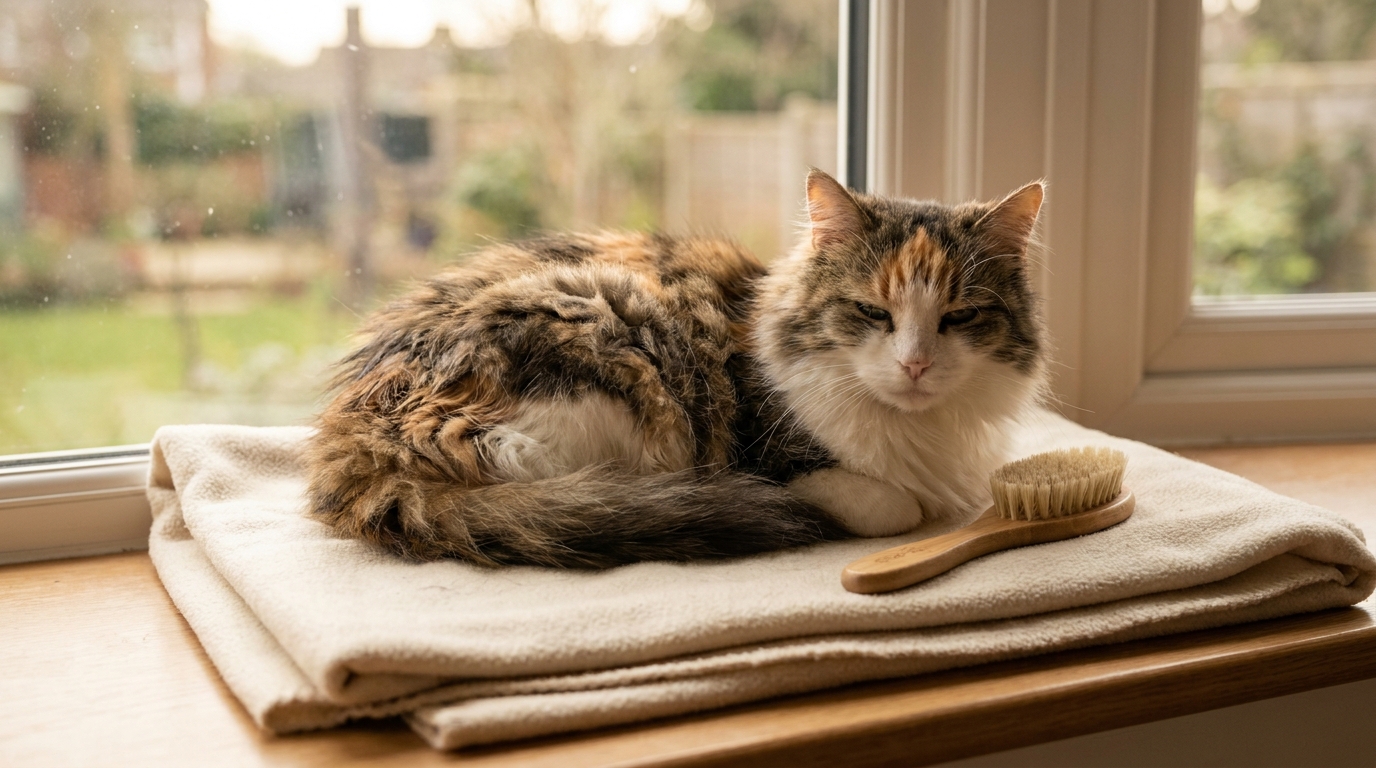
Senior cat stopped grooming? A matted or greasy back often points to pain from arthritis, dental disease or illness, not just old age.
Get your cat seen today if a grooming change comes with not eating, hiding, weakness, vomiting, trouble breathing, or raw skin, sores or a bad smell under the mats.
A cat who kept herself spotless for years and now has clumps over her hips, a spiky or oily strip down her back, or a dull, scruffy coat is telling you something has changed. This guide covers what that change can mean, which signs mean going in today, how to help her at home without hurting her, and when a vet needs to see her in person.
Senior cat stopped grooming: why it matters
A change in grooming can be linked to pain. VCA Animal Hospitals puts it plainly: "One of the most common pain-associated behavior changes in aging cats is a decrease in grooming and self-care."
Age plays a part, but it is not the whole story. The Cornell Feline Health Center notes that "Older cats groom themselves less effectively than do younger cats, sometimes resulting in hair matting, skin odor, and inflammation." Mats, a smell or red, irritated skin are not cosmetic problems. They are things a vet should know about.
How fast the change happened matters too. In its guide to caring for older cats, Cornell adds a clear warning: "(Be aware that a sudden lack of grooming may signal a health problem.)" If your old cat not grooming herself seemed to happen quickly rather than little by little, treat it as a reason to talk to a vet, not as her new normal.
When to go in today
Before anything else, look at the bigger picture. A grooming change on its own is worth a vet's look soon. A grooming change together with other signs can mean she needs care right now.
Go to an emergency clinic now
- Trouble breathing
- Collapse, or not being able to stand
- Bleeding that won't stop
- Seizures
- Straining in the litter box with no urine coming out
- A known or suspected poisoning
Get her seen in person today
- Not eating
- Hiding
- Weakness
- Vomiting
- Raw skin, sores or a bad smell under the mats
If you're not sure which group your cat is in, treat a sudden change as a reason to call a vet, not a reason to wait. While you get ready, jot down what you've noticed and roughly when it started so you can share it with the vet.
For more signs to watch in both dogs and cats, see our practical checklist for spotting a pet emergency.
Arthritis and back pain
Arthritis is one cause to look at closely when an older cat lets her coat go. VCA Animal Hospitals notes that "Osteoarthritis (OA) is one of the most common chronically painful ailments in cats, affecting more than 90% of cats 10 years of age and older."
Grooming asks a lot of a cat's body. To reach her lower back, her hips and the base of her tail, she has to twist, bend and balance. VCA explains the link: "Spinal arthritis makes it uncomfortable to twist and turn, so grooming the body, especially the hind end, becomes difficult."
That is why it helps to look closely at the places that take the most twisting to reach. VCA describes what you may see at home: "Ungroomed areas become matted, and the cat may develop an unkempt appearance. She may also object to attempts to brush her." So if a cat who used to enjoy brushing now pulls away, swats or walks off when the brush reaches her hips, that reaction is worth telling a vet about.
Pain clues VCA describes in aging cats that can go along with a grooming change:
- "Reluctance or inability to jump up on furniture, counters, and windowsills"
- Difficulty twisting and turning to groom the hind end
- Matted, unkempt areas she no longer reaches
- Objecting to being brushed
None of these clues proves arthritis on its own, and an older cat can have more than one problem at the same time. They are the kind of details a vet will want to hear, and a vet can check her joints and spine and tell you what they find.
Mouth pain and other illness
Dental pain is another thing to rule out. The Cornell Feline Health Center says "Dental disease is extremely common in older cats and can hinder eating and cause significant pain." Cornell also notes that "any condition that causes pain or impairs mobility can contribute to changes in behavior," and that changes in an older cat "can be signs of common diseases or dental problems." If you notice bad breath, drooling or trouble chewing, our guide to dental warning signs in cats explains what to look for.
Illness elsewhere in the body is worth ruling out as well. Cornell lists conditions that become more common with age, including hyperthyroidism, high blood pressure, diabetes, inflammatory bowel disease and cancer. Separately, Cornell lists an "unkempt appearance of coat or skin" among the signs that may suggest a problem in an older cat.
You can't tell these conditions apart at home by looking at the coat. A vet checks for them with an exam and, when needed, tests. That is why a grooming change deserves a proper look rather than a guess.
Weight is part of the picture too. Cornell notes that "Many cats get heavier or even obese as they age," while "other cats actually become too thin as they get older," and says that during an exam the veterinarian will "check your cat's weight and body condition." Weight loss should always be checked. Our article on senior cat weight loss explains when it is a warning sign.
Helping at home, gently
While you arrange a vet check, you can make her more comfortable. Cornell's advice is simple: "Older cats can benefit from more frequent hands-on help if their self-grooming begins to wane." Brushing does more than tidy her up. In Cornell's words, "Gently brushing or combing removes loose hairs and stimulates circulation and sebaceous gland secretions, returning luster to the coat."
- Keep sessions short, and end before she gets restless.
- Use a soft brush and a light hand, especially over bony areas.
- Start where she likes to be touched, such as her cheeks and shoulders, then work toward her back.
- Stop if she flinches, growls or turns toward you when you reach her hips, and tell your vet.
- Pick a warm, quiet spot where she can lie down comfortably.
Mats need extra care. VCA Animal Hospitals advises, "Only use clippers to remove mats — never scissors." If mats sit tight against the skin, let a groomer or your veterinary clinic remove them. If you see sores, redness or a bad smell under a mat, have a veterinarian look first. That is a same-day visit.
Small changes around the house help too. Keep food, water and a low-sided litter box where she can reach them without climbing stairs or jumping. A soft bed in a warm spot is always welcome.
Please do not give her any human pain reliever or other medicine at home. A veterinarian decides what is safe.
If you see flakes in her coat along with the mats, our guide to cat dandruff and skin clues explains what they can mean.
Over-grooming is a different problem
Bald patches, broken hairs or raw skin from licking too much are a different problem, covered in our article on a cat licking her belly bald. This article is about grooming too little.
What a RexVet online vet can and cannot do
If your cat has any of the go-now or same-day signs listed above, skip the video visit and go to an emergency clinic or your local vet in person. For a grooming change without those signs, a video visit can be a useful first step.
RexVet's veterinarians are licensed in Florida, New York and Virginia. By video, a RexVet vet can:
- Look at her coat, skin and mats on camera
- Watch her walk, jump and turn
- Look at her teeth and gums in good light
- Review changes in her weight and appetite
- Decide what needs an in-person exam or tests
By video, a vet cannot:
- Run bloodwork or thyroid tests
- Take X-rays
- Clean her teeth
- Shave out mats
Photos and short clips help. A video of her walking across the room or trying to jump onto the couch, and a close photo of the mats on her back in daylight, give the vet more to go on. Here's how to upload pet photos and videos for an online vet review.
VCA Animal Hospitals offers a simple rule for older cats: "When in doubt, have it checked out." If the veterinarian decides medication is appropriate, they can prescribe where state rules allow. In Florida, a veterinarian who has seen your pet only by video may prescribe only FDA-approved animal drugs used as labeled, for up to 14 days (1 month for flea-and-tick-only products), and cannot renew without an in-person exam.
If you'd like a vet to look at your cat's coat and the way she moves, even late at night or on a weekend, you can book a RexVet video visit. A visit is $64.99, vets are available 24/7, and the service is for pet parents in Florida, New York and Virginia only.
When to be seen in person in Florida, New York or Virginia
Some grooming changes need hands-on care. Book an in-person visit with a local vet if you notice:
- Any of the signs in the bold line at the top of this page
- Sores, raw skin or a bad smell under mats
- Weight loss
- Bad breath with drooling
- Crying out when you touch her over the back
An in-person visit can include the things a video visit cannot, such as bloodwork, thyroid tests, X-rays, dental cleaning and safely shaving out tight mats.
In Florida, state law requires a telehealth vet to give you "the contact information for at least one physical veterinary clinic in the vicinity of the patient's location" (Florida Statutes 474.2021), so you have a local clinic to turn to if your cat needs to be seen. For more on video care where you live, see our pages for Florida, New York and Virginia pet parents.
Frequently Asked Questions
Why does my old cat have a greasy back?
You can't work out the cause from the coat alone, so it's worth having a vet look at her. Pain is one thing to check: VCA notes that spinal arthritis makes it uncomfortable to twist and turn, so grooming the body, especially the hind end, becomes difficult. Cornell also notes that older cats groom themselves less effectively than younger cats. A vet will look at her coat and skin, check her weight and body condition, and help work out what is going on.
Is it normal for older cats to stop grooming?
Some change is expected: Cornell says older cats groom themselves less effectively than younger cats. A sudden stop is different. Cornell warns that a sudden lack of grooming may signal a health problem, so a quick change is a reason to see a vet rather than to put it down to age.
Should I cut out my cat's mats with scissors?
No. VCA Animal Hospitals says to only use clippers to remove mats, never scissors. If the mats are tight against her skin, let a groomer or your veterinary clinic remove them. If the skin underneath looks raw, has sores or smells bad, have a vet see her that day.
Can arthritis stop a cat from grooming?
It can. VCA explains that spinal arthritis makes it uncomfortable for a cat to twist and turn, so grooming the body, especially the hind end, becomes difficult. VCA also lists reluctance or inability to jump up on furniture, counters and windowsills among pain clues in aging cats. A vet can check her joints and spine.
Can I give my cat something for arthritis pain?
Please do not give your cat any human pain reliever or other medicine at home. A veterinarian can examine your cat and decide what, if anything, is appropriate. If the veterinarian decides medication is appropriate, they can prescribe where state rules allow.
A cat who stops grooming is showing you a change worth a vet's look, and anything on the emergency list goes to an emergency clinic first. For everything else, you can book a RexVet video visit for $64.99, and vets are available 24/7, including nights, weekends and holidays. RexVet's veterinarians are licensed in Florida, New York and Virginia, and video visits are for pet parents in those three states only.
FAQs
Why does my old cat have a greasy back?
You can't work out the cause from the coat alone, so it's worth having a vet look at her. Pain is one thing to check: VCA notes that spinal arthritis makes it uncomfortable to twist and turn, so grooming the body, especially the hind end, becomes difficult. Cornell also notes that older cats groom themselves less effectively than younger cats. A vet will look at her coat and skin, check her weight and body condition, and help work out what is going on.
Is it normal for older cats to stop grooming?
Some change is expected: Cornell says older cats groom themselves less effectively than younger cats. A sudden stop is different. Cornell warns that a sudden lack of grooming may signal a health problem, so a quick change is a reason to see a vet rather than to put it down to age.
Should I cut out my cat's mats with scissors?
No. VCA Animal Hospitals says to only use clippers to remove mats, never scissors. If the mats are tight against her skin, let a groomer or your veterinary clinic remove them. If the skin underneath looks raw, has sores or smells bad, have a vet see her that day.
Can arthritis stop a cat from grooming?
It can. VCA explains that spinal arthritis makes it uncomfortable for a cat to twist and turn, so grooming the body, especially the hind end, becomes difficult. VCA also lists reluctance or inability to jump up on furniture, counters and windowsills among pain clues in aging cats. A vet can check her joints and spine.
Can I give my cat something for arthritis pain?
Please do not give your cat any human pain reliever or other medicine at home. A veterinarian can examine your cat and decide what, if anything, is appropriate. If the veterinarian decides medication is appropriate, they can prescribe where state rules allow.
A cat who stops grooming is showing you a change worth a vet's look, and anything on the emergency list goes to an emergency clinic first. For everything else, you can book a RexVet video visit for $64.99, and vets are available 24/7, including nights, weekends and holidays. RexVet's veterinarians are licensed in Florida, New York and Virginia, and video visits are for pet parents in those three states only.
Medically Reviewed
Reviewed by Dr. Tiffany Delacruz, DVM — licensed veterinarian and CEO of RexVet. Last reviewed September 24, 2026.
Content is for informational purposes and does not replace professional veterinary advice.
Chief Executive Officer · Licensed Veterinarian
Dr. Delacruz is a licensed Doctor of Veterinary Medicine specializing in preventive care and veterinary telehealth. She reviews all health content on RexVet to ensure accuracy and clinical relevance.
Sources & References
- · American Veterinary Medical Association — Telehealth Guidelines
- · AVMA — Pet Care Resources
- · U.S. FDA — Animal & Veterinary
Need an Expert Opinion on This Topic?
Connect with a certified vet via video call in minutes
Talk to Vet Now