
Galliprant vs Carprofen (Rimadyl) for Dogs: Safety and Switching
By RexVet Team | Reviewed by Dr. Tiffany Delacruz, DVM
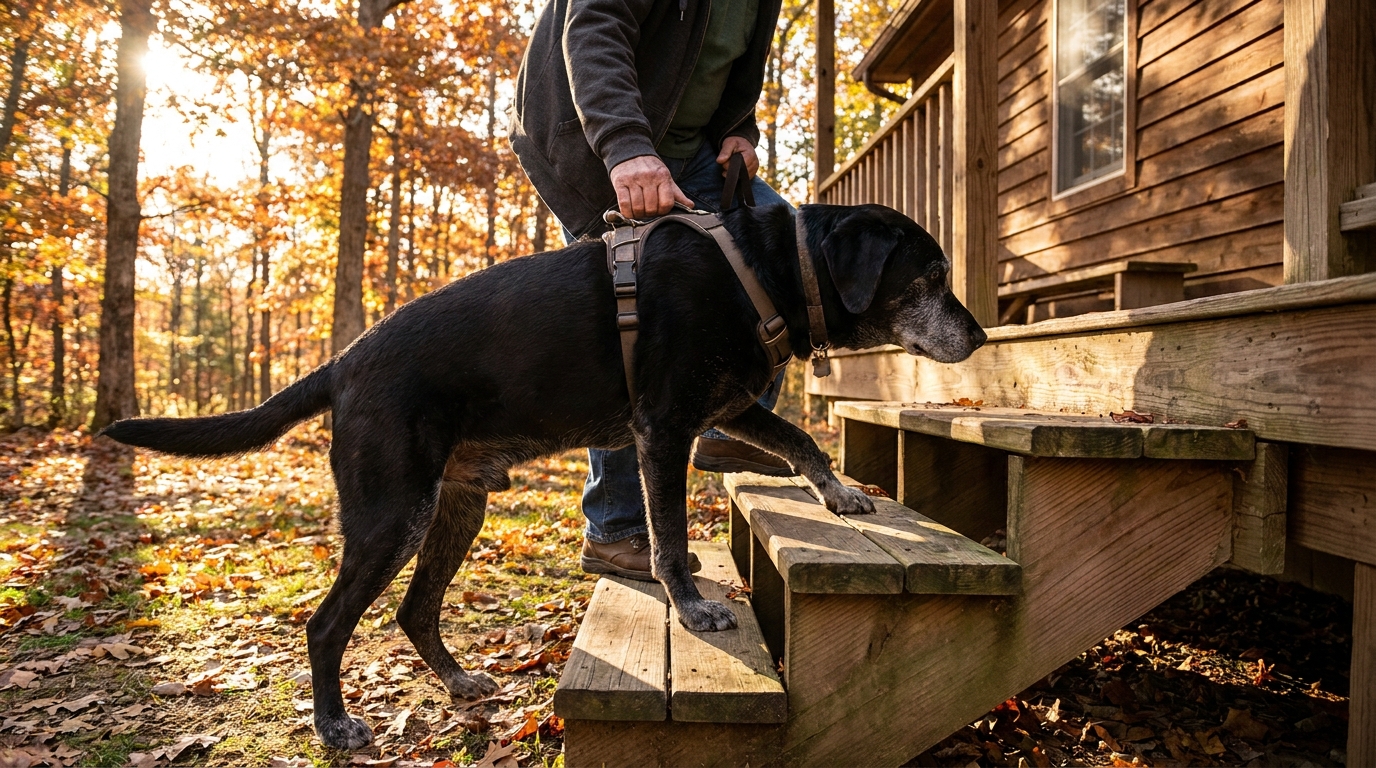
How Galliprant and carprofen differ, what the studies really show about safety, and how to switch between them without an overlap.
Quick answer: Galliprant and carprofen (Rimadyl) both treat arthritis pain in dogs but work differently: carprofen blocks COX enzymes and is also labeled for pain after surgery, while Galliprant blocks one prostaglandin receptor (EP4) and is labeled only for arthritis. Neither is proven safer. Never give both together; your vet sets the gap when switching. Black, tarry stool or vomiting blood means stop the drug and go to an ER now.
This article is general information, not a diagnosis. If you think your pet is in danger, go to the nearest emergency animal hospital.
Galliprant vs carprofen at a glance
Galliprant (generic name grapiprant) and carprofen (sold as Rimadyl and as several FDA-approved generics) are both prescription anti-inflammatory drugs, or NSAIDs, for dogs with arthritis pain.
| Feature | Galliprant | Carprofen (Rimadyl, generics) |
|---|---|---|
| How it works | Blocks the EP4 receptor; does not block COX | Blocks COX enzymes |
| Labeled for | Arthritis pain only | Arthritis pain and pain after surgery |
| Age and weight | Not tested under 9 months; owner sheet says not for dogs under 8 lb | Not tested under 6 weeks; no weight floor on label |
| Generics | None approved by FDA (Oct 2026) | Several approved by FDA |
| On the market | Since 2016 | Since 1996 |
| Bloodwork | Label advises it before and during use | Label says to consider it before and during use |
| Never give with | Carprofen, other NSAIDs, aspirin or steroids | Galliprant, other NSAIDs, aspirin or steroids |
| Cats | Not approved for cats | Not approved; label says do not use in cats |
Stop either drug and go to an ER now for black, tarry stool, vomiting blood, repeated vomiting, pale gums or collapse.
How they work, in plain words
An inflamed joint makes chemical messengers called prostaglandins, and one of them, PGE2, drives much of arthritis pain. Prostaglandins also help protect the stomach lining and keep the kidneys working normally. That double role is why every drug in this family carries stomach and kidney warnings; liver injury can also occur, by a different route.
Carprofen blocks the COX enzymes that make prostaglandins in the first place. Lab tests in canine cells show it prefers COX-2 over COX-1, but the Rimadyl label says that preference has not been shown to matter in real dogs. Meloxicam, another common dog NSAID, also blocks COX and is never given with either drug.
Galliprant leaves COX alone. It blocks EP4, one of the receptors PGE2 uses to send its pain signal. Its FDA label and the Merck Veterinary Manual both describe grapiprant this way, and FDA lists it among the NSAIDs approved for dogs. So Galliprant is a different kind of NSAID that does not block COX, and the same never-combine rules apply.
The common claim that Galliprant is easier on the stomach and kidneys is a theory based on that mechanism, not a proven result: its own label says EP4 also helps the stomach make protective mucus and heal, and helps the kidney hold salt. No trial has tested it in dogs with kidney disease.
Is Galliprant safer than carprofen (Rimadyl)? What the studies show
Not proven either way. No published trial compares Galliprant with carprofen in dogs with everyday arthritis, and a 2026 knowledge summary in Veterinary Evidence, which compared grapiprant only with no grapiprant, rated even the evidence that it eases arthritis pain as weak.
Galliprant against placebo. The main field study followed 285 client-owned dogs with arthritis, aged 2 to almost 17, for 28 days. On owner pain scores, 48.1% of dogs on Galliprant were treatment successes, against 31.3% on placebo, and occasional vomiting occurred in about 17% vs about 6%. Carprofen's trials were run differently, so side-effect rates cannot be compared across the two drugs.
Who was studied. Galliprant's long-term safety study used healthy 9-month-old Beagles, and its arthritis trial left out dogs with significant bloodwork problems. A second field study found raised liver enzymes (ALP and ALT) at Day 28. Galliprant has not been studied in dogs with kidney or liver disease, and reports since approval include stomach ulcers, pancreatitis and kidney failure, some of them fatal. High-dose tests in healthy dogs do not make an extra dose safe.
Side by side, but not in arthritis. The only studies that put grapiprant beside carprofen used short-term pain, and so did one beside meloxicam:
- A 2019 American Journal of Veterinary Research study gave 5 purpose-bred dogs a lab-induced joint flare and tried three treatments in turn. Carprofen lowered lameness the most and grapiprant the least, at 6, 12 and 24 hours, but an induced flare is not everyday arthritis.
- In a randomized trial of 42 healthy dogs having spay surgery (JAVMA, 2022), grapiprant was not worse than carprofen on pain scores over 24 hours; a 12-Beagle spay study found no difference and called its results preliminary.
- In 48 client-owned dogs after TPLO knee surgery, a 2024 study in the Journal of Veterinary Internal Medicine found lower owner pain scores at Day 3 with grapiprant than with meloxicam. In the US, Galliprant after surgery is off-label.
Carprofen's rare liver reaction. Carprofen has about 30 years of use, and its best-known rare problem is unpredictable (idiosyncratic) liver injury. In the first case series of 21 dogs (1998), signs were appetite loss, vomiting and yellowing, and most recovered after the drug was stopped and they got supportive care. Labradors made up about a quarter to a third of reported cases, but a true breed risk has not been established.
FDA's position is that no NSAID is considered more effective or safer than another. The better choice is the one that fits your dog's health, bloodwork and medicine list.
What your vet weighs when choosing
These are factors vets commonly weigh, not a recommendation for your dog.
| Situation | Often considered | Why |
|---|---|---|
| Pain after surgery | Carprofen | It is labeled for this; Galliprant use here is off-label |
| Stomach upset on carprofen | Stop it, call the vet; a switch may follow a vet-set gap | Different target, but Galliprant can also upset the stomach |
| Puppy under 9 months or dog under 8 lb | Carprofen | Galliprant was not tested under 9 months and is not for dogs under 8 lb |
| Tight budget | Generic carprofen | There is no generic Galliprant |
| Older dog | Either, after fresh bloodwork | Age alone does not decide it; bloodwork and other illnesses do |
| Kidney or liver values already off | Fresh bloodwork first; maybe a plan beyond NSAIDs | Either drug can harm the kidneys or liver |
Both labels advise a baseline blood count and chemistry panel before treatment and repeat checks during it, and FDA adds urine tests and periodic rechecks for long-term arthritis use. A video visit cannot draw blood, so these tests come from your local clinic or lab.
Tell your vet about any of these before a switch or a new start:
- A recent steroid such as prednisone, or another NSAID or aspirin
- Diuretics, or heart, seizure or behavior medicines
- A bleeding disorder (carprofen is not recommended)
- Heart disease (Galliprant has not been studied in it)
- A past sulfa-drug reaction (Galliprant is a sulfonamide-type compound)
- Pregnancy, breeding plans, and every supplement your dog gets
The Galliprant label also warns that a dog that reacted to one NSAID may react to another, so a switch after a side effect is not a guaranteed fix.
Switching from carprofen to Galliprant, or back
Never give Galliprant and carprofen on the same day. The Galliprant label says not to combine it with other NSAIDs or steroids, and its owner sheet names carprofen. The Rimadyl label warns that other NSAIDs or steroids raise the risk of stomach ulcers and perforation.
The gap between drugs. Neither label's switching advice gives a number of days; both say only to "consider appropriate washout times." FDA recommends an NSAID-free period so the first drug clears, also with no fixed number, so your vet sets the gap. Mention any recent steroid, since FDA lists those dogs among the highest risk, and never adjust an NSAID dose on your own.
- Call your vet before you stop one drug or start the other. After any side effect, stop the drug first, then call.
- Write the last-dose date for the old drug and the first-dose date for the new one on a calendar the whole household can see.
- Put the old bottle away so no one gives it out of habit.
- Watch for the warning signs in the next section, especially in the first weeks.
Comfort during the gap. The washout can mean a stiffer dog. Ease it with short leash walks instead of running or stairs, rugs on slick floors, a warm padded bed, a ramp or support sling, and keeping your dog lean. If your older dog is weak or slipping in the hind end, read about an old dog's back legs giving out and which signs mean an emergency.
No human pain relievers. Never fill the gap with ibuprofen, naproxen, aspirin or acetaminophen: in dogs they can cause stomach ulcers, kidney failure or liver injury. If your dog already got one, call a poison line or go to an ER now. If pain is not controlled, call your vet rather than raising the dose or adding a second NSAID. The Galliprant label notes a non-NSAID, non-steroid painkiller may be needed, and the Rimadyl label points to alternative pain relief.
Side effects to watch on either drug
Both owner sheets say: if you see a side effect, stop the medication and contact your vet right away. The table shows how fast to act.
| Sign | What it can mean | What to do |
|---|---|---|
| Black, tarry stool, or vomit with blood or what looks like coffee grounds | A bleeding ulcer in the gut | Stop the drug; ER now |
| Pale gums, collapse or a swollen belly | Heavy bleeding or a hole from an ulcer | Stop the drug; ER now |
| Repeated vomiting or a painful belly | A deep ulcer or organ injury | Stop the drug; ER now |
| Stumbling or a seizure | A drug reaction or other illness | Stop the drug; ER now |
| Little or no urine | Kidney injury | Stop the drug; ER now |
| Yellow gums, skin or eyes | Liver injury | Stop the drug; see a vet today |
| One vomit, diarrhea, bloody stool, not eating, lethargy or a behavior change | Stomach upset or an early ulcer | Hold the next dose; call the vet today |
| Drinking or peeing more | Kidney stress | Hold the next dose; call the vet today |
| Extra dose, both drugs the same day, or a chewed bottle | Overdose risk before signs show | Poison line or ER now |
| A cat swallowed one | Neither drug is safe for cats | Poison line or vet now |
If your vet can't see a dog with yellow gums or eyes today, go to an ER. For an extra dose, both drugs on one day, a chewed bottle or a cat that swallowed a tablet, call ASPCA Animal Poison Control at (888) 426-4435 (a consultation fee may apply) or Pet Poison Helpline at (855) 764-7661 (per-incident fee), or go to an ER, even before signs appear. Galliprant tablets and carprofen chewables are made to taste good to dogs, so keep all bottles out of reach, and do not make your dog vomit unless told to; see when making a dog throw up helps and when it harms.
Hold the next dose if your dog is not eating, is vomiting, has bloody stool or may be dehydrated, until your vet says otherwise. Before any anesthesia, tell the team which NSAID your dog takes, since the Rimadyl label notes that anesthesia plus an NSAID can affect blood flow to the kidneys.
Cost and generics
FDA's Animal Drugs @ FDA database lists several approved generic carprofen products as of October 24, 2026, one reason carprofen is often the lower-cost option, though approved does not always mean stocked. Galliprant has no approved generic: the database lists Galliprant itself as the only grapiprant product. Prices vary with your dog's size and the pharmacy, so ask for written prices for the drug and the bloodwork.
Can an online vet help you choose or switch?
If you see any side effect, both labels say to stop the drug and call your vet right away. If your dog already has an arthritis diagnosis and is stable, and you want to talk through whether a switch makes sense, or want a second opinion after you have already stopped the drug and called your vet, book a $64.99 live video visit with Dr. Tiffany Delacruz, DVM, through RexVet, a non-profit. She sees dogs in Florida, New York and Virginia, with live video slots about 8 AM-11 PM ET. She can review the history and the recent bloodwork and urine results from your clinic, and watch your dog rise and walk on camera.
Any NSAID depends on her exam, recent bloodwork from your clinic and state law, and nothing is promised. In Florida, a video-only prescription must be an FDA-approved dog drug used as labeled, for up to 14 days, and can't be renewed without an in-person exam, so ongoing arthritis medicine needs a hands-on vet. Virginia allows the exam to be done electronically; rules in New York are less settled. If she sends a prescription to a pharmacy, a pharmacy transfer fee applies; RexVet is not a pharmacy.
Black or tarry stool, vomiting blood, repeated vomiting, pale gums, stumbling, a seizure or collapse means an emergency vet now, not a video visit. Yellow gums or eyes mean stop the drug and see a vet in person today, or go to an ER if yours can't see your dog today. For a double dose or both drugs on one day, call a poison line above or go to an ER.
Book a live video visit with Dr. Delacruz for dogs in Florida, New York or Virginia.
Need an Expert Opinion on This Topic?
Book a video visit with a licensed vet, evenings and weekends included
See open timesFrequently Asked Questions
Can Galliprant and carprofen be given together, or back to back?
No. Both labels say not to combine them with other NSAIDs or steroids, and the Rimadyl label names the risk: stomach ulcers and perforation. Neither label gives a number of days for a switch; FDA advises an NSAID-free gap, and your vet sets how long. If both were given the same day, call a poison line (numbers in the side-effects section) or go to an ER now.
Is Galliprant easier on the kidneys than carprofen?
Not proven. The idea comes from Galliprant blocking EP4 instead of COX, but its label says EP4 also affects how the kidneys hold salt, and it has not been tested in dogs with kidney disease. Its owner sheet says a dog with an existing kidney or liver condition should not take it, and kidney failure has been reported. Any switch for the kidneys should follow fresh bloodwork and urine tests.
Which works faster, Galliprant or carprofen?
No study has compared their speed in everyday arthritis. In Galliprant's main trial, owner pain scores beat placebo by Day 7, the first check, and the Rimadyl owner sheet says most dogs improve in a matter of days. If pain isn't controlled, call your vet; never raise the dose or add a pain reliever yourself.
Can Galliprant be used after surgery?
Galliprant's US label covers arthritis pain only, so post-surgery use is off-label, and federal rules allow that only when a vet has examined your dog in person. Carprofen is labeled for pain after soft-tissue and orthopedic surgery.
Can my dog take Galliprant or carprofen with gabapentin?
Gabapentin is not an NSAID, and the Galliprant label notes a non-NSAID painkiller may be needed for more relief, but adding one is your vet's call. Gabapentin is a human drug, so it needs an in-person exam, and it is a controlled drug in Virginia. See our guide to carprofen and gabapentin together.
Is there a generic Galliprant?
No. As of October 2026, FDA's animal drug database lists only Galliprant and no approved generic grapiprant. Carprofen has several FDA-approved generics. Ask your vet before buying anything sold as generic grapiprant.
Can cats take Galliprant or carprofen?
Neither drug is approved for cats, and FDA (November 2024) lists no NSAID approved for long-term use in cats. Any use in a cat is off-label and needs an in-person exam. If your cat swallowed your dog's tablet, call your vet, ASPCA Animal Poison Control at (888) 426-4435 (a consultation fee may apply) or Pet Poison Helpline at (855) 764-7661 (per-incident fee) right away.
Can an online vet in Florida, New York or Virginia prescribe Galliprant or carprofen?
Possibly, but nothing is promised. Dr. Tiffany Delacruz, DVM, sees dogs in Florida, New York and Virginia by live video, and any NSAID depends on her exam, recent clinic bloodwork and state law. In Florida, a video-only prescription must be an FDA-approved dog drug used as labeled, for up to 14 days, and can't be renewed without an in-person exam, so ongoing arthritis medicine needs a hands-on vet. Virginia allows the exam to be done electronically; rules in New York are less settled. If she sends a prescription to a pharmacy, a pharmacy transfer fee applies; RexVet is not a pharmacy.
FAQs
Can Galliprant and carprofen be given together, or back to back?
No. Both labels say not to combine them with other NSAIDs or steroids, and the Rimadyl label names the risk: stomach ulcers and perforation. Neither label gives a number of days for a switch; FDA advises an NSAID-free gap, and your vet sets how long. If both were given the same day, call a poison line (numbers in the side-effects section) or go to an ER now.
Is Galliprant easier on the kidneys than carprofen?
Not proven. The idea comes from Galliprant blocking EP4 instead of COX, but its label says EP4 also affects how the kidneys hold salt, and it has not been tested in dogs with kidney disease. Its owner sheet says a dog with an existing kidney or liver condition should not take it, and kidney failure has been reported. Any switch for the kidneys should follow fresh bloodwork and urine tests.
Which works faster, Galliprant or carprofen?
No study has compared their speed in everyday arthritis. In Galliprant's main trial, owner pain scores beat placebo by Day 7, the first check, and the Rimadyl owner sheet says most dogs improve in a matter of days. If pain isn't controlled, call your vet; never raise the dose or add a pain reliever yourself.
Can Galliprant be used after surgery?
Galliprant's US label covers arthritis pain only, so post-surgery use is off-label, and federal rules allow that only when a vet has examined your dog in person. Carprofen is labeled for pain after soft-tissue and orthopedic surgery.
Can my dog take Galliprant or carprofen with gabapentin?
Gabapentin is not an NSAID, and the Galliprant label notes a non-NSAID painkiller may be needed for more relief, but adding one is your vet's call. Gabapentin is a human drug, so it needs an in-person exam, and it is a controlled drug in Virginia. See our guide to carprofen and gabapentin together.
Is there a generic Galliprant?
No. As of October 2026, FDA's animal drug database lists only Galliprant and no approved generic grapiprant. Carprofen has several FDA-approved generics. Ask your vet before buying anything sold as generic grapiprant.
Can cats take Galliprant or carprofen?
Neither drug is approved for cats, and FDA (November 2024) lists no NSAID approved for long-term use in cats. Any use in a cat is off-label and needs an in-person exam. If your cat swallowed your dog's tablet, call your vet, ASPCA Animal Poison Control at (888) 426-4435 (a consultation fee may apply) or Pet Poison Helpline at (855) 764-7661 (per-incident fee) right away.
Can an online vet in Florida, New York or Virginia prescribe Galliprant or carprofen?
Possibly, but nothing is promised. Dr. Tiffany Delacruz, DVM, sees dogs in Florida, New York and Virginia by live video, and any NSAID depends on her exam, recent clinic bloodwork and state law. In Florida, a video-only prescription must be an FDA-approved dog drug used as labeled, for up to 14 days, and can't be renewed without an in-person exam, so ongoing arthritis medicine needs a hands-on vet. Virginia allows the exam to be done electronically; rules in New York are less settled. If she sends a prescription to a pharmacy, a pharmacy transfer fee applies; RexVet is not a pharmacy.
Medically Reviewed
Reviewed by Dr. Tiffany Delacruz, DVM — licensed veterinarian and CEO of RexVet. Last reviewed October 24, 2026.
Content is for informational purposes and does not replace professional veterinary advice.
Chief Executive Officer · Licensed Veterinarian
Dr. Delacruz is a licensed Doctor of Veterinary Medicine specializing in preventive care and veterinary telehealth. She reviews all health content on RexVet to ensure accuracy and clinical relevance.
Sources & References
- · American Veterinary Medical Association — Telehealth Guidelines
- · AVMA — Pet Care Resources
- · U.S. FDA — Animal & Veterinary