
Dog Breathing Fast While Sleeping: Normal Rate and When to Worry
By RexVet Team | Reviewed by Dr. Tiffany Delacruz, DVM
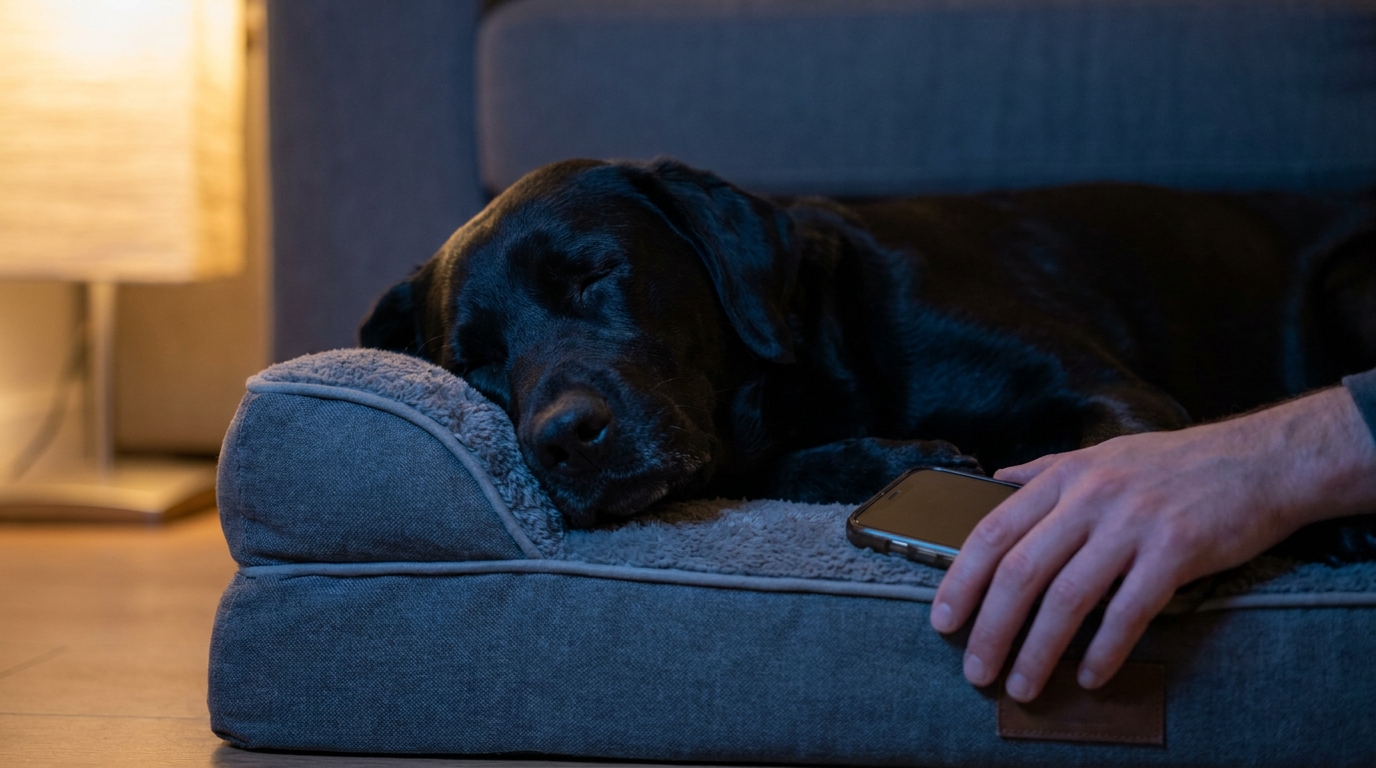
How to count your dog's sleeping breaths, what number is normal, how to tell dreaming from trouble, and which signs mean an emergency vet now.
Quick answer: A healthy adult dog sound asleep in a cool room usually takes fewer than 30 breaths a minute, and many take under 20. Count chest rises for 30 seconds and double it. Quick, irregular breaths with twitching are usually dreaming. If repeat sleeping counts stay above 30, see a vet today. Labored or open-mouth breathing at rest, or gray, blue or pale gums, means an emergency vet now.
This article is general information, not a diagnosis. If you think your pet is in danger, go to the nearest emergency animal hospital.
Stop reading and go to an emergency vet now if your dog breathes with its mouth open at rest, heaves its belly, won't lie down or keeps stretching its neck out, has new noisy breathing, has pink or frothy fluid from the nose or mouth, has collapsed or is hard to wake, has gray, blue or pale gums, or is breathing fast and seems unwell. Effort alone is enough; don't wait for the gums to change. Don't stop to book a video visit. Have someone call the ER on the way.
What is a normal breathing rate for a sleeping dog?
VCA Hospitals' home breathing guide puts the normal resting respiratory rate for dogs, calm or asleep, at 15 to 30 breaths a minute, and calls sleeping rates that stay above 30 abnormal. In a home study of 114 healthy adult dogs (Rishniw and colleagues, 2012), the average sleeping rate was about 13 and no dog averaged above 23. Some vet schools, including Cornell and Tufts, use 35 as the upper limit; this page uses 30.
No number alone is the emergency trigger; effort, open-mouth breathing, gum color change and collapse are. A low count is not a worry if your dog is otherwise acting normally.
| Situation | Breaths per minute | What it means |
|---|---|---|
| Healthy adult, sound asleep, cool room | Under 30, often under 20 | Normal (home-study average about 13) |
| Resting awake and calm | About 15-30 (VCA) | Normal; awake counts run higher |
| Puppy | A little higher; no set number | Count in deep sleep; ask your vet |
| Diagnosed heart disease | The number your vet gave you | Call that vet today if counts rise; ER if they can't |
| Repeat sleeping counts above 30 | Over 30 (some vet schools use 35) | See a vet today; ER if none can |
| Deep-sleep counts, cool room | In the 40s | In-person exam today; ER if none can |
| Effort, open mouth at rest, gum color change or collapse | Any count | Emergency vet now; one sign is enough |
For cats, see fast breathing in a sleeping cat.
How to count your dog's sleeping breaths
- Check first. Count only if your dog is breathing easily and acting normally. Any effort, open-mouth breathing at rest, gum color change, restlessness or collapse, or a cough with fast breathing in a dog with heart disease, means the ER, not counting.
- Wait for still, deep sleep (no twitching or paddling) in a room that is neither hot nor cold, not right after exercise. Don't wake your dog or hold it on its side.
- Watch the chest or belly from the side. One rise plus one fall counts as 1 breath.
- Count for 30 seconds and multiply by 2, or count a full 60 seconds if the rhythm is irregular.
- Repeat 2 or 3 times, a few minutes apart, and write each one down.
- If a count is high but your dog is comfortable, recount over the next couple of hours. If counts stay above 30, see a vet today.
Your 7-night sleeping breath chart. VCA suggests counting once a day for a week to learn your dog's normal. Bring this log to any vet visit.
| Night | Sleeping counts per minute | Notes |
|---|---|---|
| 1 | ___ / ___ / ___ | Room cool? Deep sleep? Cough? |
| 2 | ___ / ___ / ___ | Appetite, stamina |
| 3 | ___ / ___ / ___ | Sleeping on side or chest? |
| 4 | ___ / ___ / ___ | Any noisy breathing? |
| 5 | ___ / ___ / ___ | Restless at night? |
| 6 | ___ / ___ / ___ | Tired on walks? |
| 7 | ___ / ___ / ___ | Your dog's usual number: ___ |
Borderline means counts creeping up toward 30, or one count above 30 that drops back on recount. In a dog with heart disease, counts climbing above its usual number over a few days mean calling your vet that day, even under 30. The University of Missouri's cardiology service uses a rise of 20 to 30 percent or more over three days in a row.
Borderline counts? What a RexVet video visit can and can't do
If your dog looks comfortable, the gums are pink and your counts are borderline, a $64.99 live video visit with Dr. Tiffany Delacruz, DVM (for pets in Florida, New York or Virginia, about 8 AM-11 PM ET) lets her watch your dog breathe at rest, review your log and video, ask about coughing and stamina, and tell you whether your dog needs an in-person exam, which may include chest X-rays, in the next day or two, or simply more counting. A video visit cannot listen to the heart or take X-rays, and it does not guarantee any medication. If your dog already has a heart diagnosis or takes heart medication, call the vet or cardiologist who manages it today when the counts rise, rather than booking a video visit. Open-mouth or heaving breathing, gray, blue or pale gums, or collapse means an emergency vet now, not a video call.
RexVet is a non-profit with one vet, Dr. Delacruz. Book a live video visit with Dr. Delacruz.
Dreaming, panting or trouble breathing? How to tell
VCA explains that dreams usually start about 20 minutes after falling asleep, in REM sleep, when breathing can turn quick and irregular while the dog twitches and whines. Tufts describes normal panting as quick, open-mouth breathing after exercise or heat. If your dog is breathing fast but not panting, mouth closed while lying down, count the breaths.
| What you see | Usually means | What to do |
|---|---|---|
| Quick, irregular bursts with paddling, twitching or whimpers | Dreaming (REM sleep) | Recount in 10 minutes once still |
| Stiff or long jerking, drooling, confusion or wetting | Possible seizure | Vet today; ER if it repeats or won't stop (see dog seizures) |
| Open-mouth panting in a warm room or after exercise | Cooling down | Cool the room, let the dog settle, recount |
| Panting that won't settle in a cool room | Not normal panting; possible heatstroke after heat | ER now if new, after heat or exercise, or with lethargy or effort; vet today if your vet knows about it |
| Steady fast breathing, mouth closed, dog comfortable | Needs a count | See a vet today if counts stay above 30 |
| Belly pushing, flared nostrils, neck stretched, keeps sitting up | Labored breathing | ER now |
Emergency signs: skip the count and go now
AAHA's advice for sustained breathing trouble: don't call, go straight to the nearest ER. Go now for any of these:
- Open-mouth breathing at rest in a cool room.
- Belly heaving, flared nostrils, elbows held out, or head and neck stretched forward.
- Can't settle: won't lie down, lies down and gets right back up, won't lie on its side, or keeps sitting up with the head raised.
- Gray, blue, pale or white gums or tongue. The Merck Veterinary Manual notes that color changes come last, so don't wait for them.
- Collapse, fainting, or slow, gasping breathing in a dog that is hard to wake.
- Fast breathing in a dog that seems unwell.
- Pink or frothy fluid from the nose or mouth.
- New wheezing, whistling or raspy breathing at rest.
- Panting that won't settle after heat or exercise, even in a cool room, or panting with lethargy (possible heatstroke). Move your dog somewhere cool, wet the coat with cool, not icy, water, and go. See heatstroke warning signs.
- Retching with nothing coming up or a swollen belly, especially in a large, deep-chested dog (possible bloat).
- Sudden labored breathing in a dog with Cushing's disease, on long-term steroids, or after major surgery or injury. Merck lists these as risk factors for a blood clot in the lungs.
After trauma or a possible poison (such as rat bait or a medicine), go to an ER even if your dog seems fine. For a possible poison, call ASPCA Animal Poison Control at (888) 426-4435 (a consultation fee may apply) or Pet Poison Helpline at (855) 764-7661 (a per-incident fee applies) on the way. Don't make your dog vomit unless a vet tells you to.
Let your dog choose its position; VCA warns that a dog struggling to breathe may panic and bite. Keep the car cool.
Why dogs breathe fast while sleeping or resting
- Heat, humidity, exercise or excitement. Cool the room, let your dog settle into deep sleep, and recount.
- Pain, fever or anxiety. These can raise the rate at rest; call your vet if other changes come with it.
- After surgery, anesthesia or vomiting. Fast breathing afterward can be a sign of aspiration pneumonia. Call the clinic or your vet the same day; any effort means the ER.
- Steroid medicines. These can cause panting, especially at higher doses or with long-term use. Never stop a steroid on your own; call the vet who prescribed it.
- Cushing's disease. VCA lists panting as a common sign. But sudden fast breathing in a dog with Cushing's or on long-term steroids is not just a side effect: see a vet the same day, and any effort means the ER (Merck lists both as blood clot risks).
- Anemia. It can cause harder breathing and pale gums (VCA).
- Heart, lung or airway disease, including a flat-faced airway (BOAS). In older, larger dogs, AAHA flags laryngeal disease (raspy breathing, a voice change).
Heart disease and the sleeping respiratory rate
In 63 dogs with heart failure from mitral valve disease or dilated cardiomyopathy (DCM), Schober and colleagues (JAVMA, 2011) found the rate fell as heart failure resolved, and home counts were the most useful way to judge treatment. The 2019 ACVIM consensus says a rise above a dog's own baseline best predicts worsening heart failure, but it sets no single number.
Sleeping counts give fewer false alarms than awake ones. In Ohad and colleagues' 2013 JAVMA study of 190 dogs with left-sided heart disease and no symptoms, the average was 16 asleep and 21 awake. Even dogs with stable, treated heart failure usually stay under 30 in sleep (Porciello and colleagues, 2016).
Mitral valve disease is the most common heart disease in dogs, a Cornell cardiologist notes. ACVIM advises a yearly heart check for small breeds such as Cavaliers, Dachshunds and Miniature and Toy Poodles, and Cavaliers develop the disease young. See mitral valve disease in Cavaliers. DCM is the most common heart disease in large breeds and is inherited in Doberman Pinschers, per European cardiology guidelines.
One high count is not a diagnosis; heart failure is confirmed with chest X-rays and ideally an echocardiogram. If counts rise in a dog with a murmur, call the vet who manages your dog's heart care that day, or go to an ER if they can't, especially if stamina drops or your dog starts sleeping on its chest instead of its side. A cough with fast breathing, fainting or any effort means the ER.
Puppies, senior dogs and flat-faced breeds
Puppies may breathe a little faster than adult dogs, even at rest, and they twitch more in sleep. There is no reliable sleeping norm for puppies, so ask your vet what is normal. Fast breathing with a cough, nasal discharge, tiredness or not eating needs a vet the same day (pneumonia risk).
Senior dogs also twitch more in sleep, but age made no difference in the 2012 healthy-dog study, so a senior's sleeping count should still sit under 30. Start a baseline log while your dog is well.
Flat-faced breeds such as Bulldogs, Pugs and French Bulldogs can have brachycephalic obstructive airway syndrome (BOAS). The American College of Veterinary Surgeons describes noisy breathing, especially when breathing in, and notes that many affected dogs sleep on their backs; obesity makes it worse. Noisy breathing is a sign, not a breed trait. A blue tongue, collapse after heat or exercise, or gasping in sleep means the ER. See BOAS breathing problems in French Bulldogs.
How to video your dog's breathing for a vet
Film only a comfortable dog; any effort means the ER instead.
- Record 30 to 60 seconds of still, deep sleep.
- Film the chest and belly from the side, phone propped or held steady.
- Pick a quiet, cool room with the lights on.
- Add a short gum clip only if your dog is calm. Never force the mouth open.
Where to go: regular vet, ER or video visit
| Situation | Where to go | Why |
|---|---|---|
| Comfortable dog, pink gums, borderline counts | Video visit (pets in FL, NY or VA) or your regular vet within a day | Review your log and video; decide on an exam |
| Repeat sleeping counts above 30, no effort | A vet in person today; ER if none can see your dog | Above-normal rate needs an exam |
| Known heart disease or murmur, rising count | Call the vet who manages it today; ER if they can't | Exam and chest X-rays likely; they handle medication |
| Labored or open-mouth breathing at rest, color change, collapse, frothy fluid | ER now; have someone call on the way | Can be fatal; needs hands-on care |
| Fast breathing after vomiting, surgery or anesthesia | Your vet, or the clinic that did the procedure, same day; ER if any effort | Rules out problems such as aspiration |
| Overnight, outside about 8 AM-11 PM ET | ER for any distress sign; morning visit if comfortable and borderline | One vet; video slots about 8 AM-11 PM ET |
Heart failure is confirmed with an in-person exam and chest X-rays, so a video visit is not where heart medication is started or changed. For more help, see online vet vs emergency vet.
Sources
- VCA Hospitals (2024, 2025); Cornell University (2021); Tufts HeartSmart; University of Missouri Cardiology.
- ACVIM mitral valve consensus (Keene et al., 2019); Ohad et al., JAVMA 2013; Rishniw et al., 2012; Porciello et al., 2016; Schober et al., JAVMA 2011.
- Royal Veterinary College VetCompass; ESVC DCM guidelines (2017); Merck Veterinary Manual; AAHA; ACVS.
Need an Expert Opinion on This Topic?
Book a video visit with a licensed vet, evenings and weekends included
See open timesFrequently Asked Questions
How many breaths per minute is normal for a sleeping dog?
Most healthy adult dogs take fewer than 30 breaths a minute when sound asleep in a cool room, and many take under 20; one home study of 114 healthy dogs averaged about 13. VCA calls 15 to 30 normal. Sleeping counts that stay above 30 are abnormal, though some vet schools use 35.
Is my dog dreaming or having trouble breathing?
Dream breathing comes in short, irregular bursts with twitching or whimpers, and it settles on its own. Trouble breathing is steady and takes effort: the belly pushes, the nostrils flare, the mouth opens, or the dog keeps sitting up. That means an emergency vet now. Stiff, long jerking with drooling may be a seizure; call a vet today, and go to an ER if it repeats or won't stop.
Why is my dog breathing fast while sleeping but acting normal when awake?
A warm room, recent exercise and dream sleep are the usual harmless reasons, so recount in deep sleep in a cool room. If repeat counts stay above 30, or keep climbing above your dog's usual number over a few days, see a vet today. Acting normal when awake does not rule out heart or lung disease.
Is 40 breaths a minute while sleeping too fast for a dog?
Yes. Healthy dogs rarely go above 30 in sleep, and even dogs with treated heart failure usually stay under 30. The Royal Veterinary College reports that most dogs in heart failure from mitral valve disease average above 40 asleep. Recount to rule out dreaming or heat, then get your dog seen in person today, or at an ER if your vet can't. Any effort means the ER now.
Why is my puppy breathing fast while sleeping?
Puppies may breathe a little faster than adult dogs, even at rest, and they dream and twitch more. There is no reliable puppy number, so count in deep sleep and ask your vet. A cough, nasal discharge, tiredness or not eating needs a vet the same day; any effort, or pale or blue gums, means an emergency vet now.
Can an online vet help if my dog is breathing fast while sleeping?
Yes, if your dog is comfortable, the gums are pink and the counts are borderline. On video, a vet can watch your dog breathe, review your log and decide whether an in-person exam is needed. RexVet's Dr. Tiffany Delacruz, DVM, sees pets in Florida, New York and Virginia, about 8 AM-11 PM ET. Video cannot listen to the heart, take X-rays or confirm heart failure, and it does not guarantee any medication. Labored or open-mouth breathing, gray, blue or pale gums, or collapse needs an emergency vet now, not a video call.
FAQs
How many breaths per minute is normal for a sleeping dog?
Most healthy adult dogs take fewer than 30 breaths a minute when sound asleep in a cool room, and many take under 20; one home study of 114 healthy dogs averaged about 13. VCA calls 15 to 30 normal. Sleeping counts that stay above 30 are abnormal, though some vet schools use 35.
Is my dog dreaming or having trouble breathing?
Dream breathing comes in short, irregular bursts with twitching or whimpers, and it settles on its own. Trouble breathing is steady and takes effort: the belly pushes, the nostrils flare, the mouth opens, or the dog keeps sitting up. That means an emergency vet now. Stiff, long jerking with drooling may be a seizure; call a vet today, and go to an ER if it repeats or won't stop.
Why is my dog breathing fast while sleeping but acting normal when awake?
A warm room, recent exercise and dream sleep are the usual harmless reasons, so recount in deep sleep in a cool room. If repeat counts stay above 30, or keep climbing above your dog's usual number over a few days, see a vet today. Acting normal when awake does not rule out heart or lung disease.
Is 40 breaths a minute while sleeping too fast for a dog?
Yes. Healthy dogs rarely go above 30 in sleep, and even dogs with treated heart failure usually stay under 30. The Royal Veterinary College reports that most dogs in heart failure from mitral valve disease average above 40 asleep. Recount to rule out dreaming or heat, then get your dog seen in person today, or at an ER if your vet can't. Any effort means the ER now.
Why is my puppy breathing fast while sleeping?
Puppies may breathe a little faster than adult dogs, even at rest, and they dream and twitch more. There is no reliable puppy number, so count in deep sleep and ask your vet. A cough, nasal discharge, tiredness or not eating needs a vet the same day; any effort, or pale or blue gums, means an emergency vet now.
Can an online vet help if my dog is breathing fast while sleeping?
Yes, if your dog is comfortable, the gums are pink and the counts are borderline. On video, a vet can watch your dog breathe, review your log and decide whether an in-person exam is needed. RexVet's Dr. Tiffany Delacruz, DVM, sees pets in Florida, New York and Virginia, about 8 AM-11 PM ET. Video cannot listen to the heart, take X-rays or confirm heart failure, and it does not guarantee any medication. Labored or open-mouth breathing, gray, blue or pale gums, or collapse needs an emergency vet now, not a video call.
Medically Reviewed
Reviewed by Dr. Tiffany Delacruz, DVM — licensed veterinarian and CEO of RexVet. Last reviewed October 19, 2026.
Content is for informational purposes and does not replace professional veterinary advice.
Chief Executive Officer · Licensed Veterinarian
Dr. Delacruz is a licensed Doctor of Veterinary Medicine specializing in preventive care and veterinary telehealth. She reviews all health content on RexVet to ensure accuracy and clinical relevance.
Sources & References
- · American Veterinary Medical Association — Telehealth Guidelines
- · AVMA — Pet Care Resources
- · U.S. FDA — Animal & Veterinary