
Old Dog Back Legs Giving Out? Causes and When It's an Emergency
By RexVet Team | Reviewed by Dr. Tiffany Delacruz, DVM
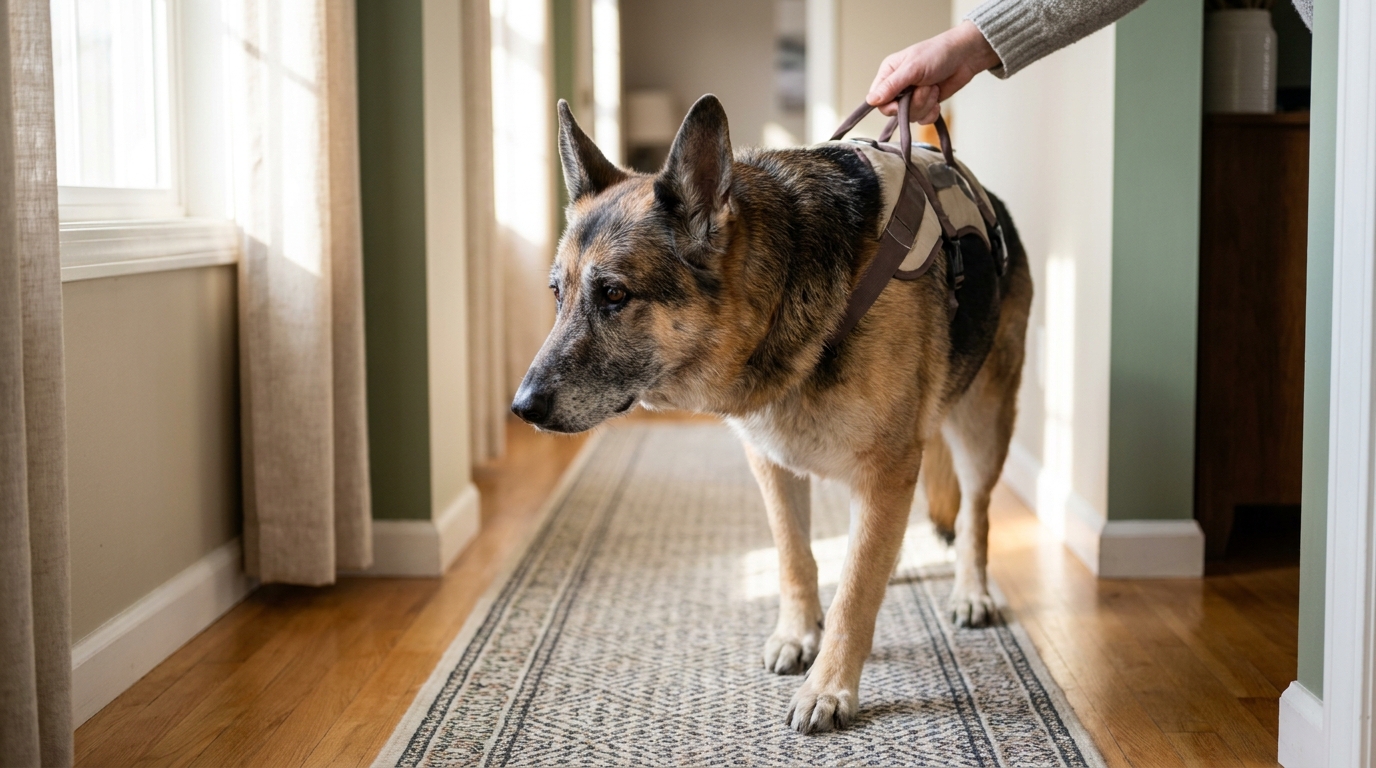
Sudden collapse means the ER now; a slow wobble means a vet exam within days. How to tell which one your senior dog has, and what to do next.
Quick answer: If your old dog's back legs suddenly give out or start to drag, or it can't pee, go to an emergency vet now; a ruptured disc or spinal stroke can't be ruled out at home. Weakness that crept in over weeks, with stiffness getting up or scuffed toenails, often points to arthritis, muscle loss or degenerative myelopathy: book a vet exam within days.
This article is general information, not a diagnosis. If you think your pet is in danger, go to the nearest emergency animal hospital.
Sudden or gradual? Start here
Legs that fail over a few hours point to the spinal cord, a clot or a problem elsewhere in the body. Weakness that built up over weeks is more often joints, muscle or a slow nerve disease.
| What you see | Could be | When to go |
|---|---|---|
| Suddenly can't stand, drags back feet | Disc rupture, spinal stroke, clot, injury | ER now |
| Getting worse over hours | Disc or spreading cord damage | ER now |
| Can't pee, dribbles or leaks | Spinal cord problem | ER now |
| Weakness reaching front legs, breathing change | Spreading cord damage, tick paralysis | ER now |
| Cold or pale back paws, sudden pain | Clot (rare in dogs) | ER now |
| Collapse, pale gums, swollen belly | Internal bleeding (not a leg problem) | ER now |
| Wobbly or shaky after sugar-free gum, nuts or pills | Xylitol, macadamia nuts, human medicine | ER or poison line now |
| Yelps when picked up, hunched, won't move | Back pain, possible disc | Same day; ER if worse |
| Stiff getting up, won't jump in the car | Arthritis or knee ligament | Vet within days |
| Slow, painless wobble, scuffed toenails | Degenerative myelopathy or other nerve disease | Vet within days |
| Thighs slowly thinning, walks normally | Age-related muscle loss | Next vet visit |
Emergency signs: go to an ER now
Painless doesn't mean safe: only an exam and imaging can tell a disc, a spinal stroke and a clot apart. Go to the nearest emergency hospital if your dog:
- Suddenly can't stand or walk, drags its back feet or knuckles over, painful or not.
- Is getting weaker over hours or a day, even if it can still walk.
- Can't pee, strains, dribbles, or leaks urine or stool, or its belly feels tight and full.
- Has weakness spreading to the front legs, or a change in breathing or swallowing.
- Went down after a fall, a jump or being hit by a car, or has sudden pain with cold, pale back paws.
- Collapsed with pale gums, a fast heartbeat, fast breathing or a swollen belly.
- Is diabetic, on insulin, and suddenly weak, wobbly or seizing.
- Ate xylitol (in sugar-free gum, candy, baked goods or some toothpaste), macadamia nuts or any human medicine.
For a possible poisoning, call ASPCA Animal Poison Control at (888) 426-4435 (a consultation fee may apply) or Pet Poison Helpline at (855) 764-7661 (per-incident fee) on the way, and don't make your dog vomit. Keep your dog as still as you can, give no medicine, and check for ticks on the way, not instead of going.
Same-day signs
Yelping when picked up, a hunched back, trembling, shaking back legs, not lifting its head or refusing to move means a hands-on exam the same day, and the ER if it gets worse or your dog stops walking. Meanwhile, keep your dog in a crate or small room with no stairs or furniture.
A 60-second home check (slow changes only)
If your dog suddenly can't walk or is getting worse, skip this and go to the ER; if it is in pain, book a same-day exam. For a calm, slowly weakening dog, these checks help you describe changes; they rule nothing out.
| Check | How | What it means |
|---|---|---|
| Toenail tops | Look for worn nail tops or scuffed toes on the back feet | Long-standing nerve issue: book an exam |
| Paw flip | Calm, standing, pain-free, slow-onset dogs only: steady the body, turn a back paw top-down, watch it flip back | Slow or no flip-back: exam soon. Normal rules nothing out |
| Bladder and bowel | Is it peeing normally? Any straining, dribbling or leaks? | Any problem: ER now |
| Back pain | Watch for a flinch, turn or yelp when you pick it up, or when it gets up or lies down | Pain: hands-on exam, same day |
| Toe feeling | Don't pinch. Your vet checks whether your dog can still feel its toes | Vet-only test |
The paw flip is part of the postural exam taught at the University of Illinois College of Veterinary Medicine. Stop if your dog cries out or snaps, and never press on the spine.
Common causes of weak back legs
1. Disc disease (IVDD)
A spinal disc bulges or ruptures and presses on the cord. The Merck Veterinary Manual lists signs from loss of back-leg control to paralysis and incontinence. ACVS says Dachshunds, Beagles and similar breeds make up most cases, typically at 3 to 6 years, but seniors still rupture discs.
In the 2022 ACVIM consensus, paralyzed dogs that could still feel deep pain recovered in 93% of cases with surgery and 60% with medical care. For dogs that had lost deep pain, it was 61% and 21%. Many disc dogs that can still walk are treated without surgery. There is no proven surgical deadline, but 10% to 33% of paralyzed dogs without deep pain develop myelomalacia, a spreading death of cord tissue, usually within days. Worried your dog is too old for surgery? See whether age alone rules out anesthesia.
Time rule: can't walk, getting worse or can't pee: ER now. Hunched or yelping but walking: same-day exam, crate rest, no home medicine.
2. Spinal stroke (FCE)
A fibrocartilaginous embolism (FCE) is a type of spinal stroke. Cornell's Riney Canine Health Center says the dog may cry out when it happens, but the pain fades quickly and one side is usually worse. It is most common in large breeds aged 3 to 7, so less typical in seniors. Rehab is the main treatment.
Time rule: ER now. Fading pain doesn't make waiting safe; a disc or clot can look the same.
3. Degenerative myelopathy (DM)
DM is a slow, painless spinal cord disease. The University of Missouri DM research group describes onset at 8 to 14 years, with wobbling, knuckling or dragging feet, sometimes in one leg first. Per Cornell, dogs lose the ability to walk after about 6 to 12 months; the Missouri group notes that loss of bladder and bowel control can follow. The DNA test shows risk only; vets diagnose DM by ruling out other causes. No treatment has been shown to stop or slow DM, though rehab may help keep muscles healthy.
Time rule: vet exam within days. Pain points away from DM, toward something that may be treatable.
4. Arthritis
ACVS lists a stiff walk, trouble getting up and reluctance to jump onto furniture or into the car. It calls a slender body weight by far the most important part of arthritis care and recommends consistent, low-impact exercise.
Time rule: vet exam within days. If a dog already on prescription pain medicine gets worse, see what to do in an arthritis flare-up on carprofen.
5. Knee ligament (cruciate) disease
ACVS calls cruciate disease one of the most common causes of back-leg lameness. Extra weight and ligament aging raise the risk, the limp may show up only after a long rest, and 40% to 60% of dogs later have trouble in the other knee.
Time rule: vet exam within days.
6. Lower-back narrowing (lumbosacral stenosis)
Merck says this is most common in large breeds, especially German Shepherds. It causes back-leg trouble, a weak tail, incontinence and lower-back pain that your vet finds on the exam.
Time rule: vet exam within days, or the same day if your dog shows back pain; ER for any bladder or bowel change.
7. Age-related muscle loss
Older dogs lose muscle even without disease. A 2012 Journal of Veterinary Internal Medicine review linked this sarcopenia to more illness and death.
Time rule: next visit if your dog walks normally; vet exam within days if its legs are weak or the thinning gets worse.
8. Nerve and nerve-to-muscle problems
Per Merck, tick paralysis starts in the back legs and can spread to all four within a few days, affecting breathing in severe cases; in North America, dogs usually recover 1 to 2 days after the tick is removed and treated, so check for ticks on the way to the vet, not instead of going. Coonhound paralysis shows up 7 to 14 days after a raccoon bite or scratch. Acquired myasthenia gravis causes weakness with exercise that eases with rest, often with regurgitation.
Time rule: spreading weakness or a breathing change means the ER; weakness tied to exercise needs a same-day exam.
9. Problems that aren't in the legs
ACVS lists weakness, collapse, pale gums, fast breathing and a swollen belly as signs of a bleeding spleen mass. Merck warns that an insulin overdose can cause life-threatening low blood sugar. The ASPCA warns that macadamia nuts and xylitol can cause weakness and wobbling. A clot to the back legs is rare in dogs, per a 2012 JAVMA study, and can start suddenly or slowly; sudden pain with cold, pale paws is an emergency.
Time rule: ER now. Call a poison line on the way for anything your dog ate.
Breed notes
Breed doesn't decide the cause, but it shifts the odds.
| Breed | Known risk | Note |
|---|---|---|
| Dachshund, Beagle, Shih Tzu, Lhasa Apso, Pekingese, French Bulldog | Disc disease (IVDD) | Typical age 3-6 is not a limit: seniors still rupture discs |
| German Shepherd | DM, lower-back disease, disc disease (age 5-12) | Pain points away from DM |
| Pembroke Welsh Corgi, Boxer, Bernese, Rhodesian Ridgeback, Chesapeake Bay Retriever | Degenerative myelopathy | DNA test shows risk only |
| Labrador Retriever | Disc disease (age 5-12) | Lean weight is the main lever for any joint |
| Large and giant breeds, Miniature Schnauzer, Shetland Sheepdog | Spinal stroke (FCE) | Less typical in seniors |
If the weakness came on slowly
Watch for stiffness getting up, worn tops of the back toenails, feet that knuckle or drag, thinner thighs, or a swaying "drunken sailor" walk, which ACVS links to mild cord damage. If your dog can still stand and walk, isn't in obvious pain and has normal bathroom habits, book a vet exam within days. Meanwhile:
- Keep your dog lean, and keep walks short, steady and low-impact.
- Note when it started and whether one side is worse, and film your dog getting up and walking.
- Start no medicine at home, including leftover pet pain pills.
A video check with RexVet for slow changes
If your dog has been getting weaker slowly over weeks or months, can still stand and walk on its own, isn't crying out, hunched or refusing to move, and is peeing and pooping normally, a $64.99 live video visit with Dr. Tiffany Delacruz, DVM, can help. It is for dogs in Florida, New York or Virginia, with live video slots about 8 AM-11 PM ET. She watches your dog get up and walk on camera, gives you her read on whether it looks more like joints or nerves, and tells you whether, and how soon, your dog needs X-rays or a hands-on exam at a local clinic.
Any pain medicine depends on that exam and on state rules, and nothing is promised. In Florida, a video-only prescription must be an FDA-approved dog drug used as labeled, for up to 14 days, and can't be renewed without an in-person exam, so ongoing arthritis medicine needs a hands-on vet. Rules in New York are less settled. If she sends a prescription to a pharmacy, a pharmacy transfer fee applies; RexVet is not a pharmacy. For seniors who need regular check-ins, the one-time $120 Family Plan covers 4 visits over 12 months for every pet in the home and never auto-renews. RexVet is a 501(c)(3) non-profit; you can book a live video visit with Dr. Delacruz.
A dog that suddenly can't walk, is dragging its legs or can't pee goes to an emergency vet, not a video visit.
What the vet does to find the cause
Your vet watches your dog rise and walk, tests reflexes and toe feeling, and examines the spine, hips, knees and bladder. X-rays help with arthritis and knees; MRI or CT is often needed for a disc or spinal stroke. For a suspected disc, ACVIM recommends at least 4 weeks of crate or small-room rest, advises against routine steroids early on, and notes the bladder may not empty fully for weeks, raising infection risk.
A video visit cannot test deep pain, do a full neurologic exam or image the spine. RexVet has one vet, with live slots about 8 AM to 11 PM ET, and holiday availability isn't guaranteed, so sudden paralysis, overnight problems and holiday emergencies belong at a local emergency hospital.
Never give human pain relievers
The FDA says no over-the-counter NSAID is approved for dogs or cats, and dog NSAIDs are prescription-only. Pet Poison Helpline says ibuprofen should not be given to pets; it can cause ulcers with bloody vomit or stool, and kidney damage. Even prescription dog NSAIDs can cause ulcers and kidney or liver failure.
- Don't give aspirin, ibuprofen, naproxen or acetaminophen. If you already did, call a poison line or go to an ER.
- Don't give leftover pet medicine or another pet's pills.
- Never combine two NSAIDs, or an NSAID with a steroid.
- Expect a full exam before any pain medicine, which the carprofen label calls for, and liver and kidney bloodwork before long-term use, which the FDA advises.
Caring for a senior dog through a slow decline
Arthritis and many disc problems can be managed for a long time. DM keeps progressing, and Merck notes that most affected dogs are euthanized within 1 to 3 years. Rehab, nursing care and bladder care can keep that time comfortable. This quality-of-life guide can help when you wonder whether your dog still enjoys its days.
Frequently Asked Questions
Why are my old dog's back legs suddenly giving out?
A ruptured disc, a spinal stroke, a blood clot, an injury, tick paralysis or a toxin can all do this, and you can't tell them apart at home. No pain doesn't make it safe to wait. If your dog can't stand, drags its feet, can't pee or is getting worse, go to an emergency vet now.
My old dog's back legs are collapsing and it's leaking urine. Is that an emergency?
Yes. New leaking, dribbling or straining to pee with weak back legs points to the spinal cord; Merck lists incontinence among disc disease signs. Go to an emergency vet now. Degenerative myelopathy can also cause leaks, but only an exam can tell them apart.
My dog can still walk but is wobbly. Is that an emergency?
It depends on speed and pain. Wobbling that worsens over hours or any trouble peeing means the ER now. A hunched back or yelping means a same-day exam, and the ER if it gets worse or your dog stops walking. A painless wobble that crept in over weeks, with normal bathroom habits, still needs a vet exam within days; arthritis, knee ligament disease and DM are each managed differently.
Can I give my dog ibuprofen, aspirin or Tylenol for back-leg pain?
No. The FDA says no over-the-counter NSAID is approved for dogs, and human NSAIDs can cause stomach ulcers and kidney damage. Tylenol (acetaminophen) isn't an NSAID, but Pet Poison Helpline warns it has a narrower margin of safety in dogs than in people and can cause liver failure. If you already gave one, call ASPCA Animal Poison Control at (888) 426-4435 (a consultation fee may apply) or Pet Poison Helpline at (855) 764-7661 (per-incident fee), or go to an ER.
My Dachshund is hunched and won't jump. What should I do?
In Dachshunds, Beagles and French Bulldogs, hunching and refusing to jump or climb stairs often mean a disc problem, even in seniors. Book an exam the same day, and go to an ER if your dog can't walk, is getting worse or can't pee. Until then, keep it crated and give no medicine.
If my dog is already paralyzed, is it too late for surgery?
Not necessarily. The 2022 ACVIM consensus found no proven deadline for disc surgery. About 6 in 10 paralyzed dogs that had lost deep pain sensation walked again after surgery, versus about 2 in 10 treated without surgery. Go now anyway: you can't tell at home whether pain sensation is gone, and in some dogs the damage keeps spreading over the following days.
Can an online vet help with my dog's back legs?
Yes for slow changes, not for sudden collapse. For dogs in Florida, New York or Virginia, a live video visit lets a vet watch your dog get up and walk and say whether X-rays or a hands-on exam come next. Video can't test pain sensation or image the spine, and no prescription is promised: Florida limits video-only prescriptions to FDA-approved animal drugs used as labeled, for up to 14 days, with no renewal without an in-person exam.
FAQs
Why are my old dog's back legs suddenly giving out?
A ruptured disc, a spinal stroke, a blood clot, an injury, tick paralysis or a toxin can all do this, and you can't tell them apart at home. No pain doesn't make it safe to wait. If your dog can't stand, drags its feet, can't pee or is getting worse, go to an emergency vet now.
My old dog's back legs are collapsing and it's leaking urine. Is that an emergency?
Yes. New leaking, dribbling or straining to pee with weak back legs points to the spinal cord; Merck lists incontinence among disc disease signs. Go to an emergency vet now. Degenerative myelopathy can also cause leaks, but only an exam can tell them apart.
My dog can still walk but is wobbly. Is that an emergency?
It depends on speed and pain. Wobbling that worsens over hours or any trouble peeing means the ER now. A hunched back or yelping means a same-day exam, and the ER if it gets worse or your dog stops walking. A painless wobble that crept in over weeks, with normal bathroom habits, still needs a vet exam within days; arthritis, knee ligament disease and DM are each managed differently.
Can I give my dog ibuprofen, aspirin or Tylenol for back-leg pain?
No. The FDA says no over-the-counter NSAID is approved for dogs, and human NSAIDs can cause stomach ulcers and kidney damage. Tylenol (acetaminophen) isn't an NSAID, but Pet Poison Helpline warns it has a narrower margin of safety in dogs than in people and can cause liver failure. If you already gave one, call ASPCA Animal Poison Control at (888) 426-4435 (a consultation fee may apply) or Pet Poison Helpline at (855) 764-7661 (per-incident fee), or go to an ER.
My Dachshund is hunched and won't jump. What should I do?
In Dachshunds, Beagles and French Bulldogs, hunching and refusing to jump or climb stairs often mean a disc problem, even in seniors. Book an exam the same day, and go to an ER if your dog can't walk, is getting worse or can't pee. Until then, keep it crated and give no medicine.
If my dog is already paralyzed, is it too late for surgery?
Not necessarily. The 2022 ACVIM consensus found no proven deadline for disc surgery. About 6 in 10 paralyzed dogs that had lost deep pain sensation walked again after surgery, versus about 2 in 10 treated without surgery. Go now anyway: you can't tell at home whether pain sensation is gone, and in some dogs the damage keeps spreading over the following days.
Can an online vet help with my dog's back legs?
Yes for slow changes, not for sudden collapse. For dogs in Florida, New York or Virginia, a live video visit lets a vet watch your dog get up and walk and say whether X-rays or a hands-on exam come next. Video can't test pain sensation or image the spine, and no prescription is promised: Florida limits video-only prescriptions to FDA-approved animal drugs used as labeled, for up to 14 days, with no renewal without an in-person exam.
Medically Reviewed
Reviewed by Dr. Tiffany Delacruz, DVM — licensed veterinarian and CEO of RexVet. Last reviewed October 18, 2026.
Content is for informational purposes and does not replace professional veterinary advice.
Chief Executive Officer · Licensed Veterinarian
Dr. Delacruz is a licensed Doctor of Veterinary Medicine specializing in preventive care and veterinary telehealth. She reviews all health content on RexVet to ensure accuracy and clinical relevance.
Sources & References
- · American Veterinary Medical Association — Telehealth Guidelines
- · AVMA — Pet Care Resources
- · U.S. FDA — Animal & Veterinary
Need an Expert Opinion on This Topic?
Connect with a certified vet via video call in minutes
Talk to Vet Now