
Lump on Dog Gums or Lips: Epulis, Wart or Cancer?
By RexVet Team | Reviewed by Dr. Tiffany Delacruz, DVM
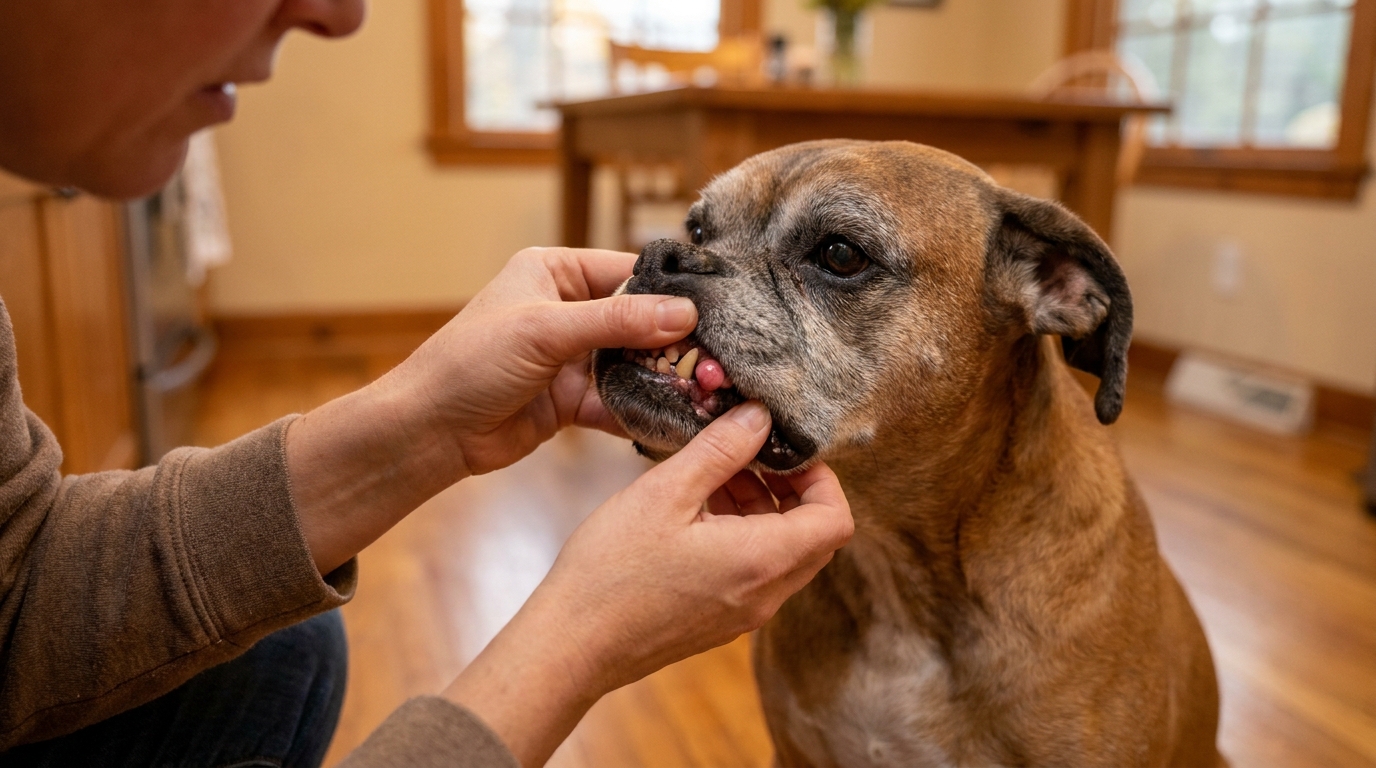
What an epulis is, why only a biopsy can rule out cancer, and how fast a new lump on your dog's gum or lip needs a vet.
Quick answer: A lump on a dog's gum is often an epulis, a usually benign growth, but mouth cancers such as melanoma can look alike; only a biopsy can tell. Any new gum or lip lump other than typical puppy warts needs an in-person exam within days, the same day if it bleeds or grows fast. Heavy or nonstop mouth bleeding, or trouble breathing or swallowing, means an emergency vet now.
This article is general information, not a diagnosis. If you think your pet is in danger, go to the nearest emergency animal hospital.
Is a lump on my dog's gum or lip an emergency?
Most gum and lip lumps in dogs are not emergencies, but go to an emergency vet now if mouth bleeding is heavy or will not stop, the gums turn pale, the dog collapses or has trouble breathing or swallowing, or the face swells fast. A lump that bled (even if it stopped), grows fast, or is open, oozing or smelly needs an in-person vet the same day; any other new gum or lip lump, at any age, needs an in-person exam within days unless it is typical young-dog warts.
For a lump bleeding on the outside of the lip, press a clean cloth on it if your dog allows; go to an emergency vet now if blood is still flowing freely after several minutes of steady pressure. Bleeding gums or bloody drool plus bruises, purple spots, a nosebleed or bloody urine or stool can mean a clotting problem, such as rat bait: emergency vet now.
A lip that puffs up suddenly, with normal breathing and pink gums, needs an in-person vet within the hour, but an emergency vet now if it started within 1 hour of a sting, shot or new medicine, followed many stings or a sting in the mouth, comes with puncture marks or fast, painful swelling after time outdoors (a possible snakebite), or is in a flat-faced dog such as a Boxer or bulldog. See dog hives and sudden bumps.
How fast to act on a dog's gum or lip lump (act on the most urgent row that fits):
| What you see | How soon | Where |
|---|---|---|
| Heavy or nonstop mouth bleeding | Now | ER |
| Pale gums, weakness or collapse | Now | ER |
| Trouble breathing or swallowing | Now | ER |
| Face swelling that spreads fast | Now | ER |
| Flat-faced dog, any face swelling | Now | ER |
| Sting in the mouth, or many stings | Now | ER |
| Puffy within 1 hour of a sting, shot or medicine | Now | ER |
| Sudden lip swelling, normal breathing | Within 1 hour | In person |
| Lump bled, then stopped | Same day | In person |
| Grows fast, open, oozes or smells | Same day | In person |
| Loose tooth and not eating | Same day | In person |
| Swelling under the eye | Within 1 day | In person |
| New gum or lip lump, dog well | Within days | In person |
| Cauliflower growth, adult dog | Within days | In person |
| Warts make eating hard | Within days | In person |
| Gums thicker on a medicine | Before next dose | Prescribing vet |
| Puppy mouth warts, eating fine | Vet look, then plan | Video or clinic |
Swelling under the eye needs a vet the same day if your dog is tired, not eating, or the eye is swelling shut, and an eye that bulges needs an emergency vet now. Never hold pressure inside your dog's mouth or put your fingers between the teeth. Many regular clinics are closed at night and over holiday weekends such as Thanksgiving; an urgent care or emergency hospital is the fallback.
What is an epulis in dogs?
An epulis is a firm, often pink gum growth next to a tooth; the American Veterinary Dental College uses the word for a gum mass of any type, and the Merck Veterinary Manual says the most common benign mouth tumors in dogs are peripheral odontogenic fibromas, once called fibromatous or ossifying epulis.
Because "epulis" only means a gum mass, the name alone never means benign. Merck says peripheral odontogenic fibromas are most common in dogs over 6 and are usually single. Penn Vet's oncology service says epulides appear more often in older dogs and that Shetland and Old English Sheepdogs are predisposed, though any breed can get one; PetMD's breed list adds Boxers and Golden Retrievers.
The American Veterinary Dental College calls acanthomatous ameloblastoma (acanthomatous epulis) "typically benign, but aggressive," and Penn Vet says it can invade nearby tissue and destroy the bone underneath, though it generally does not spread.
Why are my dog's gums growing over the teeth?
Gums that thicken over several teeth in a dog are often gum overgrowth (gingival hyperplasia), which VCA Animal Hospitals says is seen most in Boxers and is most often linked, among medicines, to cyclosporine; a vet should still check it, because only a biopsy rules out cancer.
VCA says bulldogs are also predisposed, the cause of most cases is not fully understood, and medicines are a less common trigger. Cyclosporine is an immune-system medicine for allergic and autoimmune disease; a case report in the Journal of the American Animal Hospital Association (JAAHA) calls amlodipine, a blood pressure medicine, a rare cause in dogs.
If your dog takes cyclosporine or amlodipine and the gums are thickening, call the prescribing vet before the next dose is due; the prescribing vet decides. Do not stop or change the medicine on your own. An area that looks like a single mass still needs a vet exam within days.
What causes a bump on a dog's lip?
Common causes of a bump on a dog's lip include viral warts in young dogs, chin and lip acne, a histiocytoma, an abscess and swelling from a sting or bite; a new firm lip lump on an adult dog needs an in-person exam within days, and a lip that puffs up suddenly needs an in-person vet within the hour, or an emergency vet now if it follows a sting, comes with breathing trouble or is in a flat-faced dog.
- Viral warts: cauliflower-like clusters on a young dog's lips and in its mouth; see warts on dogs.
- Chin and lip acne: red bumps or pimples, mostly in young, short-coated dogs; see dog chin acne and muzzle bumps.
- Histiocytoma: a smooth, raised pink or red bump on a young dog. Merck says most resolve within 2 to 3 months, but a new raised bump needs an in-person needle sample within days; see histiocytoma in dogs.
- Abscess: a hot, painful swelling with fever or after a bite (in person the same day). VCA Animal Hospitals says an upper tooth root abscess swells the tissue below the eye.
- Tumor: the Merck Veterinary Manual says the lips, mouth and nail beds are the most common sites for malignant melanoma, which may or may not be dark.
Lip fold dermatitis is not a lump: the Merck Veterinary Manual describes smelly, inflamed, swollen lower lip folds in drooping-lipped breeds such as spaniels, English Bulldogs and Saint Bernards.
Is a lump in my dog's mouth cancer?
You cannot tell whether a lump in a dog's mouth is cancer by looking; only a biopsy can, and the Merck Veterinary Manual says the most common mouth cancers in dogs are malignant melanoma, squamous cell carcinoma and fibrosarcoma.
Merck says the appearance of oral tumors varies, so a biopsy is imperative, and that malignant mouth tumors are more common in dogs over 8. Oral melanoma is usually firm and black but can be unpigmented, so pink does not mean safe. Cornell's veterinary college says oral squamous cell carcinoma often looks like a pink or red, irritated mass that bleeds easily, and that dogs of all ages may be affected.
VCA Animal Hospitals and Cornell list bad breath, drooling, loose teeth, facial swelling and weight loss as warning signs; with a mouth lump, these need an in-person exam within days, except bloody drool (same day), jaw or under-eye swelling (within 1 day) and face swelling that spreads fast (ER now).
Common gum and lip growths in dogs (only a biopsy can tell them apart):
| Growth | Looks like | Who gets it |
|---|---|---|
| Epulis | Firm pink lump at a tooth | Middle-aged or older |
| Overgrowth | Thick gums over teeth | Boxers; some medicines |
| Wart | Cauliflower clusters | Young dogs |
| Melanoma | Dark or unpigmented mass | Mostly older |
| Carcinoma | Raised, cauliflower or red; bleeds | Mostly older |
| Abscess | Hot, painful swelling | Broken or bad tooth |
A cauliflower-like growth in an adult dog's mouth is never assumed to be a wart; the Merck Veterinary Manual says squamous cell carcinoma can look that way, so it needs an in-person exam within days.
How do I check my dog's mouth safely?
To check a dog's mouth safely, lift the lip gently in good light while the dog is calm, never pry the jaws open or put fingers between the teeth of a dog in pain, and photograph the lump next to a ruler or coin.
- Lift the upper lip on each side and lower the bottom lip at the front, without opening the jaws.
- Note where it sits, its color, any bleeding or loose tooth, and whether your dog eats and drinks normally.
- Date each photo. Stop if your dog pulls away or seems sore.
Never cut, tie off, burn, freeze or squeeze a lump, put a human wart remover, mouth rinse or gel on it, or pull a loose tooth. Sudden heavy drooling or pawing at the mouth can mean a stick or string is stuck (see dog bad breath and mouth warning signs): do not pry or pull, and see a vet in person the same day.
A soft bubble under the tongue can be a salivary mucocele, saliva collecting after damage to a salivary duct or gland, says the Merck Veterinary Manual. A small, long-standing one in a dog that eats, drinks and breathes normally needs an in-person vet within days (the same day if it bled); never pop or drain it. Merck says a throat mucocele can block the airway, so fast swelling under the tongue or in the throat, or any with trouble breathing or swallowing, means an emergency vet now.
What does a vet do for a gum or lip lump?
A vet examines a dog's gum or lip lump and usually takes a biopsy, with dental X-rays or a CT scan to see whether it reaches the bone; the result decides the surgery.
VCA Animal Hospitals says a needle sample may not give a clear answer, so a biopsy is often preferred; Penn Vet says X-rays, CT or MRI show how far an epulis reaches. For a suspected cancer, Merck says the vet also checks nearby lymph nodes and images the chest.
Merck says removing all of a peripheral odontogenic fibroma, usually with the affected tooth or teeth, cures it. Penn Vet recommends a wide margin for the acanthomatous type, sometimes including part of the jawbone, because regrowth is common when less tissue is removed. The clinic explains the anesthesia plan; for an older dog, see is a senior dog too old for anesthesia or surgery.
When a video visit helps, and when it does not
For a dog in Florida, New York or Virginia with a new lump on the gum or lip that is eating, drinking and breathing normally, RexVet, a nonprofit online vet service, offers a $64.99 live video visit with a veterinarian licensed in the dog's state, about 8 AM to 11 PM Eastern, to look at the lump on camera and say how soon it needs an in-person exam and biopsy.
RexVet serves pets located in Florida, New York and Virginia by video visit. There are no overnight visits, and holiday hours are not confirmed, so check open slots when you book a video visit.
Go to an emergency vet now, not a video visit, if mouth bleeding is heavy or will not stop, the gums turn pale or your dog collapses, your dog has trouble breathing or swallowing, the face swells fast (any face swelling at all in a flat-faced dog such as a Boxer or bulldog), there was a sting in the mouth, or swelling under the tongue or in the throat comes on fast.
With the lip gently lifted on camera and your dated photos with a ruler or coin, the veterinarian can say whether the lump looks like typical young-dog warts, gum overgrowth or a new mass, how urgent it looks, and how to plan the in-person exam. No vet can tell by looking, on camera or in person, whether a mouth lump is cancer; the Merck Veterinary Manual says a biopsy is needed. Sampling, X-rays and removal need a clinic; the visit never replaces that exam.
A video visit does not adjust another vet's prescription: if gums thicken on cyclosporine or amlodipine, call the prescribing vet before the next dose is due.
Not video cases: a lump that bled, grows fast or smells, a dog that refuses food because of mouth pain, or a fish hook, stick or string in the mouth (in person the same day; do not pry or pull it out); a lip that puffs up suddenly with normal breathing and pink gums (in person within the hour; ER now if it began within 1 hour of a sting, shot or new medicine, or with puncture marks or fast, painful swelling after time outdoors); a puppy, senior or ill dog that will not eat or drink (in person within hours, or an emergency vet now if even sips of water come back up).
No prescription is promised; any medicine is the veterinarian's decision. In Florida (s.474.2021), a prescription based only on a video visit is limited to FDA-approved animal drugs used as labeled, for up to 14 days, with no renewal without an in-person exam; human-labeled medicines, controlled drugs and compounded anti-infectives need an in-person exam, as does any off-label use under federal rules. In Virginia the exam may be done by video; New York's rules are unsettled. RexVet is not a pharmacy; a pharmacy transfer fee applies when a prescription is sent to an outside pharmacy.
Need an Expert Opinion on This Topic?
Book a video visit with a licensed vet, evenings and weekends included
See open timesFrequently Asked Questions
Can an epulis on my dog's gum go away on its own?
No. PetMD says an epulis typically does not go away without surgery and can come back after removal. The Merck Veterinary Manual says complete removal cures the common benign type, while Penn Vet says the acanthomatous type often regrows when less tissue is removed.
Is an epulis painful for dogs?
Usually not: PetMD says most epulis growths are not painful. One can hurt if it invades the jawbone or traps plaque so a nearby tooth gets infected. A painless lump still needs an in-person exam within days, and the same day if your dog refuses food.
My puppy has bumps on its gums. Are they warts?
Often, yes: VCA Animal Hospitals says puppy mouth warts usually clear within 2 to 3 months. Have a vet look at the first ones, then follow that vet's plan; warts not cleared by about 3 months need an in-person recheck, warts that make eating hard need an in-person vet within days, and a bleeding or infected wart needs an in-person vet the same day. A puppy under 4 months that has eaten nothing for more than 8 hours needs to be seen in person today.
Can my dog's medicine make its gums grow?
Yes, sometimes, though medicines are a less common cause. VCA Animal Hospitals says cyclosporine is the drug most often linked to gum overgrowth in pets, and a JAAHA case report calls amlodipine a rare cause in dogs. If the gums thicken on either one, call the prescribing vet before the next dose is due, and do not stop or change it on your own.
Can a vet tell if a lump in my dog's mouth is cancer just by looking at it?
No. The Merck Veterinary Manual says the appearance of oral tumors varies, so a biopsy is needed for an accurate diagnosis. Any new gum or lip lump, other than typical young-dog warts, needs an in-person exam within days, or the same day if it bled, grows fast, or is open, oozing or smelly.
Do cats get gum growths too?
Yes, but Penn Vet says epulides are less common in cats. The Merck Veterinary Manual says squamous cell carcinoma is by far the most common malignant mouth tumor in cats. A mouth or jaw lump in a cat needs a vet within days, and at least the same day if the cat is hiding, very quiet or not eating; labored or open-mouth breathing means an emergency vet now.
Can an online vet look at a lump in my dog's mouth in Florida, New York or Virginia?
Yes, for a first look if your dog is located in Florida, New York or Virginia; a biopsy, X-rays and removal need a clinic. A veterinarian licensed in your dog's state can say on camera how urgent the lump looks, but not whether it is cancer, and no prescription is promised. Florida limits video-only prescriptions to FDA-approved animal drugs used as labeled for up to 14 days, Virginia allows a video exam, and New York's rules are unsettled.
FAQs
Can an epulis on my dog's gum go away on its own?
No. PetMD says an epulis typically does not go away without surgery and can come back after removal. The Merck Veterinary Manual says complete removal cures the common benign type, while Penn Vet says the acanthomatous type often regrows when less tissue is removed.
Is an epulis painful for dogs?
Usually not: PetMD says most epulis growths are not painful. One can hurt if it invades the jawbone or traps plaque so a nearby tooth gets infected. A painless lump still needs an in-person exam within days, and the same day if your dog refuses food.
My puppy has bumps on its gums. Are they warts?
Often, yes: VCA Animal Hospitals says puppy mouth warts usually clear within 2 to 3 months. Have a vet look at the first ones, then follow that vet's plan; warts not cleared by about 3 months need an in-person recheck, warts that make eating hard need an in-person vet within days, and a bleeding or infected wart needs an in-person vet the same day. A puppy under 4 months that has eaten nothing for more than 8 hours needs to be seen in person today.
Can my dog's medicine make its gums grow?
Yes, sometimes, though medicines are a less common cause. VCA Animal Hospitals says cyclosporine is the drug most often linked to gum overgrowth in pets, and a JAAHA case report calls amlodipine a rare cause in dogs. If the gums thicken on either one, call the prescribing vet before the next dose is due, and do not stop or change it on your own.
Can a vet tell if a lump in my dog's mouth is cancer just by looking at it?
No. The Merck Veterinary Manual says the appearance of oral tumors varies, so a biopsy is needed for an accurate diagnosis. Any new gum or lip lump, other than typical young-dog warts, needs an in-person exam within days, or the same day if it bled, grows fast, or is open, oozing or smelly.
Do cats get gum growths too?
Yes, but Penn Vet says epulides are less common in cats. The Merck Veterinary Manual says squamous cell carcinoma is by far the most common malignant mouth tumor in cats. A mouth or jaw lump in a cat needs a vet within days, and at least the same day if the cat is hiding, very quiet or not eating; labored or open-mouth breathing means an emergency vet now.
Can an online vet look at a lump in my dog's mouth in Florida, New York or Virginia?
Yes, for a first look if your dog is located in Florida, New York or Virginia; a biopsy, X-rays and removal need a clinic. A veterinarian licensed in your dog's state can say on camera how urgent the lump looks, but not whether it is cancer, and no prescription is promised. Florida limits video-only prescriptions to FDA-approved animal drugs used as labeled for up to 14 days, Virginia allows a video exam, and New York's rules are unsettled.
Medically Reviewed
Reviewed by Dr. Tiffany Delacruz, DVM — licensed veterinarian and CEO of RexVet. Last reviewed November 28, 2026.
Content is for informational purposes and does not replace professional veterinary advice.
Chief Executive Officer · Licensed Veterinarian
Dr. Delacruz is a licensed Doctor of Veterinary Medicine specializing in preventive care and veterinary telehealth. She reviews all health content on RexVet to ensure accuracy and clinical relevance. RexVet video visits are for pets in Florida, New York and Virginia, with a veterinarian licensed in the pet's state.
Sources & References
- · American Veterinary Medical Association — Telehealth Guidelines
- · AVMA — Pet Care Resources
- · U.S. FDA — Animal & Veterinary