
Is My Senior Dog or Cat Too Old for Anesthesia or Surgery?
By RexVet Team | Reviewed by Dr. Tiffany Delacruz, DVM
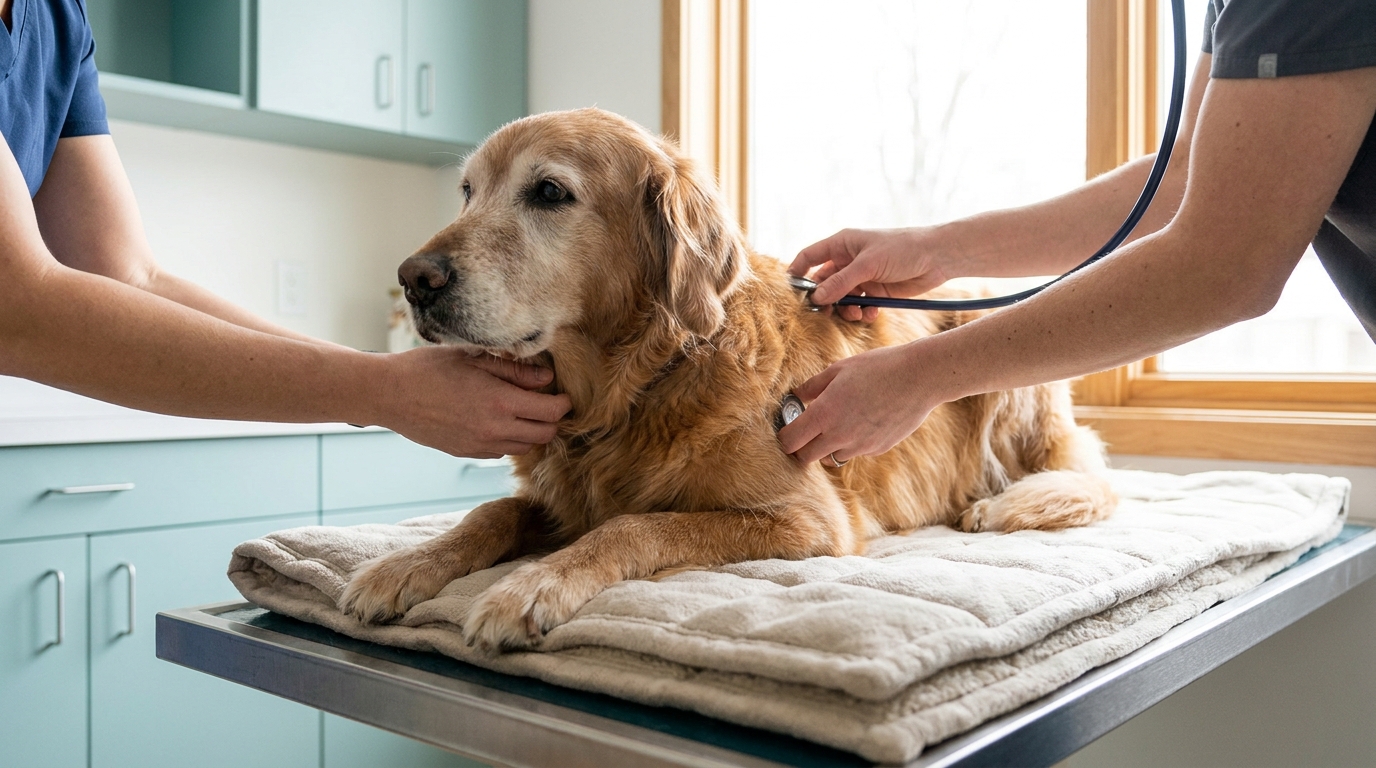
Age alone doesn't rule out anesthesia. What the studies show, which senior tests to ask for, and how to weigh a dental, lump removal or TPLO.
Quick answer: Age alone doesn't rule out anesthesia, AAHA's senior care guidelines say. Risk depends mainly on your pet's health, the procedure and its urgency. In a 2026 study of about 15,000 cats, anesthesia-related deaths ran 0.07% in healthy cats and 7% in severely ill ones. Before a planned dental, lump removal or TPLO, ask for a senior work-up and full monitoring. Emergencies can't wait: go now.
This article is general information, not a diagnosis or an anesthesia plan for your pet. Your treating veterinarian, who examines your pet in person, makes the final call.
Age Is Not a Disease: Why Health Status Matters More
The 2023 AAHA Senior Care Guidelines for dogs and cats say plainly that advanced age alone is not a contraindication to general anesthesia, and that seniors can go under anesthesia again when they need to. The 2021 AAFP feline senior care guidelines say the same about dental care: age should not stop a cat from getting needed dental treatment under anesthesia.
That doesn't mean age is irrelevant. AAHA's anesthesia guidelines put it this way: age is not a disease, but disease is more common in older pets. Older dogs and cats also handle anesthetic drugs differently and cope less well with low blood pressure and low body temperature. So the useful question isn't "how old is my pet?" but "how healthy is my pet, how big is this procedure, and how urgent is it?"
There isn't even one fixed age at which a pet becomes "senior." AAHA treats dogs as seniors in the last quarter of their expected lifespan, which comes much earlier for a Great Dane than for a Chihuahua. Cats count as seniors after about 10 years, and the feline senior guidelines note some cats may be treated as seniors from 8.
AAHA gives a good example of why health beats age. A healthy, robust 15-year-old terrier would be expected to recover quickly from a lump removal. A 13-year-old Labrador mix with laryngeal paralysis, severe arthritis and stage 3 kidney disease may need longer to recover from the same surgery. How well your pet is doing before the procedure is one of the best predictors of how they will do after it, so agree with your vet on what the surgery should achieve before you book it.
Waiting has risks too. Untreated periodontal disease keeps progressing to bone loss, loose teeth and pain, and in tiny and small senior dogs it can weaken the lower jaw enough to fracture. For lumps, a board-certified veterinary oncologist writing in Today's Veterinary Practice advises having any pea-sized lump that has been there for a month sampled rather than watched, because small tumors are easier to remove completely and the first surgery is the best chance of a cure. Any lump that is growing, changing, ulcerated, bleeding or bothering your pet should be checked in person too, whatever its size.
When Surgery Cannot Wait: Recognizing True Emergencies
Most of this article is about planned procedures. These signs are not: don't let age, screening tests or a second opinion delay care. Go to an emergency hospital now and call on the way. The team will stabilize your pet over hours, not weeks, then treat or operate as needed. These are examples, not a full list: any pet in obvious distress or severe pain needs the same urgency.
- Possible bloat (GDV): a dog, usually a large or giant breed, retching without bringing anything up, drooling, restless, with a swelling belly, or found lying down with an enlarged abdomen.
- Possible urinary blockage: a male cat straining or crying in the litter box with little or no urine. Owners often mistake this for constipation. It needs care now, not tomorrow.
- Possible pyometra (infected uterus): an unspayed female that is lethargic, off her food, drinking and urinating more, vomiting or has pale gums. Many have no vaginal discharge, so no discharge does not rule it out.
- Possible bleeding from a splenic mass: sudden weakness or collapse, pale gums, a fast heart rate or breathing, or a swelling belly, especially in an older large-breed dog.
- Possible disc rupture: sudden back or neck pain, a wobbly walk, dragging the back legs or being unable to walk.
- Possible blood clot in a cat: sudden, often painful, paralysis of the back legs.
- Possible breathing crisis: fast, labored or open-mouth breathing, or blue, purple or gray gums; in a dog with laryngeal paralysis, harsh, noisy breathing with a dark red or purple tongue.
One note on spleens, because fear of cancer makes some families hesitate. Many splenic masses in older dogs are cancer, but according to the American College of Veterinary Surgeons, 20% to 41% of splenic lesions are benign and are cured by surgery. Only removal and a pathology report can tell them apart, so a bleeding spleen in an older dog is not automatically a hopeless case.
Understanding Anesthesia Risk and ASA Classifications
Before anesthesia, your vet assigns your pet a physical status class from the American Society of Anesthesiologists (ASA) scale. It is a widely used shorthand for risk, and it is about health, not age.
| Class | Means | Example (AAHA) |
|---|---|---|
| ASA 1 | Healthy | Healthy pet being neutered |
| ASA 2 | Mild disease | Dog with mild, stable heart valve disease |
| ASA 3 | Moderate disease | Cat with stage 3 kidney disease |
| ASA 4 | Severe, life-threatening | Dog bleeding inside from a splenic mass |
| ASA 5 | Won't survive without surgery | Cat in shock from a belly infection |
Your treating team assigns the class after a hands-on exam and tests. Many seniors with kidney, heart or hormone disease sit at ASA 3 or higher, and that drives much of the extra risk, although older age still adds risk on its own.
How urgency and health combine
| Urgency | Health | Usual path |
|---|---|---|
| Emergency | Any age or health | Emergency hospital now; the team stabilizes, then treats |
| Time-sensitive (growing lump, painful teeth) | Healthy or mild disease | Senior work-up, then book soon; waiting can make surgery bigger |
| Planned | Healthy or mild (ASA 1-2) | Senior work-up, full monitoring, early-day slot |
| Planned | Moderate, stable (ASA 3) | Work-up; treat or stabilize first; ask about staging or referral |
| Planned | Severe (ASA 4) | Stabilize first; weigh comfort and lifespan benefit against risk; ask about a specialist or alternatives |
What the studies actually found
Each of these studies counted deaths over a different window and in a different era, so don't compare one study with another. These are population figures, not your own pet's risk.
| Study | Group | Deaths |
|---|---|---|
| Cats, 198 centers (2026 analysis, 48 hours) | Healthy (ASA I) | 0.07% |
| Same cats | Moderate disease (ASA III) | 0.92% |
| Same cats | Severe disease (ASA IV) | 7.01% |
| UK practices, 2002-04 (48 hours) | Dogs: healthy vs sick | 0.05% vs 1.33% |
| UK practices, 2002-04 (48 hours) | Cats: healthy vs sick | 0.11% vs 1.40% |
| UK dogs, 2010-13 (2 weeks) | 157,318 dogs, mostly young | 0.14% |
Three findings matter most for an older pet:
- Health status drives the gap. In every study above, sick pets died at many times the rate of healthy ones. In the large UK study of 157,318 dogs (2010-13 data, published 2022), poorer health, more urgent procedures and older age were all linked to higher risk.
- Older age shows up too. In that same UK study, dogs over 9 were about 1 in 8 of the dogs compared but about half of the anesthesia-related deaths. A 2025 study of 3,210 dogs at specialty dental and oral surgery clinics found 0.37% died within 2 weeks; the dogs that died had a median age of 12, against 7 for the survivors.
- Many deaths happen after the procedure. In the 2002-04 UK practice study, 47% of dog deaths and 61% of cat deaths happened after the procedure had ended, and in the 2022 dog study 58% came 1 to 14 days later. Good recovery care, in the hospital and at home, is part of lowering anesthetic risk.
Safety measures help. At one French referral hospital, the anesthetic death rate in sick (ASA 3 and above) pets fell from 4.8% to 2.2% after three safety recommendations were introduced. It was a before-and-after comparison, so other changes may have contributed, but it fits what the guidelines recommend.
Essential Pre-Anesthetic Work-Up for Senior Pets
AAHA calls for a thorough hands-on exam, documented within 12 to 24 hours before anesthesia, plus tests matched to your pet's age and health. For seniors, AAHA's 2023 guidelines focus on kidney values and a heart marker, with X-rays or ultrasound when needed.
| Test | What it checks | When |
|---|---|---|
| Hands-on exam | Heart, lungs, airway, mouth, hydration | Within 12-24 hours, in person |
| Blood count (CBC) | Red and white cells, platelets | Every senior |
| Chemistry panel | Organs, including kidneys (creatinine, SDMA) | Every senior |
| Urinalysis | Kidneys and urine | Every senior |
| Blood pressure | High blood pressure | Yearly in seniors (strongly advised in cats); routine with kidney, heart or hormone disease |
| Thyroid (T4) | Thyroid function (often overactive in older cats) | Yearly; strongly advised in cats |
| NT-proBNP | Strain on the heart | Strongly considered before anesthesia |
| ECG | Heart rhythm | High-risk breeds or an irregular beat |
| Chest X-rays, echo | Cause of a murmur | Murmur, gallop or irregular rhythm |
If your pet had normal labs in the last 3 to 6 months and is healthy, AAHA says those results may be enough; if anything was abnormal or your pet has been unwell, they should be repeated. Ask your team rather than assuming either way.
Screening often finds something. In one small study of 101 dogs over 7, pre-anesthetic screening turned up 30 new diagnoses, most often cancer, chronic kidney disease and Cushing's disease, and 13 dogs did not go on to anesthesia. In a 2025 review of 350 pre-anesthetic assessments of dogs and cats of all ages at a Spanish teaching hospital, 16.2% of planned procedures were postponed, but 63% of those were later done after more tests or treatment. A postponement usually means "stabilize first," not "never."
If your pet has a heart murmur
A murmur doesn't automatically rule out a dental or surgery, but it should be worked up. For dogs with a typical mitral valve murmur, the ACVIM consensus recommends chest X-rays, blood pressure and an echocardiogram to pin down the cause. That is murmur work-up guidance, not a rule for every anesthetic, so ask whether it should happen before an elective procedure. For cats, any murmur, gallop sound or irregular rhythm deserves a heart evaluation plus thyroid and blood pressure checks, because anesthesia and IV fluids can tip a cat with hidden heart disease into heart failure. A normal NT-proBNP doesn't prove a cat's heart is healthy; an abnormal one calls for an echocardiogram.
If heart treatment is started before a planned procedure, AAHA's example is to reschedule anesthesia 2 to 4 weeks later. That wait applies only to planned procedures. In an emergency, the hospital stabilizes the pet and operates as soon as it can.
Why Anesthesia-Free Dental Cleanings Are Not Recommended
Dental work is one of the most common reasons older pets go under anesthesia, and anesthesia-free cleaning can sound like the gentle option. The American Veterinary Dental College, AAHA and the feline guidelines all say it is not appropriate, for dogs or cats of any age.
- In an awake pet, nobody can clean under the gumline of every tooth, where periodontal disease actually lives, or examine the whole mouth.
- The airway isn't protected from debris, and a moving head risks injury.
- Scraping visible tartar is cosmetic. AAHA warns that pets cleaned this way can go long periods with untreated disease, which means more pain and higher costs later.
The AVDC acknowledges that anesthesia is never 100% risk-free, but says modern anesthesia and patient evaluation minimize the risks and that millions of dental cleanings are done safely in veterinary hospitals each year. AAHA calls the risk very low in healthy or minimally ill pets; for a senior with moderate or severe disease it is higher, which is why the work-up and monitoring matter. In the large UK dog study, dental procedures were not linked to significantly higher odds of death once other factors were taken into account.
Light sedation is not a safer shortcut either. AAHA says dental and other long, invasive or painful procedures need general anesthesia with a breathing tube. For older, medically fragile patients, a brief general anesthetic is preferred over sedation because it is more controlled, and a co-author of the 2025 ACVAA anesthesia monitoring guidelines, interviewed in Today's Veterinary Practice, has stressed that serious problems can happen even under sedation.
If your senior's mouth needs a lot of work, ask about referral to a board-certified veterinary dentist or about staging the work over two shorter sessions to limit time under anesthesia. For typical prices, see our guide to what a dog dental cleaning costs in 2026.
Safety Questions to Ask Your Veterinary Team
These are the measures the anesthesia guidelines recommend. Hospitals vary, so it is reasonable to ask which ones your pet will get.
| Measure | Why it matters |
|---|---|
| A dedicated anesthetist with a checklist | One trained person watches only your pet, start to finish |
| Pulse oximetry and capnography | Track oxygen and breathing; CO2 monitoring is now a minimum standard |
| Blood pressure and ECG | Catch low pressure and rhythm problems early |
| Warming and padding | Seniors lose heat faster |
| IV catheter and fluids | Access for drugs; support for weaker kidneys |
| Breathing tube and oxygen | Protects the airway, required for dentals |
| Shorter time under anesthesia | Surgeon ready at induction, or the work staged |
| Recovery monitoring | Many deaths happen after the procedure ends |
| An early-day slot for a planned procedure | Risk is higher late in the day and after hours |
AAHA notes that missing monitoring raises the odds of an anesthetic death 5 to 35 times. Bring this checklist to the pre-op appointment:
- What ASA class would you give my pet, and why?
- Is this procedure an emergency, time-sensitive or elective? What happens if we wait?
- Which tests do you want first, and are my pet's last labs recent enough?
- Does my pet's murmur or heart history need an echocardiogram or NT-proBNP first?
- Who will monitor anesthesia, and will they stay with my pet the whole time?
- Which monitors will you use: oxygen, CO2, blood pressure, ECG, temperature?
- Will my pet have an IV catheter and fluids, and how will you keep them warm?
- Can the work be staged, or would you refer my pet to a specialist anesthesiologist or dentist?
- If the procedure is planned, can we book the first slot of the day?
- Should I give my pet's usual medicines, food and water before surgery, and when should I stop?
- Who watches my pet in recovery, and when will you call me?
- What should I watch for at home, who do I call after hours, and when is the recheck?
For a cat having dental work, it is also fair to ask how the mouth will be held open: a 2012 review of 20 cats with blindness after anesthesia found that 13 had been under for dentistry and identified mouth gags as a possible risk factor.
Want an Independent Vet to Go Through the Bloodwork and Estimate With You?
If your pet shows any emergency sign above, or your vet has told you the procedure is urgent, go now. Don't wait for a video visit.
For a planned procedure, a second set of eyes on the paperwork can help. RexVet, a 501(c)(3) nonprofit, offers a $64.99 live video visit with a veterinarian licensed in Florida, New York or Virginia, for pets in those states. Bring your pet's pre-op lab results, medical records and the itemized estimate. The vet can explain what each test and line item is for, point out the risk factors that appear in the records you share, such as kidney values, blood pressure or a murmur your vet noted, and talk through what generally makes a procedure urgent or elective, the alternatives and your quality-of-life goals. You go back to your surgeon or anesthesia team with sharper questions. If you expect more than one conversation, the one-time $120 Family Plan covers 4 visits over 12 months with no subscription. AAHA's senior guidelines say video appointments may be used to gather background information before a clinical procedure, and that telehealth is meant to add to in-person care, not replace it.
What a video visit can't do matters just as much. It is not an anesthesia clearance, a pre-op exam or a surgical approval: listening to the heart and lungs and checking the airway and mouth happen in person, and your treating team makes the final call. We won't assign an ASA class or a risk score, re-read X-rays, echocardiograms or ECGs as a diagnosis, or tell you to cancel or delay what your vet recommends. We also won't suggest dropping monitoring, the IV catheter, pre-op labs or recovery care to lower the bill; if cost is the barrier, we can help you ask your clinic about staging or alternatives. After surgery, anything on your discharge warning list goes to your surgical team or an emergency hospital, not a video visit. Pain medicine, antibiotics and incision problems also stay with your surgical team.
Book a live video visit, or read more about getting a second opinion from an online vet.
Common Situations, Worked Through
- A robust 15-year-old terrier needs a lump removed. This is AAHA's own example of a senior expected to recover quickly. A senior work-up, full monitoring, then go ahead.
- A 13-year-old Lab mix with laryngeal paralysis, arthritis and stage 3 kidney disease. Expect a longer recovery. Agree on goals first, and ask how the team will plan fluids for the kidneys and protect the airway.
- A 12-year-old cat needs a dental, and the vet heard a new murmur. Age isn't the main issue here; the heart is. Ask about a heart work-up (usually an echocardiogram), a thyroid test and blood pressure, treatment first if needed, and possibly a staged dental.
- An 11-year-old dog has had a pea-sized lump for a month. Have it sampled with a needle or biopsied now, and plan surgery while it is small if it needs to come off.
- A 10-year-old dog has an estimate for TPLO knee surgery. This is elective orthopedic surgery under full anesthesia. Get the work-up, and ask how arthritis and any other disease will affect recovery and the activity rules afterward. Our guide to dog ACL surgery costs covers the bill.
Sometimes the real question isn't the anesthesia but whether surgery fits the time your pet has left. If that's where you are, our quality-of-life guide may help you and your vet talk it through.
Navigating Recovery and Post-Operative Comfort
AAHA's discharge guidance gives a clear picture of a normal recovery and of the signs that are not normal.
| When | What's expected |
|---|---|
| First 12-24 hours | Sleepy but easy to wake; eating less; a slight dry cough for a day or two from the breathing tube |
| By 24 hours | Appetite and activity coming back |
| After a dental | Soft or soaked food, no brushing until the gums heal |
| Days 1-14 | Steady improvement |
| 10-14 days | In-person recheck with your treating team, even after a routine cleaning |
Go to an emergency hospital now if your pet:
- Has fast, labored or open-mouth breathing, or blue, purple, gray or very pale gums. In senior cats, anesthesia and IV fluids can trigger heart failure, and fast or labored breathing is the typical sign.
- Has harsh, noisy, effortful breathing with a dark red or purple tongue, especially a dog with laryngeal paralysis.
- Can't easily be woken, collapses, is extremely weak or has a seizure.
- Seems suddenly blind, bumps into things or is disoriented.
- Vomits repeatedly, or strains to urinate with little or no urine.
- Is bleeding and it won't stop, has a swelling belly, or has an incision that has opened.
Call your surgical team the same day if:
- Appetite or activity isn't back to normal by 24 hours. For cats this matters more: not eating can set off hepatic lipidosis, a potentially fatal liver disease, especially in overweight cats.
- A cough turns moist, gets worse or brings up material, which can mean aspiration.
- Your pet seems nauseous, restless, cries out or shows other signs of pain at home, even after a smooth recovery in the hospital.
- There is oozing or bleeding from the mouth or incision, the incision looks red or swollen, or your pet keeps pawing at the mouth after a dental.
Keep watching for the full two weeks and keep the recheck appointment. Never give human pain relievers such as acetaminophen, ibuprofen or aspirin; pain medicine after surgery comes from your surgical team. For specific worries, see our guides to a dog crying after surgery, a dog not eating after a dental, a dog coughing after surgery and a dog that hasn't pooped since surgery.
Frequently Asked Questions
Is there an age when a dog or cat is too old for anesthesia?
No. AAHA's 2023 senior care guidelines state that advanced age alone is not a contraindication to general anesthesia, and the feline guidelines say age should not stop needed dental care under anesthesia. Age does raise risk, mostly because older pets more often have kidney, heart or other disease and handle drugs and cold less well. The decision rests on your pet's health, the procedure and its urgency, not a birthday.
How risky is anesthesia for a 10 to 15 year old pet?
It depends far more on health than on any single number. In a 2026 study of about 15,000 cats, death within 48 hours was 0.07% in healthy cats, 0.92% with moderate disease and about 7% with severe disease. In a UK study of 157,318 dogs, dogs over 9 were about 1 in 8 of the dogs compared but about half of the anesthesia-related deaths. These are population figures from different studies and eras, not your pet's personal risk, so ask your anesthesia team how your pet's work-up changes the picture.
What tests should my senior pet have before anesthesia?
A hands-on exam within 12 to 24 hours before anesthesia, plus a blood count, a chemistry panel with kidney values and a urinalysis. AAHA also recommends a blood pressure check and a thyroid test (especially for cats), and says NT-proBNP, a blood marker of heart strain, should be strongly considered. A murmur, gallop or irregular rhythm usually means chest X-rays and an echocardiogram. Labs from the last 3 to 6 months may be enough if they were normal and your pet is well, so ask your team.
Is anesthesia-free dental cleaning safer for an old dog or cat?
No. The American Veterinary Dental College, AAHA and the feline guidelines all say cleaning teeth without anesthesia is not appropriate. An awake pet can't have the area under the gumline cleaned or the whole mouth examined, and its airway isn't protected. Cleaning only the visible tartar is cosmetic, and the disease underneath keeps progressing. For complex mouths, ask about a board-certified dentist or staging the work.
My older pet has a heart murmur. Can they still have a dental or surgery?
Often yes, after a work-up. For dogs with a typical mitral murmur, the ACVIM consensus recommends chest X-rays, blood pressure and an echocardiogram. For cats, any murmur, gallop or irregular rhythm deserves a heart evaluation plus thyroid and blood pressure checks. If heart treatment is started before a planned procedure, AAHA's example is to reschedule anesthesia 2 to 4 weeks later. In an emergency, the hospital stabilizes the pet and operates as soon as possible.
Is sedation safer than full anesthesia for an older pet?
Not for dental cleanings or long, painful or invasive procedures. AAHA says these need general anesthesia with a breathing tube to protect the airway, and that for older, medically fragile patients a brief general anesthetic is preferable to sedation because it is more controlled. Serious problems can happen under sedation too, so a sedated pet still needs monitoring.
What is normal after anesthesia, and when should I worry?
Sleepiness for 12 to 24 hours is normal, but your pet should be easy to wake. Eating less for a day and a slight dry cough for a day or two are also expected. Go to an emergency hospital now for labored breathing, pale or blue gums, collapse, a pet you can't wake, seizures, repeated vomiting or straining with no urine. Call your surgical team the same day if appetite or activity isn't back by 24 hours, a cough turns moist or worse, or your pet seems restless or in pain.
Can a RexVet video visit clear my pet for surgery?
No. A video visit is not an anesthesia clearance, a pre-op exam or a surgical approval. The hands-on exam, including listening to the heart and checking the airway and mouth, happens in person, and your treating team makes the final call. A $64.99 live video visit with a vet licensed in Florida, New York or Virginia (for pets in those states) can go through the labs, records and estimate with you, so you return to your surgeon with sharper questions. If the procedure is urgent, don't wait for us.
FAQs
Is there an age when a dog or cat is too old for anesthesia?
No. AAHA's 2023 senior care guidelines state that advanced age alone is not a contraindication to general anesthesia, and the feline guidelines say age should not stop needed dental care under anesthesia. Age does raise risk, mostly because older pets more often have kidney, heart or other disease and handle drugs and cold less well. The decision rests on your pet's health, the procedure and its urgency, not a birthday.
How risky is anesthesia for a 10 to 15 year old pet?
It depends far more on health than on any single number. In a 2026 study of about 15,000 cats, death within 48 hours was 0.07% in healthy cats, 0.92% with moderate disease and about 7% with severe disease. In a UK study of 157,318 dogs, dogs over 9 were about 1 in 8 of the dogs compared but about half of the anesthesia-related deaths. These are population figures from different studies and eras, not your pet's personal risk, so ask your anesthesia team how your pet's work-up changes the picture.
What tests should my senior pet have before anesthesia?
A hands-on exam within 12 to 24 hours before anesthesia, plus a blood count, a chemistry panel with kidney values and a urinalysis. AAHA also recommends a blood pressure check and a thyroid test (especially for cats), and says NT-proBNP, a blood marker of heart strain, should be strongly considered. A murmur, gallop or irregular rhythm usually means chest X-rays and an echocardiogram. Labs from the last 3 to 6 months may be enough if they were normal and your pet is well, so ask your team.
Is anesthesia-free dental cleaning safer for an old dog or cat?
No. The American Veterinary Dental College, AAHA and the feline guidelines all say cleaning teeth without anesthesia is not appropriate. An awake pet can't have the area under the gumline cleaned or the whole mouth examined, and its airway isn't protected. Cleaning only the visible tartar is cosmetic, and the disease underneath keeps progressing. For complex mouths, ask about a board-certified dentist or staging the work.
My older pet has a heart murmur. Can they still have a dental or surgery?
Often yes, after a work-up. For dogs with a typical mitral murmur, the ACVIM consensus recommends chest X-rays, blood pressure and an echocardiogram. For cats, any murmur, gallop or irregular rhythm deserves a heart evaluation plus thyroid and blood pressure checks. If heart treatment is started before a planned procedure, AAHA's example is to reschedule anesthesia 2 to 4 weeks later. In an emergency, the hospital stabilizes the pet and operates as soon as possible.
Is sedation safer than full anesthesia for an older pet?
Not for dental cleanings or long, painful or invasive procedures. AAHA says these need general anesthesia with a breathing tube to protect the airway, and that for older, medically fragile patients a brief general anesthetic is preferable to sedation because it is more controlled. Serious problems can happen under sedation too, so a sedated pet still needs monitoring.
What is normal after anesthesia, and when should I worry?
Sleepiness for 12 to 24 hours is normal, but your pet should be easy to wake. Eating less for a day and a slight dry cough for a day or two are also expected. Go to an emergency hospital now for labored breathing, pale or blue gums, collapse, a pet you can't wake, seizures, repeated vomiting or straining with no urine. Call your surgical team the same day if appetite or activity isn't back by 24 hours, a cough turns moist or worse, or your pet seems restless or in pain.
Can a RexVet video visit clear my pet for surgery?
No. A video visit is not an anesthesia clearance, a pre-op exam or a surgical approval. The hands-on exam, including listening to the heart and checking the airway and mouth, happens in person, and your treating team makes the final call. A $64.99 live video visit with a vet licensed in Florida, New York or Virginia (for pets in those states) can go through the labs, records and estimate with you, so you return to your surgeon with sharper questions. If the procedure is urgent, don't wait for us.
Medically Reviewed
Reviewed by Dr. Tiffany Delacruz, DVM — licensed veterinarian and CEO of RexVet. Last reviewed October 12, 2026.
Content is for informational purposes and does not replace professional veterinary advice.
Chief Executive Officer · Licensed Veterinarian
Dr. Delacruz is a licensed Doctor of Veterinary Medicine specializing in preventive care and veterinary telehealth. She reviews all health content on RexVet to ensure accuracy and clinical relevance.
Sources & References
- · American Veterinary Medical Association — Telehealth Guidelines
- · AVMA — Pet Care Resources
- · U.S. FDA — Animal & Veterinary
Need an Expert Opinion on This Topic?
Connect with a certified vet via video call in minutes
Talk to Vet Now