
Dog Chin Acne and Muzzle Bumps: Causes and What Helps
By RexVet Team | Reviewed by Dr. Tiffany Delacruz, DVM
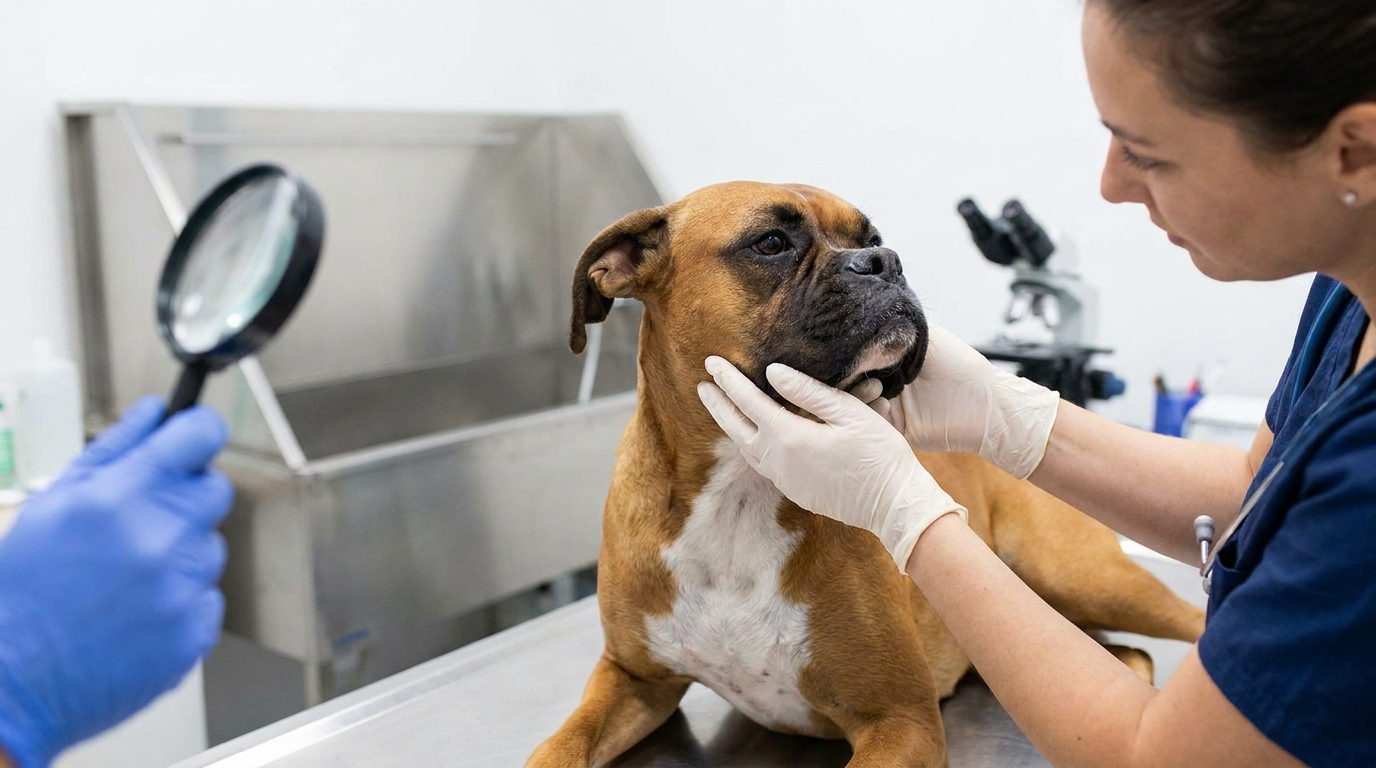
Red bumps or pimples on your dog's chin? What causes them, what is safe to do at home, and which signs need a vet the same day.
Quick answer: Dog chin acne (muzzle folliculitis) is red bumps or pimples on the chin and lips, mostly in young, short-coated dogs. Never squeeze them or use human acne products. Bumps on a well dog need a vet check within a few days, this week at the latest; bumps that hurt, ooze or smell, or a puppy with a swollen face and swollen jaw glands, need an in-person vet the same day.
This article is general information, not a diagnosis. If you think your pet is in danger, go to the nearest emergency animal hospital.
When are chin or muzzle bumps an emergency?
A dog with a swollen face or muzzle plus vomiting, heavy drooling, pale gums, weakness, hard or noisy breathing or trouble swallowing needs an emergency vet now. So does any flat-faced dog with face swelling, or a dog with a puffy face within 1 hour of a shot, sting or new medicine. Face swelling with diarrhea, collapse, a seizure or swelling toward the throat or tongue is an emergency too. Boxers and bulldogs are acne-prone and flat-faced, so the flat-faced rule covers them.
- Fast, painful swelling, especially after time outdoors or with puncture marks (a possible snakebite): an emergency vet now.
- A hot, painful swelling on the jaw, cheek or lip with fever, or after a scuffle or bite (often an abscess): an in-person vet the same day.
- A dog that licked or ate a human acne, wart or callus product: an emergency vet now if it vomits, seems weak, acts off, trembles, is wobbly, has a seizure or struggles to breathe; otherwise call ASPCA Animal Poison Control at (888) 426-4435 (a consultation fee may apply) or the Pet Poison Helpline at (855) 764-7661 (a per-incident fee applies) now.
| What you see | How soon | Where |
|---|---|---|
| Face swelling, hard breathing | Now | ER |
| Flat-faced dog, any face swelling | Now | ER |
| Puffy face within 1 hour of a shot or sting | Now | ER |
| Licked or ate acne cream, vomiting or weak | Now | ER |
| Licked acne cream, acting fine | Now | Poison line |
| Puffy face, normal breathing | Within 1 hour | In person |
| Bumps that hurt, ooze or smell | Same day | In person |
| Bumps with fever, low energy or not eating | Same day | In person |
| Puppy: swollen face, jaw glands | Same day | In person |
| Bumps keep coming back | Within days | In person |
| One firm lump that stays | Within days | In person |
| Crusts on nose bridge, ear flaps or pads | Within days | In person |
| Bumps past 2 days, dog well | This week | Video or clinic |
What is dog chin acne?
Dog chin acne is inflammation of the hair follicles on the chin, lips and muzzle, which vets call muzzle folliculitis and, when deeper, furunculosis. A University of Minnesota veterinary dermatology handbook says it is common in short-coated breeds and starts young, with red bumps first and pimples or yellowish crusts if bacteria infect the skin. PetMD says most affected dogs are between 6 months and a year old.
VCA Animal Hospitals lists the breeds most often affected: boxers, English bulldogs, French bulldogs, Great Danes, German shorthaired pointers, weimaraners, mastiffs, rottweilers, Labrador retrievers and Doberman pinschers. VCA says severe cases can swell the lips and muzzle and cause bleeding wounds or scabs on the face. Deep, infected chin acne overlaps with pyoderma in dogs.
RexVet's own data from video visits in 2025 and 2026 found: "Skin was the top concern in RexVet dog visits (18%), followed by itching, ear problems and allergies." These are concerns owners picked when booking, not diagnoses, and the data covers skin problems in general, not chin acne.
What causes bumps on a dog's chin?
Many cases of dog chin acne start with trauma to the chin, such as rubbing, rooting or rough play, that breaks short hairs off near the skin and inflames the follicle; bacteria can then infect the damaged skin. VCA Animal Hospitals says the inflammation is often sterile (not infected) at first and names rooting in dirt, scratching the face and rough-edged plastic bowls, with genes thought to play an important role. PetMD adds rubbing on carpet or rough surfaces and itching from a skin allergy.
Plastic bowls are a suspected trigger, not a proven cause. The Merck Veterinary Manual says Staphylococcus pseudintermedius is the primary cause of bacterial skin infection in dogs and lists the chin and the bridge of the muzzle among sites prone to deep infection. Allergy bumps on short-coated dogs are covered in pit bull skin allergies and bumps.
Is it chin acne, warts or something else?
Warts, mange mites, ringworm, hives and puppy strangles can all look like chin acne, and only a vet exam, sometimes with a skin scraping or culture, tells them apart.
| Bump type | Looks like | Clue |
|---|---|---|
| Acne | Red bumps, pimples | Young, short coat |
| Warts | Raised, cauliflower | Around mouth |
| Demodex mites | Patchy hair loss | Lips, eyes, front legs |
| Ringworm | Scaly bald patch | Can spread to people |
| Hives | Raised welts | Hours to 2 days |
| Puppy strangles | Swollen face, crusts | Swollen jaw glands |
| Bowl reaction | Red chin skin | Where bowl touches |
| Single lump | One firm bump | Needs needle test |
Skin scrapings, cytology (a skin sample) and cultures are done in person, and PetMD says a fungal culture for ringworm typically takes 10 to 14 days.
- Warts: Viral papillomas are most common around or in the mouth. A new wart-like growth on an adult dog needs an in-person exam within days, or the same day if it bleeds or grows fast (see warts on dogs). A mouth growth that makes breathing or swallowing hard needs an emergency vet now.
- Demodex mites: The Merck Veterinary Manual says localized Demodex usually appears around the lips, eyes and front legs of dogs under 1 year old and is not considered contagious (see dog losing hair in patches).
- Hives: New hives or a puffy face need an emergency vet now in a flat-faced dog, within 1 hour of a shot, sting or new medicine, or with hard breathing, pale gums, vomiting or weakness. Spreading hives need an in-person vet now, and hives later on the day of a shot need a call to the vaccinating clinic now. Other new hives or a puffy face with normal breathing and pink gums need an in-person vet within 1 hour (see dog hives or sudden bumps).
- Puppy strangles: VCA says it commonly affects puppies up to six months old, with sudden face swelling, pustules, heavy scabbing, swollen jaw glands and often a fever: an in-person vet the same day.
Can I pop my dog's chin pimples?
No, never squeeze a dog's chin pimples: VCA Animal Hospitals says squeezing makes hair follicles more likely to rupture, which worsens the inflammation. Never squeeze a single firm bump, or one that swells and shrinks in the same spot, either: it can be a mast cell tumor and needs an in-person needle sample within days.
Can I use human acne products on my dog?
No, do not put human acne washes, creams or spot treatments, benzoyl peroxide ones included, on a dog: they are not made for dog skin, and a dog will lick them off. Pet Poison Helpline lists topical medicines for acne, warts and calluses among products that can contain aspirin-like salicylates, and it says cats are much more sensitive to aspirin poisoning than dogs. A pet that licked or ate one and vomits, seems weak, acts off, trembles, is wobbly, has a seizure or struggles to breathe needs an emergency vet now; otherwise call one of the poison lines listed above now.
Never put a leftover or human steroid or antibiotic cream on chin bumps: if the bumps are mites, a steroid can make them worse, and the Merck Veterinary Manual says steroid creams and pills should not be used for Demodex.
What helps dog chin acne at home?
At home, keep a dog's chin clean and dry, remove whatever rubs it, and put nothing on the bumps unless a vet who has examined your dog says to. PetMD says keeping the chin clean and dry can help prevent secondary infections.
- Wipe the chin gently with a soft, damp cloth and pat it dry.
- Use a smooth food and water bowl, washed every day.
- Cut down on rooting, rough face play and rubbing on carpet where you can.
- Take a daylight photo of the chin every few days.
That means no hydrogen peroxide, rubbing alcohol, tea tree or other essential oils, apple cider vinegar, or human or leftover creams. Never give your dog a person's or another pet's pills.
How does a vet treat dog chin acne?
A vet treating dog chin acne first rules out mange mites, ringworm and puppy strangles, then treats the inflamed follicles and any infection. Tests are done in person: a skin scraping and cytology (a skin sample), which the University of Minnesota handbook says should be routine; a fungal culture; a bacterial culture of deep sores if antibiotic pills are being considered; and, rarely, a biopsy.
Treatment types (the vet picks each product and schedule):
- Topical benzoyl peroxide, the most common treatment, per VCA Animal Hospitals; the University of Minnesota handbook notes these gels can irritate skin, so the vet picks the product and how it is used.
- A topical antibiotic for an infected or stubborn case after a skin sample, not as a first step.
- A topical steroid to calm inflammation, used only once mites are ruled out.
- Antibiotic pills for infected bumps, which VCA says are typically given for four to eight weeks if used.
- Allergy management, when an allergy keeps the dog rubbing its face.
For puppy strangles, VCA says vets most often use a vet-directed course of steroid pills over several weeks, so a puppy with a swollen face always needs an in-person vet.
Will my dog grow out of chin acne?
Not always: vet sources give no age at which dogs outgrow chin acne, and some dogs keep getting flares. VCA says severe cases left untreated can scar for good. A University of Minnesota veterinary dermatology handbook says mild cases may clear on their own, while PetMD says chin acne usually needs some treatment. A well dog with new chin bumps still needs a vet check within a few days, this week at the latest, and an in-person vet the same day if the bumps hurt, ooze pus or blood, smell, or come with fever, low energy or not eating.
Bumps that keep coming back, no change 3 to 4 days into a vet's treatment, acne-like bumps that first appear in an adult dog, and pustules or crusts on the bridge of the nose, the ear flaps or the footpads (possible pemphigus, which needs a biopsy) all need an in-person exam within days.
When does a video visit help with dog chin acne?
A video visit fits a dog that is eating, drinking and acting normally and has small red chin or muzzle bumps or pimples that have lasted past 2 days, with no swelling, pus, blood or bad smell. RexVet, a nonprofit online vet service, serves pets located in Florida, New York and Virginia by video visit. A $64.99 live video visit is with a licensed RexVet vet, and your dog must be located in one of those states during the visit.
A veterinarian licensed in your pet's state can look at the chin on camera in good light, and photos can add to that live look. They can ask about bowls, rough play, rubbing, fleas, allergies and diet, then give a care plan and say whether an in-person exam is needed and how soon. If that fits your dog, you can book a live video visit.
Skin scrapings, cytology, cultures, needle samples, biopsies, bloodwork and injections all happen in person. The veterinarian can say whether the bumps could be mites and whether a skin scraping is needed; medicine for mites often needs an in-person exam first. Typical mouth warts on a young dog can suit video; hives suit video only once they have faded.
Live video slots run about 8 AM to 11 PM ET. There are no overnight visits, and holiday hours are not confirmed, so check open slots when you book. Outside those hours, or in any emergency, go to an emergency hospital.
Guidelines call for a skin sample (cytology) before any antibiotic, and that sample is taken in person. VCA says antibiotic pills, if used, typically run four to eight weeks; that is longer than Florida's 14-day video-only limit, so infected chin bumps usually need a clinic.
RexVet's own visit data shows how often skin visits end with medicine: "Of the main concern groups, visits for vomiting, diarrhea or digestive problems were among the most likely to end with a prescription (21%), while only 5% of skin and itching visits did." No prescription is promised; a video visit may end with the veterinarian's advice and a care plan.
Any medicine is the veterinarian's decision after the visit, within state and federal rules. Florida (s. 474.2021) limits a video-only prescription to FDA-approved animal drugs used as labeled, for up to 14 days (up to 1 month for products labeled solely for flea and tick control), with no renewal without an in-person exam, and bars human-labeled, controlled and compounded anti-infective drugs on a video-only visit. Federal rules (21 CFR 530) require an in-person exam before a vet directs a human drug or an off-label animal drug, in every state, Virginia included. Virginia allows the exam itself to be electronic. New York's rules are unsettled, so a visit there may cover less. RexVet is not a pharmacy: a pharmacy transfer fee applies if a prescription is sent to an outside pharmacy, and the medicine is paid for separately.
A video visit is not the right first step for face swelling, new hives, a licked acne product, sores that ooze, bleed or smell, fever, a puppy with a swollen face, bumps that keep coming back, a single firm lump, or new bumps in an adult dog: follow the in-person and emergency steps above.
Need an Expert Opinion on This Topic?
Book a video visit with a licensed vet, evenings and weekends included
See open timesFrequently Asked Questions
Can dogs get acne?
Yes, dogs get chin acne: red bumps or pimples on the chin, lips and muzzle that vets call muzzle folliculitis. PetMD says it is fairly common in young, short-coated breeds.
Is dog chin acne contagious to people or other pets?
Usually not. PetMD says dog acne is most often not contagious, but ringworm, which can look like acne early on, spreads to people and other pets. A scaly bald patch, or a similar patch on another pet, needs an in-person vet within days, and a person with an itchy or ring-shaped rash should see their own doctor.
Why does my dog have blackheads or dark spots on his chin?
Dark spots can come with chin acne, but mites can look the same, so do not squeeze them; have a vet check the chin within a few days. VCA Animal Hospitals says Demodex mites should be considered, and ruling them out takes an in-person skin scraping. Spots that ooze, bleed or smell need an in-person vet the same day.
Can plastic bowls cause chin acne in dogs?
Possibly: plastic bowls are a suspected trigger for dog chin acne, not a proven cause. VCA Animal Hospitals names plastic bowls with rough edges, and PetMD says some pets react to plastic and that bacteria or yeast can hide in micro-scratches. A smooth bowl washed every day is a simple step to try.
Why does my adult dog suddenly have bumps on his chin?
An adult dog with new chin bumps needs an in-person exam within days, because adult bumps can be warts, mites, a lump or an allergy. Never squeeze a single firm bump; it needs a needle sample. The Merck Veterinary Manual says new widespread Demodex in adult dogs is often triggered by cancer, Cushing's disease, hypothyroidism or diabetes.
My puppy has little red bumps on his chin. What is it?
Little red bumps on a puppy's chin can be chin acne; PetMD says most affected dogs are between 6 months and a year old. A puppy that acts normally needs a vet check within a few days; never squeeze the bumps. A puppy with a swollen face, muzzle crusts and swollen jaw glands may have puppy strangles: an in-person vet the same day.
Can an online vet look at my dog's chin bumps in Florida, New York or Virginia?
Yes, as a first step: a veterinarian licensed in your pet's state can look at the chin on camera and say how urgent it is. For a dog located in Florida, New York or Virginia during the visit, the veterinarian can say which in-person tests are needed. A puffy face, new hives, oozing sores or a puppy with a swollen face need in-person or emergency care instead. No prescription is promised, and guidelines call for an in-person skin sample before any antibiotic. Florida limits a video-only prescription to FDA-approved animal drugs used as labeled, for up to 14 days (1 month for products labeled solely for flea and tick control), with no renewal without an in-person exam, and bars human-labeled, controlled and compounded anti-infective drugs; federal rules require an in-person exam for human or off-label drugs in every state, Virginia included; Virginia allows an electronic exam; and New York's rules are unsettled.
FAQs
Can dogs get acne?
Yes, dogs get chin acne: red bumps or pimples on the chin, lips and muzzle that vets call muzzle folliculitis. PetMD says it is fairly common in young, short-coated breeds.
Is dog chin acne contagious to people or other pets?
Usually not. PetMD says dog acne is most often not contagious, but ringworm, which can look like acne early on, spreads to people and other pets. A scaly bald patch, or a similar patch on another pet, needs an in-person vet within days, and a person with an itchy or ring-shaped rash should see their own doctor.
Why does my dog have blackheads or dark spots on his chin?
Dark spots can come with chin acne, but mites can look the same, so do not squeeze them; have a vet check the chin within a few days. VCA Animal Hospitals says Demodex mites should be considered, and ruling them out takes an in-person skin scraping. Spots that ooze, bleed or smell need an in-person vet the same day.
Can plastic bowls cause chin acne in dogs?
Possibly: plastic bowls are a suspected trigger for dog chin acne, not a proven cause. VCA Animal Hospitals names plastic bowls with rough edges, and PetMD says some pets react to plastic and that bacteria or yeast can hide in micro-scratches. A smooth bowl washed every day is a simple step to try.
Why does my adult dog suddenly have bumps on his chin?
An adult dog with new chin bumps needs an in-person exam within days, because adult bumps can be warts, mites, a lump or an allergy. Never squeeze a single firm bump; it needs a needle sample. The Merck Veterinary Manual says new widespread Demodex in adult dogs is often triggered by cancer, Cushing's disease, hypothyroidism or diabetes.
My puppy has little red bumps on his chin. What is it?
Little red bumps on a puppy's chin can be chin acne; PetMD says most affected dogs are between 6 months and a year old. A puppy that acts normally needs a vet check within a few days; never squeeze the bumps. A puppy with a swollen face, muzzle crusts and swollen jaw glands may have puppy strangles: an in-person vet the same day.
Can an online vet look at my dog's chin bumps in Florida, New York or Virginia?
Yes, as a first step: a veterinarian licensed in your pet's state can look at the chin on camera and say how urgent it is. For a dog located in Florida, New York or Virginia during the visit, the veterinarian can say which in-person tests are needed. A puffy face, new hives, oozing sores or a puppy with a swollen face need in-person or emergency care instead. No prescription is promised, and guidelines call for an in-person skin sample before any antibiotic. Florida limits a video-only prescription to FDA-approved animal drugs used as labeled, for up to 14 days (1 month for products labeled solely for flea and tick control), with no renewal without an in-person exam, and bars human-labeled, controlled and compounded anti-infective drugs; federal rules require an in-person exam for human or off-label drugs in every state, Virginia included; Virginia allows an electronic exam; and New York's rules are unsettled.
Medically Reviewed
Reviewed by Dr. Tiffany Delacruz, DVM — licensed veterinarian and CEO of RexVet. Last reviewed November 16, 2026.
Content is for informational purposes and does not replace professional veterinary advice.
Chief Executive Officer · Licensed Veterinarian
Dr. Delacruz is a licensed Doctor of Veterinary Medicine specializing in preventive care and veterinary telehealth. She reviews all health content on RexVet to ensure accuracy and clinical relevance.
Sources & References
- · American Veterinary Medical Association — Telehealth Guidelines
- · AVMA — Pet Care Resources
- · U.S. FDA — Animal & Veterinary