
Frostbite and Hypothermia in Dogs: Signs and First Aid
By RexVet Team | Reviewed by Dr. Tiffany Delacruz, DVM
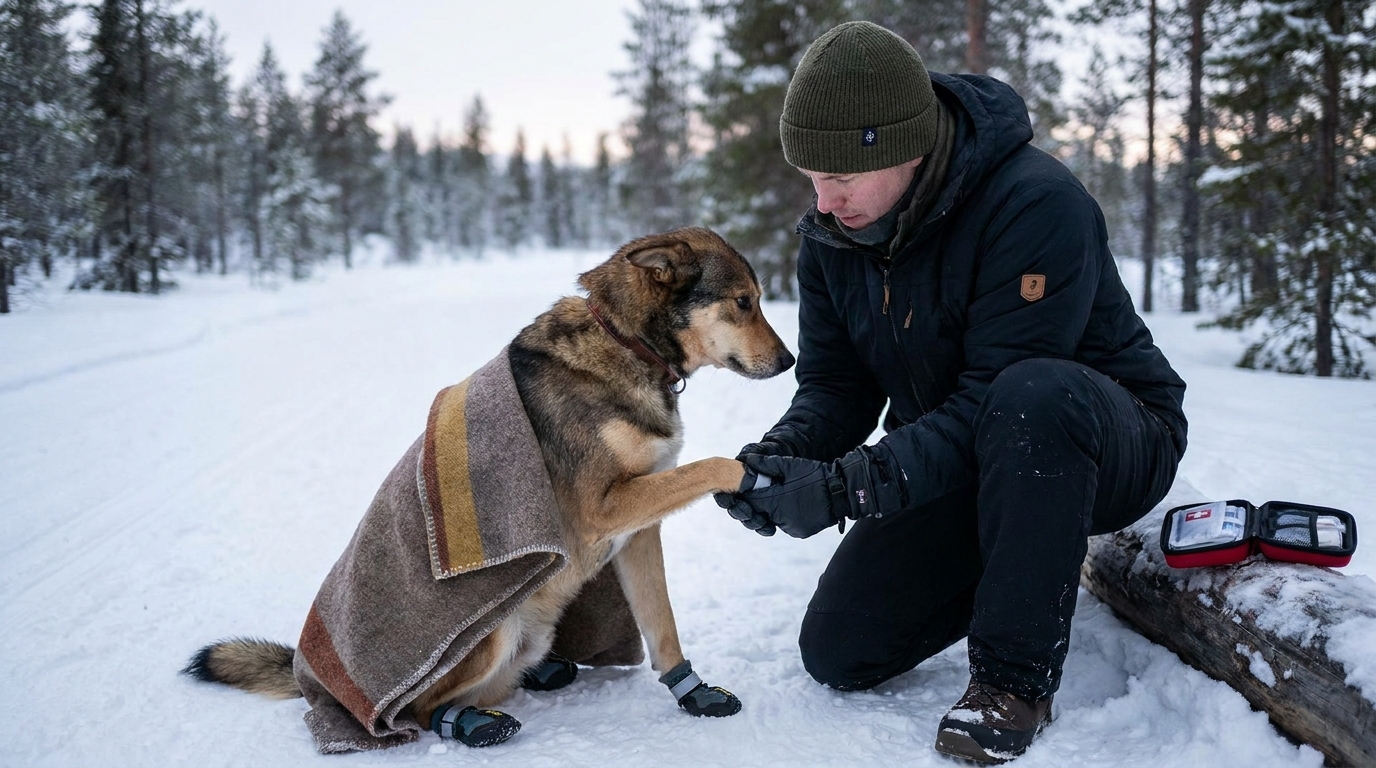
How to spot frostbite and hypothermia in a dog, what to do first, and how frostbitten skin heals.
Quick answer: VCA Animal Hospitals says frostbite on a dog shows as pale, gray or bluish skin that feels cold or brittle on the ear tips, tail or paws; never rub it, and see a vet in person now (an ER if your vet is closed). Weakness, confusion, slow breathing, shivering that stops while still cold, or a rectal reading below about 99°F signals hypothermia and means an emergency vet now.
This article is general information, not a diagnosis. If you think your pet is in danger, go to the nearest emergency animal hospital.
What does frostbite look like on a dog?
Frostbite on a dog usually hits the ear tips, tail and paws, and VCA Animal Hospitals says the skin looks pale, gray or bluish and feels cold, brittle or painful; any patch like that needs an in-person vet now, or an emergency vet if your own vet is closed.
VCA also lists swelling, pain when touched, licking or chewing at the spot, blisters or skin ulcers, and blackened or dead skin.
As it thaws, VCA says frostbitten tissue may turn red and painful, so a pale ear tip that turns red and sore is still frostbite, not a sign of healing. The Merck Veterinary Manual says severe frostbite can turn black and hard and eventually fall off, especially at the outer ear tips.
What are the signs of hypothermia in a dog?
A dog with hypothermia turns weak, tired or confused, gets stiff muscles, breathes slowly or shallowly, may collapse, and can stop shivering while still cold; any of these, or a rectal reading below about 99°F after cold exposure, means an emergency vet now.
Cornell's Riney Canine Health Center calls hypothermia life-threatening. AAHA lists shivering, weakness and pale or cool skin as early signs, and lethargy, confusion, slow breathing and a slow heart rate as advanced ones. A dog that is only shivering and otherwise alert should come inside, be dried and wrapped in warm blankets, and get a vet's advice now: Texas A&M's vet college says to take the pet to a veterinarian or get a veterinarian's advice if hypothermia is suspected. A rectal reading below about 99°F, or any other sign, means an emergency vet now. Do not rely on shivering: the Merck Veterinary Manual says it is not a reliable sign, and Texas A&M's vet college says shivering stops as the pet becomes more neurologically affected.
Also go to an emergency vet now for a dog that went through ice and then coughs, breathes fast or hard, or has gray or blue gums, even if it seems warm; a weak, chilled young puppy; or a low temperature in a dog that was not out in the cold.
Merck gives a dog's normal rectal temperature; Texas A&M grades hypothermia by body temperature.
| Grade | Temperature | What to do |
|---|---|---|
| Normal | 99.5 to 102.5°F | Watch signs |
| Mild | 90 to 99°F | ER now |
| Moderate | 82 to 90°F | ER now |
| Severe | Below 82°F | ER now |
Take a rectal temperature only if your dog is alert with no emergency sign. Skip it if your dog is painful, confused or snapping, and never stop to measure before leaving.
Frostbite or hypothermia: which do you treat first?
Treat hypothermia before frostbite in a dog that has both: Texas A&M's College of Veterinary Medicine says hypothermia can be fatal, and VCA Animal Hospitals says to treat the hypothermia first by warming the whole dog slowly before the frostbitten spot.
Warm the chest and belly first, then the ears or paws. Frostbite plus any hypothermia sign means an emergency vet now.
How to warm up a dog with hypothermia or frostbite
A dog that was out in the cold too long should go straight into a warm, dry room, be dried and wrapped in warm blankets, and see a vet in person now for possible frostbite or an emergency vet for any hypothermia sign; warm a frostbitten spot only indoors, gently, and never rub it.
Dry a wet dog first (Merck Veterinary Manual), remove snow and ice from the coat and toes (University of Illinois), and add towel-wrapped warm (not hot) water bottles around the body (AAHA, Merck), mainly the chest and belly. Carry a dog with frostbitten paws rather than let it walk through snow again, since VCA Animal Hospitals says refreezing injures tissue further, and keep it wrapped in dryer-warmed towels in the car (VCA).
Sources: VCA, Merck, AAHA and Texas A&M. Never let warming delay leaving for the vet.
| Do | Do not |
|---|---|
| Dry the coat | Rub or massage |
| Warm blankets | Heating pad |
| Wrapped warm bottles | Hair dryer |
| Warm water, indoors | Hot water |
| Pat skin dry | Snow on skin |
| Carry to the car | Thaw if it may refreeze |
| Go to a vet | Food or human pills |
Check the skin under the bottles, because a weak dog cannot move away from heat, and keep it away from space heaters, fireplaces and car vents. Texas A&M warns that heating pads applied directly to pets can cause thermal burns. A small burn needs an in-person vet the same day; a large or deep burn, a burn on the face, or a dog that chewed a cord or was shocked needs an ER now. Never put a cold dog in a bath or shower.
For the frostbitten spot only, VCA says to use warm, never hot, water at 98.6°F to 113°F (37°C to 45°C), comfortable to rest your hand in, as a compress or a bowl soak. Numb skin cannot feel a burn, so if unsure, use cooler water, never hotter. Pat it dry; do not break blisters, wrap it tightly, or apply creams, ointments, oils or petroleum jelly.
Give no food, and no pain medicine unless a veterinarian says to: VCA says many human pain relievers, including acetaminophen and aspirin, can be toxic to dogs (see human pain relievers and dogs). If your dog falls through ice, never go onto the ice after it; call 911 or the fire department.
Frostbite or just cold ears?
A dog's ear tip, tail tip or paw that looks pale, gray or bluish, or feels hard, brittle or painful, is possible frostbite and needs an in-person vet now.
The University of Illinois vet college describes frostbitten skin as pale, firm and cool. VCA Animal Hospitals explains that below 32°F (0°C), blood vessels near a dog's skin narrow to keep the core warm, moving blood away from the ears, paws and tail.
Frostbite signs from VCA Animal Hospitals and the University of Illinois.
| What you see | Likely cause | Next step |
|---|---|---|
| Cool ears, normal color | Cold weather | Recheck daily |
| Pale, gray or hard ear tip | Frostbite? | In-person now |
| Red, sore after thawing | Frostbite | In-person now |
| Black or blistered skin | Dead tissue | In-person now |
| Red, raw pads after salt | Salt burn? | Rinse; in-person, same day |
| Dry split pads, no blood | Cracked pads | Home care |
| Limp tail after cold swim | Limber tail? | In-person soon |
| Limp tail, weak back legs | Spine? | In-person now |
Dry, shallow pad cracks with no bleeding, swelling or limping are usually home care (see cracked dog paw pads in winter); a bleeding crack, a swollen paw or a limp needs an in-person vet the same day. A limp tail after a cold swim may be limber tail, but VCA lists look-alikes such as a fracture and spinal disease that need a hands-on exam. A limp tail with weak or wobbly back legs or trouble peeing or pooping, or one that follows a fall or injury, needs an in-person vet now.
How cold, and for how long, before a dog gets frostbite?
No time outside in cold weather is guaranteed safe for a dog: the Merck Veterinary Manual says wind and wet fur make frostbite more likely, and RexVet's cold-weather chart keeps even hardy adult dogs to about 30 minutes at most below 20°F.
See RexVet's chart of how cold is too cold for dogs by size and coat. Cornell's Riney Canine Health Center names the higher-risk dogs: puppies, small or thin-coated dogs, older, underweight or ill dogs, and dogs not used to cold; VCA adds dogs with heart disease or diabetes. Texas A&M says Huskies and Malamutes are less prone to hypothermia. A thick coat still does not prevent frostbite, especially when wet. For cats, see how cold is too cold for cats.
Why frostbite can show up days later
Frostbite in a dog can take several days to show, especially on the tail tip and ear tips, VCA Animal Hospitals and Cornell say, so check the ears, tail and paws every day for several days after a bad cold exposure.
Cornell says frostbite is harder to detect at first, so a dog that looks mild on day one still needs the in-person exam. Photograph the ear tips, tail tip and pads daily in the same light. New pale, dark, blistered, oozing or foul-smelling skin means an in-person vet now; VCA links pus or a foul smell to a secondary bacterial infection.
How do vets treat frostbite, and how long does it take to heal?
An in-person vet treats a frostbitten dog's hypothermia, shock and pain first, then watches which tissue survives; VCA Animal Hospitals says mild frostbite usually heals with little permanent damage, while severely frostbitten tissue turns dark blue to black and sloughs off over several days to weeks.
VCA says frostbite is diagnosed from the history and a physical exam, with blood and urine tests after long or extreme cold exposure, and that thawing tissue is extremely painful. Severe frostbite can permanently disfigure or change the tissue, and extreme cases need surgical removal or amputation. The Merck Veterinary Manual says any amputation should wait until a veterinarian can clearly tell living tissue from dead tissue, so keep every recheck.
Cold snaps in Florida, New York and Virginia
Dogs in Florida, New York and Virginia all face frostbite and hypothermia risk in a cold snap, and Cornell says dogs not used to cold are at higher risk.
- Florida has no statewide cold-weather rule; its cruelty law, Fla. Stat. 828.12, covers depriving an animal of necessary shelter. Check your county or city rules.
- New York's Agriculture and Markets Law 353-b requires a dog left outdoors to have shelter suited to its breed, condition and the climate, with a waterproof roof, insulation and room to stand, turn and lie down; it sets no temperature.
- Virginia's Va. Code 3.2-6500 calls for a windbreak and enough bedding in cold weather, and a tether alone is not adequate shelter at an actual or effective outdoor temperature of 32°F or lower or during a winter storm warning, unless animal control has found the dog safe. That is a shelter rule, not a ban on dogs outdoors.
Laws change; this is general information, not legal advice.
When a RexVet video visit helps, and when it does not
RexVet, a nonprofit online vet service, serves pets located in Florida, New York and Virginia by video visit, but a video call cannot warm a dog or treat frostbite or hypothermia.
Go to an emergency vet now if your dog is weak, wobbly, confused or very sleepy, has stiff muscles, is breathing slowly, has collapsed, has stopped shivering while still cold, or reads below about 99°F rectally after cold exposure, and for frostbite or an icy-water soak with any of these signs. Pale, gray, bluish, hard, blistered or blackening skin, including an ear tip or paw that was pale and has turned red and sore, needs a vet in person now (an emergency vet if your own vet is closed). If your dog may have licked or drunk antifreeze, go to an emergency vet now and call a poison line on the way, even with no signs (see antifreeze poisoning signs and timing). For swallowed ice melt or rock salt, get care now, even with no signs, from an emergency vet, ASPCA Animal Poison Control at (888) 426-4435 (a consultation fee may apply) or Pet Poison Helpline at (855) 764-7661 (a per-incident fee applies), and do not make your dog vomit unless a vet or a poison line says to.
A $64.99 live video visit with a licensed RexVet vet fits once your dog is indoors, warm, alert and eating, with normal-looking skin: cracked or salt-irritated pads with no bleeding, swelling, limping or raw or discolored spots; a normal-colored ear or tail tip, so the veterinarian can tell you what to recheck; outdoor limits, coats and booties for a puppy, a senior or a dog with diabetes or heart disease; and home-care questions between rechecks after in-person frostbite treatment.
A video visit does not change or refill medicines a hospital sent home, and any new pale, dark, blistered, oozing or foul-smelling skin means an in-person vet now. Your dog must be located in one of those three states during the visit, and you see a veterinarian licensed in your pet's state. Live slots run about 8 AM to 11 PM ET; if none is open, or it is late and you are worried, go to an ER instead of waiting. No prescription is promised; pain control and wound care for frostbite are in-person care. RexVet is not a pharmacy, and a pharmacy transfer fee applies if a prescription is sent to an outside pharmacy. Book a video visit.
Need an Expert Opinion on This Topic?
Book a video visit with a licensed vet, evenings and weekends included
See open timesFrequently Asked Questions
Can frostbite on a dog heal on its own?
Do not count on it: possible frostbite needs an in-person vet now, because the damage can take days to show and severe cases need treatment. VCA Animal Hospitals says severe frostbite can permanently disfigure or change the tissue.
Should I put my dog's frozen paw in warm water?
Only indoors, with warm (never hot) water, and only if the paw cannot freeze again; then get your dog to a vet in person now. VCA Animal Hospitals gives a range of 98.6°F to 113°F (37°C to 45°C), warm enough to rest your hand in comfortably; numb skin cannot feel a burn, so if unsure, use cooler water, never hotter. Treat any hypothermia first, never rub the paw, and never let warming delay leaving.
Can dogs get frostbite on their paws from walking in snow?
Yes. VCA Animal Hospitals says the paws, ears and tail are most often frostbitten, especially when wet. After snowy walks, clear ice balls from between the toes and dry the paws; a pale, gray, bluish, cold or hard pad needs a vet in person now.
Is it normal for my dog's ears to feel cold in winter?
Ears can feel cool in winter, but pale, gray, bluish, hard or brittle ear tips may be frostbite and need an in-person vet now. Frostbite can take several days to show (VCA Animal Hospitals, Cornell), so check them daily for several days after a long cold outing.
My dog stopped shivering but still feels cold. Is that a good sign?
No. A cold dog that stops shivering may be getting worse: dry it, wrap it in warm blankets and go to an emergency vet now. Texas A&M's vet college says the shivering stops as the pet becomes more neurologically affected, and the Merck Veterinary Manual says a pet with hypothermia should be seen by a veterinarian immediately.
What body temperature means my dog has hypothermia?
Below about 99°F after cold exposure means an emergency vet now, and any hypothermia sign means the same whatever the number. The Merck Veterinary Manual puts a dog's normal rectal temperature at 99.5 to 102.5°F, and Texas A&M's vet college calls 90 to 99°F mild hypothermia. Never delay leaving to measure.
Can I put a hand warmer on my dog to warm it up?
No. Keep hand warmers off your dog's skin and out of reach, and use warm blankets instead, because a weak dog cannot move away from a hot spot. Pet Poison Helpline says some warmers contain iron, which can be very toxic if swallowed. If your dog ate one, go to an ER now or call ASPCA Animal Poison Control at (888) 426-4435 (a consultation fee may apply) or Pet Poison Helpline at (855) 764-7661 (a per-incident fee applies), even if it seems fine, and do not make it vomit unless a vet or a poison line says to. RexVet's hand warmer poisoning guide lists the signs.
Can an online vet check my dog for frostbite on a video call in Florida, New York or Virginia?
No, not for suspected frostbite or hypothermia: frostbite needs an in-person vet now and hypothermia an emergency vet now, because both need a hands-on exam. For a warm, alert, eating dog with normal-looking skin located in Florida, New York or Virginia, a licensed RexVet vet can look at the ear tips, tail tip and pads on camera and plan rechecks, coats and booties; no prescription is promised. If medicine comes up, Florida's s.474.2021 limits telehealth-only prescriptions to FDA-approved animal drugs used as labeled, for up to 14 days (1 month for products labeled only for fleas and ticks), with no renewal without an in-person exam and no human-labeled, controlled or compounded anti-infective drugs. Federal rules (21 CFR 530.3) require an in-person exam or visit before off-label or human-drug use. Virginia allows the exam to be electronic; New York's rules are not settled.
FAQs
Can frostbite on a dog heal on its own?
Do not count on it: possible frostbite needs an in-person vet now, because the damage can take days to show and severe cases need treatment. VCA Animal Hospitals says severe frostbite can permanently disfigure or change the tissue.
Should I put my dog's frozen paw in warm water?
Only indoors, with warm (never hot) water, and only if the paw cannot freeze again; then get your dog to a vet in person now. VCA Animal Hospitals gives a range of 98.6°F to 113°F (37°C to 45°C), warm enough to rest your hand in comfortably; numb skin cannot feel a burn, so if unsure, use cooler water, never hotter. Treat any hypothermia first, never rub the paw, and never let warming delay leaving.
Can dogs get frostbite on their paws from walking in snow?
Yes. VCA Animal Hospitals says the paws, ears and tail are most often frostbitten, especially when wet. After snowy walks, clear ice balls from between the toes and dry the paws; a pale, gray, bluish, cold or hard pad needs a vet in person now.
Is it normal for my dog's ears to feel cold in winter?
Ears can feel cool in winter, but pale, gray, bluish, hard or brittle ear tips may be frostbite and need an in-person vet now. Frostbite can take several days to show (VCA Animal Hospitals, Cornell), so check them daily for several days after a long cold outing.
My dog stopped shivering but still feels cold. Is that a good sign?
No. A cold dog that stops shivering may be getting worse: dry it, wrap it in warm blankets and go to an emergency vet now. Texas A&M's vet college says the shivering stops as the pet becomes more neurologically affected, and the Merck Veterinary Manual says a pet with hypothermia should be seen by a veterinarian immediately.
What body temperature means my dog has hypothermia?
Below about 99°F after cold exposure means an emergency vet now, and any hypothermia sign means the same whatever the number. The Merck Veterinary Manual puts a dog's normal rectal temperature at 99.5 to 102.5°F, and Texas A&M's vet college calls 90 to 99°F mild hypothermia. Never delay leaving to measure.
Can I put a hand warmer on my dog to warm it up?
No. Keep hand warmers off your dog's skin and out of reach, and use warm blankets instead, because a weak dog cannot move away from a hot spot. Pet Poison Helpline says some warmers contain iron, which can be very toxic if swallowed. If your dog ate one, go to an ER now or call ASPCA Animal Poison Control at (888) 426-4435 (a consultation fee may apply) or Pet Poison Helpline at (855) 764-7661 (a per-incident fee applies), even if it seems fine, and do not make it vomit unless a vet or a poison line says to. RexVet's hand warmer poisoning guide lists the signs.
Can an online vet check my dog for frostbite on a video call in Florida, New York or Virginia?
No, not for suspected frostbite or hypothermia: frostbite needs an in-person vet now and hypothermia an emergency vet now, because both need a hands-on exam. For a warm, alert, eating dog with normal-looking skin located in Florida, New York or Virginia, a licensed RexVet vet can look at the ear tips, tail tip and pads on camera and plan rechecks, coats and booties; no prescription is promised. If medicine comes up, Florida's s.474.2021 limits telehealth-only prescriptions to FDA-approved animal drugs used as labeled, for up to 14 days (1 month for products labeled only for fleas and ticks), with no renewal without an in-person exam and no human-labeled, controlled or compounded anti-infective drugs. Federal rules (21 CFR 530.3) require an in-person exam or visit before off-label or human-drug use. Virginia allows the exam to be electronic; New York's rules are not settled.
Medically Reviewed
Reviewed by Dr. Tiffany Delacruz, DVM — licensed veterinarian and CEO of RexVet. Last reviewed November 5, 2026.
Content is for informational purposes and does not replace professional veterinary advice.
Chief Executive Officer · Licensed Veterinarian
Dr. Delacruz is a licensed Doctor of Veterinary Medicine specializing in preventive care and veterinary telehealth. She reviews all health content on RexVet to ensure accuracy and clinical relevance.
Sources & References
- · American Veterinary Medical Association — Telehealth Guidelines
- · AVMA — Pet Care Resources
- · U.S. FDA — Animal & Veterinary