
FIP in Cats: Early Symptoms, Wet vs Dry Signs and When to See a Vet
By RexVet Team | Reviewed by Dr. Tiffany Delacruz, DVM
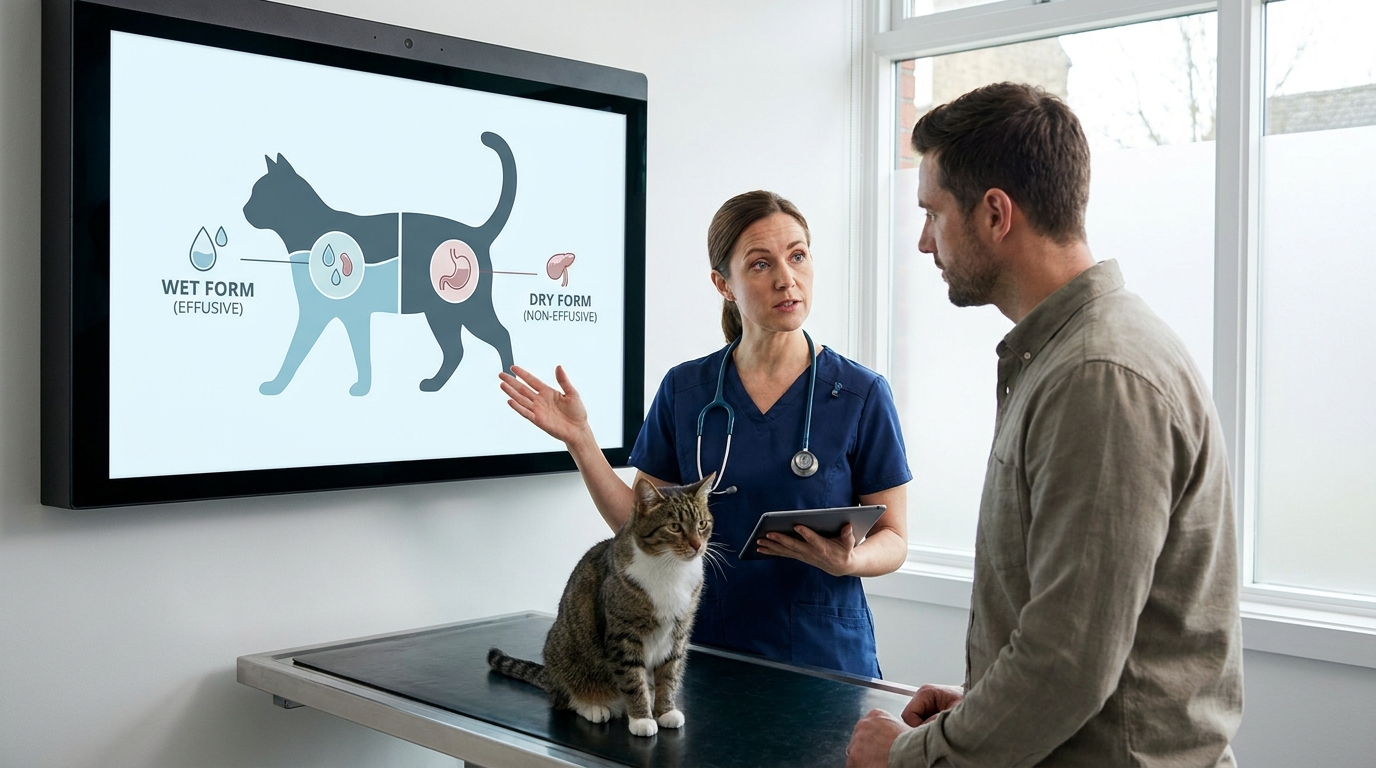
Fever, weight loss, a swelling belly: how to spot FIP symptoms in cats early, tell wet from dry, and know which signs mean the ER now.
Quick answer: The first FIP symptoms in cats are usually vague: a fever that comes and goes, eating less, weight loss and low energy. Most cases are in cats under 2, though seniors can get it too. A swollen belly with easy breathing, yellow gums, a wobbly walk or a cloudy eye means an in-person vet today. Fast or labored breathing at rest, a seizure or collapse means the ER now.
This article is general information, not a diagnosis. If you think your pet is in danger, go to the nearest emergency animal hospital.
FIP Symptoms in Cats: ER Now, Vet Today or This Week
Go to an emergency vet now if your cat is breathing fast or with effort while resting, breathing with its mouth open, has pale, gray or bluish gums, has a belly that is swelling quickly, has a seizure, collapses or cannot stand, suddenly cannot use its back legs, or suddenly seems blind.
Feline infectious peritonitis (FIP) rarely starts with a crisis. It usually begins as small, vague changes. If more than one line below fits, follow the most urgent.
In-person vet today (go to an ER if your clinic cannot see your cat today):
- An adult cat that has eaten little or nothing for about a day, or any kitten that will not eat.
- A swollen or pot belly while breathing stays easy.
- Yellow gums, skin or whites of the eyes (jaundice).
- A cloudy eye, blood or pus in the front of the eye, a change in iris color, or pupils of different sizes.
- A new wobbly walk, weak back legs, a head tilt or a sudden change in behavior.
- A cat on FIP treatment, or recently finished, that stops eating, loses weight, runs a fever again or shows new nerve signs: call the treating vet promptly.
Book a vet visit this week: a young or newly adopted cat that is breathing comfortably but has a fever that comes and goes (or did not clear up with antibiotics), is eating less but still eating, or is slowly losing weight or energy. Ask the vet whether an FIP workup makes sense, and mention any recent stress, such as adoption, surgery or a new cat; FIP often shows up in the weeks after one.
What FIP Is, and Why Most Cats With Feline Coronavirus Never Get It
FIP starts with feline coronavirus (FCoV), a very common cat virus that spreads through feces and shared litter boxes. Most cats that carry it never become seriously ill. In a few, a mutated form of the virus spreads through the body inside immune cells and sets off the inflammation that damages organs and, in many cats, makes fluid leak into the belly or chest.
The Cornell Feline Health Center puts the share that develop FIP at 5 to 10% of exposed cats, and the risk is highest in shelters, catteries and multi-cat homes. That is a figure for groups of cats, not your own cat's odds. UC Davis notes that signs can appear within days, several weeks or sometimes months of infection, and only rarely a year or more later.
Age matters. Most cases are in cats under 2 (VCA Animal Hospitals says three months to two years), but FIP can happen at any age, including in senior cats. The Merck Veterinary Manual also lists older age (over 10), group housing and purebred lineage as risk factors.
Early Signs of FIP: The Vague Phase
The Merck Veterinary Manual lists the common early signs as lethargy, a poor appetite, weight loss or failure to gain weight, and a fluctuating fever that does not respond to antibiotics. None is specific to FIP; the pattern in a young cat is what matters.
| Sign | What owners notice | How urgent |
|---|---|---|
| Fever that comes and goes | Warm ears, sleepy, then seems fine; may not clear up with antibiotics | Vet this week; ask about FIP |
| Eating less | Leaves food or skips meals | Vet today if barely eating for a day; kitten not eating: same day |
| Weight loss or poor growth | Bony back or hips; kitten smaller than its littermates | Vet this week |
| Low energy, hiding | Sleeps more, skips play, hides | Vet this week; today if also not eating |
| Scruffy coat | Dull, greasy or unkempt fur | Mention it at the visit |
| Mild diarrhea | Soft stool that comes and goes | Vet this week if it lasts |
Any of these plus fast or hard breathing at rest, pale or bluish gums, or collapse means the ER now. Never give a cat human fever or pain medicine; acetaminophen and ibuprofen can poison cats. If your cat has already swallowed any, call an emergency vet or a pet poison hotline now.
Watch appetite most closely. Cornell warns that going without food can seriously affect an adult cat's health after as little as 24 hours, and that for a kitten under six weeks old, 12 hours without food can be life-threatening. If the diarrhea has blood in it, our guide to blood in cat stool explains what the color can mean.
Wet FIP vs Dry FIP Symptoms
Wet FIP is also called "effusive" because fluid leaks into the belly or chest. Dry FIP is "non-effusive": instead of fluid, small areas of inflammation form in organs, the eyes, the brain or the spinal cord.
| Feature | Wet FIP | Dry FIP |
|---|---|---|
| Where it shows | Fluid in the belly or chest | Organs, eyes, brain and spine |
| Key signs | Pot belly, fast or hard breathing | Cloudy eye, wobbly walk, seizures |
| Shared signs | Fever, poor appetite, weight loss | Fever, poor appetite, weight loss |
| How fast it moves | Usually fast | Slower, harder to spot |
| How common | Most cases | Fewer cases |
Most cases are wet (about two-thirds in UC Davis data). Cornell says wet signs usually develop and progress fairly quickly, and a lot of fluid makes breathing hard; with chest fluid, Merck lists fast or labored breathing and bluish gums. That is an ER trip.
Cornell says dry FIP signs develop more slowly and can include seizures and loss of coordination. The forms are not fixed: some cats start dry and later develop fluid, or the reverse. Jaundice can appear with either form and means a vet today.
Eye and Nerve Signs Owners Miss
Eye changes can be the first visible clue in dry FIP. The 2022 AAFP/EveryCat FIP Diagnosis Guidelines list cloudiness or blood in the front of the eye, a change in iris color, pupils of different sizes, and blindness. UC Davis explains that eye FIP starts as anterior uveitis, an inflammation inside the front of the eye, and that glaucoma develops in some cases. Any of these changes needs an in-person exam the same day; sudden blindness means the ER. Squinting is not a specific FIP sign, but a squint lasting over a day needs a vet, and a squint with a cloudy or red eye, or in a cat with a fever, needs one the same day.
The same guidelines list the nerve signs: seizures, odd behavior, tremors, wobbliness, a head tilt, eyes that flick side to side (nystagmus) and circling. A seizure means the ER now; any new wobble, head tilt or behavior change needs a vet today.
FIP in Kittens: What Is Different
The 2022 AAFP/EveryCat guidelines note that lethargy and failure to thrive are common early complaints in kittens: a kitten that falls behind its littermates, plays less and eats less.
A pot belly is the classic source of confusion. The Merck Veterinary Manual notes that young animals with roundworms often have a dull coat and a pot belly, and that poor growth is often the first sign. A round belly on a bright, playful kitten that eats well may be worms; that kitten can have a vet check this week, but a belly that is getting bigger or feels tight needs an in-person vet the same day. A swollen belly with a fever, low energy or a poor appetite needs an in-person vet today, and a home deworming should not delay that visit.
In a newly adopted kitten, some hiding is normal; a fever, steady weight loss or not eating are not. Our guide to a newly adopted cat not eating, hiding or sneezing covers what is normal in those first days.
FIP or Something Else?
Every FIP sign has other, often more common, causes. This table draws mainly on the Merck Veterinary Manual's list of FIP look-alikes.
| Sign | When FIP is more likely | Other common causes |
|---|---|---|
| Swollen belly | Cat under 2 with fever and low energy | Worms, heart failure, cancer, belly infection, inflamed liver or bile ducts |
| Fast breathing | Young cat with fever or weight loss | Heart disease, asthma, pus in the chest |
| Weight loss | Young cat, fever, eating less | Thyroid (older cats), diabetes, lymphoma |
| Eye changes | Young cat with fever or nerve signs | Toxoplasma, FeLV or FIV, fungal infection, injury |
Fast or hard breathing at rest is an ER trip whatever the cause.
Merck's look-alike list also includes pancreatitis, and Cornell lists rapid breathing, wheezing and coughing among the signs of feline asthma. Our guide to a cat breathing fast while sleeping explains how to tell normal from urgent.
Weight loss in an older cat usually points elsewhere first. VCA says the typical hyperthyroid cat is middle-aged or older and loses weight despite a bigger appetite (see cat hyperthyroidism symptoms), and Cornell says diabetes most often shows as weight loss despite a good appetite plus more thirst and urination (see cat diabetes symptoms). A cat with FIP usually eats less, not more.
How Vets Diagnose FIP
Cornell says there is no definitive test for FIP. Vets build the diagnosis from several pieces, all done in person:
- History and exam: age, recent stress, fever, belly fluid, eye or nerve signs.
- Bloodwork: the 2022 AAFP/EveryCat guidelines describe a typical pattern of high globulin (a blood protein) with a low albumin-to-globulin ratio.
- Imaging: ultrasound or X-rays to look for fluid or organ changes.
- Fluid testing: if there is fluid, the vet can examine a sample, run a Rivalta test and send fluid for PCR testing for the virus.
Two results are often misread. A positive coronavirus antibody test only shows exposure, and Merck notes that most cats that test positive never develop FIP. And a negative Rivalta test on fluid makes FIP unlikely, while a positive one needs more testing.
Is FIP Treatable Now?
Yes. Cornell says studies suggest the antiviral GS-441524 is a safe and effective treatment option, which has changed the outlook for cats with FIP.
There is still no FDA-approved FIP drug as of October 2026. Since May 2024, FDA has said it does not intend to take enforcement action when a veterinarian prescribes compounded GS-441524 for a specific cat under its compounding guidance. That guidance requires a prescription from a vet whose relationship with your cat is based on examining it.
Treatment usually runs about 12 weeks. Some vets use shorter courses for cats that respond quickly, but only the treating vet should decide when to stop; never stop early on your own, even if your cat seems well. Treatment includes in-person rechecks. The 2025 FelineVMA FIP guide advises weighing the cat weekly. Relapses are uncommon, most likely in the first month after treatment ends, and can look different from the first illness.
Unregulated FIP products sold online have been found to contain different amounts of drug than labeled; use only a product prescribed by your cat's vet.
Is FIP Contagious to Other Cats in the Home?
The coronavirus spreads mainly through feces and shared litter boxes; FIP itself is generally not considered contagious between cats. Merck says the coronavirus most often passes from mother cats to their kittens and that the mutated virus behind FIP is not considered transmissible. The 2025 FelineVMA guide adds that a cat with FIP does not need to be isolated and the other cats should not be given antivirals.
- Scoop litter boxes daily, keep enough boxes for every cat, and keep them away from food and water.
- Remove litter and waste before you disinfect a box, because the virus can survive in feces for a while.
- Ask your vet about timing before adding a new kitten, since kittens pick up the coronavirus easily and a new arrival adds stress.
An intranasal FIP vaccine exists, but the 2020 AAHA/AAFP Feline Vaccination Guidelines list it as not generally recommended.
FIP comes from a cat-specific coronavirus that is different from the COVID-19 virus and is not considered a risk to people.
What a RexVet Video Visit Can and Cannot Do
If your cat has any sign from the ER list at the top of this page, skip the video visit and go to an emergency vet. A cat that has stopped eating, or shows any sign on the in-person list above, needs an in-person exam today.
RexVet is a 501(c)(3) nonprofit with one bookable vet, Dr. Tiffany Delacruz, DVM, licensed in Florida, New York and Virginia, so your cat must be in one of those states at the time of the call. If your cat is breathing comfortably at rest and has a fever that comes and goes, is eating less but still eating, or is losing weight or energy, a $64.99 live video visit can help you plan the next step. Live slots run about 8 AM to 11 PM ET. Dr. Delacruz can help you judge how urgent the signs look, list the in-person tests to ask your clinic for, go over results you already have, point you to a nearby clinic that can run them and, after a diagnosis, answer questions about rechecks, relapse signs and the other cats at home.
The honest limits: a video visit cannot diagnose or rule out FIP, because that takes in-person bloodwork, imaging and fluid testing. It also cannot lead to a prescription for FIP antivirals. GS-441524 is a compounded, unapproved drug, and in Florida compounded antivirals and human drugs such as remdesivir need an in-person exam first. Florida also limits video-only prescriptions to FDA-approved animal drugs used on-label, for up to 14 days, with no renewal without an in-person exam, far short of a course of about 12 weeks. Federal rules require a vet-client-patient relationship based on examining the cat, and FDA says that relationship cannot be set up through video alone. So RexVet does not prescribe FIP antivirals by video in any state.
If your cat fits the picture above, you can book a live video visit with Dr. Delacruz.
Need an Expert Opinion on This Topic?
Book a video visit with a licensed vet, evenings and weekends included
See open timesFrequently Asked Questions
What are the first signs of FIP in cats?
Early FIP is vague: a fever that comes and goes, often one that did not clear up with antibiotics, plus eating less, weight loss or poor growth, and low energy. If your cat has eaten little for about a day, or a kitten will not eat, see a vet the same day.
Can indoor cats get FIP?
Yes. Feline coronavirus often passes from mother cats to kittens and spreads through shared litter boxes, so many indoor cats have carried it since kittenhood. Only a small minority of infected cats develop FIP, and the risk is highest in young cats from shelters, catteries and multi-cat homes.
Can FIP be cured?
FIP is now treatable, and many cats recover with a full vet-prescribed antiviral course. Cornell says studies suggest GS-441524 is a safe and effective treatment option. There is no FDA-approved FIP drug, but FDA has said it does not intend to take enforcement action when a vet prescribes compounded GS-441524 for a specific cat. Treatment usually runs about 12 weeks with in-person rechecks, and relapses are uncommon.
How long can a cat live with FIP?
Untreated, FIP usually moves fast. The Merck Veterinary Manual says cats with wet FIP typically survive days to weeks and cats with dry FIP weeks to months. With antiviral treatment from a vet, many cats now recover.
Is FIP contagious to other cats or to people?
The coronavirus behind FIP spreads through feces and shared litter boxes, but FIP itself is generally not considered contagious between cats. It is not considered a risk to people, and its virus is different from the one that causes COVID-19.
Is there a test for FIP?
There is no single test. A positive coronavirus antibody result only shows exposure. Vets combine bloodwork, ultrasound or X-rays, and testing of any belly or chest fluid, all in person.
Can an online vet prescribe FIP treatment?
Not by video alone. In Florida, compounded antivirals and human drugs need an in-person exam first, and video-only prescriptions are capped at 14 days of FDA-approved animal drugs used on-label. Federal rules also require a relationship based on examining the cat, and FDA says that cannot be set up through video alone in any state. If no emergency signs apply and your cat is in Florida, New York or Virginia, a live video visit with Dr. Tiffany Delacruz, DVM, can still help you talk through your cat's signs and which tests to ask for.
FAQs
What are the first signs of FIP in cats?
Early FIP is vague: a fever that comes and goes, often one that did not clear up with antibiotics, plus eating less, weight loss or poor growth, and low energy. If your cat has eaten little for about a day, or a kitten will not eat, see a vet the same day.
Can indoor cats get FIP?
Yes. Feline coronavirus often passes from mother cats to kittens and spreads through shared litter boxes, so many indoor cats have carried it since kittenhood. Only a small minority of infected cats develop FIP, and the risk is highest in young cats from shelters, catteries and multi-cat homes.
Can FIP be cured?
FIP is now treatable, and many cats recover with a full vet-prescribed antiviral course. Cornell says studies suggest GS-441524 is a safe and effective treatment option. There is no FDA-approved FIP drug, but FDA has said it does not intend to take enforcement action when a vet prescribes compounded GS-441524 for a specific cat. Treatment usually runs about 12 weeks with in-person rechecks, and relapses are uncommon.
How long can a cat live with FIP?
Untreated, FIP usually moves fast. The Merck Veterinary Manual says cats with wet FIP typically survive days to weeks and cats with dry FIP weeks to months. With antiviral treatment from a vet, many cats now recover.
Is FIP contagious to other cats or to people?
The coronavirus behind FIP spreads through feces and shared litter boxes, but FIP itself is generally not considered contagious between cats. It is not considered a risk to people, and its virus is different from the one that causes COVID-19.
Is there a test for FIP?
There is no single test. A positive coronavirus antibody result only shows exposure. Vets combine bloodwork, ultrasound or X-rays, and testing of any belly or chest fluid, all in person.
Can an online vet prescribe FIP treatment?
Not by video alone. In Florida, compounded antivirals and human drugs need an in-person exam first, and video-only prescriptions are capped at 14 days of FDA-approved animal drugs used on-label. Federal rules also require a relationship based on examining the cat, and FDA says that cannot be set up through video alone in any state. If no emergency signs apply and your cat is in Florida, New York or Virginia, a live video visit with Dr. Tiffany Delacruz, DVM, can still help you talk through your cat's signs and which tests to ask for.
Medically Reviewed
Reviewed by Dr. Tiffany Delacruz, DVM — licensed veterinarian and CEO of RexVet. Last reviewed October 24, 2026.
Content is for informational purposes and does not replace professional veterinary advice.
Chief Executive Officer · Licensed Veterinarian
Dr. Delacruz is a licensed Doctor of Veterinary Medicine specializing in preventive care and veterinary telehealth. She reviews all health content on RexVet to ensure accuracy and clinical relevance.
Sources & References
- · American Veterinary Medical Association — Telehealth Guidelines
- · AVMA — Pet Care Resources
- · U.S. FDA — Animal & Veterinary