
Blood in Cat Stool: Bright Red vs Black and When to Worry
By RexVet Team | Reviewed by Dr. Tiffany Delacruz, DVM
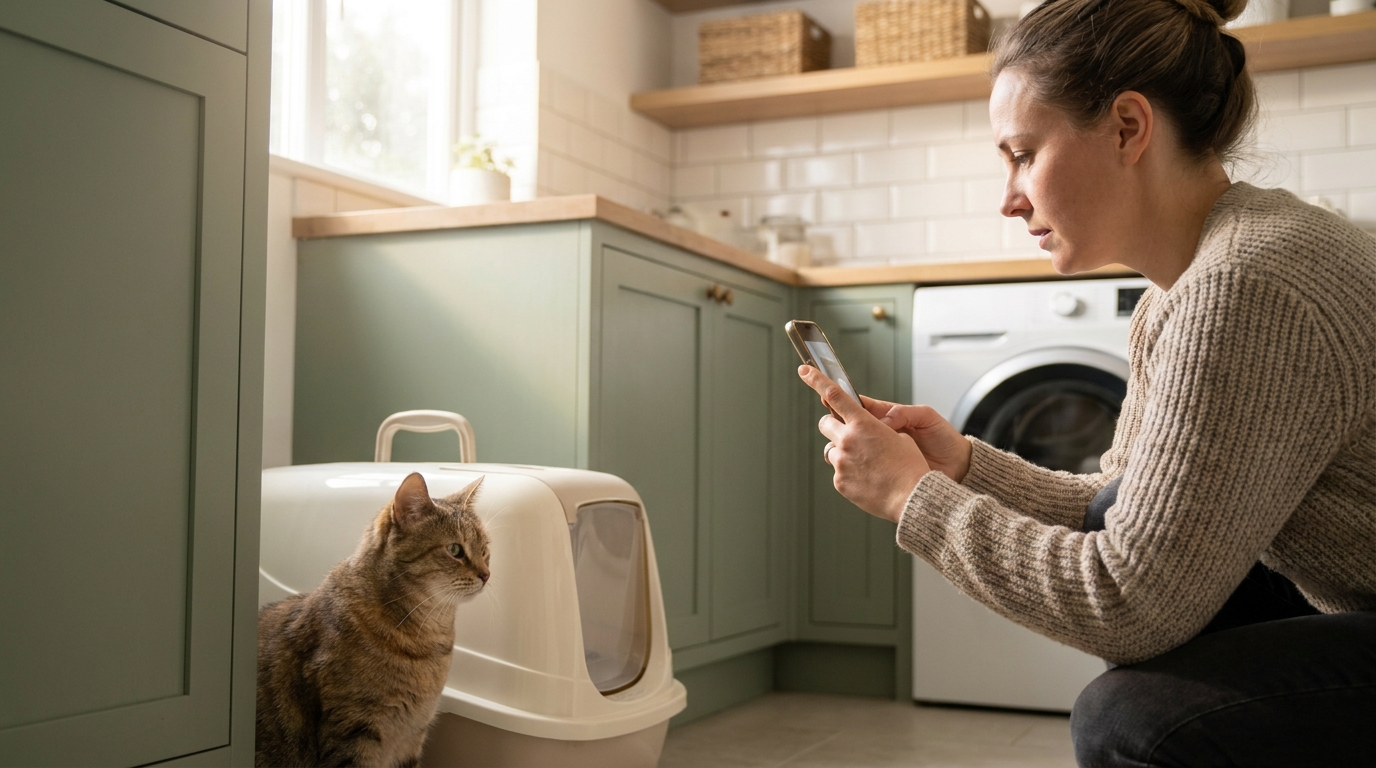
What red, maroon or black blood in your cat's poop can mean, which signs need the ER now, and what to have ready when you call a vet.
Quick answer: A streak of bright red blood on formed stool, in an adult cat eating, peeing and acting normal, often comes from the lower bowel: call a vet within a day. Blood in a kitten, or with one vomit or not eating, needs a same-day vet. Go to an ER now for black stool, clots, repeated vomiting, pale gums, weakness, possible rat poison, or a male cat with any litter-box change.
This article is general information, not a diagnosis. If you think your pet is in danger, go to the nearest emergency animal hospital.
Quick Triage: ER Now, Same Day or Within a Day
If more than one row fits your cat, follow the most urgent one. "Vet the same day" means an in-person clinic.
| What you see | Do this | Why |
|---|---|---|
| Stool that is mostly blood or clots; pale gums; weakness or collapse | ER now | Possible heavy bleeding or shock (Merck) |
| Red vomit, vomit like coffee grounds, or black stool | ER or vet now | Bleeding in the gut |
| Possible rat or mouse bait in the past few weeks, even if your cat seems fine | ER now; bring the package | Bleeding often shows 3 to 7 days later (Merck) |
| Male cat with any litter-box change (straining, little or no urine) | ER now | Cornell: "an absolute emergency" |
| Blood plus vomiting more than once | ER now | Possible bleeding higher up |
| String, thread, tinsel, ribbon or a hair tie hanging from the mouth or bottom, or possibly swallowed | ER now; don't pull it | Gut damage |
| An injury, or possible access to a human pain reliever | ER now | Injury or poisoning |
| Kitten not fully vaccinated, or a new shelter cat, with diarrhea plus vomiting, fever, lethargy or not eating | ER or vet now; keep it away from other cats | Feline distemper risk (Merck) |
| Any blood in a kitten's stool; blood plus one vomit, lethargy or not eating | Vet the same day | Cats hide illness (AAFP) |
| Blood in more than one stool | In-person vet the same day | Needs a rectal exam and fecal tests |
| One streak on a formed stool; adult cat eating, peeing and acting normal | Call a vet within a day | Keep a photo and a fresh sample |
Also go to an ER now for bleeding anywhere else (a nosebleed, bruising, bleeding gums or bloody urine), blood dripping from the rectum, fast or open-mouth breathing, a cold, limp cat, or trauma such as a fall or a bite near the tail.
For possible bait or a human pain reliever, call ASPCA Animal Poison Control at (888) 426-4435 (a consultation fee may apply) or Pet Poison Helpline at (855) 764-7661 (per-incident fee) on the way, not instead of going. Never make a cat vomit at home. Bring the bait package: not every rat poison causes bleeding, and the Merck Veterinary Manual says bromethalin, a nerve poison with no antidote, typically causes paralysis in cats.
See a vet in person the same day for tissue sticking out of the anus (don't try to push it back), blood or pus on the fur beside the anus, belly pain (hunched, crying when picked up), a swollen belly or fever. Go to the ER if your cat is also weak.
Litter Box Check: Is It Stool or Urine?
Pink or red clumps in the litter that aren't on a stool may be bloody urine. The Animal Medical Center (AMC) lists blood in the urine among blockage signs. A female cat with bloody urine but no blood in her stool needs a same-day vet. Go to an ER now if she strains, makes frequent trips or passes little or no urine (female cats can block too, AMC), or if there is blood in both her urine and stool.
Go to an ER now for a male cat with any litter-box change: straining, frequent trips, little or no urine, crying in the box or licking his genitals. The Cornell Feline Health Center calls urethral obstruction "an absolute emergency" and warns that a blocked cat may die in less than 24 to 48 hours. Straining to pee can look like constipation, so never give a laxative or hairball remedy.
Bright Red, Dark Red or Black: What the Color Can Tell You
Color is a clue, not a diagnosis. Merck links fresh red blood to the large intestine and black, tarry stool (melena) to bleeding in the stomach or small intestine.
| What it looks like | Where it often comes from | How fast to act |
|---|---|---|
| Bright red streak on a formed stool | Lower bowel or anus: hard stool, straining, colitis | Call a vet within a day; same day if it repeats |
| Red blood with mucus or jelly; small, frequent stools | Colitis (Merck); T. foetus parasite in young shelter cats | Vet the same day |
| Bloody diarrhea | Colitis; coccidia in kittens (Merck); T. foetus | Same day; ER if it keeps coming or your cat is weak |
| Drops of fresh blood at the end, or blood or pus beside the anus | A tear, polyps or an anal sac abscess (uncommon in cats, Merck) | Same day; ER after a bite or fall |
| Dark red or maroon, mixed through the stool | Color alone can't place it; treat it as more than a streak | Vet now; ER with weakness or pale gums |
| Black, tarry (melena) | Stomach or small intestine; less often hookworms in kittens (Cornell) | ER or vet now |
| Pink or red clumps in the litter, not on a stool | May be urine (AMC) | Male: ER now. Female: same-day vet; ER if she strains, passes little or no urine, or stool is bloody too |
Pepto-Bismol and Kaopectate can turn stool black, so tell the vet if you gave either one, and still treat black stool as urgent. Cats with stomach or intestinal ulcers rarely pass black stool (Merck), so normal-colored stool doesn't rule out bleeding higher up.
Blood in the Stool but Acting Normal
One streak of bright red blood in a cat that is still eating, peeing and playing usually points low in the bowel or at the anus. Common reasons:
- Colitis. Merck says cats with colitis strain and often pass small, mucus-laden stools, sometimes with bright red blood. In most cases the cause is unknown.
- A hard stool or straining. Merck links straining to inflammation of the rectum and anus.
- Parasites, mostly in kittens and young cats from shelters or catteries.
- A gut upset after a sudden food change or stress. Cornell says these can cause a brief bout of loose stool or diarrhea. Don't assume either one explains blood.
- Food sensitivity, which a vet sorts out with a diet trial.
Cats "may appear healthy even if they are sick or hurting," says the American Association of Feline Practitioners (AAFP). Call a vet within a day (the same day if you also see mucus, diarrhea or small, frequent stools), keep a photo and a fresh, refrigerated sample, and see a vet the same day if blood shows up again.
Common Causes by Age
| Life stage | Common causes | Extra caution |
|---|---|---|
| Kittens | Coccidia (occasionally bloody); T. foetus; less often hookworms (tarry stool) | Any blood: same-day vet. Shots unfinished plus vomiting, fever or lethargy: ER or vet now |
| Adults | Colitis (cause often unknown); hard stool; gut upset after a food change or stress | Male with any litter-box change: ER. Possible rat bait: ER |
| Seniors | Constipation, IBD, clotting problems, polyps (uncommon) or tumors such as lymphoma | Blood plus weight loss, vomiting or poor appetite: vet the same day |
Kittens. Coccidia mostly sicken kittens aged 4 to 12 weeks, and the diarrhea occasionally turns bloody (Merck). Hookworms, a less common cause, can leave dark, tarry stool (Cornell). Tritrichomonas foetus, a gut parasite of young shelter and cattery cats, causes frequent loose stools that might contain blood or mucus (Texas A&M GI Lab). Giardia and roundworms usually cause loose or mucoid stool, not blood (Companion Animal Parasite Council, CAPC). Panleukopenia (feline distemper) diarrhea usually isn't bloody (Merck), but a kitten that isn't fully vaccinated, with vomiting, fever or lethargy, needs an ER or a vet now. Some of these parasites can infect people, so wear gloves when you scoop.
Seniors. Merck says rectal polyps occur infrequently in cats and malignant rectal tumors are usually lymphoma. Blood plus weight loss needs a same-day in-person exam; see our guide to a cat losing weight while still eating. For a hyperthyroid cat on methimazole, black or bloody stool, bloody vomit, a nosebleed, bruising or pale gums mean an ER now. See our guide to hyperthyroidism in cats.
Blood With Mucus, Diarrhea, Vomiting or Constipation
- Mucus or jelly points toward the large bowel, as in colitis (Merck). See a vet the same day.
- Bloody diarrhea. See a vet the same day, or an ER if it keeps coming or your cat is weak.
- Vomiting. One vomit means a vet the same day. Red vomit, vomit like coffee grounds, or vomiting more than once means the ER. See our guide to a cat throwing up white foam.
- Not eating. Blood with a poor appetite means a vet the same day. Even without blood, call a vet once your cat has gone about 24 hours without food, and sooner for a kitten, senior, overweight or diabetic cat.
- Straining or constipation. Straining that produces nothing needs a vet the same day, or an ER now if you also find no urine clumps in the litter. In a male cat, treat any litter-box change as urinary and go to the ER.
Blood After Deworming, a Vaccine, Spay or Food Change
Don't assume blood after a new product or procedure is normal. Call the clinic that gave it, today.
- Dewormer, flea or heartworm product. The Drontal label says worms may be seen in the stool a day or so after treatment, and the Bravecto Plus label lists bloody stool among reactions seen in laboratory studies. Call the vet who prescribed or applied it, or your own vet.
- Vaccine, spay or other surgery. Call the clinic that did it.
- A vet-prescribed NSAID or steroid, or insulin. If your cat vomits, eats less or has diarrhea, call the prescribing vet before the next dose. Black stool means the ER or a vet now.
- Food change. Call a vet rather than switching again.
What Not to Do at Home
- No Pepto-Bismol or Kaopectate unless your vet tells you to. US Kaopectate was reformulated with bismuth subsalicylate (DVM360), and Merck warns that salicylate poisoning is possible, especially in cats.
- No Imodium (loperamide) unless your vet tells you to. Merck calls it controversial in cats.
- Never give a human pain reliever. Merck says cats are more sensitive than dogs to acetaminophen and ibuprofen.
- No fasting. Never hold back food on purpose, especially from a kitten.
- No pumpkin, fiber, probiotics or homemade bland diet unless your vet recommends it.
- No over-the-counter dewormer first. A vet chooses a dewormer after a fecal test.
- No laxative, enema or hairball remedy. Straining may be a urinary blockage, and some human enemas can poison cats.
For future food changes, switch gradually over about 7 to 10 days (an AAFP-hosted handout), and keep bait, medicines and string out of reach.
How to Collect a Stool Sample and Take Photos
- Ask the clinic first. Some tests, such as a direct smear for Giardia or Tritrichomonas, need a very fresh sample that has not been refrigerated (CAPC), so ask before you refrigerate it. Never delay a visit to get one.
- Bag the freshest stool you can, without litter, in a sealed bag or container.
- Refrigerate it as soon as possible, but don't freeze it (Purdue Animal Disease Diagnostic Laboratory).
- Photograph it in good light next to a coin for scale, plus any blood on the fur, litter or floor.
- Write down when the blood started, how many stools had it, appetite, vomiting, urine clumps, and any recent food change, dewormer, flea product, procedure or stress such as travel or a new pet.
What the Vet Will Check
Merck's workup for colitis starts with a fecal flotation, fecal smears for Giardia, a thorough rectal exam (which can find polyps or tumors) and tests for feline leukemia and immunodeficiency viruses (FeLV and FIV). The vet may add bloodwork and clotting tests, a PCR test for T. foetus, or x-rays or ultrasound. Stable cats often get a vet-directed diet trial before advanced tests, and therapeutic GI diets are sold under a veterinarian's direction.
When a Video Visit Helps, and Its Limits
RexVet is a 501(c)(3) nonprofit. If your cat is in Florida, New York or Virginia, you can book a $64.99 live video visit with Dr. Tiffany Delacruz, DVM when a slot is open (usually about 8 AM to 11 PM ET). It suits an adult cat that is still eating, peeing and acting normal but has a single streak of bright red blood on a formed stool. Have stool photos and your notes on food, deworming and stress ready. She will go over them and tell you whether your cat needs an in-person fecal test, rectal exam or bloodwork, and how soon. A video visit can't do a rectal exam or fecal tests, and it can't confirm the cause on its own.
It is not the right first step for black or tarry stool, stool that is mostly blood or clots, pale gums, a weak cat, red or repeated vomiting, a kitten with blood in its stool, possible rat or mouse bait, or a male cat with any litter-box change. Those go to an ER (call a poison line on the way for possible bait) or an in-person clinic the same day.
A prescription is never guaranteed. In Florida, a prescription from a video visit alone must be an FDA-approved animal drug used exactly as labeled, for 14 days at most (1 month for flea- and tick-only products), and it can't be renewed without an in-person exam. No drug is FDA-approved for cats with Giardia or coccidia, and metronidazole is not labeled for cats, so treatment for those causes needs a vet who has examined your cat in person. Federal rules require an in-person exam before any cat gets a drug off-label or a human drug, whatever the state. Virginia allows the exam itself by video, but a prescription still depends on Dr. Delacruz's judgment; New York's telehealth rules are still unsettled. RexVet is not a pharmacy, so if Dr. Delacruz does write a prescription, a pharmacy transfer fee applies when RexVet sends it to an outside pharmacy.
Need an Expert Opinion on This Topic?
Book a video visit with a licensed vet, evenings and weekends included
See open timesFrequently Asked Questions
Is blood in cat stool an emergency?
Sometimes. Black, tarry stool, clots, red or repeated vomiting, pale gums, weakness, possible rat bait or a male cat with any litter-box change means an ER now. Blood in a kitten's stool, or with one vomit or not eating, needs a vet the same day. One streak in an adult cat acting normal still needs a call to a vet within a day.
Why is my cat pooping blood but acting normal?
It usually points low in the bowel or at the anus: a hard stool, straining, colitis, parasites, or a gut upset after a food change or stress. Cats hide illness well (AAFP), so call a vet within a day, keep a photo and a fresh, refrigerated sample, and see a vet the same day if it happens again.
Can stress or changing cat food cause bloody stool?
Stress such as travel can cause a brief bout of loose stool, and an abrupt diet change can cause diarrhea for a few days (Cornell). Don't assume either one explains blood; call a vet instead. A vet should choose any diet after an exam.
Is blood in poop after deworming normal?
Don't assume it is. The Bravecto Plus label lists bloody stool among reactions seen in laboratory studies. Call the vet who prescribed or applied the product today; black stool, stool that is mostly blood, pale gums or weakness means an ER now.
Why is there blood in my kitten's poop?
Common reasons are coccidia (occasionally bloody, ages 4 to 12 weeks, Merck), Tritrichomonas in shelter or cattery kittens, and less often hookworms (dark, tarry stool, Cornell). Any blood needs a vet the same day, and a kitten that isn't fully vaccinated, with vomiting, fever or lethargy, needs an ER or a vet now. Never hold back food from a kitten.
Will blood in my cat's stool go away on its own?
A single streak may not come back, but you can't tell the cause from home. Call a vet within a day, see a vet the same day if it repeats, and go to an ER for any red flag. Don't give Pepto-Bismol, Kaopectate or Imodium unless your vet tells you to.
Can an online vet help with blood in my cat's stool in Florida, New York or Virginia?
For an adult cat that has a streak of blood but is eating, peeing and acting normal, yes, as a first step: the video-visit section above explains how to book a live visit with Dr. Tiffany Delacruz, DVM, and the prescription limits. A video visit can't do fecal tests or a rectal exam, and a prescription is never guaranteed. Red flags go to an ER.
FAQs
Is blood in cat stool an emergency?
Sometimes. Black, tarry stool, clots, red or repeated vomiting, pale gums, weakness, possible rat bait or a male cat with any litter-box change means an ER now. Blood in a kitten's stool, or with one vomit or not eating, needs a vet the same day. One streak in an adult cat acting normal still needs a call to a vet within a day.
Why is my cat pooping blood but acting normal?
It usually points low in the bowel or at the anus: a hard stool, straining, colitis, parasites, or a gut upset after a food change or stress. Cats hide illness well (AAFP), so call a vet within a day, keep a photo and a fresh, refrigerated sample, and see a vet the same day if it happens again.
Can stress or changing cat food cause bloody stool?
Stress such as travel can cause a brief bout of loose stool, and an abrupt diet change can cause diarrhea for a few days (Cornell). Don't assume either one explains blood; call a vet instead. A vet should choose any diet after an exam.
Is blood in poop after deworming normal?
Don't assume it is. The Bravecto Plus label lists bloody stool among reactions seen in laboratory studies. Call the vet who prescribed or applied the product today; black stool, stool that is mostly blood, pale gums or weakness means an ER now.
Why is there blood in my kitten's poop?
Common reasons are coccidia (occasionally bloody, ages 4 to 12 weeks, Merck), Tritrichomonas in shelter or cattery kittens, and less often hookworms (dark, tarry stool, Cornell). Any blood needs a vet the same day, and a kitten that isn't fully vaccinated, with vomiting, fever or lethargy, needs an ER or a vet now. Never hold back food from a kitten.
Will blood in my cat's stool go away on its own?
A single streak may not come back, but you can't tell the cause from home. Call a vet within a day, see a vet the same day if it repeats, and go to an ER for any red flag. Don't give Pepto-Bismol, Kaopectate or Imodium unless your vet tells you to.
Can an online vet help with blood in my cat's stool in Florida, New York or Virginia?
For an adult cat that has a streak of blood but is eating, peeing and acting normal, yes, as a first step: the video-visit section above explains how to book a live visit with Dr. Tiffany Delacruz, DVM, and the prescription limits. A video visit can't do fecal tests or a rectal exam, and a prescription is never guaranteed. Red flags go to an ER.
Medically Reviewed
Reviewed by Dr. Tiffany Delacruz, DVM — licensed veterinarian and CEO of RexVet. Last reviewed October 22, 2026.
Content is for informational purposes and does not replace professional veterinary advice.
Chief Executive Officer · Licensed Veterinarian
Dr. Delacruz is a licensed Doctor of Veterinary Medicine specializing in preventive care and veterinary telehealth. She reviews all health content on RexVet to ensure accuracy and clinical relevance.
Sources & References
- · American Veterinary Medical Association — Telehealth Guidelines
- · AVMA — Pet Care Resources
- · U.S. FDA — Animal & Veterinary