
Cat Throwing Up Undigested Food: Eating Too Fast or Sick?
By RexVet Team | Reviewed by Dr. Tiffany Delacruz, DVM
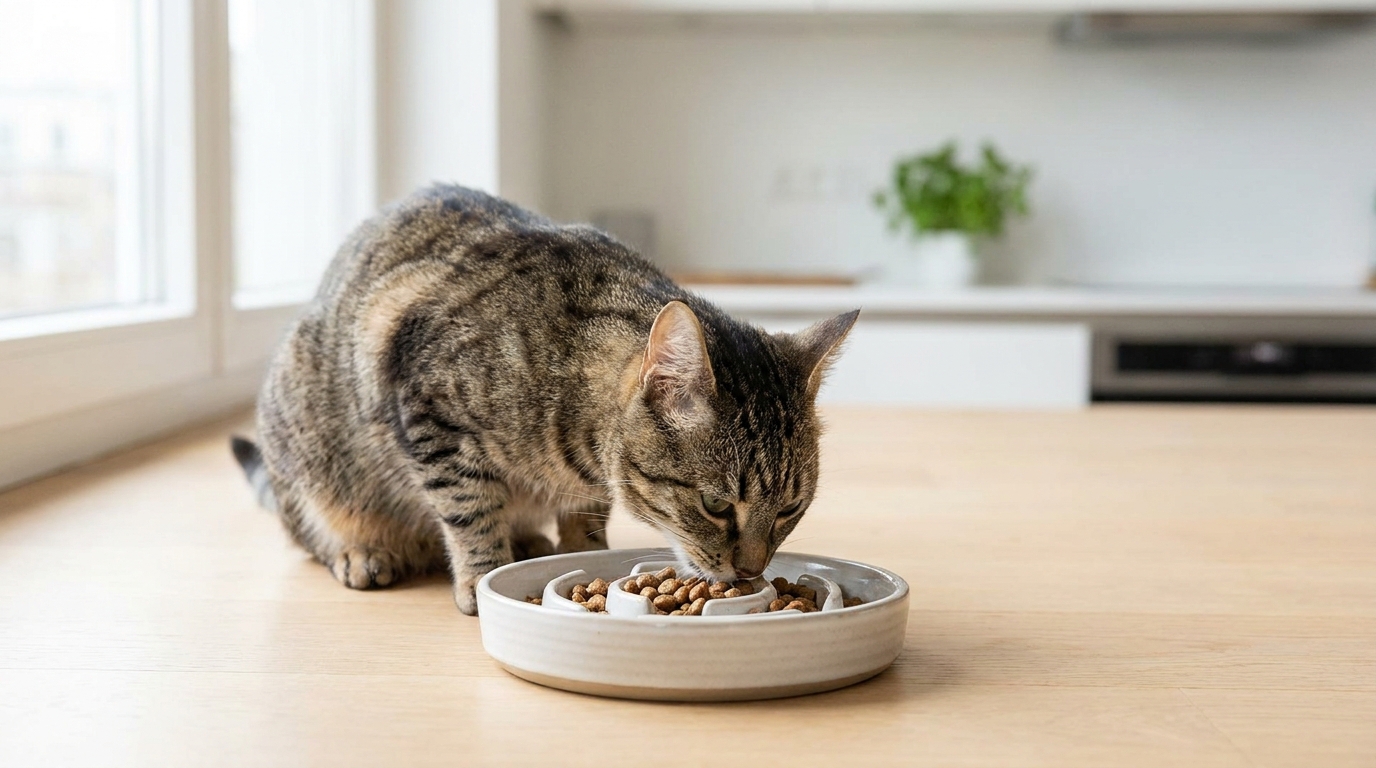
Food that comes back up soon after a meal can mean eating too fast or regurgitation. How to tell, what helps and when a cat needs a vet.
Quick answer: Undigested food soon after a meal may mean eating too fast or regurgitation; one episode in an adult cat that then acts normally often settles. See a vet in person the same day if it happens more than once in a day, keeps coming up without heaving, or your cat hides, has low energy or skips food for about 24 hours. Emergency vet now: a male cat with any litter-box change, hard breathing or weakness.
This article is general information, not a diagnosis. If you think your pet is in danger, go to the nearest emergency animal hospital.
Why is my cat throwing up undigested food?
Common reasons a cat throws up undigested food are eating too fast or too much, a sudden food change, a hairball and an irritated stomach or bowel; the Cornell Feline Health Center also lists swallowed objects such as string, toxins, parasites, constipation, inflammatory bowel disease and illnesses such as kidney disease, diabetes and an overactive thyroid.
In an older cat, suddenly gulping meals can be a symptom of an overactive thyroid: a senior cat that gulps food, begs and brings food up, especially while losing weight, needs bloodwork including a thyroid test.
In a male cat, check the litter box too: the Merck Veterinary Manual lists vomiting among the signs of a urinary blockage, a medical emergency, so a male with any litter-box change (straining, frequent trips, little or no urine) needs an emergency vet now, even if it looks like constipation.
When is throwing up food an emergency?
A cat that throws up food needs an emergency vet now if it is a male with any litter-box change; may have swallowed string, a lily, antifreeze or a medicine; vomits blood or material like coffee grounds; breathes fast, hard or with its mouth open; or is weak or collapsed.
| Sign | Where | When |
|---|---|---|
| Male cat, any litter-box change | ER | Now |
| Possible string, lily, antifreeze or medicine | ER; poison line on the way | Now |
| Red vomit, vomit like coffee grounds, or black stool | ER | Now |
| Fast, hard or open-mouth breathing, or blue gums | ER | Now |
| Drooling, gagging, trying to swallow again and again | ER | Now |
| Weak, collapsed, seizing or trembling, pale or yellow gums, or cold ears or paws | ER | Now |
| Diabetic, or drinking or peeing more, plus vomiting, refusing food or weak | ER | Now |
| On insulin, skipped a meal, not vomiting | Call the prescribing vet | Before the next dose; in person today; ER if wobbly or weak |
| More than once today, or water won't stay down | In person | Same day |
| Food comes up again without heaving, or a new cough | In person | Same day |
| Repeated dry retching | In person | Same day; ER if nonstop |
| No food for about 24 hours | In person | Same day; kitten, senior, overweight or diabetic: sooner |
| Any kitten vomiting | In person | Same day |
| Hiding, low energy, sore or swollen belly | In person | Same day; ER if weak |
| Hairballs, now constipated or not eating | In person | Same day |
| Started after a new medicine or surgery | Call the treating vet | Same day |
| Older cat losing weight and vomiting | In person | Within a day or two |
| More than once a week, cat well | Vet | Prompt check |
| Every week or two, cat well | Vet | Routine exam |
| Once, then acts normal | Home | Watch 24 h; call if it repeats |
"In person" means a clinic exam, not a video visit. If more than one row fits, follow the most urgent. Late at night, or when your clinic can't fit your cat in, a same-day row means an emergency hospital. The same tiers apply to white foam or yellow bile.
If a toxin is possible, even if your cat seems fine (with lilies, any part counts, including pollen licked off the fur and water from the vase), call ASPCA Animal Poison Control at (888) 426-4435 (a consultation fee may apply) or the Pet Poison Helpline at (855) 764-7661 (per-incident fee) on the way to the ER, not instead of going. Thread, yarn, ribbon and tinsel count as string. Never pull a string from your cat's mouth or bottom: the Merck Veterinary Manual explains that an anchored string can cut into the bowel. Never make a cat vomit; hydrogen peroxide is never safe for cats.
Right after eating vs hours later: what it means
Undigested food that comes up a few minutes after a meal without belly heaves is often spit-up from the food pipe or a meal eaten too fast, while food that comes up hours later after strong heaving is more likely true vomiting from the stomach, but timing is only a clue.
| When | Looks like | Likely |
|---|---|---|
| Soon after eating, no heaving | Whole food, may look tube-shaped or slimy | Food pipe (spit-up) or gulping |
| Soon after eating, with heaving | Whole kibble | Ate too fast or too much |
| Hours later, with heaving | Partly digested food | Vomiting from the stomach |
| Hours after meals, again and again | Food still undigested | Stomach slow or blocked |
| Long after the last meal | Foam or yellow bile | Vomiting on an empty stomach |
| Crouched, neck stretched out | Hacking; little comes up | Cough or asthma |
| Not tied to meals | Hair packed in a tube | Hairball |
Neither timing nor shape is proof: food from the food pipe can come back hours after a meal, a hairball can look tube-shaped too, and repeated episodes need a vet whatever the timing.
Undigested food that keeps coming up hours after meals, especially with a drop in appetite, can mean the stomach is slow to empty or partly blocked: see a vet in person the same day. The dog version of this guide uses dog timing that doesn't apply to cats.
Is it regurgitation or vomiting?
Regurgitation is a passive backflow of swallowed food from a cat's food pipe (esophagus) without belly heaves, while vomiting comes with warning signs such as nausea, drooling or shivering and repeated belly contractions, as the Merck Veterinary Manual describes.
You may not see those signs, so the difference is a clue, not proof. Merck adds that regurgitation may point to a problem in the throat or food pipe, such as inflammation, narrowing or something stuck.
- Once, cat otherwise well: book a non-urgent vet check.
- Again: see a vet in person the same day for an exam with chest X-rays; the Merck Veterinary Manual lists pneumonia from inhaled food as a complication.
- Fast, hard or open-mouthed breathing afterward: emergency vet now. A new cough without hard breathing needs an in-person vet the same day.
- Drooling, gagging and trying to swallow again and again: emergency vet now; something may be stuck. The Merck Veterinary Manual says bones are the most common objects lodged in a cat's esophagus.
- Started after anesthesia, surgery or a course of tablets: in-person vet the same day. Call the treating vet, and don't stop or change any medicine yourself.
Film an episode to show a vet if it's safe, but never delay an emergency trip to film.
My cat eats too fast and throws up: what helps?
For a cat that eats too fast and throws up, try several small meals a day, an easy puzzle feeder and a separate feeding spot for each cat; the American Association of Feline Practitioners and the International Society of Feline Medicine recommend all three in their feeding guidance.
- Split the daily amount into several small meals.
- Start with a simple puzzle feeder, and keep the usual bowl available until your cat uses the feeder.
- Spread dry food thinly on a flat tray or plate (a simple home trick, not part of that guidance).
- Feed each cat out of sight of the others. The same guidance notes that a cat trying to avoid a stressful encounter may gorge and then vomit.
- Change foods gradually. The American Animal Hospital Association warns that a sudden food switch can upset a cat's stomach.
Make sure your cat still eats its full amount: the Merck Veterinary Manual calls fatty liver (hepatic lipidosis) the most common acquired liver disease in cats and a potentially fatal one, and it starts when a cat stops eating. If food still comes up after you slow meals down, book a vet check.
Could it be hairballs or something else?
Hair packed into what a cat brings up suggests a hairball, but frequent hairballs deserve a vet check: a review in the Journal of Feline Medicine and Surgery (Cannon, 2013) says that in most shorthaired cats, frequent hairballs point to an underlying chronic disease.
The Cornell Feline Health Center says it is not uncommon for a cat to bring up a hairball every week or two; that is worth raising at a routine exam, and Cornell recommends a prompt vet check if a cat vomits more than once a week. Hacking with the neck stretched out may be asthma, Cornell notes: a new cough needs an in-person vet the same day, and fast, hard or open-mouthed breathing means the ER now.
An overactive thyroid, which the Cornell Feline Health Center says mostly affects middle-aged and older cats, causes weight loss with a bigger appetite and can also cause vomiting; inflammatory bowel disease and kidney disease are other causes.
- Older cat losing weight and vomiting: in-person exam with bloodwork, including a thyroid test, within a day or two. See overactive thyroid signs in cats.
- Also drinking or peeing more, refusing food, weak or much quieter: emergency vet now. See why an older cat drinks a lot of water and early signs of diabetes in cats.
What should I do after my cat throws up food?
After a cat throws up food, don't hold food back on purpose: keep fresh water available and, once the cat has stopped retching and seems settled, offer a small portion of its usual food, then keep to small, frequent meals if it stays down.
If that small meal comes back up, count it as a second episode and see a vet in person the same day. The Cornell Feline Health Center warns that not eating can seriously harm an adult cat in as little as 24 hours; about 24 hours without food means an in-person vet the same day, sooner for a kitten, senior, overweight or diabetic cat.
A diabetic cat that vomits needs an emergency vet now. If a cat on insulin skips a meal, follow your vet's missed-meal plan, or call the prescribing vet or an ER before the next injection, and never give extra.
Don't give human medicines, laxatives or hairball remedies without a vet's approval. Check the litter box, take a photo of what came up, and note when it happened and whether your cat heaved.
When a video visit helps
A live video visit fits a cat that brings up food now and then but is still eating, drinking, peeing and acting normally, or an owner who has filmed an episode and wants to know whether it was regurgitation, eating too fast or vomiting.
RexVet, a nonprofit online vet service, serves pets located in Florida, New York and Virginia by video visit. A $64.99 live video visit connects you with a licensed RexVet vet, a veterinarian licensed in your pet's state, when a slot is open (usually about 8 AM to 11 PM ET); a same-day slot is not guaranteed. Book a live video visit.
During the live visit, show the veterinarian your phone video of an episode. They can review your cat's diet, feeding setup and how often it happens, help you set up a slow-feeding plan, and tell you whether your cat needs an in-person exam, bloodwork or X-rays, and how soon.
From RexVet's visit study: Of the main concern groups, visits for vomiting, diarrhea or digestive problems were among the most likely to end with a prescription (21%), while only 5% of skin and itching visits did. Whether any medicine fits is the veterinarian's decision, and a visit may end with advice and a care plan instead of a prescription. No prescription is promised. Anti-nausea medicine can't be promised on a video visit: the tablets vets commonly use for cats are off-label, which federal rules allow only after an in-person exam. Florida law limits prescriptions based only on telehealth to FDA-approved animal drugs used as labeled, for up to 14 days (1 month for products labeled only for fleas and ticks), with no renewal without an in-person exam and no human-labeled, controlled or compounded anti-infective drugs. Virginia allows the exam to be done electronically, though federal off-label rules still apply there. New York's rules for video-only prescribing are unsettled, and the veterinarian will tell you what applies. If the veterinarian prescribes something and it is sent to an outside pharmacy, a pharmacy transfer fee applies; RexVet is not a pharmacy.
A video visit can't feel the belly or bladder, look under the tongue, run bloodwork or take X-rays, so it can't rule out a blockage, a food-pipe problem, thyroid disease or kidney disease.
A video visit is not the right first step for a male cat with any litter-box change; possible string, a lily, antifreeze or a medicine; blood in the vomit or black stool; fast, hard or open-mouthed breathing; or weakness or collapse: go to an emergency vet now. Vomiting more than once in a day, repeated regurgitation, repeated dry retching, about 24 hours without food, hiding or low energy, or a vomiting kitten needs a vet in person the same day, or an emergency hospital if your clinic is closed or full.
Need an Expert Opinion on This Topic?
Book a video visit with a licensed vet, evenings and weekends included
See open timesFrequently Asked Questions
Should I feed my cat again after it throws up undigested food?
Yes, in small amounts; don't hold food back on purpose. Once your cat has stopped retching and seems settled, offer a small portion of its usual food, with fresh water available. If that meal comes back up, see a vet in person the same day, as you should after about 24 hours without food (sooner for a kitten, senior, overweight or diabetic cat). A diabetic cat that vomits needs an emergency vet now; never give extra insulin.
My cat threw up its food but is acting normal. Should I worry?
Not usually, if it happened once in an adult cat that is eating, drinking, peeing and acting like itself: watch closely for 24 hours. Call a vet if it happens again; more than once in a day means an in-person vet the same day. Food that came up without heaving deserves a non-urgent vet check. A vomiting kitten needs a vet in person the same day, and a male cat with any litter-box change needs an emergency vet now.
Why does my cat throw up right after eating dry food?
Eating too fast or too much is a common reason, but food that comes back up without heaving can also mean a food-pipe problem. Smaller meals and an easy puzzle feeder help a cat that gulps. If food comes up again without heaving, see a vet in person the same day. An older cat that suddenly gulps meals and is losing weight needs bloodwork, including a thyroid test.
Is it normal for a cat to throw up more than once a week?
No, even if it acts normal. The Cornell Feline Health Center recommends a prompt vet check for a cat that vomits more than once a week, and says a cat that often brings up what it just ate needs a vet visit. Vomiting with lethargy, blood, a poorer appetite, more thirst, a change in peeing or diarrhea needs a vet sooner. Vomiting or hairballs every week or two are worth raising at a routine exam.
Can switching cat food make my cat throw up?
Yes. The American Animal Hospital Association warns that a sudden food switch can upset a cat's stomach, so change foods gradually, and don't start a new food right after your cat has vomited. The Merck Veterinary Manual lists a disliked new food among the triggers for fatty liver, so see a vet in person the same day if your cat goes about 24 hours without eating.
Can an online vet help with my cat throwing up food in Florida, New York or Virginia?
Yes, if your cat is located in Florida, New York or Virginia and is stable: still eating, drinking, peeing normally and acting like itself. On a live video visit, a licensed RexVet vet can watch your video of an episode, review feeding and tell you whether your cat needs an in-person exam, bloodwork or X-rays. A video visit can't feel the belly, run bloodwork or take X-rays, so it can't rule out a blockage, and a male cat with any litter-box change, fast or hard breathing, or weakness needs an emergency vet now, not a video visit. Repeated regurgitation, vomiting more than once in a day, about 24 hours without food or a vomiting kitten need a clinic the same day. No prescription is promised: the anti-nausea tablets vets commonly use for cats are off-label, which federal rules allow only after an in-person exam. Florida limits telehealth-only prescriptions to FDA-approved animal drugs used on-label for up to 14 days (1 month for products labeled only for fleas and ticks), with no renewal without an in-person exam; Virginia allows an electronic exam, though federal off-label rules still apply; New York's rules are unsettled.
FAQs
Should I feed my cat again after it throws up undigested food?
Yes, in small amounts; don't hold food back on purpose. Once your cat has stopped retching and seems settled, offer a small portion of its usual food, with fresh water available. If that meal comes back up, see a vet in person the same day, as you should after about 24 hours without food (sooner for a kitten, senior, overweight or diabetic cat). A diabetic cat that vomits needs an emergency vet now; never give extra insulin.
My cat threw up its food but is acting normal. Should I worry?
Not usually, if it happened once in an adult cat that is eating, drinking, peeing and acting like itself: watch closely for 24 hours. Call a vet if it happens again; more than once in a day means an in-person vet the same day. Food that came up without heaving deserves a non-urgent vet check. A vomiting kitten needs a vet in person the same day, and a male cat with any litter-box change needs an emergency vet now.
Why does my cat throw up right after eating dry food?
Eating too fast or too much is a common reason, but food that comes back up without heaving can also mean a food-pipe problem. Smaller meals and an easy puzzle feeder help a cat that gulps. If food comes up again without heaving, see a vet in person the same day. An older cat that suddenly gulps meals and is losing weight needs bloodwork, including a thyroid test.
Is it normal for a cat to throw up more than once a week?
No, even if it acts normal. The Cornell Feline Health Center recommends a prompt vet check for a cat that vomits more than once a week, and says a cat that often brings up what it just ate needs a vet visit. Vomiting with lethargy, blood, a poorer appetite, more thirst, a change in peeing or diarrhea needs a vet sooner. Vomiting or hairballs every week or two are worth raising at a routine exam.
Can switching cat food make my cat throw up?
Yes. The American Animal Hospital Association warns that a sudden food switch can upset a cat's stomach, so change foods gradually, and don't start a new food right after your cat has vomited. The Merck Veterinary Manual lists a disliked new food among the triggers for fatty liver, so see a vet in person the same day if your cat goes about 24 hours without eating.
Can an online vet help with my cat throwing up food in Florida, New York or Virginia?
Yes, if your cat is located in Florida, New York or Virginia and is stable: still eating, drinking, peeing normally and acting like itself. On a live video visit, a licensed RexVet vet can watch your video of an episode, review feeding and tell you whether your cat needs an in-person exam, bloodwork or X-rays. A video visit can't feel the belly, run bloodwork or take X-rays, so it can't rule out a blockage, and a male cat with any litter-box change, fast or hard breathing, or weakness needs an emergency vet now, not a video visit. Repeated regurgitation, vomiting more than once in a day, about 24 hours without food or a vomiting kitten need a clinic the same day. No prescription is promised: the anti-nausea tablets vets commonly use for cats are off-label, which federal rules allow only after an in-person exam. Florida limits telehealth-only prescriptions to FDA-approved animal drugs used on-label for up to 14 days (1 month for products labeled only for fleas and ticks), with no renewal without an in-person exam; Virginia allows an electronic exam, though federal off-label rules still apply; New York's rules are unsettled.
Medically Reviewed
Reviewed by Dr. Tiffany Delacruz, DVM — licensed veterinarian and CEO of RexVet. Last reviewed November 5, 2026.
Content is for informational purposes and does not replace professional veterinary advice.
Chief Executive Officer · Licensed Veterinarian
Dr. Delacruz is a licensed Doctor of Veterinary Medicine specializing in preventive care and veterinary telehealth. She reviews all health content on RexVet to ensure accuracy and clinical relevance.
Sources & References
- · American Veterinary Medical Association — Telehealth Guidelines
- · AVMA — Pet Care Resources
- · U.S. FDA — Animal & Veterinary