
Cat Sleeping in Litter Box? When It Means an Emergency
By RexVet Team | Reviewed by Dr. Tiffany Delacruz, DVM
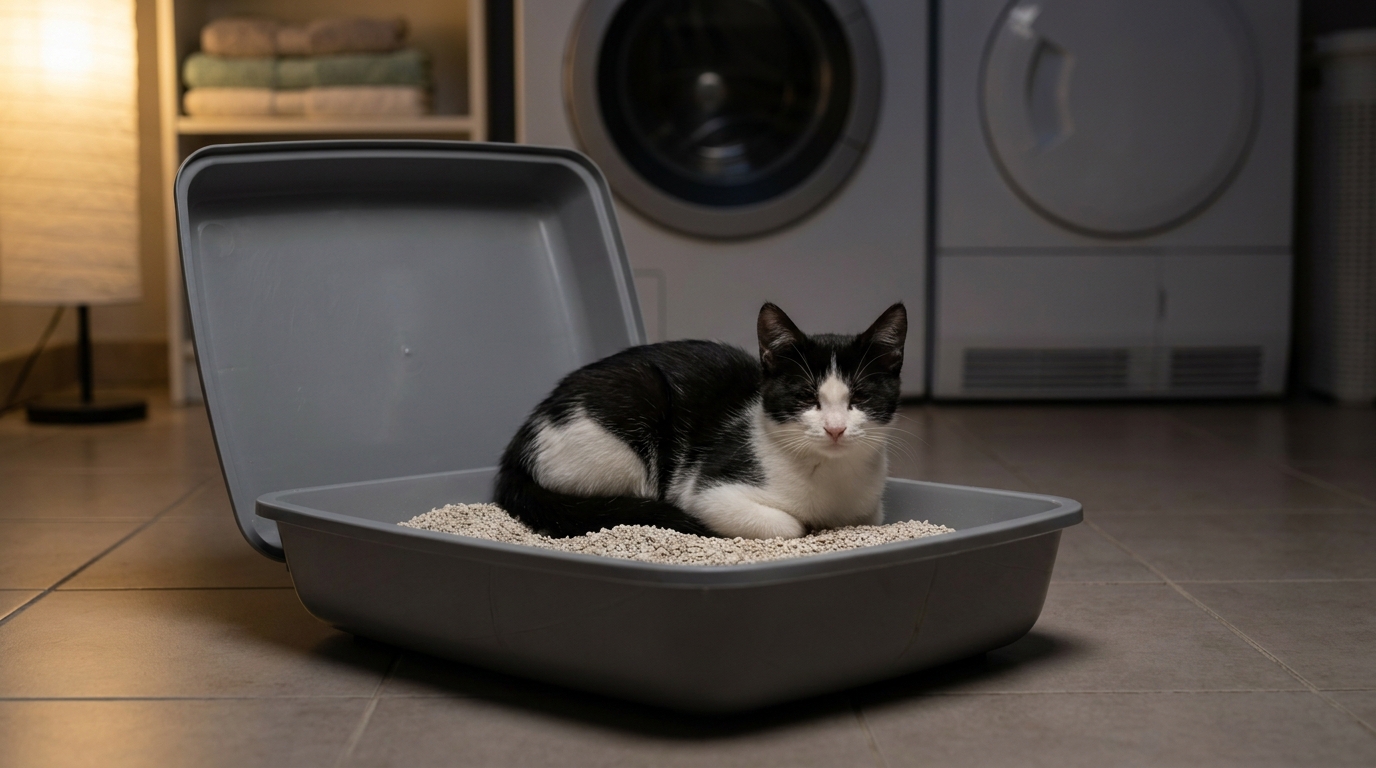
Cat sleeping in litter box can mean a urinary problem, pain or stress; a male cat straining with little or no urine needs an emergency vet now.
Go to an emergency vet now if your cat, especially a male, is straining, crying in the box, licking the genitals, or passing little or no urine, or if you find no fresh urine clumps in the box; a urinary blockage can be fatal without fast treatment.
Finding your cat curled up in the litter box, maybe for the second time tonight, is unsettling. It is worth checking out, and a vet will want to rule out urinary problems, pain and stress. There is no single explanation for it, so this guide walks you through the checks that matter, starting with the one that cannot wait.
Cat Sleeping in Litter Box: The Urinary Question Comes First
A cat lying in the litter box may be a cat that is trying to pee and cannot. That is the possibility to rule out before anything else, because it is the one that can turn dangerous fast.
The Cornell Feline Health Center lists these signs of lower urinary tract disease:
- Difficult or painful urination
- Increased frequency of urination
- Crying out while urinating
- Blood in the urine
- Inappropriate urination (that is, outside of the litter box)
- Frequent licking of the genital region
Cornell adds that cats with urethral obstruction "will pass little or no urine and will become increasingly distressed." In its own words, "A urethral obstruction is an absolute emergency, requiring immediate veterinary treatment." Cornell also notes that "Male cats may be at an increased risk."
The University of Florida Small Animal Hospital explains why speed matters: particularly in male cats, "the inability to urinate leads to a rapid build-up of toxic substances."
A quiet cat in the box is not proof that all is well, so do the next check before you read any further. It takes less effort than reading this page.
The Quick Emergency Check: Are There Fresh Urine Clumps?
Look in the box now. With clumping litter, fresh urine forms clumps you can see and scoop.
The University of Florida Small Animal Hospital puts it plainly: "No urine in the litter box or just drops of discolored urine may be an indicator that your cat has a urinary obstruction." UF adds that blocked pets "will often be seen straining to urinate but producing no urine or producing only a few drops."
If there are no fresh urine clumps, or only drops, go to an emergency vet now, especially with a male cat. Do not wait to see if it passes, and do not wait for other signs to show up first. As UF says, "This is a true veterinary emergency, particularly in male cats."
The same page is clear about both the stakes and the hope: "Left untreated, this condition will be fatal, but with appropriate and rapid treatment the vast majority of pets can be saved."
One caveat: this check only works if you use clumping litter and you know when the box was last scooped. If you cannot tell whether your cat has peed recently, and especially if he is male, treat it as no urine and go to an emergency vet now. A quiet cat is no exception. Scooping the box and checking again later only makes sense for a cat that is clearly comfortable and that you saw peeing recently.
For more detail, read our guide on a male cat straining to pee and our cat urinary blockage and FLUTD guide. If you are weighing other symptoms too, our pet emergency checklist can help you decide quickly.
Other Medical Reasons a Vet Will Want to Rule Out
Once a blockage is off the table, a vet will look at other possibilities. These are rule-outs, not a diagnosis. Only an exam can sort them out.
Urinary problems that are not a blockage
Urinary problems are still among the first things a vet will want to rule out, even when urine is coming out. Lower urinary tract disease covers several conditions, and Cornell notes that "Feline idiopathic cystitis (FIC) is the most common diagnosis" in cats with lower urinary tract signs, so the cause is not always an infection.
Constipation or diarrhea
Digestive trouble is another thing a vet will want to rule out. If your cat has not passed stool for a while, our guide to a cat that hasn't pooped covers what to watch for.
If you cannot tell whether your cat is straining to pass stool or to pee, go back to the clump check above before anything else.
Joint pain
Pain can make the box harder to use. Cornell's page on older cats, "Is Your Cat Slowing Down?", notes that "The cat may have trouble hopping in and out of its litter box." Stiffness or reluctance to climb is worth mentioning to your vet.
Feeling unwell and hiding
Some cats that feel sick tuck themselves away. A vet will want to know about any hiding, poor appetite or vomiting that comes along with time spent in the box.
Sorting out how urgent it is
- Emergency vet now: crying while urinating, straining, or trips to the box with nothing coming out.
- See a vet soon: a change in appetite, hiding or stiffness while your cat is still passing normal urine clumps.
Stress, New Cats and Feeling Safe
Stress can play a real part in bladder trouble. According to Cornell, "stressful environmental factors, including living in a multi-cat household and changes in routine, such as a move to a new home, may also increase the risk" of lower urinary tract signs. Cornell also says, "Stress seems to be an important factor in the development of FIC."
A newly adopted cat may treat the box as a safe spot at first. That can settle as your cat learns the house.
Even when a move, a new pet or a change in routine seems to explain everything, do the clump check above first. Stress and a urinary problem can show up together.
For the longer term, Cornell notes that "Environmental enrichment and modification can reduce stress." Your vet can help you work out which changes suit your cat and your home. If your cat is also hiding around the house, our article on why cats hide explains what to look for.
What to Do Tonight
If the box has no fresh urine clumps, you cannot tell whether your cat has peed, or your cat is straining, crying or going back again and again with nothing coming out, stop here and go to an emergency vet now, especially with a male cat.
If your cat is clearly comfortable and you have seen normal urine clumps or seen them pee recently, these steps help overnight:
- Scoop the box now so you can tell whether new clumps appear.
- Note each box visit and whether urine comes out. If a visit ends with no urine, go to the emergency vet instead of logging.
- Offer a covered bed or hiding spot near, but not in, the box.
- Keep fresh water available.
- Check that you have enough boxes. The ASPCA advises: "Be sure to have a litter box for each of your cats, as well as one extra."
- Do not scold your cat or pull them out roughly. Keep the room calm and quiet.
A simple log of box visits and what you find, with times, gives any vet you see next a clearer picture than memory alone.
Senior Cats and the Box
An old cat sleeping in the litter box may be having trouble getting in and out, the joint problem Cornell describes in the section above. Ask your vet whether a box with a lower side, placed on the floor your cat spends time on, would help.
Older cats still get urinary problems, so the clump check applies to them too. New mobility trouble in a senior is a reason for an in-person exam rather than something to live with. Our senior cat care guide covers comfort changes at home.
What a RexVet Online Vet Can and Cannot Do for a Cat Sleeping in the Litter Box
If your cat is straining or passing no urine, skip the video visit and go to an emergency vet.
For a cat that is still peeing normally, a video visit can help you decide what comes next. On camera, a veterinarian can watch your cat in and around the box, look at the clumps with you, check for urinary warning signs and send a blocked-looking cat straight to an emergency clinic. They can also build a plan with you for stress, box setup and mobility causes. RexVet is a 501(c)(3) non-profit veterinary telehealth service, and our online vet for cats page explains how visits work.
A video vet cannot feel your cat's bladder, test urine, take X-rays or relieve a blockage. Those need an in-person clinic.
If the veterinarian decides medication is appropriate, they can prescribe where state rules allow. Florida limits telehealth-only prescribing to a 14-day supply with no renewal without an in-person exam, and no controlled substances are prescribed by video.
If your cat is not straining and is still passing urine, you can book a RexVet video visit for $64.99. Vets are available 24/7, including nights, weekends and holidays. RexVet's veterinarians are licensed in Florida, New York and Virginia, so visits are for pet parents located in those states.
When to See a Vet in Person in Florida, New York or Virginia
The emergency signs are covered in the clump check above. Beyond those, book an in-person exam soon if you notice:
- Any of the urinary signs in Cornell's list, even if urine is coming out
- Blood in the urine
- Repeated trips to the box (with nothing coming out, that is an emergency)
- Not eating
- Hiding along with vomiting
- A senior cat with new trouble getting in and out of the box
Cornell notes that a veterinarian will likely perform "a physical examination and a urinalysis," and sometimes further tests, which need an in-person visit.
In Florida, a telehealth vet must give you "the contact information for at least one physical veterinary clinic in the vicinity of the patient's location," under the Florida Statutes. You can read more about visits in each state on our Florida, New York and Virginia pages.
Frequently Asked Questions
Why is my cat lying in the litter box?
First check for fresh urine clumps; if there are none or your cat is straining, go to an emergency vet now. If urine is coming out normally, a vet will want to rule out urinary problems, pain, digestive trouble and stress. There is no single cause, so an exam is the way to find out.
Is a cat sleeping in the litter box a sign of a UTI?
It can be a urinary problem, and that is one of the first things a vet will want to rule out. As the urinary section above explains, though, the cause is not always an infection. Telling the possibilities apart takes an in-person exam and a urine test, which a video visit cannot do.
Why is my new cat sleeping in the litter box?
Cornell names a move to a new home as a stress that may increase the risk of urinary signs, so a new cat spending time in the box is worth watching closely. If your new cat is straining, crying, or you find no fresh urine clumps, go to an emergency vet now. If they are eating, drinking and peeing normally, the box may simply be a quiet retreat while they settle in, and the tips in What to Do Tonight can help.
Should I worry if my old cat sleeps in the litter box?
It is worth a vet visit. Your cat may be having trouble getting in and out, the joint problem described above. Check for fresh urine clumps first, since seniors get urinary problems too, and treat no clumps as an emergency.
How can I tell if my cat is blocked?
Warning signs include straining with no urine or only drops, crying in the box, licking the genitals, repeated trips with nothing coming out, and no fresh clumps. You cannot confirm a blockage at home. If you see these signs, go to an in-person emergency clinic now; this is especially urgent in male cats. Do not book a video visit first.
If your cat is still passing urine normally but keeps settling in the box, a vet can help you find out why. You can book a video visit now for $64.99, 24/7. RexVet's veterinarians are licensed in Florida, New York and Virginia.
FAQs
Why is my cat lying in the litter box?
First check for fresh urine clumps; if there are none or your cat is straining, go to an emergency vet now. If urine is coming out normally, a vet will want to rule out urinary problems, pain, digestive trouble and stress. There is no single cause, so an exam is the way to find out.
Is a cat sleeping in the litter box a sign of a UTI?
It can be a urinary problem, and that is one of the first things a vet will want to rule out. As the urinary section above explains, though, the cause is not always an infection. Telling the possibilities apart takes an in-person exam and a urine test, which a video visit cannot do.
Why is my new cat sleeping in the litter box?
Cornell names a move to a new home as a stress that may increase the risk of urinary signs, so a new cat spending time in the box is worth watching closely. If your new cat is straining, crying, or you find no fresh urine clumps, go to an emergency vet now. If they are eating, drinking and peeing normally, the box may simply be a quiet retreat while they settle in, and the tips in What to Do Tonight can help.
Should I worry if my old cat sleeps in the litter box?
It is worth a vet visit. Your cat may be having trouble getting in and out, the joint problem described above. Check for fresh urine clumps first, since seniors get urinary problems too, and treat no clumps as an emergency.
How can I tell if my cat is blocked?
Warning signs include straining with no urine or only drops, crying in the box, licking the genitals, repeated trips with nothing coming out, and no fresh clumps. You cannot confirm a blockage at home. If you see these signs, go to an in-person emergency clinic now; this is especially urgent in male cats. Do not book a video visit first.
If your cat is still passing urine normally but keeps settling in the box, a vet can help you find out why. You can book a video visit now for $64.99, 24/7. RexVet's veterinarians are licensed in Florida, New York and Virginia.
Medically Reviewed
Reviewed by Dr. Tiffany Delacruz, DVM — licensed veterinarian and CEO of RexVet. Last reviewed September 22, 2026.
Content is for informational purposes and does not replace professional veterinary advice.
Chief Executive Officer · Licensed Veterinarian
Dr. Delacruz is a licensed Doctor of Veterinary Medicine specializing in preventive care and veterinary telehealth. She reviews all health content on RexVet to ensure accuracy and clinical relevance.
Sources & References
- · American Veterinary Medical Association — Telehealth Guidelines
- · AVMA — Pet Care Resources
- · U.S. FDA — Animal & Veterinary
Need an Expert Opinion on This Topic?
Connect with a certified vet via video call in minutes
Talk to Vet Now