
Cat Pupils Different Sizes or Dilated? When to Worry
By RexVet Team | Reviewed by Dr. Tiffany Delacruz, DVM
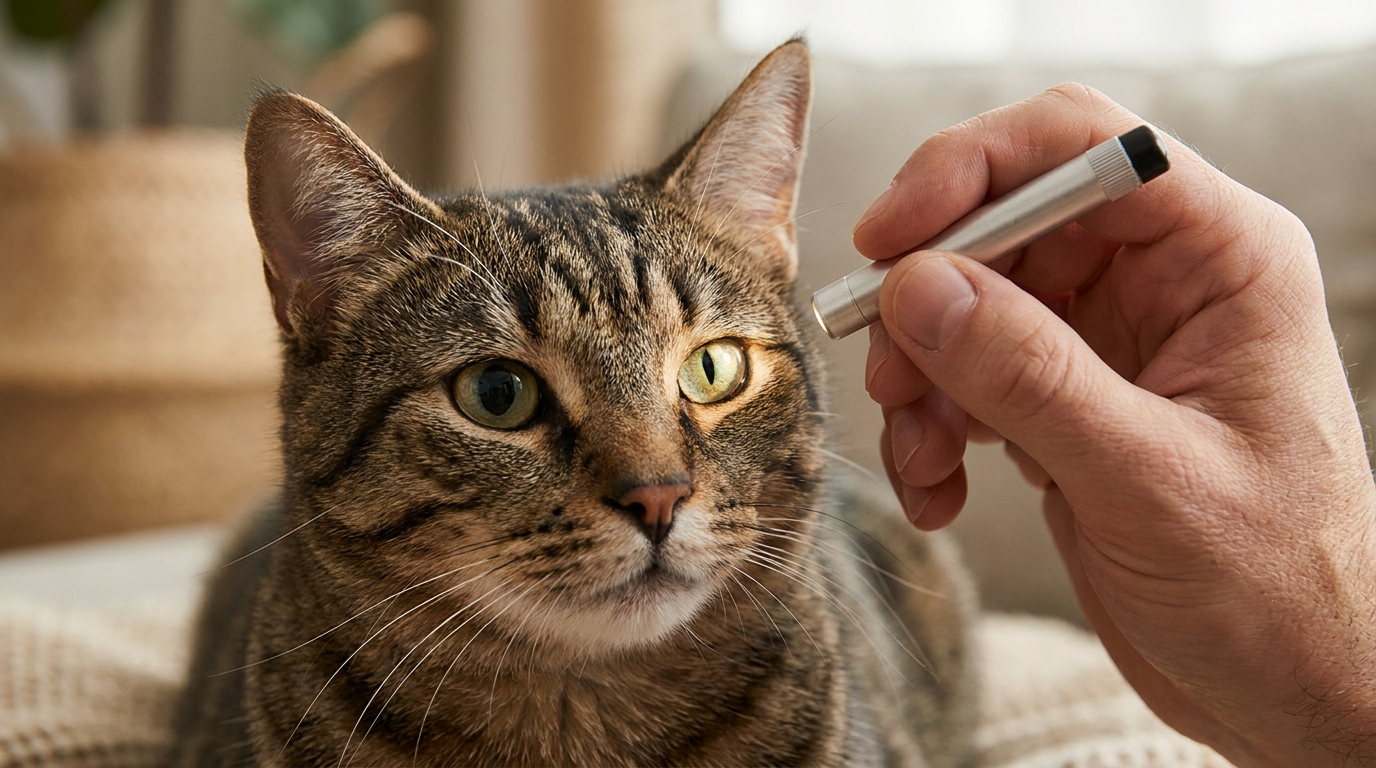
Uneven or wide pupils in a cat: which signs mean the ER now, which mean a vet today, the usual causes, and how to film the eyes for the vet.
Quick answer: A cat's two pupils should always match and shrink in bright light. Go to an emergency vet now if the pupils changed suddenly, one or both stay big in bright light, your cat bumps into things, an eye looks cloudy or bulging, the change follows a fall or fight or comes with wobbling, or a poison or medicine is possible. Newly noticed uneven pupils in a cat acting normal need an in-person vet today.
This article is general information, not a diagnosis. If you think your pet is in danger, go to the nearest emergency animal hospital.
When are a cat's pupils an emergency?
Go to an emergency vet now if your cat's pupils became uneven suddenly or stay wide in bright light, your cat bumps into furniture, misjudges jumps or can't find the food bowl or litter box, the change came after a fall, car accident or fight (even if your cat seems fine now), or it comes with a head tilt, wobbling, circling, flicking eyes, facial drooping, disorientation, a seizure, collapse, blood in the eye, or a cloudy, blue or bulging eye. Cornell veterinary ophthalmologists say sudden blindness should always be treated as an emergency.
Uneven or wide pupils: how soon to go
| What you see | How soon | Where |
|---|---|---|
| Pupils changed suddenly | Now | ER |
| Pupil stays wide in bright light | Now | ER |
| Bumps into things, misses jumps | Now | ER |
| Cloudy, blue or bulging eye | Now | ER |
| Blood in the eye | Now | ER |
| After a fall, fight or car | Now | ER |
| With head tilt, wobbling or seizure | Now | ER |
| Possible poison or medicine | Now | Poison line or ER |
| Red or squinting eye | Today | In-person vet |
| Droopy lid, small pupil | Today | In-person vet |
| Uneven, cat acting normal | Today | In-person vet |
| Vet-seen, unchanged difference | Routine | Vet recheck |
| Both wide in play, shrink in light | No rush | Normal |
If your regular vet can't see your cat today, go to an emergency vet. If more than one row fits, follow the most urgent one.
A diabetic cat on insulin that is wobbly, unusually sleepy, trembling or seizing may have low blood sugar, so go to an emergency vet now (see cat diabetes emergencies). A head tilt on its own is a same-day vet visit, but a head tilt with uneven pupils is an emergency. After a fall, fight or car accident, a cat with pupil changes needs an emergency vet even if it seems fine, because falls and blows can detach the retina.
What do normal cat pupils do?
Healthy cat pupils are the same size, narrow to slits in bright light, and widen in dim light or when a cat is excited by play or scared. The Merck Veterinary Manual explains that a cat's pupil enlarges in the dark and becomes smaller in bright light. CatWatch, the newsletter produced with the Cornell Feline Health Center, says stress turns both pupils into big round "saucers," and a wiggling toy can do the same. Pupils widened by fear or play shrink again once the cat calms down in a bright room; pupils that stay big in bright light, or that don't match, are not stress.
The American College of Veterinary Ophthalmologists (ACVO) says thinning of the iris muscle is a frequent aging change that widens the pupil, slows its response to light and can leave the pupils unequal; Merck adds that iris thinning leaves a ragged pupil edge. ACVO notes it must be told apart from glaucoma, Horner's syndrome and uveitis, so call it aging only after a vet has examined it, and only while it stays the same.
Why are my cat's pupils different sizes?
Unequal pupils in a cat, called anisocoria, come from a problem in one eye (uveitis, glaucoma, a scratched cornea, an injury, a tumor or scarring from old inflammation) or in the nerves that control the pupil (Horner's syndrome or brain and nerve disease), and only an in-person exam with a light and an eye pressure check can tell which. Cornell ophthalmologist Dr. Thomas Kern advises owners to check whether the two pupils look different, because such changes can reveal a problem before it becomes irreversible.
Common causes of uneven pupils in cats
| Cause | Clue | How soon |
|---|---|---|
| High blood pressure | Big pupils, acts blind, older cat | ER now |
| Glaucoma | Big pupil, cloudy or bulging eye | ER now |
| Injury | After a fall, fight or car | ER now |
| Poison or medicine | Wide pupils, tremors, twitching | Poison line or ER now |
| Uveitis or scratched cornea | Small pupil, red, squinting eye | Today |
| Horner's syndrome | Droopy lid, small pupil, third eyelid up | Today |
| Eye tumor or FeLV | Iris color change, D-shaped pupil | Today |
| Iris thinning (vet-found) | Ragged, slow pupil, unchanged | Routine |
Pupil size is a clue, not a diagnosis.
The Merck Veterinary Manual says uveitis is common in cats and can come from infections such as FIP, feline leukemia (FeLV), FIV and toxoplasmosis, often as their only sign. Merck also says FeLV-related lymphoma can change the pupils months before other signs, and that diffuse iris melanoma, the most common primary eye tumor in cats, shows as an iris that steadily darkens. A changing iris color or a D-shaped pupil needs an in-person exam the same day.
Why are my older cat's pupils always dilated?
In an older cat, pupils that stay wide in bright light, or bumping into things and missed jumps, can mean high blood pressure has damaged or detached the retinas, so go to an emergency vet now. Cornell veterinary ophthalmologists say hypertensive retinopathy, retina damage from high blood pressure, is the most common cause of sudden blindness they see in cats that otherwise seemed well, and it mostly affects older cats. High blood pressure usually damages both eyes, so both pupils often look large and slow to shrink in light, but one eye can be worse than the other.
The Cornell Feline Health Center says sight lost to high blood pressure can sometimes come back only if it is treated very quickly; in most cases the loss is permanent.
Cornell also says chronic kidney disease is the most common disease behind high blood pressure in cats, and an overactive thyroid is another cause. More thirst, weight loss or night yowling in an older cat deserves a vet check (see old cat drinking a lot of water and hyperthyroidism in cats), and any of these plus a pupil change needs a blood pressure check the same day, or an emergency vet now if the pupils changed suddenly, stay wide in bright light, or your cat seems not to see. RexVet's visit data show: "41% of RexVet video visits were for pets aged 7 or older."
A smaller pupil with a droopy eyelid: Horner's syndrome
In a cat, a small pupil on one side with a droopy upper eyelid, a raised third eyelid and a sunken-looking eye can be Horner's syndrome, a nerve problem that is not painful by itself but needs a same-day in-person exam to find the cause.
Common causes in cats are middle-ear disease and injuries such as being hit by a car; less often a growth in the chest or head; often no cause is found. The Merck Veterinary Manual explains that middle-ear inflammation can cause these signs, so mention any ear discharge or head shaking. CatWatch says Horner's syndrome usually resolves once its cause does, but the cause can be serious, and an owner can't confirm Horner's at home. Go to an emergency vet now if the signs follow a fall or injury, or come with a head tilt, wobbling or labored breathing.
Uneven pupils with squinting, redness or a cloudy eye
In a cat, a small pupil in a red, squinting eye can mean uveitis or a scratched cornea and needs an in-person vet as soon as possible today, while a large pupil in a cloudy, blue or bulging eye, or an eye that looks bigger than the other, can mean glaucoma, which needs an emergency vet now. The Merck Veterinary Manual says sudden uveitis shows as a small pupil, light sensitivity and squinting, and that the first signs of glaucoma are a dilated pupil that moves slowly or not at all, red eye whites, a swollen, discolored cornea and a firm eyeball. Merck says a cat with any sign of glaucoma should be seen immediately, and Cornell says glaucoma damage is not reversible.
Both problems are painful, but cats hide pain: Merck says glaucoma pain usually shows as behavior changes rather than squinting, so watch for hiding or eating less. A squinting eye with a pupil that doesn't match the other side means going straight in, as the guide to why a cat squints one eye explains. Never put any drops or ointments in the eye before a vet exam, including human or leftover ones, and never shine a bright light into a squinting, red or painful eye.
Could a poison or medicine cause dilated pupils?
Yes: cannabis, human antidepressants, some cold and allergy decongestants, dog flea and tick products put on a cat (or picked up by grooming or cuddling a freshly treated dog), and nightshade-family plants including tomato leaves and stems can widen a cat's pupils, so call a pet poison line or go to an emergency vet now if your cat may have been exposed.
The ASPCA lists marijuana and tomato plants (the green parts) as toxic to cats, with dilated pupils among the signs. Pet Poison Helpline warns that dog flea products on cats, human antidepressants and some decongestants can cause dilated pupils with tremors or seizures, and even a small amount can cause serious signs. If your cat is already trembling, twitching, drooling, agitated or seizing, go to an emergency vet now and have someone call a poison line on the way. Otherwise, call ASPCA Animal Poison Control at (888) 426-4435 (a consultation fee may apply) or Pet Poison Helpline at (855) 764-7661 (a per-incident fee applies), or go straight to an emergency vet.
What will the vet check?
A vet examining a cat's uneven or dilated pupils will check how each pupil reacts to light in a darkened room, test vision and reflexes, measure eye pressure and blood pressure, stain the eye, look at the retina and inside the ears, and may run blood tests for kidney disease, an overactive thyroid and infections such as FeLV and FIV. The Cornell Feline Health Center says blood pressure is measured with a cuff on a front leg or the tail. None of these tests can be done on a video call.
How to take a useful photo or video for the vet
Film both of your cat's eyes straight on in normal room light and again in a dim room, then have a second person briefly shine a separate light from the side for a second or two, so the vet can compare how each pupil shrinks; skip the light for a squinting, red or painful eye. If your cat has collapsed or shows any emergency sign from the first table, skip the filming and go to an emergency vet now.
- Keep the camera flash off, and find an older photo of your cat's face to show whether the difference is new.
- Film your cat walking across the room to show balance, but never make a wobbly cat jump.
- For a hand-wave check, wave toward each eye from a short distance without touching the whiskers or lashes or making a breeze. If your cat doesn't blink and the pupils are wide, treat it as sudden blindness and go to an emergency vet now.
A pupil that shrinks in light does not mean the eye is fine or that your cat can see. These notes help the vet but are not a diagnosis.
When does a video visit help?
A video visit can help decide how soon a cat with uneven pupils needs an in-person eye exam when the cat is eating, moving normally, seeing well and not squinting, but it does not replace that exam. RexVet, a nonprofit online vet service, serves pets located in Florida, New York and Virginia by video visit. A $64.99 live video visit is with a veterinarian licensed in your pet's state. Slots run about 8 AM to 11 PM ET, and a same-day slot is not guaranteed: if you can't get a video slot today, see a vet in person today, and never wait for a video visit when an emergency sign is present.
RexVet's visit data show: "Eye problems were the top specific concern in RexVet cat visits (17%), ahead of urinary health and breathing problems."
Not a fit (go to an emergency vet now): pupils that changed suddenly, a pupil that stays wide in bright light, bumping into things, a cloudy, blue or bulging eye, blood in the eye, a head tilt, wobbling, facial drooping or a seizure along with the pupil change, a recent fall, fight, car accident or blow to the head, or a cat that is lethargic or not eating. A red, squinting or painful eye is not a video fit either: it needs an in-person vet as soon as possible today. For a possible poison or medicine, call a pet poison line or go to an ER.
A video visit fits a comfortable cat with, for example, a smaller pupil and a droopy lid, a pupil difference a vet has seen before that may have changed, or both pupils wide but the same size and still shrinking in bright light when you're unsure that's normal. On camera, a licensed RexVet vet may be able to compare both pupils in dim and bright light, watch your cat move, review your photos, and tell you whether to go to an emergency vet now or to an in-person exam later today. The veterinarian cannot measure eye pressure or blood pressure, stain the eye, look at the retina or run blood tests, so uneven pupils still need an in-person eye exam.
No prescription is promised; any medicine is the veterinarian's decision after the visit, within state and federal rules. Glaucoma, uveitis and high blood pressure need in-clinic tests before treatment starts. RexVet is not a pharmacy, and a pharmacy transfer fee applies when RexVet sends a prescription to an outside pharmacy.
Need an Expert Opinion on This Topic?
Book a video visit with a licensed vet, evenings and weekends included
See open timesFrequently Asked Questions
Is it normal for a cat's pupils to be different sizes?
No, a cat's two pupils should always match in size. The Cornell Feline Health Center says healthy cat pupils are of equal size, and CatWatch says unequal pupils are never normal in cats. A newly noticed difference needs an in-person vet today, and a sudden change needs an emergency vet now.
Why are my cat's pupils always big?
Pupils that stay big in bright light aren't normal and need an emergency vet now, especially in an older cat or one bumping into things. Wide pupils that react slowly or not at all to light can be a sign of retina damage from high blood pressure, glaucoma, or a poison or medicine.
Can anisocoria in cats go away?
Sometimes, depending on the cause: Horner's syndrome often fades once its cause clears, but glaucoma damage is permanent, so get an exam today, or go to an emergency vet now if the change was sudden or the eye is cloudy, blue or bulging. Only an exam can tell which cause your cat has.
Is a cat with uneven pupils in pain?
Sometimes: glaucoma and uveitis are painful, while Horner's syndrome is not painful by itself, and cats hide eye pain well. Watch for hiding, eating less or pawing at the eye. An uneven pupil with squinting or redness needs an in-person vet as soon as possible today, and a cloudy or bulging eye needs an emergency vet now.
Can stress dilate a cat's pupils?
Yes, fear, stress and excitement widen both pupils equally, and they shrink again once the cat calms down in a bright room. Stress does not make the pupils unequal: pupils that don't match need a vet today, and pupils that stay big in bright light need an emergency vet now.
Can an online vet check my cat's pupils in Florida, New York or Virginia?
Partly: a licensed RexVet vet can watch your cat's pupils on camera and help gauge urgency, but uneven pupils need an in-person exam. For a cat located in Florida, New York or Virginia, the veterinarian may be able to compare the pupils in dim and bright light and tell you whether to go to an emergency vet now or to a clinic later today, but cannot measure eye pressure or blood pressure on video. No prescription is promised, and treatment for glaucoma, uveitis or high blood pressure starts only after in-person tests. In Florida, a video-only prescription is limited to FDA-approved animal drugs used as labeled, for up to 14 days for most animal drugs (1 month for products labeled only for flea and tick control), with no renewal without an in-person exam and no human-labeled, controlled or compounded anti-infective drugs. Federal rule 21 CFR 530.3 requires an in-person exam for extralabel or human-drug use, Virginia allows an electronic exam, and New York's rules are still unsettled.
FAQs
Is it normal for a cat's pupils to be different sizes?
No, a cat's two pupils should always match in size. The Cornell Feline Health Center says healthy cat pupils are of equal size, and CatWatch says unequal pupils are never normal in cats. A newly noticed difference needs an in-person vet today, and a sudden change needs an emergency vet now.
Why are my cat's pupils always big?
Pupils that stay big in bright light aren't normal and need an emergency vet now, especially in an older cat or one bumping into things. Wide pupils that react slowly or not at all to light can be a sign of retina damage from high blood pressure, glaucoma, or a poison or medicine.
Can anisocoria in cats go away?
Sometimes, depending on the cause: Horner's syndrome often fades once its cause clears, but glaucoma damage is permanent, so get an exam today, or go to an emergency vet now if the change was sudden or the eye is cloudy, blue or bulging. Only an exam can tell which cause your cat has.
Is a cat with uneven pupils in pain?
Sometimes: glaucoma and uveitis are painful, while Horner's syndrome is not painful by itself, and cats hide eye pain well. Watch for hiding, eating less or pawing at the eye. An uneven pupil with squinting or redness needs an in-person vet as soon as possible today, and a cloudy or bulging eye needs an emergency vet now.
Can stress dilate a cat's pupils?
Yes, fear, stress and excitement widen both pupils equally, and they shrink again once the cat calms down in a bright room. Stress does not make the pupils unequal: pupils that don't match need a vet today, and pupils that stay big in bright light need an emergency vet now.
Can an online vet check my cat's pupils in Florida, New York or Virginia?
Partly: a licensed RexVet vet can watch your cat's pupils on camera and help gauge urgency, but uneven pupils need an in-person exam. For a cat located in Florida, New York or Virginia, the veterinarian may be able to compare the pupils in dim and bright light and tell you whether to go to an emergency vet now or to a clinic later today, but cannot measure eye pressure or blood pressure on video. No prescription is promised, and treatment for glaucoma, uveitis or high blood pressure starts only after in-person tests. In Florida, a video-only prescription is limited to FDA-approved animal drugs used as labeled, for up to 14 days for most animal drugs (1 month for products labeled only for flea and tick control), with no renewal without an in-person exam and no human-labeled, controlled or compounded anti-infective drugs. Federal rule 21 CFR 530.3 requires an in-person exam for extralabel or human-drug use, Virginia allows an electronic exam, and New York's rules are still unsettled.
Medically Reviewed
Reviewed by Dr. Tiffany Delacruz, DVM — licensed veterinarian and CEO of RexVet. Last reviewed November 15, 2026.
Content is for informational purposes and does not replace professional veterinary advice.
Chief Executive Officer · Licensed Veterinarian
Dr. Delacruz is a licensed Doctor of Veterinary Medicine specializing in preventive care and veterinary telehealth. She reviews all health content on RexVet to ensure accuracy and clinical relevance.
Sources & References
- · American Veterinary Medical Association — Telehealth Guidelines
- · AVMA — Pet Care Resources
- · U.S. FDA — Animal & Veterinary