
Why Is My Dog Always Cold? Hypothyroidism and Other Causes
By RexVet Team | Reviewed by Dr. Tiffany Delacruz, DVM
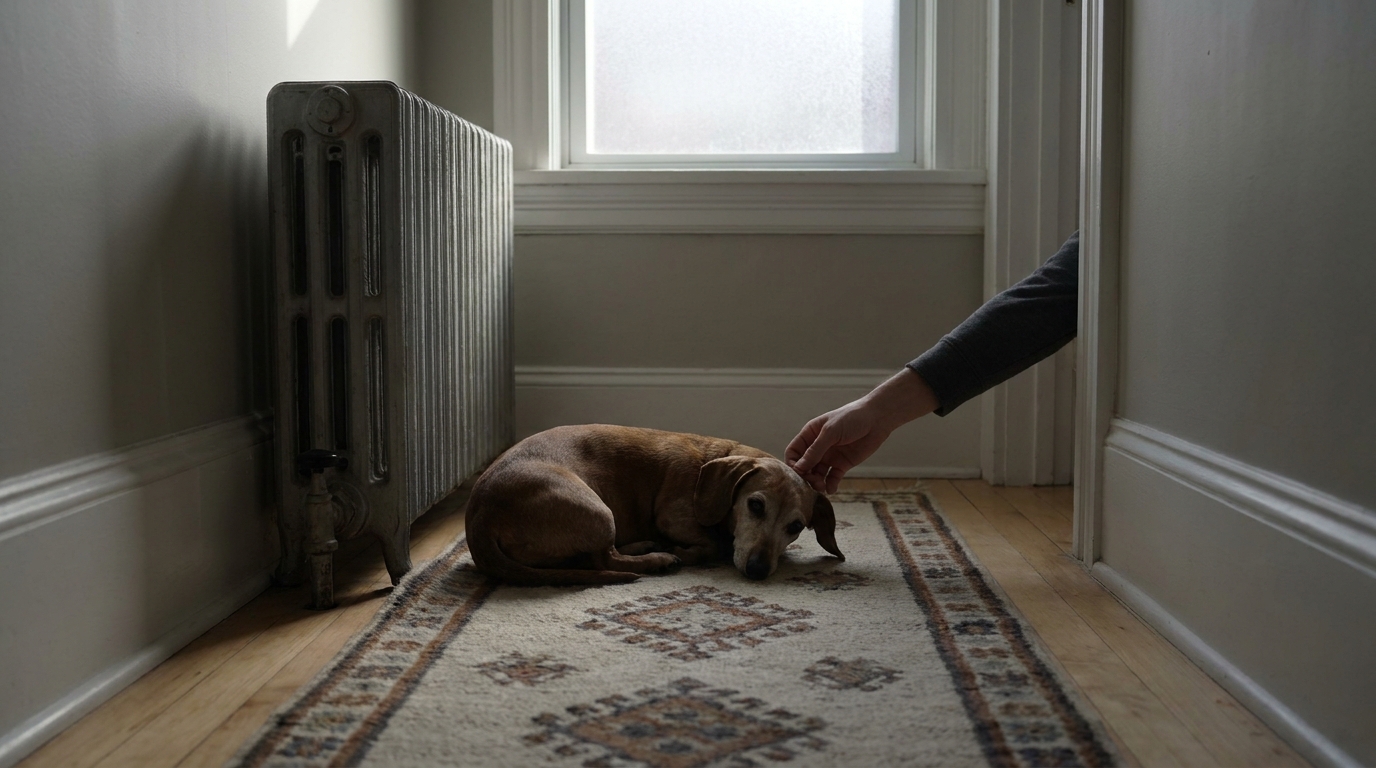
Why some dogs run cold, how to check a dog's real temperature, the thyroid signs that need blood tests, and when a cold dog needs an ER.
Quick answer: Small or thin-coated dogs, puppies and seniors feel cold sooner, so a heater-loving dog is often normal. A dog that is newly always cold and gaining weight, slowing down, losing hair or getting repeat infections may have hypothyroidism and needs a vet within days for blood tests. A cold dog that is weak, confused, has pale gums or a rectal reading below about 99 F needs an emergency vet now.
This article is general information, not a diagnosis. If you think your pet is in danger, go to the nearest emergency animal hospital.
Emergency signs: cold, weak and pale
A dog that feels cold and is also weak, wobbly, confused or very sleepy, has pale or gray gums, slow or shallow breathing, or has stopped shivering while still cold needs an emergency vet now. The same goes for:
- Stiff muscles, a slow heartbeat, collapse, or suddenly being unable to stand or use the back legs
- A rectal reading below about 99 F, whether or not the dog was out in the cold
- A toy-breed or young puppy that is weak, wobbly, trembling, dull or having a seizure (possible low blood sugar); don't force food, sugar or syrup into its mouth
- A dog on insulin that is weak, uncoordinated, having a seizure or collapsed
- A newborn puppy under 4 weeks old that feels cold or won't nurse (warm it slowly against your body on the way; don't feed it until warm)
The Merck Veterinary Manual says shivering is not a reliable sign of hypothermia, so a dog that isn't shivering can still be dangerously cold. Rewarm on the way to the ER, never instead of going: dry the dog, wrap it in warm blankets with towel-wrapped warm (not hot) water bottles, and give no food. Don't put a heating pad on the dog or use a hair dryer or hot water. Ear tips, paws or a tail that turn pale, gray, hard, blistered or black after cold may be frostbite and need an in-person vet now; don't rub the area, and know that frostbite damage can take days to show. For outdoor limits, see how cold is too cold for dogs.
Normal reasons a dog seeks warmth
Body size, coat, body fat and age decide how well a dog holds heat, so small dogs, puppies, seniors and thin-coated breeds such as Greyhounds, Whippets and Chihuahuas feel the cold sooner (Cornell, PDSA). Cornell's Riney Canine Health Center says puppies have very little body fat and older, underweight or sick dogs may struggle to stay warm. The AVMA adds that short-legged pets get cold faster.
The Merck Veterinary Manual notes that ear tips, feet and the tail are poorly insulated, so cool ears on an alert dog say little about its core temperature. What matters most is change: a lifelong heater lover is different from a dog that only started hunting for warm spots this year.
How to tell if your dog is actually cold
A rectal thermometer is the only accurate way to tell if a dog is cold; the Merck Veterinary Manual lists a dog's average temperature as 101 to 102.5 F and its normal range as 99.5 to 102.5 F, and a reading below about 99 F means an emergency vet now.
Ear and armpit readings are less accurate (Merck). Measure only an alert, calm dog, and never delay leaving for the ER to measure.
| Reading | What it means | Action |
|---|---|---|
| 101-102.5 F | Average (Merck) | Normal |
| 99.5-102.5 F | Normal range | Normal |
| Below 99 F | Too low | ER now |
A low reading in a warm house is a sign of illness, not of a thin coat; Merck links low body temperature to severe illness, including severe heart disease.
Hypothyroidism: when a slow thyroid makes a dog cold
Hypothyroidism, an underactive thyroid, slows a dog's metabolism and, according to the Merck Veterinary Manual and Cornell, can cause cold intolerance, weight gain without eating more, low energy, hair loss on the trunk and tail and repeat skin or ear infections; a dog with these signs needs a vet within days for blood tests.
Cornell's Riney Canine Health Center calls lethargy, weight gain and cold intolerance the most common signs, and Merck says some dogs with a slow thyroid seek out heat. Merck and Cornell describe these signs:
| Sign | What you might notice |
|---|---|
| Cold intolerance | Seeks out heat |
| Weight gain | Same food, heavier |
| Low energy | Dull, less active |
| Hair loss | Trunk, tail base, no itch |
| Dry coat | Dull, brittle |
| Repeat infections | Skin and ears |
| Darker skin | Rubbed areas |
| Slow regrowth | After clipping |
| Puffy face | Severe cases |
Itchy skin and ear infections have many other causes, so a vet rules those out too; see dog itching but no fleas and why a dog keeps getting ear infections. Rarely, a hypothyroid dog's dullness quickly turns into stupor, with a very low temperature and a slow heartbeat or slow breathing; Merck calls this myxedema coma, and it needs an ER now.
Which dogs get hypothyroidism?
Hypothyroidism is most often diagnosed in medium to large dogs 4 to 10 years old, and the Merck Veterinary Manual lists Golden Retrievers, Doberman Pinschers, Irish Setters, Dachshunds, Cocker Spaniels and Airedale Terriers among predisposed breeds; Cornell also names Boxers.
Cornell gives an average age at diagnosis of 6 to 7 years and says the disease may be more common in spayed females and neutered males. Merck says it is rare, not absent, in toy and miniature breeds, and Cornell lists Chihuahuas among the breeds least often diagnosed. Small size alone explains a lot of chilliness, but a small dog that is also gaining weight, losing hair or slowing down still needs a vet within days for blood tests. Merck says Greyhounds generally have lower T4 than other breeds, so a Greyhound can run cold and test low without having the disease.
Other medical reasons a dog feels cold
Heart disease, kidney disease, diabetes, hormone problems, weight loss and other serious illness can make it harder for a dog to stay warm (AVMA, Cornell), and a cold dog that is also weak, pale or wobbly needs an emergency vet now.
Anemia, Addison's disease and pain can cause weakness, low energy or trembling that owners can mistake for being cold. What to rule out, and how soon:
| Cause | Other clues | How soon |
|---|---|---|
| Low sugar | Toy puppy, wobbly | ER now |
| Anemia | Pale gums, weak | ER now |
| Heart disease | Cough, tires fast | Within days |
| Kidney, diabetes | Drinks, pees more | Vet in 1-2 days |
| Addison's | Vomiting, lethargy on and off | Within days; collapse: ER |
| Pain | Restless, hiding | Same day |
| Weight loss | Bony back, hips | Exam in 1-2 weeks |
Fainting, labored breathing, or blue or gray gums mean an ER now, whether or not your dog has a heart diagnosis (possible heart failure); sleeping breaths repeatedly above 30 a minute mean a vet today. Collapse, a very slow heartbeat, severe or bloody vomiting or diarrhea, or vomiting again and again means an ER now, even in a dog never diagnosed with Addison's (possible Addisonian crisis). Increased thirst plus vomiting, refusing food or a very dull dog means an in-person vet today, and fast weight loss, such as 10% in a month, needs a vet within a few days; see old dog losing weight but still eating.
How hypothyroidism is diagnosed and treated
A vet confirms hypothyroidism with an in-person blood draw, usually a total T4 screen followed by free T4 and TSH, because the Merck Veterinary Manual says one low T4 does not prove it and older age, other illnesses and some medicines can lower thyroid levels; treatment is a prescription thyroid hormone tablet given every day, usually for life, with in-person rechecks.
Merck says free T4 measured by equilibrium dialysis is more accurate, and TSH stays normal in 20 to 40% of dogs with confirmed disease. A vet may also treat another illness first and retest rather than start thyroid medicine on one low number. Drugs such as steroids, phenobarbital, sulfonamides and clomipramine change results too, so tell the vet everything your dog takes and don't stop any prescribed medicine on your own. Even dogs with normal thyroids can show some improvement on thyroid hormone (Merck), so improvement on thyroid pills alone does not prove a dog has the disease.
Levothyroxine is the standard treatment, and the FDA has approved levothyroxine tablets for dogs (Thyro-Tabs Canine and ThyroKare); they are prescription-only, and a vet decides after an exam and blood tests. Give it the same way every day (always with food or always without) and don't switch brands without the vet. Merck says energy improves within about 2 weeks, while skin, coat and weight can take up to 3 months, with an in-person T4 recheck after 4 to 8 weeks. A dog on thyroid medicine that becomes thirsty, restless, pants a lot, loses weight or has a racing heart may be getting too much; call the vet within days, or go to an ER if it collapses or struggles to breathe.
Keeping a cold-natured dog comfortable
A warm bed away from drafts, a dry, well-fitted sweater for small, thin-coated or older dogs, shorter walks in the cold and drying the coat and feet after walks keep most cold-natured dogs comfortable.
Give your dog a choice of sleeping spots so it can move warmer or cooler, and keep a few dry sweaters; the AVMA warns a wet one makes a dog colder. Wipe the feet, legs and belly after walks; see cracked dog paw pads in winter. The AVMA says space heaters can burn a pet or be knocked over and start a fire, and heated pet mats can still burn, so keep heaters behind a barrier. A heater or heating-pad burn needs an in-person vet the same day; a large or deep burn, a burn on the face, or a chewed cord means an ER now.
A dog that is slower, gaining weight, seeking warmth and losing coat may have a hormone problem such as an underactive thyroid, not just arthritis, and needs a vet within days for blood tests; see dog arthritis in cold weather.
When a video visit helps
RexVet, a nonprofit online vet service, sees pets located in Florida, New York and Virginia by video visit. A video visit fits a dog that seems cold more often than it used to and has gained weight, is slowing down, or has thinning fur or repeat skin or ear infections, and is otherwise alert and eating, with the dog in one of those states during the visit.
Book a $64.99 live video visit with a licensed RexVet vet. Live video slots run about 8 AM to 11 PM ET, and the booking page shows the next open time.
The veterinarian goes through the signs, weight history, coat and skin on camera, tells you what else could explain them, and which blood tests to ask for in person; a thyroid panel needs a blood draw by an in-person vet (a clinic or a mobile vet), who sends it to a lab. If your dog is already diagnosed, the veterinarian can go over results and symptoms with you between rechecks; recheck blood tests and dose changes still happen in person, and a video visit is not a way to renew thyroid medicine in Florida.
The one-time $120 Family Plan covers 4 visits over 12 months for every pet in the home and never auto-renews, which suits a first review and later check-ins on symptoms and lab results.
There are no overnight visits; after about 11 PM, if a problem can't wait for the next open slot, or in an emergency, go to a 24-hour emergency animal hospital instead of waiting. A dog that is cold and weak, wobbly, confused or very sleepy, has pale or gray gums, slow or shallow breathing, has stopped shivering while still cold, or reads below about 99 F needs the nearest emergency vet now, not a video visit.
No prescription is promised; any medicine is the veterinarian's decision after the visit. Thyroid medicine is usually lifelong and needs bloodwork first. Florida's s.474.2021 limits telehealth-only prescribing to FDA-approved animal drugs used as labeled, for up to 14 days (1 month for products labeled only for fleas and ticks), with no renewal without an in-person exam, and no human-labeled, controlled or compounded antibacterial, antifungal, antiviral or antiparasitic drugs, so ongoing thyroid treatment in Florida runs through an in-person vet. Virginia allows the exam to be electronic, but the blood draw is still in person. New York's telehealth prescribing rules are not settled. In every state, federal rules require an in-person exam before a vet uses a human-labeled drug or uses a drug off-label. RexVet is not a pharmacy; a pharmacy transfer fee applies if a prescription is sent to an outside pharmacy, and the medicine itself is paid for at the pharmacy.
From RexVet's visit study: 41% of RexVet video visits were for pets aged 7 or older.
Need an Expert Opinion on This Topic?
Book a video visit with a licensed vet, evenings and weekends included
See open timesFrequently Asked Questions
Is it normal for my dog's ears and paws to feel cold?
Cool ears and paws on their own are usually not a worry in an alert, comfortable dog, but touch can't tell you its temperature. The Merck Veterinary Manual notes these areas are poorly insulated and cool first; a rectal thermometer is the accurate check, and a weak or confused cold dog needs an ER now. Ear tips or paws that turn pale, gray, hard, blistered or black after cold may be frostbite and need an in-person vet now.
Why does my dog always lie by the heater?
Often because the dog is small, thin-coated, young or old, but new heat-seeking with weight gain, low energy or hair loss can be hypothyroidism. The Merck Veterinary Manual says some dogs with an underactive thyroid have trouble keeping warm and seek out heat. A dog that started doing this and is also slowing down or gaining weight needs a vet within days for blood tests.
Can hypothyroidism make my dog gain weight even if it eats the same amount?
Yes. The Merck Veterinary Manual says hypothyroidism causes weight gain without an increase in appetite. A dog getting heavier on the same food that is also slowing down or losing coat needs a vet within days for blood tests, not a "thyroid support" product.
Can my dog's food or diet cause hypothyroidism?
Not usually. The Merck Veterinary Manual says more than 95% of cases in dogs come from destruction of the thyroid gland itself, and Cornell names an immune attack on the gland and atrophy as causes. The diet problem is the opposite one: the FDA warns that food or treats containing thyroid tissue can cause an overactive thyroid, which usually reverses once the dog stops eating them.
Will my dog need thyroid medicine for the rest of its life?
Usually, yes. The Merck Veterinary Manual says that, with few exceptions, a dog with hypothyroidism needs thyroid hormone replacement for life: a prescription tablet given every day, with in-person blood rechecks.
Can an online vet help if I think my dog has hypothyroidism and we live in Florida, New York or Virginia?
Yes, for an alert, eating dog: a licensed RexVet vet can review the signs on video, but thyroid testing needs an in-person blood draw. For a pet located in Florida, New York or Virginia, the veterinarian can go over the signs, coat, weight trend and past lab results and say which tests to ask for; the blood draw, diagnosis, rechecks and long-term medicine go through an in-person vet. Florida limits telehealth-only prescriptions to FDA-approved animal drugs used as labeled, for up to 14 days, with no renewal without an in-person exam and no human-labeled drugs. Virginia allows an electronic exam, but the blood draw is still in person; New York's rules are not settled. In every state, federal rules require an in-person exam before a vet uses a human-labeled or off-label drug. No prescription is promised.
Why is my dog shivering inside when the house is warm?
A small, thin-coated or older dog may just feel cool indoors, but shivering in a warm room can also mean pain or illness. Pain can make a warm dog tremble, and that needs a same-day exam. A trembling toy puppy that is also weak or wobbly may have low blood sugar and needs an ER now, as does a shivering dog that is weak, confused or has pale or gray gums. Trembling can also be a sign of poisoning: if your dog may have eaten something it shouldn't, such as chocolate, moldy food or someone's medicine, call a vet or a poison line now (numbers below).
Can I give my dog my own thyroid medicine?
No. Never give a dog a person's or leftover thyroid pills; a vet decides on thyroid medicine only after an exam and blood tests. If your dog swallowed thyroid pills, call a vet or a poison line now: ASPCA Animal Poison Control at (888) 426-4435 (a consultation fee may apply) or the Pet Poison Helpline at (855) 764-7661 (a per-incident fee applies).
FAQs
Is it normal for my dog's ears and paws to feel cold?
Cool ears and paws on their own are usually not a worry in an alert, comfortable dog, but touch can't tell you its temperature. The Merck Veterinary Manual notes these areas are poorly insulated and cool first; a rectal thermometer is the accurate check, and a weak or confused cold dog needs an ER now. Ear tips or paws that turn pale, gray, hard, blistered or black after cold may be frostbite and need an in-person vet now.
Why does my dog always lie by the heater?
Often because the dog is small, thin-coated, young or old, but new heat-seeking with weight gain, low energy or hair loss can be hypothyroidism. The Merck Veterinary Manual says some dogs with an underactive thyroid have trouble keeping warm and seek out heat. A dog that started doing this and is also slowing down or gaining weight needs a vet within days for blood tests.
Can hypothyroidism make my dog gain weight even if it eats the same amount?
Yes. The Merck Veterinary Manual says hypothyroidism causes weight gain without an increase in appetite. A dog getting heavier on the same food that is also slowing down or losing coat needs a vet within days for blood tests, not a "thyroid support" product.
Can my dog's food or diet cause hypothyroidism?
Not usually. The Merck Veterinary Manual says more than 95% of cases in dogs come from destruction of the thyroid gland itself, and Cornell names an immune attack on the gland and atrophy as causes. The diet problem is the opposite one: the FDA warns that food or treats containing thyroid tissue can cause an overactive thyroid, which usually reverses once the dog stops eating them.
Will my dog need thyroid medicine for the rest of its life?
Usually, yes. The Merck Veterinary Manual says that, with few exceptions, a dog with hypothyroidism needs thyroid hormone replacement for life: a prescription tablet given every day, with in-person blood rechecks.
Can an online vet help if I think my dog has hypothyroidism and we live in Florida, New York or Virginia?
Yes, for an alert, eating dog: a licensed RexVet vet can review the signs on video, but thyroid testing needs an in-person blood draw. For a pet located in Florida, New York or Virginia, the veterinarian can go over the signs, coat, weight trend and past lab results and say which tests to ask for; the blood draw, diagnosis, rechecks and long-term medicine go through an in-person vet. Florida limits telehealth-only prescriptions to FDA-approved animal drugs used as labeled, for up to 14 days, with no renewal without an in-person exam and no human-labeled drugs. Virginia allows an electronic exam, but the blood draw is still in person; New York's rules are not settled. In every state, federal rules require an in-person exam before a vet uses a human-labeled or off-label drug. No prescription is promised.
Why is my dog shivering inside when the house is warm?
A small, thin-coated or older dog may just feel cool indoors, but shivering in a warm room can also mean pain or illness. Pain can make a warm dog tremble, and that needs a same-day exam. A trembling toy puppy that is also weak or wobbly may have low blood sugar and needs an ER now, as does a shivering dog that is weak, confused or has pale or gray gums. Trembling can also be a sign of poisoning: if your dog may have eaten something it shouldn't, such as chocolate, moldy food or someone's medicine, call a vet or a poison line now (numbers below).
Can I give my dog my own thyroid medicine?
No. Never give a dog a person's or leftover thyroid pills; a vet decides on thyroid medicine only after an exam and blood tests. If your dog swallowed thyroid pills, call a vet or a poison line now: ASPCA Animal Poison Control at (888) 426-4435 (a consultation fee may apply) or the Pet Poison Helpline at (855) 764-7661 (a per-incident fee applies).
Medically Reviewed
Reviewed by Dr. Tiffany Delacruz, DVM — licensed veterinarian and CEO of RexVet. Last reviewed November 4, 2026.
Content is for informational purposes and does not replace professional veterinary advice.
Chief Executive Officer · Licensed Veterinarian
Dr. Delacruz is a licensed Doctor of Veterinary Medicine specializing in preventive care and veterinary telehealth. She reviews all health content on RexVet to ensure accuracy and clinical relevance.
Sources & References
- · American Veterinary Medical Association — Telehealth Guidelines
- · AVMA — Pet Care Resources
- · U.S. FDA — Animal & Veterinary