
Senior Cat Yowling at Night: Dementia or Medical Cause?
By RexVet Team | Reviewed by Dr. Tiffany Delacruz, DVM
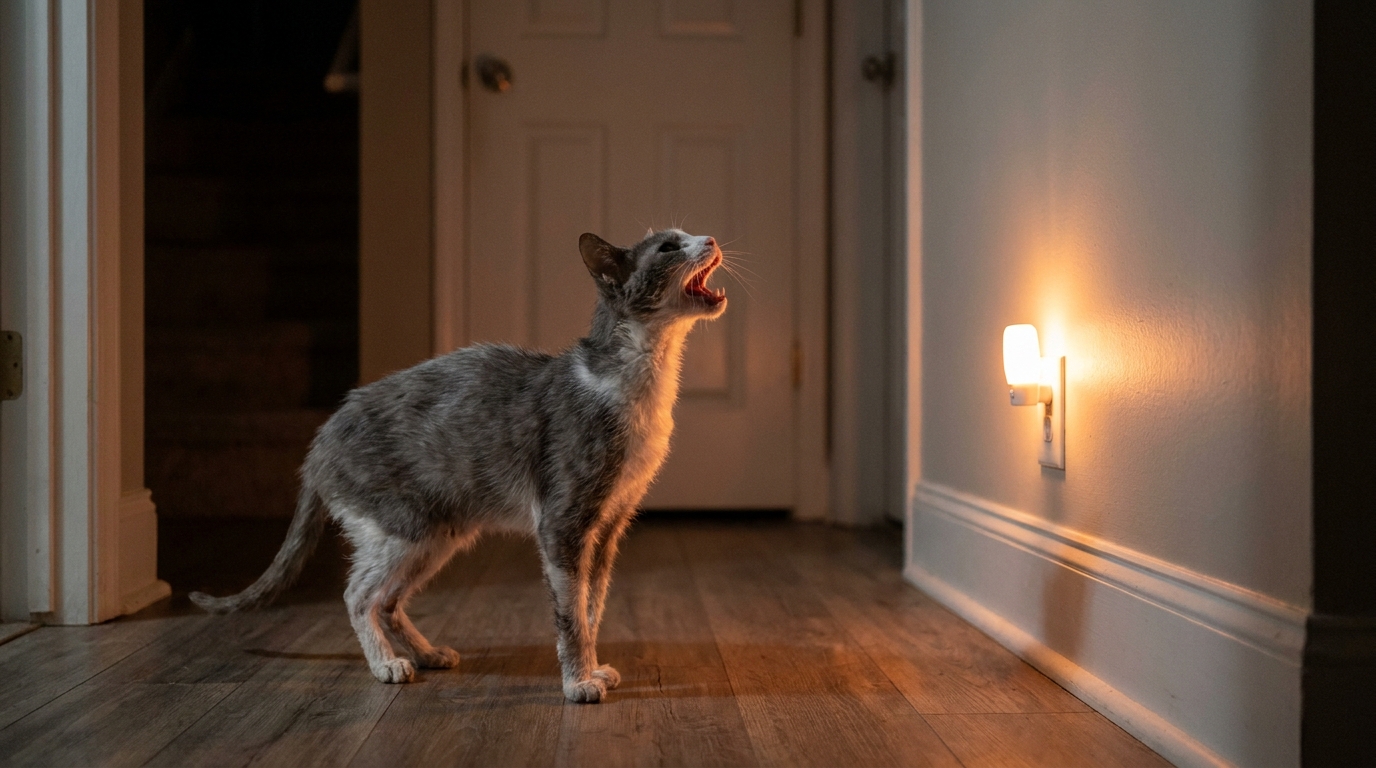
Thyroid trouble, high blood pressure, pain or fading senses can make an old cat yowl at night. Here is how urgent each sign is.
Quick answer: New night yowling in a cat over 10 often has a medical cause: an overactive thyroid, high blood pressure, kidney disease, arthritis pain, or hearing and vision loss. Dementia is diagnosed only after those are ruled out. See a vet within a few days if your cat is otherwise well, the same day for eye changes, and an ER now for litter-box straining, dragging back legs, a seizure or open-mouth breathing.
This article is general information, not a diagnosis. If you think your pet is in danger, go to the nearest emergency animal hospital.
How urgent is it? A night-yowling triage
Most night yowling is not an emergency, but a few signs are. Act on the first row that matches what you see.
| Sign | May mean | Do this |
|---|---|---|
| Straining, little or no pee | Urinary blockage | ER now |
| Back legs drag, cold or pale paws | Blood clot | ER now |
| Seizure, circling, head tilt, collapse | Brain or high BP | ER now |
| Open-mouth or fast breathing | Heart or lungs | ER now |
| Ate lilies, human meds or dog flea drops | Poisoning | ER or poison line |
| Dilated pupils, bumps into things, blood in eye | High BP, retina | Vet today or ER |
| Not eating a full day, repeated vomiting, hiding, cries when touched | Pain or illness | Vet today or ER |
| Yowling plus weight loss, big appetite or thirst | Thyroid, kidney, diabetes | Vet within days |
| Gradual change, otherwise well | Senses, pain, dementia | Vet in a few days |
Cornell Feline Health Center warns that a blocked cat can die in less than a day or two. Any cat straining in the litter box with little or no urine, especially a male, needs an ER now. Do not wait for morning, and do not try to decide at home whether it is constipation. Back legs (or sometimes one front leg) that suddenly drag or go limp, often with crying, cold legs or pale or bluish paw pads, can mean a blood clot from heart disease. Go to an ER now.
For a possible toxin, such as any part of a lily (the FDA warns that pollen and vase water count), a dog flea product or a human medicine, go to an ER or call ASPCA Animal Poison Control at (888) 426-4435 (a consultation fee may apply) or Pet Poison Helpline at (855) 764-7661 (per-incident fee).
Why older cats start yowling at night
Vet guidelines from AAHA and the AAFP count cats over 10 as seniors. The ASPCA notes that aging cats are prone to an overactive thyroid and kidney disease, either of which can cause excessive meowing, and that an older cat who starts meowing a lot should also be checked for sight or hearing loss and cognitive dysfunction. Sudden loud meowing at night is a reason for a vet check, not just old age.
In one study of 37 cats with cognitive dysfunction (Černá, Gunn-Moore and colleagues, 2020), the crying split about evenly between mostly at night, mostly by day, or both. Confused cats often cried from another room or wandered while crying. Some cats settle when you come; others keep going. The same paper warns that high blood pressure, an overactive thyroid, FIV and toxoplasmosis can cause changes identical to dementia, so vets check the body first.
| Cause | Clues | How vets check |
|---|---|---|
| Thyroid | Weight loss, big appetite | T4 blood test |
| High BP | Eye changes, blindness | BP reading |
| Kidney | Thirst, big urine clumps | Blood, urine tests |
| Diabetes | Thirst, hunger, weight loss | Blood, urine tests |
| Arthritis | Stops jumping, stiff | Exam, X-rays |
| Mouth pain | Eating changes | Mouth exam |
| Hearing loss | No response to sound | Exam |
| Brain tumor | Mimics dementia | Advanced imaging |
| Dementia | Seems lost, sleep flipped | Ruling out the rest |
Overactive thyroid (hyperthyroidism), a common medical cause
An overactive thyroid is the most common hormone disease in older cats and affects about 1 in 10 cats over age 10, according to the FDA and the AAFP senior care guidelines. The Merck Veterinary Manual lists hyperactivity and excessive vocalization among the most common signs, along with weight loss despite a big appetite and more drinking and peeing. An old cat yowling at night who is getting thinner while begging for food fits this picture. Untreated, it can lead to high blood pressure, eye damage and heart disease.
Most affected cats have a raised T4 level on a blood test, Cornell notes. Thyroid medicine for cats is FDA-approved, but it is started only after bloodwork confirms the diagnosis and it needs repeat blood tests, so a video visit cannot start or promise it. Read more on the early signs of cat hyperthyroidism.
High blood pressure and sudden blindness
The ISFM consensus guidelines (2017) say high blood pressure is common in older cats, often comes with kidney disease or an overactive thyroid, and damages the eyes, heart, brain and kidneys, sometimes permanently.
Dilated pupils, bumping into things, blood inside the eye or sudden blindness need a vet the same day. Fast treatment can save the retina, but sight comes back in only some cats. The ACVIM guidelines (2018) say sudden blindness can be the first sign of high blood pressure. If no vet can see your cat today, go to an ER. ACVIM also lists brain signs such as seizures, sudden disorientation and a head tilt. Any seizure or a new head tilt means an ER now, and so does confusion that comes on suddenly, over hours.
Blood pressure has to be measured in person with a cuff. ACVIM grades a systolic reading of 160 to 179 as moderate risk and 180 or higher as severe, and calls a yearly check reasonable from about age 9.
Kidney disease, thirst and night restlessness
A cat with failing kidneys often drinks and pees more, which can mean extra night trips to the water bowl and litter box, and crying when the bowl is empty or the box is full. Watch for a bowl that empties faster and bigger urine clumps. To judge how much drinking is too much, see old cat drinking a lot of water: causes and when to worry.
Diabetes also causes thirst, hunger and weight loss. If that sounds like your cat, read the early signs of cat diabetes and see a vet within days, or the same day if she also vomits, seems weak or stops eating (an ER if no vet can see her today), because diabetes can tip into a life-threatening crisis.
Arthritis and hidden pain
Cats with arthritis rarely limp, so it is easy to miss. The AAFP senior care guidelines say joint disease affects up to 74% of cats aged 12 or older. Veterinary behaviorist John Ciribassi, DVM, DACVB, lists arthritis, ear infections and mouth pain among the medical causes of abnormal crying.
Watch for a cat who stops jumping, seems stiff, or changes how she eats. See a vet the same day if she hides, sits hunched or cries when touched. Pain relief needs a vet who has examined her. Never give human pain relievers: the FDA says acetaminophen (Tylenol) can damage the liver and red blood cells of dogs and cats, and cats are more prone to the red blood cell damage.
Hearing and vision loss: why the dark is harder at night
Cornell Feline Health Center says hearing loss and deafness are often found in elderly cats. Černá and colleagues note that losing sight or hearing makes cats more dependent on their owners and may add to attention seeking. In a dark, quiet house, a cat has fewer cues about where she is and where you are, and calling out may be how she finds you.
The Merck Veterinary Manual notes that a sleeping animal that does not wake to a sound suggests deafness in both ears. If your cat sleeps through you walking in or saying her name, tell your vet.
Cat dementia is diagnosed only after the rest is ruled out
Feline cognitive dysfunction is the cat version of dementia, and signs are reported from about age 10. In one owner survey of 154 cats aged 11 to 21 (Moffat and Landsberg, reported in Landsberg et al., JFMS 2010), about 28% of cats aged 11 to 14 and half of cats over 15 showed age-related behavior changes. That is a reason to look for a cause, not a diagnosis.
Vets list loud crying, especially at night, among the signs of feline cognitive dysfunction. Others include:
- Seeming lost or stuck in a familiar room
- Crying at night and walking around at the same time
- A flipped sleep pattern: restless at night, sleeping more by day
- Changes in how she interacts with you or other pets
- A change in activity level
- Litter box accidents
The AAFP senior care guidelines and Landsberg's 2010 review say dementia is diagnosed only after medical and environmental causes are ruled out, and every sign above can also come from the conditions in this article. For a 15-year-old cat yowling at night, that means a blood pressure reading, a retina exam, bloodwork and a urine test first. Dementia cannot be diagnosed on a video call.
If testing finds nothing else, care centers on a steady routine, daily play and a home set up so she gets lost less often. Vet sources describe no FDA-approved dementia drug for cats, so ask your vet what fits your cat.
Attention, hunger or a routine change?
Once a vet rules out illness, some night crying is simply a healthy cat asking for something. The ASPCA advises checking her needs first (litter box, water, food, access to a room), then not rewarding demanding meows: wait for a moment of quiet, then give attention. Never scold or hit a cat for meowing. A confused cat needs calm reassurance instead, say Černá and colleagues. A cat who is suddenly ravenous, especially while losing weight, needs a thyroid and diabetes check.
Vets note that schedule changes can stress older cats. According to NIST, US daylight saving time ends at 2 a.m. on the first Sunday in November. After clocks fall back on Sunday, Nov 1, 2026, a cat used to breakfast at 6 will start asking at 5 by the new clock, so the crying seems to start an hour earlier. One option is to shift her meal times in small steps over several days.
Keep a night log before the vet visit
The AAFP senior care guidelines call for more than one checkup a year for senior cats and ask owners to report subtle changes. Start this log tonight and bring it to the visit.
| Record | Why it helps |
|---|---|
| Time and length of each episode | Shows the pattern |
| Where she is when she cries | Lost vs. calling you |
| Does she settle when you come? | Confusion or attention |
| Water, food and litter changes | Thyroid, kidney, diabetes |
| Weight, once a week | Weight loss is a clue |
| Phone video of one episode | The vet sees it |
| New pet, food, move or schedule | Stress triggers |
| Fall clock change | Meal times shift |
What helps tonight while you wait
These steps, drawn from the AAFP, Černá and colleagues, and Dr. Ciribassi, ease nights but do not replace a vet visit:
- Put night lights in hallways and where she sleeps.
- Keep food, water and litter where they have always been. If stairs are hard, add an extra set on the floor where she sleeps.
- Give her a warm bed, plus low ramps or steps to favorite spots.
- At night, keep her in a smaller area, such as one quiet room with everything she needs.
- Try soft radio and a synthetic cat pheromone diffuser.
- Play with her every evening.
- Offer a late small meal only if your vet agrees.
- Never punish, scold, use a squirt bottle, or shut a confused cat out.
Do not give melatonin, Benadryl or any human sleep aid without your vet's OK. Research in cats is limited, and the right choice depends on your cat's other conditions.
What a video visit can and cannot do
If your senior cat is stable (eating and drinking, peeing without straining, walking normally, breathing calmly, and showing none of the warning signs in the triage table) and the night yowling is new or getting worse, a $64.99 live video visit with Dr. Tiffany Delacruz, DVM, is a reasonable first step. RexVet is a 501(c)(3) non-profit, and visits are live video, not chat or phone. Your cat must be physically in Florida, New York or Virginia during the call. Visits run about 8 AM-11 PM ET, so book for the next day, not for a 3 AM episode. Show Dr. Delacruz a phone video of an episode and your night log. She can help work out which causes fit, how urgent it is, and which in-person tests to ask your local vet for: a blood pressure reading (taken before any blood draw), an eye exam of the retina, bloodwork with a thyroid (T4) level and kidney values, a urine test, and FIV/FeLV testing. She cannot take blood pressure, examine the retina or run labs over video, and dementia cannot be diagnosed on a video call. Whether any medication makes sense depends on an exam and test results, so no prescription is promised. RexVet is not a pharmacy; if Dr. Delacruz does write a prescription, a pharmacy transfer fee applies when RexVet sends it to an outside pharmacy.
Some cases are not video-visit cases. Straining with little or no urine, back legs that suddenly drag with crying, cold legs or pale or bluish paw pads, a seizure, circling, head tilt or collapse, or open-mouth breathing mean an emergency clinic now. Sudden blindness, dilated pupils, blood in the eye or bumping into things need an in-person vet today, or an ER if no vet can see your cat today. If you suspect a toxin, go to an ER or call ASPCA Animal Poison Control at (888) 426-4435 (a consultation fee may apply) or Pet Poison Helpline at (855) 764-7661 (per-incident fee).
Need an Expert Opinion on This Topic?
Book a video visit with a licensed vet, evenings and weekends included
See open timesFrequently Asked Questions
Why does my old cat yowl at night but act fine in the morning?
A dark, quiet house is harder for a cat with fading sight or hearing, or with the confusion of cognitive dysfunction. An overactive thyroid can also make a cat restless and hungry. A normal morning does not rule out thyroid disease, high blood pressure or kidney disease, so book a vet check within a few days, or sooner if you see any sign from the triage table above.
Is yowling at night a sign my cat is dying?
Not on its own. It usually points to a condition a vet can look for, and many, such as an overactive thyroid, high blood pressure and arthritis pain, can be treated or managed. Yowling with straining to pee, open-mouth breathing, a seizure, collapse or sudden back-leg weakness needs an emergency vet now. A full day without eating, repeated vomiting or hiding needs a vet today.
Can cats get dementia, and at what age?
Yes. Feline cognitive dysfunction is the cat version of dementia. Signs such as night crying, seeming lost and changed sleep are reported from about age 10. Vets diagnose it only after ruling out thyroid disease, high blood pressure, kidney disease, diabetes, pain and other medical causes.
How do I get my senior cat to stop yowling at night? Should I ignore it?
No. Start with a vet check, because the fix depends on the cause. Never scold, punish or shut a confused cat out. If a healthy cat is demanding attention, wait for a moment of quiet before you respond. A confused cat needs calm reassurance instead.
Can I give my cat melatonin or Benadryl to help her sleep?
Not without your vet's OK. Research on melatonin in cats is limited, and the right choice depends on your cat's other conditions and medicines. The same goes for Benadryl and any human sleep aid.
Can a video vet visit help with night yowling if my cat is in Florida, New York or Virginia?
Partly. If your cat is physically in one of these states and is stable, a live video visit can review her history, your night log and an episode video, and judge how urgent it is. Video cannot take blood pressure, examine the retina or run labs, so it cannot diagnose dementia or high blood pressure; those checks need an in-person vet. If medicine comes up: in Florida, a video-only prescription is limited to FDA-approved animal drugs used as labeled, for up to 14 days (1 month for products labeled only for flea and tick), with no renewal without an in-person exam, and no human, controlled or compounded anti-infective drugs without one. Virginia allows the exam to be electronic. New York has not settled its veterinary telehealth rules, so ask what applies to your cat. Federal rules require a vet who has examined your cat in person before using a drug off-label, including human medicines, in every state. Thyroid medicine also needs bloodwork first.
FAQs
Why does my old cat yowl at night but act fine in the morning?
A dark, quiet house is harder for a cat with fading sight or hearing, or with the confusion of cognitive dysfunction. An overactive thyroid can also make a cat restless and hungry. A normal morning does not rule out thyroid disease, high blood pressure or kidney disease, so book a vet check within a few days, or sooner if you see any sign from the triage table above.
Is yowling at night a sign my cat is dying?
Not on its own. It usually points to a condition a vet can look for, and many, such as an overactive thyroid, high blood pressure and arthritis pain, can be treated or managed. Yowling with straining to pee, open-mouth breathing, a seizure, collapse or sudden back-leg weakness needs an emergency vet now. A full day without eating, repeated vomiting or hiding needs a vet today.
Can cats get dementia, and at what age?
Yes. Feline cognitive dysfunction is the cat version of dementia. Signs such as night crying, seeming lost and changed sleep are reported from about age 10. Vets diagnose it only after ruling out thyroid disease, high blood pressure, kidney disease, diabetes, pain and other medical causes.
How do I get my senior cat to stop yowling at night? Should I ignore it?
No. Start with a vet check, because the fix depends on the cause. Never scold, punish or shut a confused cat out. If a healthy cat is demanding attention, wait for a moment of quiet before you respond. A confused cat needs calm reassurance instead.
Can I give my cat melatonin or Benadryl to help her sleep?
Not without your vet's OK. Research on melatonin in cats is limited, and the right choice depends on your cat's other conditions and medicines. The same goes for Benadryl and any human sleep aid.
Can a video vet visit help with night yowling if my cat is in Florida, New York or Virginia?
Partly. If your cat is physically in one of these states and is stable, a live video visit can review her history, your night log and an episode video, and judge how urgent it is. Video cannot take blood pressure, examine the retina or run labs, so it cannot diagnose dementia or high blood pressure; those checks need an in-person vet. If medicine comes up: in Florida, a video-only prescription is limited to FDA-approved animal drugs used as labeled, for up to 14 days (1 month for products labeled only for flea and tick), with no renewal without an in-person exam, and no human, controlled or compounded anti-infective drugs without one. Virginia allows the exam to be electronic. New York has not settled its veterinary telehealth rules, so ask what applies to your cat. Federal rules require a vet who has examined your cat in person before using a drug off-label, including human medicines, in every state. Thyroid medicine also needs bloodwork first.
Medically Reviewed
Reviewed by Dr. Tiffany Delacruz, DVM — licensed veterinarian and CEO of RexVet. Last reviewed October 30, 2026.
Content is for informational purposes and does not replace professional veterinary advice.
Chief Executive Officer · Licensed Veterinarian
Dr. Delacruz is a licensed Doctor of Veterinary Medicine specializing in preventive care and veterinary telehealth. She reviews all health content on RexVet to ensure accuracy and clinical relevance.
Sources & References
- · American Veterinary Medical Association — Telehealth Guidelines
- · AVMA — Pet Care Resources
- · U.S. FDA — Animal & Veterinary