
Pyoderma in Dogs: Skin Infection Signs and When to Worry
By RexVet Team | Reviewed by Dr. Tiffany Delacruz, DVM
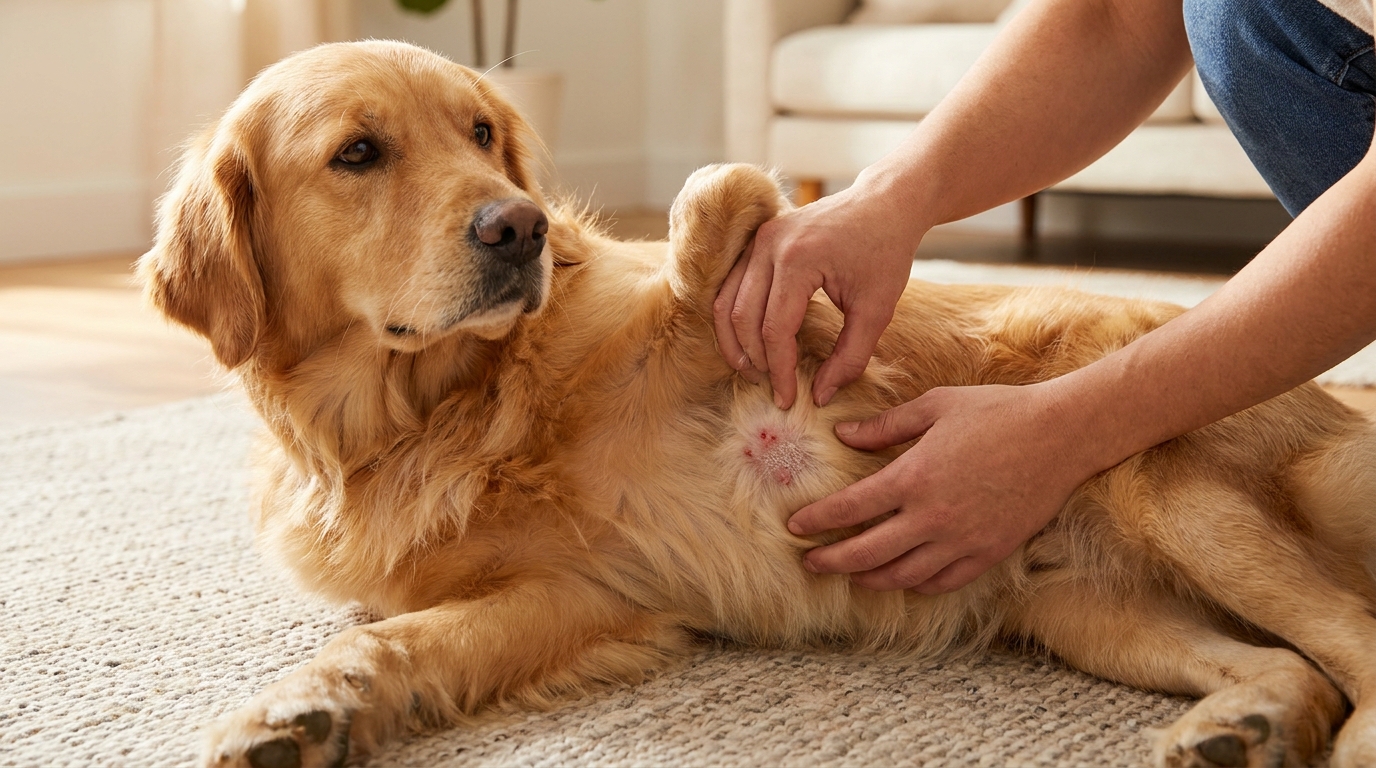
Red bumps, pimples, crusts or peeling rings on your dog's belly? How to spot a skin infection, what sets it off and which signs need a vet today.
Quick answer: Pyoderma in dogs is a bacterial skin infection, usually set off by allergies or fleas, that causes small red bumps, pimples, peeling rings and crusts on the belly, armpits or trunk. See a vet within a few days if your dog otherwise acts normal. Sores that hurt, ooze pus or blood, smell, or come with fever or low energy need an in-person vet today.
This article is general information, not a diagnosis. If you think your pet is in danger, go to the nearest emergency animal hospital.
What does pyoderma look like on a dog?
The Merck Veterinary Manual says pyoderma in dogs most often affects the trunk and belly, where it shows up as small pimples at hair follicles, rings of peeling skin, crusts, scale and patchy hair loss. A dog with a few of these spots that is eating, playing and not in pain needs a vet check within a few days.
Merck says the welts of a skin infection in short-haired dogs can look like hives, but the hairs in them come out easily, which helps a vet tell them apart. Unlike hives, these welts last for days; see sudden hives or bumps all over a dog.
Deep pyoderma is less common but more serious: Merck lists pain, crusting, odor and oozing of blood and pus as its hallmarks. The 2025 ISCAID antimicrobial use guidelines for canine pyoderma sort the infection by depth:
| Type | Looks like | Where |
|---|---|---|
| Surface | Raw, wet patch or red fold | Folds, licked spots |
| Superficial | Pimples, peeling rings, crusts | Belly, trunk, armpits |
| Deep | Pain, pus, blood, odor | Chin, elbows, feet, back |
| Puppy (impetigo) | Pimples on bare belly | Groin, armpits |
For crusts along the back, see scabs on a dog's back.
When is a dog skin infection an emergency?
A dog skin infection needs an emergency vet now with hard or noisy breathing, collapse, pale gums, fast swelling with severe pain, or purple or black peeling skin; an in-person vet today if sores hurt, ooze pus or blood, smell or come with fever or low energy; and otherwise a vet check within a few days.
| Sign | Next step |
|---|---|
| Hard or noisy breathing | Emergency vet now |
| Weak, collapsed or pale gums | Emergency vet now |
| Fast swelling, severe pain | Emergency vet now |
| Skin purple or black, peeling | Emergency vet now |
| Swelling or hives with vomiting | Emergency vet now |
| Puffy face, normal breathing | In-person vet within 1 hour |
| Hives spreading | In-person vet now |
| Purple, bruise-like bumps | Same day (ER if weak) |
| New purple dots or bruises, no injury | Emergency vet today |
| Oozing pus or blood, odor, draining holes | In-person vet today |
| Back pain or bumps after a bath or grooming | In-person vet today |
| Fever, low energy, not eating | In-person vet today |
| Draining paw sore, or won't put weight on a swollen foot | In-person vet today |
| Hot spot over 24 hours old or spreading | In-person vet today |
| Crusts spreading or with hair loss | In person within days |
| No change 3 to 4 days into antibiotic pills | In person within days |
| A few pimples, dog acts normal | Vet check within days |
Any face swelling in a flat-faced breed; hives or a puffy face within 1 hour of a shot, sting or new medicine; trouble swallowing or swelling toward the throat or tongue; or hives or swelling with vomiting, diarrhea or drooling means an emergency vet now.
Do not wait for the skin to change color: a 2023 case series in Today's Veterinary Practice says necrotizing fasciitis, a life-threatening infection, starts with pain far worse than the skin looks, fast-spreading swelling and sudden limping, and needs an emergency vet now.
The 2025 ISCAID guidelines say post-grooming furunculosis, a deep infection along the back, starts within 24 to 48 hours of a bath or swim plus grooming, often with back pain, fever or low energy. Those signs need an in-person vet the same day, or an emergency vet if the dog is weak or collapses.
What causes pyoderma in dogs?
The Merck Veterinary Manual says skin infections in dogs are usually triggered by another problem, most often fleas or mites, allergies or skin damage, with underactive thyroid and Cushing's disease as other common causes.
Dr. Clarissa Souza, a veterinary dermatologist at the University of Illinois, says pyoderma is always secondary to another problem, most often allergies. Merck names flea bite, food and environmental allergies; if your dog scratches with no fleas in sight, see a dog itching but no fleas.
Merck also links deep pyoderma to Demodex mites, which take an in-person skin scrape to find, and names warm, moist skin folds, armpits and feet as prone to infection. The bacteria involved are usually the dog's own staph, so pyoderma is often called a staph infection: Merck lists Staphylococcus pseudintermedius among the normal resident bacteria on dog skin.
Is it pyoderma, hives, a hot spot, ringworm or mange?
How a spot looks and how long it lasts are the best clues to whether a dog has pyoderma, hives, a hot spot, ringworm or mange, and any spot that has not cleared in a few days needs a vet check.
| Problem | Looks like | Lasts |
|---|---|---|
| Hives | Raised, rounded welts | Hours to 2 days |
| Skin infection | Pimples, crusts, peeling rings | Builds over days |
| Hot spot | Raw, wet, painful patch | Grows fast |
| Ringworm | Round, scaly bald patch | Weeks or more |
| Mange | Crusts, intense itch | Weeks or more |
A hot spot that spreads fast, is more than 24 hours old, or has pimples around its edge needs an in-person vet today; Cornell's Riney Canine Health Center says one that old is likely infected. For thick-coated dogs, see German Shepherd skin problems.
Possible mange (intense itch, crusts on ear edges, elbows, hocks or belly) or ringworm (a round, scaly bald patch), or a similar patch on another pet or a person, needs an in-person vet within days.
ISCAID also lists look-alikes that need an in-person exam and biopsy within days: pemphigus foliaceus (pustules and crusts on the nose bridge, ear flaps or footpads) and skin lymphoma in an older dog whose sore will not heal. Skin that turns dark or black within days needs an in-person vet now, but slow gray or black darkening after an infection is usually leftover pigment, not an emergency; see dog skin turning black.
Are pimples on a puppy's belly serious?
Pimples on a puppy's belly are often puppy pyoderma, also called impetigo, and a puppy that is eating and playing needs a vet check within a few days. VCA Animal Hospitals says it often shows up on thin-haired skin such as the groin and underarms.
The 2025 ISCAID guidelines say only some cases clear on their own, especially once poor nutrition, poor hygiene or worms are corrected, so do not count on it.
Puppy strangles (juvenile cellulitis) looks like a skin infection but is not one; a puppy under about 6 months with a swollen face, muzzle or eyelid crusts and swollen glands under the jaw needs an in-person vet the same day.
In adult dogs, large, fragile pustules on the belly or groin, especially with Cushing's disease or steroid use, point to bullous impetigo, which ISCAID says is unlikely to clear on its own; see a vet in person within days.
Will a dog skin infection go away on its own?
A dog skin infection is unlikely to clear for good while its trigger, such as fleas or an allergy, is still there, so see a vet if it has not cleared in a few days, as PDSA, a UK veterinary charity, advises.
How is pyoderma treated: medicated baths or antibiotics?
The 2025 ISCAID antimicrobial use guidelines for canine pyoderma call topical therapy alone the treatment of choice for surface and superficial pyoderma, and save antibiotic pills for deep infections or when topical care fails. Topical therapy means medicated baths, sprays or wipes that a vet chooses.
A vet confirms the infection first: ISCAID says cytology, a skin sample checked under a microscope, should be done in every case before antimicrobials are used.
Of the main concern groups, visits for vomiting, diarrhea or digestive problems were among the most likely to end with a prescription (21%), while only 5% of skin and itching visits did. No prescription is promised.
A dog getting worse at any point, or with no change 3 to 4 days into antibiotic pills, needs an in-person exam within days. Deep infections usually need weeks of treatment and an in-clinic recheck.
Never give leftover antibiotics or another pet's or a person's pills, and never stop a prescribed course early; Dr. Souza warns against both, and the University of Illinois pet health column that quotes her adds that rechecks are essential.
Is pyoderma contagious to people or other dogs?
Pyoderma in dogs is usually not contagious, because it grows from the dog's own normal skin bacteria, but look-alikes do spread: the Merck Veterinary Manual calls sarcoptic mange highly contagious among dogs and says people in contact can be infected, and the CDC says ringworm can spread between pets and people. Resistant dog staph (MRSP) rarely infects people; wash your hands after touching the sores and avoid contact with them. ISCAID says resistant staph can also spread among dogs and contaminate the home. Anyone at home with an itchy or ring-shaped rash should see their own doctor.
Why does my dog keep getting skin infections?
The Merck Veterinary Manual says a dog's skin infection most often keeps coming back because the trigger was never found, the treatment was too short or too weak, or the recheck was skipped. Have the vet confirm the infection has cleared before treatment stops.
Repeat infections need an in-person workup within days: a culture, deep skin scrapings to rule out mites, and blood tests for an underactive thyroid or Cushing's disease. ISCAID lists acral lick dermatitis, a spot on a leg licked raw, as a deep form; see lick granuloma in dogs.
What can I do at home before the vet visit?
Before a vet visit for a dog skin infection, take clear daylight photos of the sores each day, stop your dog licking or chewing them (with a cone if needed), keep skin folds clean and dry, and do not squeeze or pop the bumps.
- No human antibiotic or steroid creams unless a vet who has examined your dog in person says to, and no essential oils, home remedies or leftover pills.
- Treat every pet in the home for fleas with a product labeled for each pet's species, age and weight; never use a dog flea product on a cat.
If your dog licked or ate a flea product, skin cream, shampoo or medicine, or a dog flea product went on a cat, call ASPCA Animal Poison Control at (888) 426-4435 (a consultation fee may apply) or the Pet Poison Helpline at (855) 764-7661 (a per-incident fee applies). Go straight to an emergency vet if the pet is trembling, wobbly, seizing or struggling to breathe.
When does a video visit help?
A video visit can be a good first step for a dog with a few new bumps, pimples, peeling rings or crusts that is still eating, playing and not in pain. RexVet, a nonprofit online vet service, serves pets located in Florida, New York and Virginia by video visit, with live slots about 8 AM to 11 PM ET; a live video visit with a licensed RexVet vet is $64.99.
The veterinarian looks at the skin on camera, asks about fleas, allergies, recent baths or grooming, steroid use and past infections, helps sort out which is most likely (hives, a hot spot, mites or a skin infection), explains flea control for every pet in the home, and says whether the dog needs a skin scrape or cytology in person, and how soon.
Guidelines call for a skin sample (cytology) before any antibiotic, and that sample is taken in person. Deeper infections usually need weeks of treatment and an in-person recheck, longer than Florida's 14-day video-only limit, so those usually need a clinic. No prescription is promised; any medicine is the veterinarian's decision after the visit, within state and federal rules (see the FAQ). If the veterinarian prescribes, a pharmacy fills it and a pharmacy transfer fee applies.
Not the right fit:
- Hard or noisy breathing, trouble swallowing, swelling toward the throat or tongue, vomiting or diarrhea with new swelling or hives, pale gums, collapse, fast painful swelling, purple or black skin, any face swelling in a flat-faced breed, or a puffy face within 1 hour of a shot, sting or new medicine: emergency vet now.
- Any other new puffy face with normal breathing and pink gums: in-person vet within 1 hour.
- Sores that hurt, ooze or smell, back pain or bumps after a bath or grooming, or fever or low energy: in-person vet today.
- A pet that licked or ate a flea product, cream or medicine: a poison line above, or an emergency vet first if the pet is trembling, wobbly, seizing or struggling to breathe.
- Repeat infections, or suspected mange or ringworm: a clinic.
Book a video visit. The one-time $120 Family Plan (4 visits over 12 months, every pet in the home, never auto-renews) can cover video check-ins while the skin heals; a recheck that needs a skin sample, or renewing a Florida prescription, needs an in-person exam.
Need an Expert Opinion on This Topic?
Book a video visit with a licensed vet, evenings and weekends included
See open timesFrequently Asked Questions
How long does a dog skin infection take to heal?
With treatment, most superficial skin infections in dogs improve within 1 to 2 weeks and clear within 3 to 4 weeks. The 2025 ISCAID guidelines report that timeline from trials of treatment applied to the skin, and advise a vet recheck after 2 to 3 weeks. A dog getting worse at any point, or with no change 3 to 4 days into antibiotic pills, needs an in-person exam within days. Patchy hair loss can remain for up to 6 weeks after the pimples heal; new pimples or peeling rings are the warning sign.
Can I put human antibiotic cream on my dog's skin infection?
No. Skip human antibiotic, steroid or other creams unless a vet who has examined your dog in person says to use one. The 2025 ISCAID guidelines say antiseptics on the skin should be prioritized over antibiotics used on the skin. If your dog licked or ate a cream, call ASPCA Animal Poison Control at (888) 426-4435 (a consultation fee may apply) or the Pet Poison Helpline at (855) 764-7661 (a per-incident fee applies); go straight to an emergency vet if your dog is trembling, wobbly, seizing or struggling to breathe.
How can I tell if my dog's skin infection is bacterial or yeast?
You usually cannot tell by looking: a vet confirms it with cytology, a skin sample checked under a microscope at an in-person visit. PDSA, a UK veterinary charity, says bacterial infections often cause red, circular patches that can smell pungent, while yeast can cause a greasy coat and a sour smell.
Why does my puppy have little pimples on his belly?
Little pimples on a puppy's belly are often puppy pyoderma (impetigo); if the puppy is eating and playing, see a vet within a few days. A puppy under about 6 months with a swollen face, crusts on the muzzle or eyelids and swollen glands under the jaw needs an in-person vet the same day.
My dog has red bumps with pus and scabs on his belly. Does he need a vet?
Yes. If the pus stays inside small pimples and he is eating, playing and not in pain, see a vet within a few days. The Merck Veterinary Manual lists small pus-filled pimples, crusts and peeling rings on the belly as signs of superficial pyoderma. Sores that hurt, ooze pus or blood, smell or form draining holes, or come with fever, low energy or not eating, need an in-person vet today.
Can an online vet help with my dog's skin infection in Florida, New York or Virginia?
Yes, as a first step: a vet licensed in your pet's state can check the skin on camera; confirming pyoderma takes an in-person skin sample. For a dog located in Florida, New York or Virginia, a video visit can cover the history, how urgent it is, a flea and allergy plan, and which in-person tests are needed. No prescription is promised. Florida (s. 474.2021) limits a video-only prescription to FDA-approved animal drugs used as labeled, for up to 14 days (up to 1 month for products labeled solely for flea and tick control), with no renewal without an in-person exam, and bars human-labeled, controlled and compounded anti-infective drugs on a video-only visit. Federal rules (21 CFR 530) allow extralabel use, including human drugs, only within a vet-client-patient relationship built on an in-person exam or timely visits to where the animal is kept. Virginia allows the exam to be electronic, but any medicine is still the veterinarian's call. New York's telehealth rules are unsettled, so a New York visit may cover less.
FAQs
How long does a dog skin infection take to heal?
With treatment, most superficial skin infections in dogs improve within 1 to 2 weeks and clear within 3 to 4 weeks. The 2025 ISCAID guidelines report that timeline from trials of treatment applied to the skin, and advise a vet recheck after 2 to 3 weeks. A dog getting worse at any point, or with no change 3 to 4 days into antibiotic pills, needs an in-person exam within days. Patchy hair loss can remain for up to 6 weeks after the pimples heal; new pimples or peeling rings are the warning sign.
Can I put human antibiotic cream on my dog's skin infection?
No. Skip human antibiotic, steroid or other creams unless a vet who has examined your dog in person says to use one. The 2025 ISCAID guidelines say antiseptics on the skin should be prioritized over antibiotics used on the skin. If your dog licked or ate a cream, call ASPCA Animal Poison Control at (888) 426-4435 (a consultation fee may apply) or the Pet Poison Helpline at (855) 764-7661 (a per-incident fee applies); go straight to an emergency vet if your dog is trembling, wobbly, seizing or struggling to breathe.
How can I tell if my dog's skin infection is bacterial or yeast?
You usually cannot tell by looking: a vet confirms it with cytology, a skin sample checked under a microscope at an in-person visit. PDSA, a UK veterinary charity, says bacterial infections often cause red, circular patches that can smell pungent, while yeast can cause a greasy coat and a sour smell.
Why does my puppy have little pimples on his belly?
Little pimples on a puppy's belly are often puppy pyoderma (impetigo); if the puppy is eating and playing, see a vet within a few days. A puppy under about 6 months with a swollen face, crusts on the muzzle or eyelids and swollen glands under the jaw needs an in-person vet the same day.
My dog has red bumps with pus and scabs on his belly. Does he need a vet?
Yes. If the pus stays inside small pimples and he is eating, playing and not in pain, see a vet within a few days. The Merck Veterinary Manual lists small pus-filled pimples, crusts and peeling rings on the belly as signs of superficial pyoderma. Sores that hurt, ooze pus or blood, smell or form draining holes, or come with fever, low energy or not eating, need an in-person vet today.
Can an online vet help with my dog's skin infection in Florida, New York or Virginia?
Yes, as a first step: a vet licensed in your pet's state can check the skin on camera; confirming pyoderma takes an in-person skin sample. For a dog located in Florida, New York or Virginia, a video visit can cover the history, how urgent it is, a flea and allergy plan, and which in-person tests are needed. No prescription is promised. Florida (s. 474.2021) limits a video-only prescription to FDA-approved animal drugs used as labeled, for up to 14 days (up to 1 month for products labeled solely for flea and tick control), with no renewal without an in-person exam, and bars human-labeled, controlled and compounded anti-infective drugs on a video-only visit. Federal rules (21 CFR 530) allow extralabel use, including human drugs, only within a vet-client-patient relationship built on an in-person exam or timely visits to where the animal is kept. Virginia allows the exam to be electronic, but any medicine is still the veterinarian's call. New York's telehealth rules are unsettled, so a New York visit may cover less.
Medically Reviewed
Reviewed by Dr. Tiffany Delacruz, DVM — licensed veterinarian and CEO of RexVet. Last reviewed November 12, 2026.
Content is for informational purposes and does not replace professional veterinary advice.
Chief Executive Officer · Licensed Veterinarian
Dr. Delacruz is a licensed Doctor of Veterinary Medicine specializing in preventive care and veterinary telehealth. She reviews all health content on RexVet to ensure accuracy and clinical relevance.
Sources & References
- · American Veterinary Medical Association — Telehealth Guidelines
- · AVMA — Pet Care Resources
- · U.S. FDA — Animal & Veterinary