
Dog Scabs on Back: Fleas, Skin Infection or Allergy?
By RexVet Team | Reviewed by Dr. Tiffany Delacruz, DVM
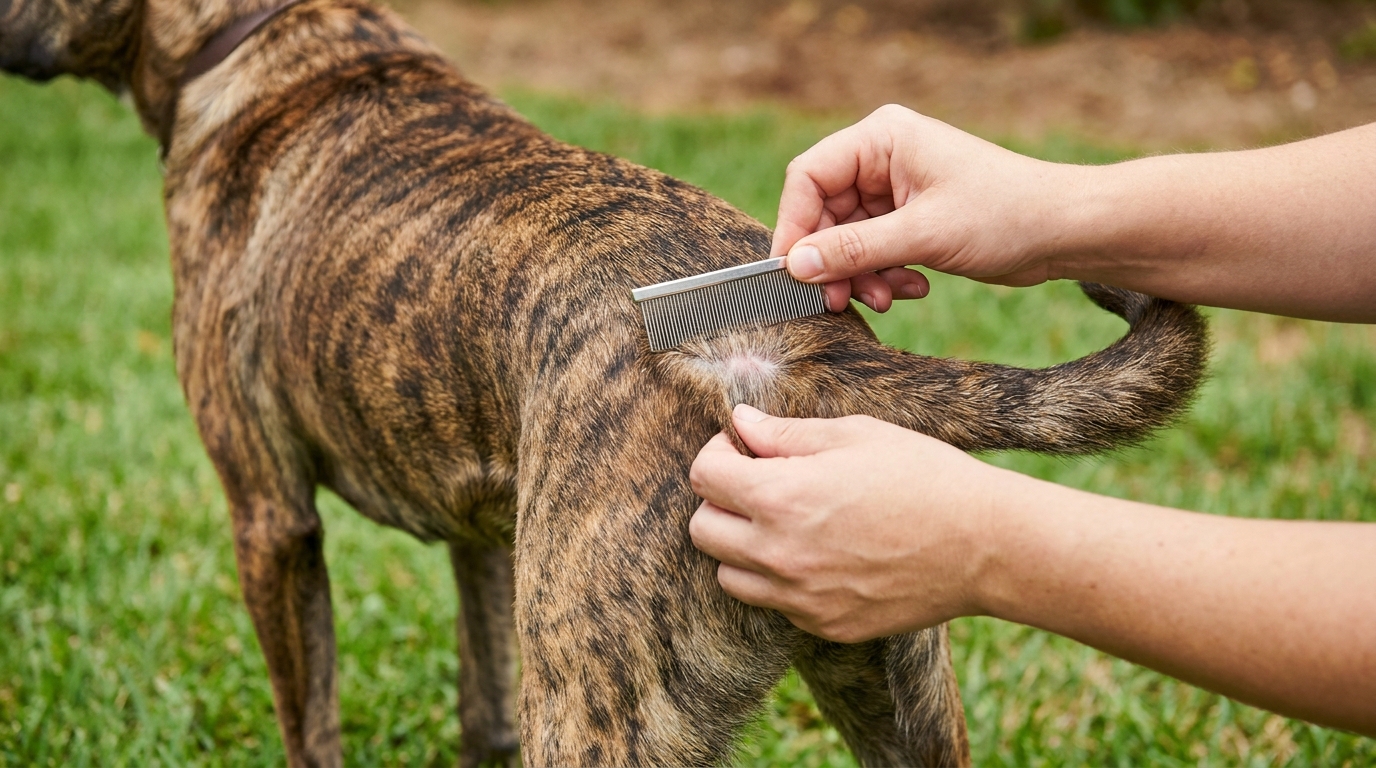
Where the scabs sit is the best clue. Use this location map, a 2-minute flea check and clear red flags to decide what to do tonight.
Quick answer: Itchy scabs on a dog's middle-to-lower back and tail base are the classic sign of flea allergy, even if you see no fleas. Crusty bumps on the trunk and belly often mean a surface skin infection. Comb for flea dirt tonight and put every dog and cat on a flea product labeled for its species. Scabs that hurt, ooze, smell or come with fever need an in-person vet today.
This article is general information, not a diagnosis. If you think your pet is in danger, go to the nearest emergency animal hospital.
Where the scabs are: a location map
| Where the scabs are | Common causes | Next step |
|---|---|---|
| Middle and lower back, tail base, backs of thighs | Flea allergy, even if you see no fleas | Flea-dirt test; flea control for every pet |
| Back, with heavy flaky dandruff | Cheyletiella mites (can spread to people) | Clinic tape test or scrape |
| Back: painful, oozing bumps days after grooming | Deep skin infection (furunculosis) | Same-day in-person vet |
| Trunk and belly: pimples, peeling rings, crusts | Surface skin infection (pyoderma) | Vet exam; clinic cytology confirms |
| Belly, chest, elbows, hocks, ear edges; intense itch | Sarcoptic mange (contagious, people too) | In-person exam; treat all dogs in contact |
| Paws, face, ears, armpits, belly | Skin allergy (atopic dermatitis) | Vet allergy plan; fix fleas first |
| Round bald, scaly patches anywhere | Ringworm, a fungus (spreads to people) | Clinic tests (Wood's lamp, culture, PCR) |
| Small bald patches on a young dog's face or front legs | Localized Demodex mites | Skin scrape to confirm |
| Bridge of the nose or face (sometimes body only) | Pemphigus foliaceus | In-person exam; biopsy confirms |
| Ear or tail tips turning purple or black | Vasculitis | Emergency vet now |
| Around the eyes and mouth in Huskies and Malamutes | Zinc-responsive skin disease | In-person exam |
Patterns overlap, and any itchy dog can pick up a skin infection on top, so use the map as a starting point, not a diagnosis.
When scabs need an emergency vet or a same-day visit
Emergency vet now:
- Tremors, wobbliness or a seizure after a flea or tick product (isoxazoline chew labels warn about these).
- Your dog licked or ate a flea product, or a dog product went on a cat. Call ASPCA Animal Poison Control at (888) 426-4435 (a consultation fee may apply) or the Pet Poison Helpline at (855) 764-7661 (a per-incident fee applies), or go to an ER.
- A puppy, tiny or elderly dog covered in fleas with pale gums, weakness or collapse. The Companion Animal Parasite Council (CAPC) warns heavy flea loads can cause serious blood loss and death, especially in young animals.
- Skin turning purple or black, ulcerating or sloughing on the ear tips, tail or footpads (signs of vasculitis, per the Merck Veterinary Manual).
- Facial swelling, hives or trouble breathing.
In-person vet the same day:
- Scabs that hurt, smell, or ooze blood or pus, or draining holes in the skin (Merck's hallmarks of deep infection).
- Painful bumps or bleeding, oozing sores along the back within a few days of a bath or grooming (post-grooming furunculosis).
- Crusts with fever, low energy, poor appetite, weight loss or obvious pain.
In-person exam within days, no wait-and-see:
- Scabs spreading quickly or with hair loss.
- Intense itch with crusts on the ear edges, elbows, hocks or belly (possible mange, so check every dog in the home).
- A scab on a lump, or a sore that bleeds or keeps growing.
- Skin infections that keep coming back.
- No improvement 3 to 4 days into a vet's treatment (Merck says to rethink the diagnosis then).
If anyone at home gets an itchy or ring-shaped rash, they should see their own doctor, and the dog needs a check.
Scabs on the middle-to-lower back and near the tail: think fleas first
Itchy scabs on the middle-to-lower back, the base of the tail and the backs of the thighs are the classic pattern of flea allergy. In long-standing, severe cases it can spread almost anywhere, including the face and ears (Merck Veterinary Manual).
Merck describes flea allergy as itch, small bumps and crusts, often with hair loss. Scratching and licking can create hot spots and a second, bacterial infection. Over time the skin can turn hairless, dark and thick, with small firm lumps on the back and rump.
Not finding fleas does not rule out flea allergy. Allergic pets can groom fleas off, so vets often treat strict flea control as the test. Merck notes skin and blood flea-allergy tests have limited accuracy and are no longer recommended. Itch medicine can ease a dog while flea control takes hold, but it should never replace flea control.
The 2-minute flea-dirt test
- Lay a damp white paper towel under your dog.
- Run a fine-tooth flea comb through the fur on the back and tail base, down to the skin.
- Tap the comb onto the towel and look for reddish-black specks shaped like pellets or commas.
- Crush them. If they dissolve into a reddish-brown smear, that is flea dirt (flea droppings), per the Merck Veterinary Manual.
A clean towel does not rule out flea allergy.
A whole-house flea plan
Merck says flea control has to cover the itchy pet, the other pets and the home.
- Every dog and cat, year-round. CAPC recommends year-round flea control for every dog and cat in the home. In warm climates it is lifelong (Merck).
- The right product for each animal. Use only a flea product labeled for that species, age and weight. Never put a dog product on a cat, and do not stack flea products.
- The home, too. Flea pupae can sit in pet bedding (CAPC), so wash or replace bedding.
- Time. CAPC says most fleas already in a home emerge as adults over about 3 to 5 weeks, so a few fleas in week 2 or 3 do not by themselves mean the product failed (see still getting fleas on flea prevention). Clearing an established infestation often takes up to 3 months (Merck).
- Seizure history. Isoxazoline chews carry label warnings for tremors and seizures, so tell the vet if your dog has ever had a seizure. See flea and tick prevention for dogs with seizures.
CAPC notes the common cat and dog flea also carries germs that infect people, including the cause of cat scratch disease.
Crusty bumps on the trunk and belly: surface skin infection
Bacterial skin infection (pyoderma) shows up most often on the trunk and belly, according to Merck. The surface form looks like small pimples at hair follicles, rings of peeling skin, crusts, scale and patchy hair loss. It is often set off by allergies (flea, food or environmental) and sometimes by hormone diseases such as an underactive thyroid or Cushing's disease, which is why infections that keep coming back need an in-person workup.
For most surface skin infections, medicated baths and other topical treatment are the main or only treatment (Merck). Oral antibiotics are kept for deep or widespread infection, or when topical care fails. A skin-cell test (cytology) at a clinic confirms the infection, and skin not improving within a few days of treatment needs a recheck. Deeper infections that need antibiotic pills often take several weeks, which by our reading of Florida law can run past the state's 14-day telehealth limit, so they usually need a clinic.
Belly, armpits, paws and face: skin allergy
Atopic dermatitis, an allergy to things in the environment, most often affects the paws, face, ears, the bend of the front legs, the armpits and the belly (Merck). It usually starts between 6 months and 3 years of age. Food allergy is another possible trigger, and a vet decides how to test for it. Fix fleas first either way. Our guide to dog skin allergies covers long-term care.
Itch medicines need a vet. The oclacitinib (Apoquel) label limits it to dogs at least 12 months old, rules out dogs with serious infections and warns it may make infections, including Demodex, more likely. So a vet checks for infection and mites first, and itch medicine never replaces flea control. Skip human allergy pills and leftover steroids. If your dog is still scratching on an allergy medicine, read why a dog can stay itchy on Apoquel.
Mites and ringworm: causes that can spread to people
Cheyletiella ("walking dandruff") causes scaling along the back, with itch that ranges from none to severe, and Merck notes people in the home are often affected. A vet confirms it with tape, a surface scrape or flea combing.
Sarcoptic mange usually starts on the belly, chest, ears, elbows and hocks with intense itch. It spreads readily between dogs, and people in contact can become infected. Suspected mange needs an in-person exam. A negative scrape does not rule it out, and every dog in contact needs treatment. Some flea-and-tick chews work against mange mites but are not FDA-approved for mange.
Demodex in young dogs. In puppies and young dogs, a few small bald, scaly patches from Demodex mites, usually around the lips, eyes and front legs, often clear on their own and are not considered contagious. A vet should still confirm it with a skin scrape, because it can look like mange or ringworm. Spreading patches, or Demodex in an adult dog, need an in-person workup. Merck warns against steroids in any dog with Demodex.
Ringworm is a fungal infection, not a worm, causing hair loss, scale, crusts, redness and bumps. No single test is the gold standard, so vets combine a Wood's lamp, fungal culture, PCR and microscopy. The CDC says ringworm spreads easily from pets to people, so anyone at home with a ring-shaped or itchy rash should tell their doctor. Spores do not multiply in the home; physical cleaning, then disinfection, removes them (Merck).
Scabs on the ear tips, nose and face
- Ear edges. Tight crusts on the ear margins with intense itch suggest sarcoptic mange. Look-alikes include fly bites, which leave small bloody crusts on the tips of upright ears or the folded surface of floppy ears, and ear margin seborrhea (common in Dachshunds), which leaves waxy gray-yellow scale along the edges of both ears and can become swollen and cracked (Merck). A vet tells these apart from mange. Ear tips turning purple or black, sharp-edged ulcers or sloughing skin point to vasculitis, inflammation of the blood vessel walls that also hits the tail and footpads (Merck). Treat that as an emergency.
- Nose and face. Pemphigus foliaceus is uncommon but is the most common autoimmune skin disease in dogs. It usually starts on the face, though some dogs get crusts only on the body. Crusts with fever, low energy or poor appetite need an in-person vet the same day, and confirming pemphigus takes a skin biopsy. A review in Today's Veterinary Practice notes it has been linked to some topical flea and tick products.
- Eyes and mouth in Huskies and Malamutes. Tight scale, crusts and redness can be zinc-responsive skin disease (Merck). Do not start zinc or change your dog's calcium on your own. A vet confirms this condition and sets any supplement.
Which checks happen at home, on video and at a clinic
Many causes look alike, so a clinic test often settles it.
| Check | What it looks for | Where |
|---|---|---|
| Flea comb and damp paper towel | Flea dirt | Home |
| Skin scrape | Sarcoptic or Demodex mites | Clinic |
| Tape or impression cytology | Bacteria, inflammatory cells, pemphigus clues, Cheyletiella | Clinic |
| Wood's lamp, fungal culture or PCR | Ringworm | Clinic |
| Skin biopsy | Pemphigus and other deep disease | Clinic |
| Needle sample of a lump | What the lump is made of | Clinic |
| Live video exam | Likely causes, urgency, flea and allergy plan, tests needed | Video visit |
How to photograph your dog's skin for a vet
Photos make a live video visit more useful and help track changes. They support an exam; they do not replace one.
- Use daylight or bright, even light, with no flash glare.
- Part the fur with your fingers or a comb.
- Take one wide shot that shows where the scabs are, then close-ups.
- Put a coin or ruler next to the spot for scale.
- Shoot before you bathe the dog or put anything on the skin.
- Photograph the flea-comb results on the damp paper towel.
- Reshoot the same spots every few days.
Not sure what the scabs are? Talk it through with RexVet
Book a $64.99 live video visit with Dr. Tiffany Delacruz, DVM, licensed in Florida, New York and Virginia (live slots about 8 AM-11 PM ET; your pet needs to be in one of those states). She can look at the scabs on live video, ask about fleas, itch, diet and the other pets at home, tell you how urgent it is, lay out a whole-home flea and allergy plan, and say which tests need a clinic. If your dog has any emergency or same-day sign listed above, go in person, not video.
Where appropriate and state rules allow, a flea-and-tick-only product may be an option, and so may an itch medicine approved for dogs and used as labeled, if she rules out infection and mange as far as video allows and your dog is old enough (many itchy, scabby dogs need a clinic skin scrape or cytology first). Not every visit ends in a prescription; that is her call, and itch medicine never replaces flea control. In Florida a telehealth-only prescription covers up to 1 month of a flea-and-tick-only product or up to 14 days of other FDA-approved animal drugs used as labeled, with no renewal without an in-person exam. Virginia allows an electronic exam, and New York's rules are unsettled, so she will tell you what is possible. RexVet is not a pharmacy: if she sends a prescription to an outside pharmacy, a pharmacy transfer fee applies (Terms 5.4), and the medicine is paid for separately.
Several pets scratching? The one-time $120 Family Plan covers 4 visits over 12 months for every pet in the home, costs less than two single visits and never auto-renews.
Frequently Asked Questions
Why does my dog have scabs on his back but no fleas?
Flea allergy is still the top suspect when scabs sit on the middle-to-lower back, the tail base and the backs of the thighs. Allergic dogs can groom fleas off, so you may never see one. Vets often use strict flea control on every dog and cat in the home, kept up for weeks, as the test. Cheyletiella mites and surface skin infections are other common causes.
What do crusty scabs on a dog's ear tips mean?
Tightly stuck crusts along the ear edges with intense itch are a classic sign of sarcoptic mange, which spreads to other dogs and to people. Ear tips that turn purple or black, ulcerate or slough point to vasculitis and need an emergency vet now. Fly bites and ear margin seborrhea (common in Dachshunds) can look similar, so a vet should rule out mange. Ear crusts plus nose or face crusts can mean pemphigus foliaceus.
How do I treat crusty scabs on my dog?
Treat the cause, not just the scab. Start or fix flea control for every dog and cat at home and stop the licking. Do not pick the scabs or put hydrogen peroxide, rubbing alcohol, essential oils or human creams on them. Surface infections are usually treated with medicated baths a vet chooses. See a vet within days if scabs spread or come with hair loss, and the same day if they hurt, ooze or smell.
Are scabs on my dog's back contagious?
Some causes are. Sarcoptic mange spreads easily between dogs and can spread to people, Cheyletiella often affects people in the home, and the CDC says ringworm spreads easily from pets to people. Flea allergy is not contagious, but fleas move between pets, so treat every dog and cat. Surface skin infections and the small Demodex patches of young dogs are not considered contagious. Anyone at home with an itchy or ring-shaped rash should see their own doctor.
Do scabs on a dog's back need antibiotics?
Not usually as a first step. The Merck Veterinary Manual says surface skin infections should be treated with topical therapy alone, such as medicated baths. Oral antibiotics are kept for deep, widespread or stubborn infections, confirmed with a clinic skin-cell test. Those courses often run several weeks and usually need a clinic recheck. Do not give leftover or human antibiotics.
When are scabs on a dog an emergency?
Go to an ER now for tremors, wobbliness or seizures after a flea product; a puppy, tiny or elderly dog covered in fleas with pale gums, weakness or collapse; skin turning purple or black, ulcerating or sloughing; or facial swelling, hives or trouble breathing. If a pet licked or ate a flea product, or a dog product went on a cat, call ASPCA Animal Poison Control at (888) 426-4435 (a consultation fee may apply) or the Pet Poison Helpline at (855) 764-7661 (a per-incident fee applies), or go to an ER. Painful, smelly or oozing scabs, or crusts with fever, need an in-person vet the same day.
FAQs
Why does my dog have scabs on his back but no fleas?
Flea allergy is still the top suspect when scabs sit on the middle-to-lower back, the tail base and the backs of the thighs. Allergic dogs can groom fleas off, so you may never see one. Vets often use strict flea control on every dog and cat in the home, kept up for weeks, as the test. Cheyletiella mites and surface skin infections are other common causes.
What do crusty scabs on a dog's ear tips mean?
Tightly stuck crusts along the ear edges with intense itch are a classic sign of sarcoptic mange, which spreads to other dogs and to people. Ear tips that turn purple or black, ulcerate or slough point to vasculitis and need an emergency vet now. Fly bites and ear margin seborrhea (common in Dachshunds) can look similar, so a vet should rule out mange. Ear crusts plus nose or face crusts can mean pemphigus foliaceus.
How do I treat crusty scabs on my dog?
Treat the cause, not just the scab. Start or fix flea control for every dog and cat at home and stop the licking. Do not pick the scabs or put hydrogen peroxide, rubbing alcohol, essential oils or human creams on them. Surface infections are usually treated with medicated baths a vet chooses. See a vet within days if scabs spread or come with hair loss, and the same day if they hurt, ooze or smell.
Are scabs on my dog's back contagious?
Some causes are. Sarcoptic mange spreads easily between dogs and can spread to people, Cheyletiella often affects people in the home, and the CDC says ringworm spreads easily from pets to people. Flea allergy is not contagious, but fleas move between pets, so treat every dog and cat. Surface skin infections and the small Demodex patches of young dogs are not considered contagious. Anyone at home with an itchy or ring-shaped rash should see their own doctor.
Do scabs on a dog's back need antibiotics?
Not usually as a first step. The Merck Veterinary Manual says surface skin infections should be treated with topical therapy alone, such as medicated baths. Oral antibiotics are kept for deep, widespread or stubborn infections, confirmed with a clinic skin-cell test. Those courses often run several weeks and usually need a clinic recheck. Do not give leftover or human antibiotics.
When are scabs on a dog an emergency?
Go to an ER now for tremors, wobbliness or seizures after a flea product; a puppy, tiny or elderly dog covered in fleas with pale gums, weakness or collapse; skin turning purple or black, ulcerating or sloughing; or facial swelling, hives or trouble breathing. If a pet licked or ate a flea product, or a dog product went on a cat, call ASPCA Animal Poison Control at (888) 426-4435 (a consultation fee may apply) or the Pet Poison Helpline at (855) 764-7661 (a per-incident fee applies), or go to an ER. Painful, smelly or oozing scabs, or crusts with fever, need an in-person vet the same day.
Medically Reviewed
Reviewed by Dr. Tiffany Delacruz, DVM — licensed veterinarian and CEO of RexVet. Last reviewed October 18, 2026.
Content is for informational purposes and does not replace professional veterinary advice.
Chief Executive Officer · Licensed Veterinarian
Dr. Delacruz is a licensed Doctor of Veterinary Medicine specializing in preventive care and veterinary telehealth. She reviews all health content on RexVet to ensure accuracy and clinical relevance.
Sources & References
- · American Veterinary Medical Association — Telehealth Guidelines
- · AVMA — Pet Care Resources
- · U.S. FDA — Animal & Veterinary
Need an Expert Opinion on This Topic?
Connect with a certified vet via video call in minutes
Talk to Vet Now