
Lick Granuloma in Dogs: Why One Spot Gets Licked Raw
By RexVet Team | Reviewed by Dr. Tiffany Delacruz, DVM
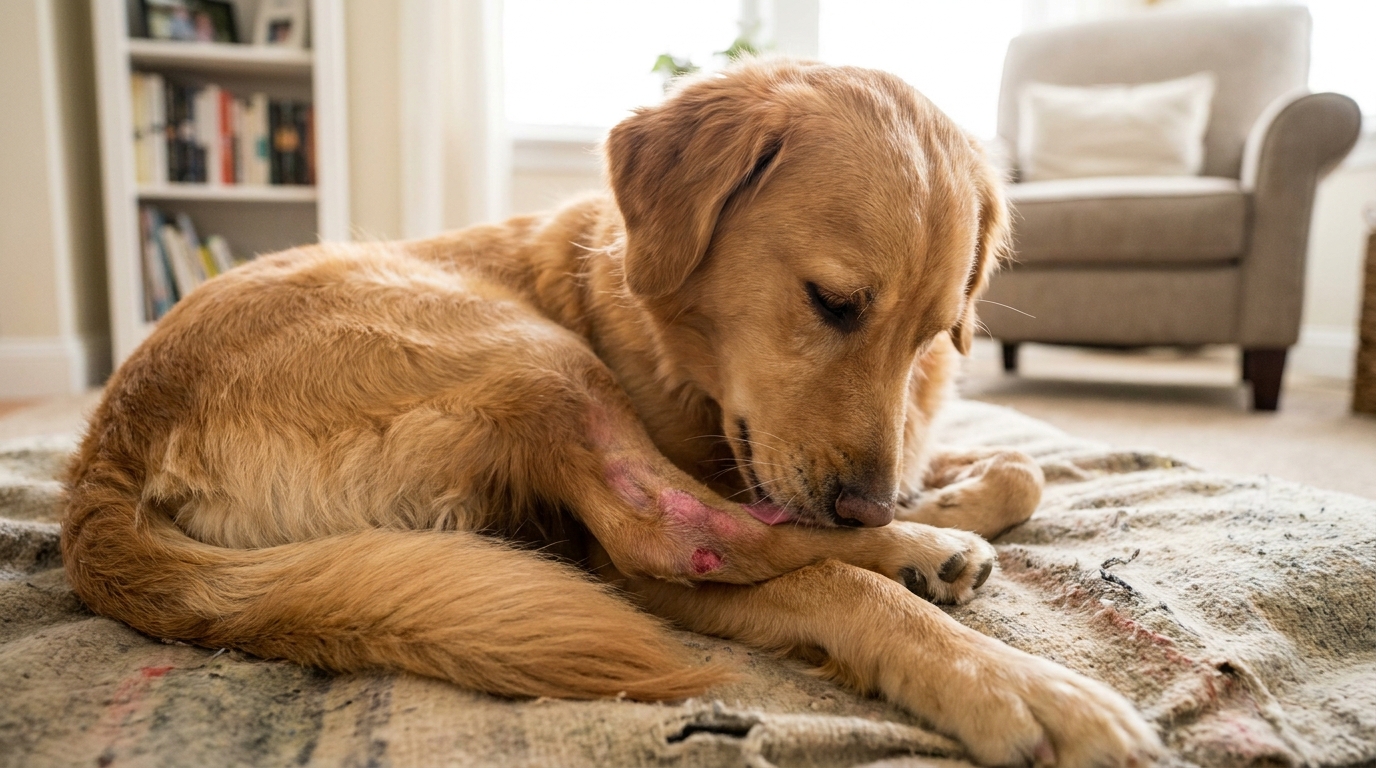
Why a dog licks one spot on the leg raw, how to tell a lick granuloma from a hot spot or a lump, which signs need a vet today, and what helps.
Quick answer: A dog licking one spot on the lower leg until it is raw, bald or thick may have a lick granuloma (acral lick dermatitis); VCA Animal Hospitals says it most often forms on the top of a front leg near the wrist. Put a cone on your dog today and see a vet within days. Pus, a bad smell or a spreading sore needs an in-person vet the same day.
This article is general information, not a diagnosis. If you think your pet is in danger, go to the nearest emergency animal hospital.
What is a lick granuloma?
A lick granuloma (acral lick dermatitis) is a firm, raised, often hairless sore that a dog makes by licking the same spot over and over, most often on the top of a front leg near the wrist, and it needs a vet within days.
VCA Animal Hospitals says the sore usually forms at the wrist (carpus), on the top or outer side of a front leg; hind legs are affected less often. VCA says lick granulomas occur mainly in medium to large breeds, particularly Doberman Pinschers, Great Danes, Labrador Retrievers, Weimaraners, Golden Retrievers and Boxers, but any breed can develop one.
From RexVet's visit data: Skin was the top concern in RexVet dog visits (18%), followed by itching, ear problems and allergies. These are concerns owners picked when booking, not diagnoses.
When is a licked spot a same-day problem?
A dog with a licked sore that oozes pus or blood, smells bad or is spreading needs an in-person vet the same day, and a hot, swollen wrist or leg under the sore needs one now.
- ER now: your dog swallowed hard plastic cone pieces, anything sharp, string, thread or long bandage strips, even with no signs. Do not make your dog vomit or pull on string you can see.
- In person now: your dog swallowed pieces of a sock, soft bandage or soft cone (your own vet if they can see your dog right away, otherwise an emergency vet). Do not make your dog vomit. See what to do if a dog swallowed a sock.
- ER now: a deep chewed-open wound, exposed tissue, or bleeding that does not stop with gentle pressure.
- In person now, no heat on it: a hot, swollen wrist, joint or leg near the licked spot.
- Same day, in person: pus, blood or a bad smell from the sore, a spreading sore, or an open, weeping sore with fever, tiredness or not eating.
- Same day, hands-on exam: your dog will not put weight on the leg. Go to the ER now if that followed a fall, a hard slip or being hit by a car, or if the leg is swollen, misshapen or bleeding.
- Vet within days: a new limp while your dog still puts weight on the leg, or a firm, thick, bald or raw spot that will not heal.
Is it a hot spot, a lick granuloma or a lump?
A hot spot is wet and appears quickly, a lick granuloma is firm and builds slowly, and a lump needs an in-person needle test; a hot spot that spreads fast or is more than 24 hours old needs an in-person vet today.
VCA Animal Hospitals describes hot spots (acute moist dermatitis) as red sores that appear quickly and ooze. Cornell's Riney Canine Health Center says a hot spot more than 24 hours old is likely infected; the German Shepherd skin guide covers hot spot care.
| Spot | Likely | Next step |
|---|---|---|
| Wet, spreads fast | Hot spot | In person today |
| Firm, thick, bald | Lick granuloma | Vet within days |
| Raised lump | Lump or growth | Needle test, within days |
| Pus or bad smell | Infection | Same day, in person |
| Hot, swollen leg | Infection or injury | In person now, no heat |
A firm, thick, bald patch of skin (not a raised lump) usually needs in-person tests; a video visit can be the first look.
Mast cell tumors are a common skin cancer in dogs, often on the legs, and the Merck Veterinary Manual says looks alone cannot tell one from a harmless lump. A firm or raised lump, a sore sitting on a lump, or a spot that grows or swells and shrinks needs an in-person needle test within days, or the same day if it bleeds or grows fast, the same rule as for skin bumps on pit bulls.
The Merck Veterinary Manual lists the lower end of the radius, the bone just above the wrist, among the most common sites of bone tumors in dogs, so a hard, bony swelling there with a limp needs in-person X-rays within days. Draining holes, nodules, sores on several legs, or a sore over an old surgery site or metal implant also need an in-person exam within days.
Why does my dog keep licking the same spot on the leg?
A dog keeps licking the same spot on its leg because something first set off the licking, such as an allergy, an infection, a cut, joint pain, anxiety or too little exercise, and then the licking itself keeps the sore going, so both need care.
VCA Animal Hospitals says the cause is unknown and probably mixed: allergies, infection and joint pain, plus fear, anxiety or compulsive disorder, and even an insect sting can start it. A review in Veterinary Clinics of North America: Small Animal Practice describes an itch-lick cycle in which infection in particular keeps the licking going.
Licking after rest or on cold days, with stiffness, can point to joint pain that flares in the cold. Licking the paws too, or itchy ears, points to an allergy, covered in the guides to itching with no fleas in sight and food allergy and elimination diets. Boredom counts too: the Merck Veterinary Manual lists a lack of outlets for normal behavior as a trigger, but says to rule out allergies, parasites, infection and pain first.
| When it licks | Possible cause | What helps |
|---|---|---|
| Alone or bored | Too little activity | More walks, play |
| After rest, cold days | Joint pain | Vet check |
| Paws, ears too | Allergy | Flea control, vet |
| After a cut or sting | Injury, irritant | Cone, watch it |
| New home or routine | Anxiety | Steady routine |
Will a lick granuloma go away on its own?
A lick granuloma usually does not go away without treatment, because constant licking keeps the skin from healing and infection often sits deep under the surface, so see a vet within days.
In a 2008 study in Veterinary Dermatology, bacteria grew from deep tissue samples in 30 of 31 lick granulomas, and surface swabs matched the deeper bacteria in only 8 of 22 dogs; the authors concluded these sores call for tissue cultures, which are taken in person. VCA Animal Hospitals says lick granulomas are often chronic, relapsing problems that need long-term treatment, though most cases can be treated successfully when owners follow through.
What can I do at home for a lick granuloma?
The best thing to do today for a dog licking one spot raw is to stop the licking with a cone, keep the spot dry with nothing on it, and take a dated photo each day until the vet visit.
- Cone first. VCA Animal Hospitals says e-collars, bandages or shirts may be used early to stop the licking. Check that your dog can eat and drink in the cone, use a shirt or sleeve only while you watch, and skip tight wraps; if a wrap gets wet, slips or smells, or the toes swell or feel cold, take it off and call a vet the same day.
- Nothing on the sore. No hydrogen peroxide, rubbing alcohol, tea tree or other essential oils, apple cider vinegar, human creams, bitter sprays or leftover antibiotics. The Merck Veterinary Manual says hydrogen peroxide is toxic to healthy tissue.
- A daily record. Take a daylight photo each day and note when the licking happens: after rest, alone, at night or after walks.
- More exercise and play. The Merck Veterinary Manual says to start with exercise and mental stimulation suited to your dog's age and breed, then gently interrupt the licking and redirect your dog to play or a long-lasting chew.
- Flea control kept current for every dog and cat in the home, with a product labeled for that pet's species, age and weight.
How does a vet treat a lick granuloma?
A vet treats a lick granuloma by working on three things at once: the infection, the underlying cause and the licking habit, and most tests are done in person.
The Veterinary Clinics of North America review says success means treating the primary disease, the infection and the behavior. VCA Animal Hospitals says a vet may X-ray the joint under the sore, test the skin for bacteria, yeast or fungus, and take a biopsy to rule out mange or a tumor.
Guidelines published in 2025 by the International Society for Companion Animal Infectious Diseases (ISCAID) call for a skin cytology test before any antibiotic and start treatment of a deep skin infection with 3 weeks of medicine, followed by a recheck. If the sore is worse, or shows no change at all, 3 to 4 days into a vet's treatment, call that vet; it needs an in-person recheck within days. Do not stop or change the medicine on your own, and never use leftover antibiotics.
How long does a lick granuloma take to heal?
A lick granuloma usually takes weeks to heal, often longer, and it can come back if the cause and the licking habit are not treated, so keep every recheck until a vet says the infection has cleared.
The Merck Veterinary Manual says treatment should continue until the sore has fully cleared and a recheck shows no infection under the microscope. Keep the cone on until your vet says to stop, and keep up the exercise after healing, since the habit can return.
When does a video visit fit a dog that keeps licking one spot?
RexVet, a nonprofit online vet service, serves pets located in Florida, New York and Virginia by video visit. A $64.99 live video visit with a licensed RexVet vet can be the first look for a dog that keeps licking one spot raw, bald or thick when the spot is not hot, swollen, smelly, oozing or spreading and the dog is otherwise well.
On camera, a veterinarian licensed in your pet's state looks at the spot, along with daylight photos and a short video of the licking and of your dog walking. They take the licking history, sort out whether it looks more like a lick granuloma or a hot spot, look for the likely trigger, set up a plan to stop the licking and say which in-person tests are needed. Your dog must be located in Florida, New York or Virginia during the visit. Live video slots run about 8 AM to 11 PM ET. There are no overnight visits, and holiday hours are not confirmed, so check open slots when you book. Book a live video visit.
Skin cytology, a skin scraping, a deep tissue culture, a biopsy, a needle test of a lump and X-rays are done in person, and a sore that has lasted for weeks usually needs at least one of them.
A video visit is not the first step for any same-day, in-person-now or ER sign listed above, or for a firm lump or bony swelling at the wrist, which needs a needle test or X-rays in person within days.
From RexVet's own visit data: Of the main concern groups, visits for vomiting, diarrhea or digestive problems were among the most likely to end with a prescription (21%), while only 5% of skin and itching visits did.
The veterinarian decides whether any medicine is right, and RexVet does not promise a prescription. Because the ISCAID guidelines call for skin cytology before any antibiotic, treatment for an infected lick granuloma usually starts after an in-person skin sample. Florida (s.474.2021) limits video-only prescriptions to FDA-approved animal drugs used as labeled, for up to 14 days (1 month for products labeled only for flea and tick control), with no renewal without an in-person exam; human-labeled drugs, controlled drugs and compounded antibacterial, antifungal, antiviral or antiparasitic drugs need an in-person exam. Under federal rules (21 CFR 530.3), a human medicine or an off-label use of an animal drug needs a vet who has examined the dog in person, in every state, and the Merck Veterinary Manual notes that behavior medicines for lick granulomas are used off-label. Virginia allows an electronic exam, but that does not override the federal rule; New York's rules for video-only prescriptions are still unsettled. RexVet is not a pharmacy; a pharmacy transfer fee applies when RexVet sends a prescription to an outside pharmacy.
Need an Expert Opinion on This Topic?
Book a video visit with a licensed vet, evenings and weekends included
See open timesFrequently Asked Questions
My dog keeps licking his wrist and now there's a bald, raw spot. What should I do?
Put a cone on your dog today, keep the spot dry with nothing on it, and see a vet within days. Go in person the same day if the sore oozes pus or blood, smells or spreads, and now if the wrist is hot and swollen.
Can I put antibiotic cream on a spot my dog licked raw?
No, not unless a vet who examined your dog says so: your dog licks it off, and infection often sits deep under the skin. If your dog licked off a human prescription skin cream or gel, or vomits or acts unwell after licking any cream, call ASPCA Animal Poison Control at (888) 426-4435 (a consultation fee may apply) or the Pet Poison Helpline at (855) 764-7661 (a per-incident fee applies) now, or go to an emergency vet.
Is a lick granuloma on my dog cancer?
No, a lick granuloma is not cancer, but a tumor can look like one, so a firm or growing lump, a sore sitting on a lump, or a spot that swells and shrinks needs an in-person needle test within days. A 2007 report in the Journal of the American Animal Hospital Association described six dogs whose lick-granuloma-like sores were caused by other diseases, including a mast cell tumor and lymphoma. A new sore in an older dog that never licked before needs a needle sample within days, or the same day if it bleeds or grows fast.
Why does my dog lick his leg more at night?
Usually because night is quiet: a dog lying down can reach the spot easily, and nothing distracts it from licking. VCA Animal Hospitals says lick granulomas form on spots a dog can lick constantly while lying in a normal position. Give a walk and a long-lasting chew before bed, and keep the cone on overnight.
Do cats get lick granulomas?
Not usually: lick granulomas are described mainly in dogs, and a cat that licks a patch bald most often has an itch problem. In a 2006 study in the Journal of the American Veterinary Medical Association, 16 of 21 cats referred for presumed stress-related hair loss had a medical cause of itching. A raised red sore or lip ulcer on a cat is more often part of eosinophilic granuloma complex, which the Merck Veterinary Manual says is most commonly caused by an allergy, often to fleas. A sore or lump on a cat that does not heal needs an in-person exam within days. A cat licking its belly or genitals while straining to pee, especially a male passing little or no urine, needs an ER now.
Can an online vet treat my dog's lick granuloma by video if we live in Florida, New York or Virginia?
Partly: a video visit can look at the spot, find the likely trigger and plan care, but tests and longer treatment need an in-person vet. On camera, a veterinarian licensed in your pet's state can look at the sore and how your dog walks, check for triggers, set up a cone and exercise plan, and say what must happen in person; your dog must be located in one of those states during the visit. Skin cytology and scrapings, deep tissue cultures, biopsies, lump needle tests and X-rays need an in-person visit. In Florida, a prescription after a video-only visit is limited to FDA-approved animal drugs used as labeled, for up to 14 days (1 month for products labeled only for flea and tick control), with no renewal without an in-person exam; human-labeled drugs, controlled drugs and compounded antibacterial, antifungal, antiviral or antiparasitic drugs need an in-person exam. Federal rules (21 CFR 530.3) require an in-person exam before a human medicine or an off-label animal drug is used, in every state, including behavior medicines for licking. Virginia allows an electronic exam, but that does not override the federal rule. New York's rules for video-only prescriptions are still unsettled. No prescription is promised.
FAQs
My dog keeps licking his wrist and now there's a bald, raw spot. What should I do?
Put a cone on your dog today, keep the spot dry with nothing on it, and see a vet within days. Go in person the same day if the sore oozes pus or blood, smells or spreads, and now if the wrist is hot and swollen.
Can I put antibiotic cream on a spot my dog licked raw?
No, not unless a vet who examined your dog says so: your dog licks it off, and infection often sits deep under the skin. If your dog licked off a human prescription skin cream or gel, or vomits or acts unwell after licking any cream, call ASPCA Animal Poison Control at (888) 426-4435 (a consultation fee may apply) or the Pet Poison Helpline at (855) 764-7661 (a per-incident fee applies) now, or go to an emergency vet.
Is a lick granuloma on my dog cancer?
No, a lick granuloma is not cancer, but a tumor can look like one, so a firm or growing lump, a sore sitting on a lump, or a spot that swells and shrinks needs an in-person needle test within days. A 2007 report in the Journal of the American Animal Hospital Association described six dogs whose lick-granuloma-like sores were caused by other diseases, including a mast cell tumor and lymphoma. A new sore in an older dog that never licked before needs a needle sample within days, or the same day if it bleeds or grows fast.
Why does my dog lick his leg more at night?
Usually because night is quiet: a dog lying down can reach the spot easily, and nothing distracts it from licking. VCA Animal Hospitals says lick granulomas form on spots a dog can lick constantly while lying in a normal position. Give a walk and a long-lasting chew before bed, and keep the cone on overnight.
Do cats get lick granulomas?
Not usually: lick granulomas are described mainly in dogs, and a cat that licks a patch bald most often has an itch problem. In a 2006 study in the Journal of the American Veterinary Medical Association, 16 of 21 cats referred for presumed stress-related hair loss had a medical cause of itching. A raised red sore or lip ulcer on a cat is more often part of eosinophilic granuloma complex, which the Merck Veterinary Manual says is most commonly caused by an allergy, often to fleas. A sore or lump on a cat that does not heal needs an in-person exam within days. A cat licking its belly or genitals while straining to pee, especially a male passing little or no urine, needs an ER now.
Can an online vet treat my dog's lick granuloma by video if we live in Florida, New York or Virginia?
Partly: a video visit can look at the spot, find the likely trigger and plan care, but tests and longer treatment need an in-person vet. On camera, a veterinarian licensed in your pet's state can look at the sore and how your dog walks, check for triggers, set up a cone and exercise plan, and say what must happen in person; your dog must be located in one of those states during the visit. Skin cytology and scrapings, deep tissue cultures, biopsies, lump needle tests and X-rays need an in-person visit. In Florida, a prescription after a video-only visit is limited to FDA-approved animal drugs used as labeled, for up to 14 days (1 month for products labeled only for flea and tick control), with no renewal without an in-person exam; human-labeled drugs, controlled drugs and compounded antibacterial, antifungal, antiviral or antiparasitic drugs need an in-person exam. Federal rules (21 CFR 530.3) require an in-person exam before a human medicine or an off-label animal drug is used, in every state, including behavior medicines for licking. Virginia allows an electronic exam, but that does not override the federal rule. New York's rules for video-only prescriptions are still unsettled. No prescription is promised.
Medically Reviewed
Reviewed by Dr. Tiffany Delacruz, DVM — licensed veterinarian and CEO of RexVet. Last reviewed November 6, 2026.
Content is for informational purposes and does not replace professional veterinary advice.
Chief Executive Officer · Licensed Veterinarian
Dr. Delacruz is a licensed Doctor of Veterinary Medicine specializing in preventive care and veterinary telehealth. She reviews all health content on RexVet to ensure accuracy and clinical relevance.
Sources & References
- · American Veterinary Medical Association — Telehealth Guidelines
- · AVMA — Pet Care Resources
- · U.S. FDA — Animal & Veterinary