
My Dog Ate an Ant Bait Trap: What to Do Right Now
By RexVet Team | Reviewed by Dr. Tiffany Delacruz, DVM
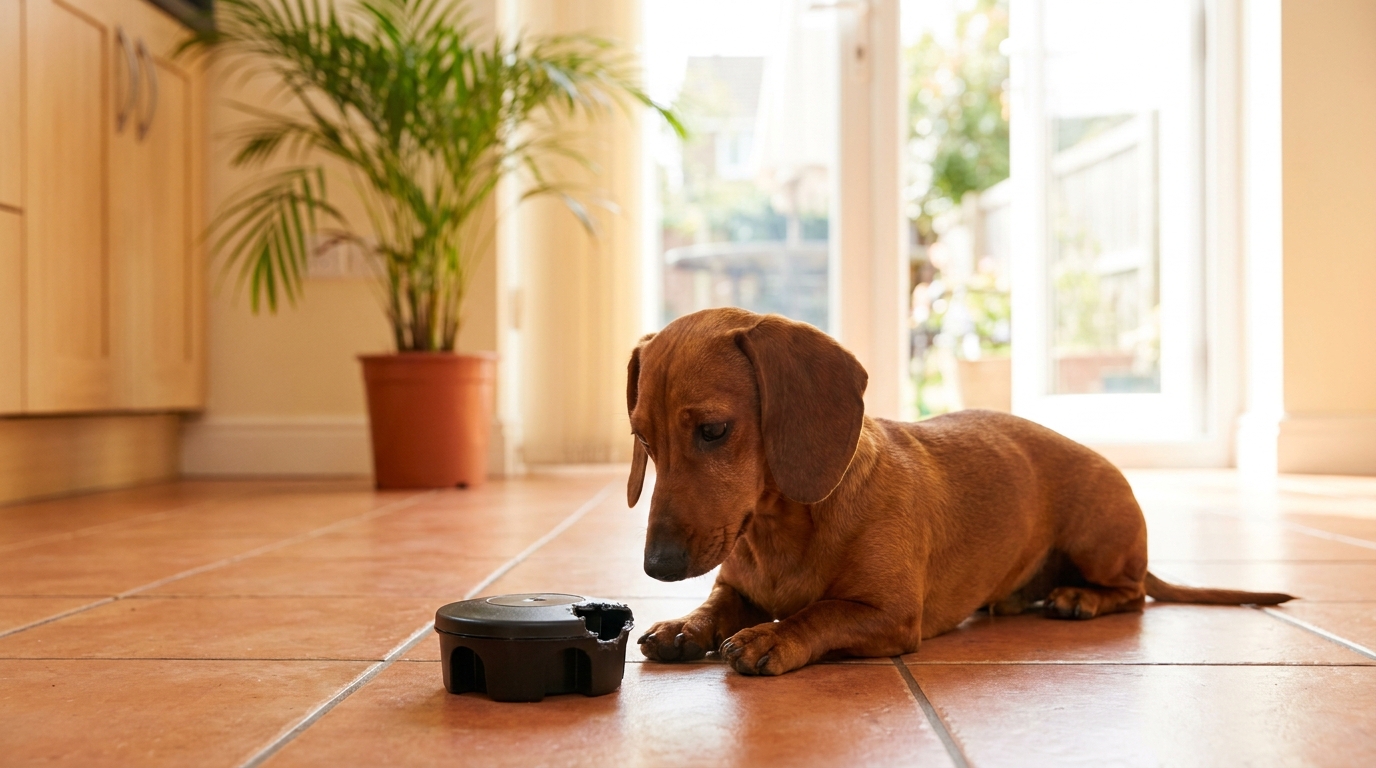
My dog ate an ant bait trap? The insecticide is usually a tiny dose; the bigger risks are swallowed plastic and a bait that was not for ants at all.
Go to an in-person emergency vet now if your dog is trembling, drooling heavily, having a seizure, vomiting over and over or straining, has a painful belly, or if the bait may have been rat, mouse or snail bait rather than ant bait.
My Dog Ate an Ant Bait Trap: What Is Inside
You found a chewed bait station under the couch or by the kitchen door, and your dog looks pleased with itself. Here is what was in it.
Ant and roach bait stations are small plastic or metal cases with a sweet bait inside. ASPCA Animal Poison Control Center veterinarians, writing in Today's Veterinary Nurse, explain that "The baits contain peanut butter, breadcrumbs, sugar, and other sweeteners that act as attractants for roaches and ants." That food smell is exactly why dogs go after them.
The same authors list the insecticides you are likely to see on the label: "Some common insecticides used in these traps include boric acid, chlorpyrifos, fipronil, indoxacarb, abamectin, and hydramethylnon."
The reassuring part is the amount. ASPCA Animal Poison Control veterinarians report that "Bait traps have very low concentrations of insecticides and have a wide margin of safety in dog and cat exposures." They add that "Gastrointestinal (GI) upset is the most common clinical sign seen when these baits are ingested."
That does not make ant baits harmless. It means the poison is usually not the main worry. The two things that matter more are the plastic or metal case your dog may have swallowed, and whether the bait was really an ant bait in the first place.
Emergency Signs, and the Rat-Bait Mix-Up
Before anything else, check your dog against this list. Any one of these means go to an in-person emergency vet now:
- Trembling or shaking
- Heavy drooling
- A seizure
- Vomiting over and over, or straining without passing stool
- A painful belly
- Any chance the bait was rat, mouse or snail bait
That last point matters a lot. Rat, mouse and snail baits contain different poisons from ant baits, and they are treated as emergency cases. If there is any chance your dog ate one of those, or you cannot tell which bait it was, go to an in-person emergency vet now and bring the packaging. Our guide on whether a dog that ate a dead mouse could be poisoned explains why rodent bait is treated so differently.
If you are not sure whether what you are seeing counts as an emergency, use this practical pet emergency checklist. When in doubt, go in.
For poison questions on the way, or while you decide, you can call a poison line:
- ASPCA Animal Poison Control: (888) 426-4435
- Pet Poison Helpline: (855) 764-7661
Both answer 24/7, and a consultation fee may apply. Have the product package in your hand when you call.
The Real Danger Is Usually the Plastic
A dog that chews a bait station can swallow part of the case along with the bait. That is where the real risk usually sits.
ASPCA Animal Poison Control veterinarians put it plainly: "Life-threatening clinical signs are not expected; however, some dogs may eat the plastic or metal bait casing, which could lead to a foreign body obstruction." Because the casing could cause an obstruction, watch your dog closely if any of it is missing.
A foreign body obstruction means a piece is stuck somewhere in the stomach or intestines and food cannot pass. The signs to look for, and which ones mean go in now, are in the section on what to watch over the next day or two, below.
The source says the casing could lead to an obstruction, not that it always will, which is why the next step is careful watching rather than panic. The same logic applies to other things dogs swallow on a walk, as our article on what to do when a dog eats a chicken bone off the street explains.
Check your dog's mouth for cuts too, and keep every piece you find. Your vet or the poison line will want to know roughly how much of the case is missing.
Florida Lawns: Fire-Ant Baits and Granules
Many Florida yards are treated for fire ants with baits or granules, so a dog nosing through the grass can end up eating some. These lawn products are not the same as an indoor bait station, and each one has its own directions.
Read the product bag for its pet directions, keep your dog off treated areas as the label directs, and if your dog ate granules, call a poison line with the product name. Take a photo of the bag, or bring it inside, before you dial.
If your dog was stung rather than poisoned, see our guide to fire ant bites on dogs in Florida.
What to Do Right Now
If your dog has none of the emergency signs above, work through these steps calmly:
- Pick up every remaining trap so your dog cannot get more.
- Gather the chewed pieces and count how many traps or pieces are missing.
- Photograph the product label so the poison line or your vet can see the exact product and active ingredient.
- Look in your dog's mouth for cuts or stuck pieces. If you can do it safely, take any loose pieces from the front of the mouth. Never reach into the throat, and stop if your dog resists; a scared or queasy dog may bite.
- Offer fresh water.
- Do not make your dog vomit. That is a veterinarian's decision.
Size matters here. Pet Poison Helpline notes that "Typically, smaller dogs can experience more pronounced symptoms." A small dog that chewed through a bait station deserves a quicker call than a large dog that licked one.
Pet Poison Helpline also says ant poisoning is handled "by calling Pet Poison Helpline® at (855) 764-7661 and your veterinarian." Keep the product name and the photo of the label ready when you call. The ASPCA Animal Poison Control Center says it is "available 24/7, 365 days a year" at (888) 426-4435. A fee may apply for either line.
What to Watch Over the Next Day or Two
Most of what you need to do next is watch. Keep your dog close over the next day or two, and check the signs below.
Pet Poison Helpline lists the likely signs: "Potential clinical signs of ant trap poisoning are diarrhea, vomiting, and bloody stool, along with other symptoms." They also note that a dog that licks or eats the bait "may or may not get sick."
Watch for these, and call a vet promptly if any appear:
- Diarrhea or a single episode of vomiting
- Not eating
- Blood in the stool, or no stool at all
Some signs are not watch-at-home signs at all. Repeated vomiting, a painful belly, or straining without passing stool can be signs of a blockage, so go to an in-person emergency vet now if you see any of them. A blockage cannot be diagnosed or treated by video.
If vomiting is the main thing you are seeing, our guide on why a dog is vomiting walks through what different patterns can mean.
What a RexVet Online Vet Can and Cannot Do After a Dog Eats an Ant Trap
If your dog is acting normally and you want a veterinarian's eyes on the situation, a video visit can help you sort out the next step. RexVet's veterinarians are licensed in Florida, New York and Virginia and are available 24/7 by video.
On a video visit, a veterinarian can:
- Read the product label and active ingredient with you on camera
- Look at your dog's mouth with you for cuts or stuck pieces
- Weigh the plastic risk by your dog's size and how much casing is missing
- Help you decide whether to watch at home, call poison control, or go in now
A video vet cannot take X-rays, induce vomiting, give fluids or remove a blockage. If any of those may be needed, they will send you to an in-person clinic.
If the veterinarian decides medication is appropriate, they can prescribe where state rules allow. In Florida, a veterinarian who has seen your pet only by video may prescribe only FDA-approved animal drugs used as labeled, for up to 14 days (1 month for flea-and-tick-only products), and cannot renew without an in-person exam.
RexVet's veterinarians are available 24/7 for pet parents in Florida, New York and Virginia only. A video visit is $64.99; book a RexVet video visit.
When to See a Vet in Person in Florida, New York or Virginia
Go to an in-person vet now, not a video visit, if any of these apply:
- Tremors, heavy drooling or a seizure
- Repeated vomiting, or straining without passing stool
- Belly pain
- A small dog that swallowed a whole casing
- A lot of casing is missing and you cannot find it
- Any doubt that it was ant bait rather than rat, mouse or snail bait
Bring the product package, the chewed pieces and the photo of the label. They help the clinic team work out what your dog ate and how much.
If you start with a video visit in Florida, the law already builds in a path to in-person care: a Florida telehealth vet must give "the contact information for at least one physical veterinary clinic in the vicinity of the patient's location" (Fla. Stat. 474.2021).
For more on how video care works where you live, see our pages for an online vet in Florida, an online vet in New York and an online vet in Virginia.
Frequently Asked Questions
Are ant traps poisonous to dogs?
They contain insecticide, so they are not harmless. ASPCA Animal Poison Control veterinarians report that bait traps have very low concentrations of insecticides and a wide margin of safety in dogs, and stomach upset is the most common sign. The bigger worries are swallowed casing and a bait that may not have been for ants. Read the label and call a poison line with the product name if you are unsure.
What if my dog ate the plastic part of an ant trap?
The plastic or metal casing could cause a foreign body obstruction, so watch your dog closely over the next day or two. Repeated vomiting or belly pain means go to an in-person emergency vet now, and not eating means call a vet promptly. If a small dog swallowed a whole casing, go in person rather than waiting.
What are the symptoms of ant bait poisoning in dogs?
Pet Poison Helpline lists diarrhea, vomiting and bloody stool as possible signs, and smaller dogs can have more pronounced symptoms. Keep a close eye on your dog over the next day or two, and call a vet if any sign appears. Trembling, heavy drooling or a seizure is an emergency.
Is fire ant bait on the lawn dangerous for dogs?
It depends on the product, so read the bag's pet directions and keep your dog off treated areas as the label says. If your dog ate granules, call a poison line with the product name. If your dog shows any emergency sign, go to an in-person emergency vet.
Should I make my dog throw up after eating an ant trap?
No. Do not try to make your dog throw up at home; only a veterinarian should make that call. Instead, phone a poison line or a veterinarian with the product label in front of you.
Remember the order: any emergency sign, or any chance the bait was rat, mouse or snail bait, means an in-person emergency vet first. If your dog seems fine and you want a veterinarian to look at the label, the chewed pieces and your dog with you, RexVet's veterinarians are available 24/7 for pet parents in Florida, New York and Virginia only. A video visit is $64.99; book a video visit now.
FAQs
Are ant traps poisonous to dogs?
They contain insecticide, so they are not harmless. ASPCA Animal Poison Control veterinarians report that bait traps have very low concentrations of insecticides and a wide margin of safety in dogs, and stomach upset is the most common sign. The bigger worries are swallowed casing and a bait that may not have been for ants. Read the label and call a poison line with the product name if you are unsure.
What if my dog ate the plastic part of an ant trap?
The plastic or metal casing could cause a foreign body obstruction, so watch your dog closely over the next day or two. Repeated vomiting or belly pain means go to an in-person emergency vet now, and not eating means call a vet promptly. If a small dog swallowed a whole casing, go in person rather than waiting.
What are the symptoms of ant bait poisoning in dogs?
Pet Poison Helpline lists diarrhea, vomiting and bloody stool as possible signs, and smaller dogs can have more pronounced symptoms. Keep a close eye on your dog over the next day or two, and call a vet if any sign appears. Trembling, heavy drooling or a seizure is an emergency.
Is fire ant bait on the lawn dangerous for dogs?
It depends on the product, so read the bag's pet directions and keep your dog off treated areas as the label says. If your dog ate granules, call a poison line with the product name. If your dog shows any emergency sign, go to an in-person emergency vet.
Should I make my dog throw up after eating an ant trap?
No. Do not try to make your dog throw up at home; only a veterinarian should make that call. Instead, phone a poison line or a veterinarian with the product label in front of you.
Remember the order: any emergency sign, or any chance the bait was rat, mouse or snail bait, means an in-person emergency vet first. If your dog seems fine and you want a veterinarian to look at the label, the chewed pieces and your dog with you, RexVet's veterinarians are available 24/7 for pet parents in Florida, New York and Virginia only. A video visit is $64.99; book a video visit now.
Medically Reviewed
Reviewed by Dr. Tiffany Delacruz, DVM — licensed veterinarian and CEO of RexVet. Last reviewed September 23, 2026.
Content is for informational purposes and does not replace professional veterinary advice.
Chief Executive Officer · Licensed Veterinarian
Dr. Delacruz is a licensed Doctor of Veterinary Medicine specializing in preventive care and veterinary telehealth. She reviews all health content on RexVet to ensure accuracy and clinical relevance.
Sources & References
- · American Veterinary Medical Association — Telehealth Guidelines
- · AVMA — Pet Care Resources
- · U.S. FDA — Animal & Veterinary
Need an Expert Opinion on This Topic?
Connect with a certified vet via video call in minutes
Talk to Vet Now