
Dog Crying All Night After Surgery: Pain or Anesthesia?
By RexVet Team | Reviewed by Dr. Tiffany Delacruz, DVM
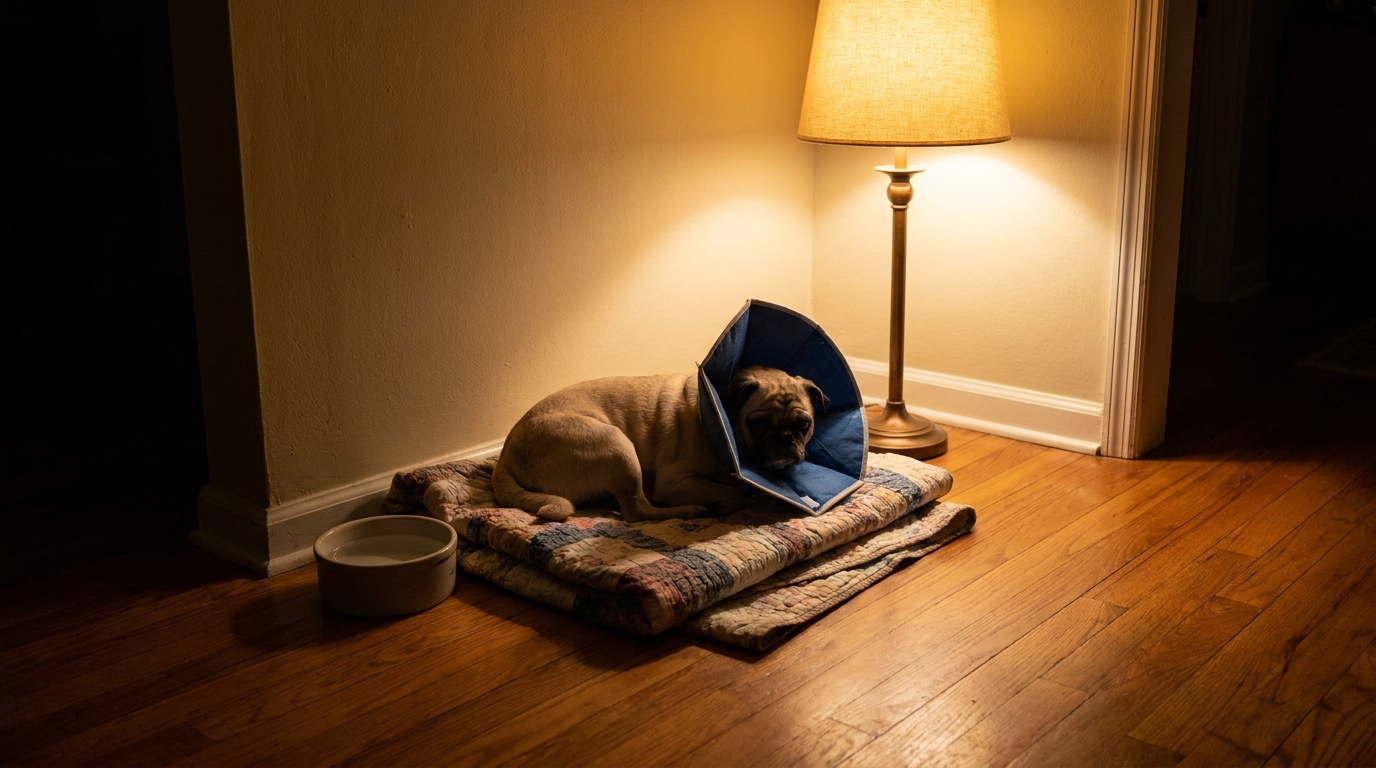
Whining and pacing the first night after anesthesia are common and usually fade by morning, but pain, a full bladder and real emergencies look alike.
If your dog cannot be roused, has pale or white gums, is struggling to breathe, has continuous bleeding or a swollen or open incision, keeps vomiting, or cries without stopping and gets worse when touched, call the surgeon's emergency line or go to an in-person emergency vet now.
If none of those signs are present, take a breath. A dog crying all night after surgery is often the anesthesia wearing off; the sections below help you tell that apart from pain and a full bladder, and tell you what to do about each.
Why your dog is crying all night after surgery: what is normal on night one
VCA Animal Hospitals says anesthetic drugs can take several hours to wear off and may leave a dog drowsy for about a day; many dogs are sleepy or tired for 12 to 24 hours after anesthesia. The American College of Veterinary Surgeons (ACVS) says pets commonly sleep more and are less interactive for the rest of the day, and that some appear restless, confused or more vocal as they recover; those signs should gradually improve. VCA also notes that the breathing tube can cause mild irritation and a slight cough.
A board-certified veterinary anesthesiologist writing in Clinician's Brief lists six common causes of a rough recovery. As a guide, not a diagnosis:
- Emergence delirium: the dog comes round before it is fully conscious and is confused and agitated, and may not seem to know where it is or who you are.
- Pain: the surgical site hurts and no position feels right.
- Anxiety: a strange day, a strange cone and a strange feeling in the body.
- A distended bladder: the bladder fills up while the dog is too groggy to ask to go out, and a full bladder alone can make a dog cry, pace and pant.
- Opioid dysphoria: the strong pain relievers used around surgery leave some dogs agitated and unable to settle rather than sleepy.
- Sedative (benzodiazepine) disinhibition: a sedative given with anesthesia can, in some dogs, strip away normal inhibitions instead of calming them.
Anesthesia dysphoria vs. pain: how to tell the difference at home
Two rules first: never press on the incision or the belly, and do not hold your dog down. A painful dog can bite; a struggling dog can pull an incision open. Comparing a sore area with a normal one is the veterinary team's job.
Clinician's Brief and the North American Veterinary Anesthesia Society (NAVAS) describe dysphoria as vocalization, restlessness, panting, difficulty settling down, a raised body temperature and a dog that does not respond to human contact. Pain, Clinician's Brief says, looks much the same, with one difference: aggression or guarding when the painful area is touched. NAVAS adds that the hardest case is a dog that is quietly but relentlessly whining.
The home guide, a guide not a diagnosis: sit on the floor a short distance away, speak softly, do not restrain your dog, and watch.
- A dog that does not seem to respond to your voice or touch, and cannot settle however quiet the room, is more likely disoriented.
- A dog that guards, flinches or snaps when you approach or touch the surgical side, or gets worse when moved, is more likely in pain.
Either way, the surgeon's line is the right call if the crying is not improving.
The cause owners miss: a full bladder
Clinician's Brief notes that bladder distension by itself can cause vocalization, restlessness and panting, and that patients who can walk should be walked to relieve it. First question: has your dog peed since coming home?
If not, a short, slow leash walk on flat ground is the first thing to try. Keep the cone on, skip the stairs, and never let the dog off-leash or allow jumping. ACVS says some pets urinate less or more than usual on the first day, and that a delayed bowel movement for one or two days is common, so a skipped poop tonight is not a worry.
If the walk produces no urine and your dog stays restless, panting or crying, call the surgeon's after-hours line tonight rather than waiting for morning.
Did the pain medication go in as directed?
ACVS says pain medications should be given exactly as directed, and that skipping doses or stopping early can result in increased discomfort and may slow recovery. VCA says to read the label carefully and give all medication as instructed.
Check the discharge sheet for when the first at-home dose was due, whether a long-acting pain injection was given at the clinic, and whether a dose is due right now. A dog restless after surgery is sometimes a dog whose scheduled dose has not gone in yet.
Never double a dose, never give an early dose, and never add a human pain reliever, leftover medication, supplement or anything else not on the discharge sheet. If the timing is unclear, do not guess: call the clinic or its emergency line and ask. RexVet's pages on pain relief for dogs and carprofen for dogs describe what surgeons commonly send home, without doses.
What you can safely do right now to help your dog settle
All of this is low-risk and often enough to get a dog that won't settle after surgery through to morning:
- A dim, quiet room away from other pets and children, even in a New York apartment where the crying wakes the neighbors.
- The Elizabethan collar stays on. VCA says to contact the hospital and request one if you were not given one.
- A low bed or folded blanket on the floor rather than furniture.
- If the clinic allowed food, VCA says you may offer about half the regular dinner a few hours after arriving home, plus water. Do not force either.
- No stairs, no jumping, no play, and no repeated picking up. Sit nearby and talk in a low, calm voice instead.
- Keep the house cool, especially in a warm Florida home, because heat-panting is easy to mistake for pain. Panting that looks labored or very fast, or does not ease once the room is cool, is a red flag.
- Write down the time, what your dog is doing, whether it has peed, and when the last dose was given. The surgeon or an online vet will ask.
Red flags: when crying after surgery is not dysphoria
Some signs mean a complication, and none can wait for a morning appointment or a video visit. Any of these means the surgeon's emergency line or an in-person 24-hour emergency hospital now:
- Your dog is unusually sluggish or you cannot rouse it easily; VCA says to contact the hospital immediately.
- Pale or white gums.
- Labored or very rapid breathing, or struggling to breathe (see signs of respiratory distress in dogs).
- Continuous or excessive bleeding, or excessive swelling or redness at the incision; VCA lists these as contact-the-hospital-immediately signs.
- The incision opening, or discharge, heat or a bad odor from it; ACVS lists these among the incision concerns that need the veterinary team.
- Repeated vomiting.
- A belly that looks swollen or tight.
- Crying that gets worse with touch and never settles.
- Worsening lethargy, weakness or behavior changes, or pain that is persistent or getting worse; ACVS says to contact the veterinary team for these.
In Florida, New York and Virginia the clinic's discharge sheet lists an after-hours number; call it first. If there is none, go to a 24-hour emergency hospital. An online vet cannot treat any of these; see online vet vs. emergency vet.
What the surgical clinic will do, and what an online vet can and cannot do
Any change to post-surgical medication, whether more pain relief, a sedative or a different drug, is the operating clinic's decision, because they know what was given during and after the procedure. That is why the discharge sheet usually lists an after-hours number.
An online vet cannot change that plan, but can help you decide whether the call needs to happen tonight. On video, a veterinarian watches your dog: posture, panting, whether it settles when you sit with it, and how it reacts when you approach the surgical side. The vet checks gum color and counts breaths on camera, asks whether the dog has urinated and whether the dispensed medication was given as directed, and reads the discharge sheet with you. Then the online vet can tell you whether what you are seeing fits normal anesthesia recovery or needs the surgeon's emergency line tonight. If any red-flag sign is present, the answer is the emergency line or the ER, not a booking. For pain signs beyond the first 72 hours, see how to tell if your dog is in pain; for a dog trembling as well as crying, see dog shaking: pain or anxiety.
If your dog is awake, breathing normally and has pink gums, you can book a RexVet video visit now for $64.99. RexVet's veterinarians are licensed in Florida, New York and Virginia only and are available 24/7. It is triage and reassurance, not a prescription or a change to the surgeon's plan.
What the next 72 hours usually look like
Night one is usually the roughest. ACVS says the restlessness, confusion and extra vocalizing should gradually improve, and VCA says the drowsiness usually lifts within about a day. Your dog may still be sleepier than usual on day two; lethargy that is getting worse is different, and a call-now sign. Appetite and normal toileting come back, and activity stays restricted for as long as the surgeon said.
VCA says the incision should stay clean with the edges together and the surrounding skin a normal or slightly reddish-pink color; look once a day without touching it.
Call the surgeon in the morning if your dog is still crying, not eating, not peeing, or if anything at the incision has changed. If your dog was just altered, the spay and neuter recovery guide covers the following week; if panting continues past recovery, see the excessive panting in dogs guide.
You do not have to sit on the floor alone until the clinic opens. If your dog has none of the emergency signs above but will not settle, you can book a video visit with a RexVet veterinarian for $64.99, 24/7; RexVet's veterinarians are licensed in Florida, New York and Virginia only. The vet will say plainly whether this fits normal night-one recovery or needs the surgeon's line or an ER now, and cannot prescribe or change the plan.
Frequently asked questions
Is it normal for a dog to cry all night after surgery?
Some whining, pacing and panting on the first night is common and should gradually improve. ACVS says some pets are restless, confused or more vocal as anesthesia wears off. A dog crying all night after surgery that is not settling at all, gets worse, or shows any red-flag sign needs the surgeon's emergency line tonight; otherwise call the clinic in the morning.
How can I tell if my dog is in pain or just disoriented from anesthesia?
A disoriented dog paces and vocalizes without responding to your voice or touch, while a painful dog guards, flinches or snaps when you approach or touch the surgical side. Never press on the incision to check; if your dog cannot settle, call the surgeon's line or have a RexVet veterinarian look on camera.
How long does anesthesia dysphoria last in dogs?
There is no fixed number. VCA says anesthetic drugs can take several hours to wear off and many dogs are sleepy or tired for 12 to 24 hours, and ACVS says restlessness and confusion should gradually improve. If it is not improving by morning, or gets worse tonight, call the surgical team; any medication change is the operating clinic's decision.
Can I give my dog something to calm him down or more pain medication tonight?
No. Nothing extra: no human pain reliever, no leftovers, no supplement, no early or doubled dose. Check the discharge sheet for when the next dose is due and give only that. Dosing belongs to the operating clinic, so call its emergency line; an online vet can help you read the sheet but cannot change the medication.
Can an online vet help if my dog won't settle the night after surgery?
Yes, as long as none of the emergency signs are present. On video a veterinarian can watch posture and breathing, check gum color, and see how your dog reacts when you approach the surgical side, then tell you whether this fits normal recovery or needs the surgeon's line or an emergency clinic now. The online vet cannot change medication.
Sources
- Clinician's Brief: Rough Anesthetic Recoveries in Dogs & Cats
- North American Veterinary Anesthesia Society: Handling Ruff Recoveries
- American College of Veterinary Surgeons: Postoperative Care After Surgery
- VCA Animal Hospitals: Post-Operative Instructions in Dogs
- VCA Animal Hospitals: Anesthesia for Dogs
FAQs
Is it normal for a dog to cry all night after surgery?
Some whining, pacing and panting on the first night is common and should gradually improve. ACVS says some pets are restless, confused or more vocal as anesthesia wears off. A dog crying all night after surgery that is not settling at all, gets worse, or shows any red-flag sign needs the surgeon's emergency line tonight; otherwise call the clinic in the morning.
How can I tell if my dog is in pain or just disoriented from anesthesia?
A disoriented dog paces and vocalizes without responding to your voice or touch, while a painful dog guards, flinches or snaps when you approach or touch the surgical side. Never press on the incision to check; if your dog cannot settle, call the surgeon's line or have a RexVet veterinarian look on camera.
How long does anesthesia dysphoria last in dogs?
There is no fixed number. VCA says anesthetic drugs can take several hours to wear off and many dogs are sleepy or tired for 12 to 24 hours, and ACVS says restlessness and confusion should gradually improve. If it is not improving by morning, or gets worse tonight, call the surgical team; any medication change is the operating clinic's decision.
Can I give my dog something to calm him down or more pain medication tonight?
No. Nothing extra: no human pain reliever, no leftovers, no supplement, no early or doubled dose. Check the discharge sheet for when the next dose is due and give only that. Dosing belongs to the operating clinic, so call its emergency line; an online vet can help you read the sheet but cannot change the medication.
Can an online vet help if my dog won't settle the night after surgery?
Yes, as long as none of the emergency signs are present. On video a veterinarian can watch posture and breathing, check gum color, and see how your dog reacts when you approach the surgical side, then tell you whether this fits normal recovery or needs the surgeon's line or an emergency clinic now. The online vet cannot change medication.
Sources
- Clinician's Brief: Rough Anesthetic Recoveries in Dogs & Cats
- North American Veterinary Anesthesia Society: Handling Ruff Recoveries
- American College of Veterinary Surgeons: Postoperative Care After Surgery
- VCA Animal Hospitals: Post-Operative Instructions in Dogs
- VCA Animal Hospitals: Anesthesia for Dogs
Medically Reviewed
Reviewed by Dr. Tiffany Delacruz, DVM — licensed veterinarian and CEO of RexVet. Last reviewed September 19, 2026.
Content is for informational purposes and does not replace professional veterinary advice.
Chief Executive Officer · Licensed Veterinarian
Dr. Delacruz is a licensed Doctor of Veterinary Medicine specializing in preventive care and veterinary telehealth. She reviews all health content on RexVet to ensure accuracy and clinical relevance.
Sources & References
- · American Veterinary Medical Association — Telehealth Guidelines
- · AVMA — Pet Care Resources
- · U.S. FDA — Animal & Veterinary
Need an Expert Opinion on This Topic?
Connect with a certified vet via video call in minutes
Talk to Vet Now