
Dog Hasn't Pooped Since Surgery? When to Worry Tonight
By RexVet Team | Reviewed by Dr. Tiffany Delacruz, DVM
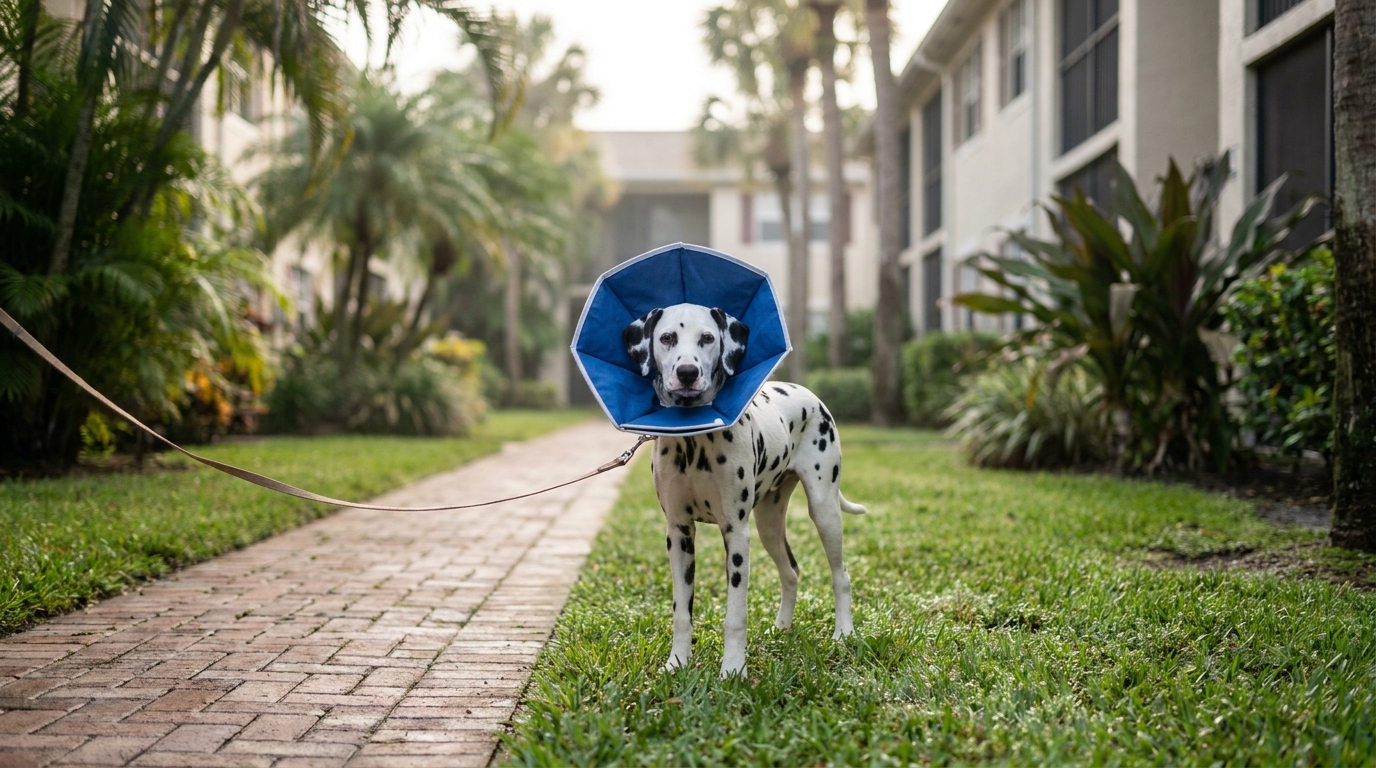
Dog hasn't pooped since surgery? A short delay is common; call a vet after 48 hours home. Vomiting or repeated straining means ER now.
Go to an emergency vet now if your dog strains again and again with nothing coming out, can't pee, vomits, has a swollen, hard or painful belly, is very weak or hard to wake, collapses, has a seizure, or has trouble breathing.
Dog hasn't pooped since surgery: how long is normal?
Your dog is home, eating a little and peeing, but has not pooped. The advice you find can seem to disagree, partly because each source starts its clock at a different point.
PetMD's guide to dog surgery aftercare says: "It’s common for dogs to have a delayed bowel movement after surgery, but prolonged constipation should be monitored." It also says: "Most dogs should have a bowel movement within 48 hours after returning home."
The American College of Veterinary Surgeons (ACVS) counts from the surgery itself: "It is common for pets to have a delayed bowel movement for one or two days after surgery. Reduced food intake, pain medications, and decreased activity can all contribute."
Tufts' Lerner spay/neuter clinic, writing about its own spay and neuter patients, also counts from the surgery: "Some pets may not have a bowel movement for 3-4 days after surgery and this is normal due to a decreased food consumption and decreased activity level."
So the windows differ by source, and only PetMD's 48 hours is counted from the time your dog came home. PetMD's advice is "Contact your veterinarian if no bowel movement occurs after 48 hours", counted from homecoming.
That call threshold applies only to a dog with none of the emergency signs. A dog that strains again and again with nothing coming out, vomits, or has a swollen, hard or painful belly does not wait: go to an emergency vet now.
Emergency signs: go to an ER now, not a video call
Go to an emergency vet now if you see any of these:
- straining again and again with nothing coming out
- can't pee
- any vomiting
- a swollen, hard or painful belly
- very weak or hard to wake
- collapse
- a seizure
- trouble breathing
We treat repeated straining as an emergency because at home you often cannot tell whether a straining dog is trying to poop or trying to pee, and PetMD says: "Inability to urinate after surgery is a medical emergency and requires immediate veterinary care."
PetMD also says: "Vomiting, seizures, difficulty breathing, or inability to urinate require immediate veterinary care." On vomiting in particular, PetMD notes that "vomiting can interfere with healing—especially after abdominal procedures—so prompt evaluation is important."
A spay is abdominal surgery, so this applies to spayed dogs too. With your surgeon's office closed for the night, any vomiting after surgery means go to an emergency vet now.
The Merck Veterinary Manual, describing intestinal obstruction, warns: "The dog may be unable to stop vomiting, which can lead to life-threatening consequences."
If you are unsure whether a sign is present, go now.
Why surgery slows things down
PetMD lists these causes of constipation after surgery:
- anesthesia medications, which slow gut movement
- surgical manipulation of the digestive system
- reduced food intake before and after surgery
PetMD adds: "A short delay is normal, especially since your dog likely fasted before surgery, meaning there may be little in the digestive tract to pass initially."
Speaking of constipation in dogs in general, not specifically after surgery, the Merck Veterinary Manual notes: "A lack of water intake or the reluctance to defecate on a regular basis due to environmental stress or pain that occurs while defecating contributes to the formation of hard, dry feces."
Do not stop or change anything the surgeon sent home on your own. PetMD says: "Only give your dog pain medications that are prescribed by your veterinarian."
If your dog is also restless or crying at night but has none of the emergency signs, see our guide to a dog crying all night after surgery.
Constipated or just empty? What to check tonight
PetMD gives these as signs of constipation:
- Straining to pass stool
- Passing small, dry, or hard stools
- Vocalizing during attempts
- Frequent attempts with little or no result
VCA Animal Hospitals says: "If your dog is constipated, they will probably try to pass feces several times, unsuccessfully."
A small amount of watery stool can fool you. VCA notes: "Sometimes, the liquid feces are mistaken for diarrhea".
Merck also notes: "Some animals are quite ill and also have lethargy, depression, loss of appetite, vomiting, and abdominal discomfort."
Our own rule for tonight: straining again and again with nothing coming out, any vomiting, a swollen, hard or painful belly, or a dog that is very weak or hard to wake means go to an emergency vet now, even if your dog otherwise seems bright. Those signs can appear on constipation lists, but that does not make them safe to watch at home.
A dog that is bright, drinking, peeing normally and eating a little, with none of the emergency signs, and that simply has not pooped yet, is a call-the-surgeon or video-vet situation.
Write these down now for whoever sees your dog:
- the type of surgery and the date
- when your dog came home
- when your dog last pooped
- what and how much your dog has eaten
- whether your dog pees normally
- which discharge-sheet medicines were given, and when
- any vomiting
What you can safely do before morning
These steps are for a dog with none of the emergency signs.
Keep water within reach. ACVS says: "Access to fresh water should always be available unless otherwise instructed." The Merck Veterinary Manual, on constipated dogs, says: "Affected dogs should receive plenty of water."
Feed exactly what the discharge sheet says.
Offer calm leash trips outside to your dog's usual spot for bathroom breaks, within the surgeon's activity limits. In its advice on leash use, ACVS says: "Dogs should be taken outside on a leash for bathroom breaks only, unless otherwise instructed."
Between trips, keep things quiet and confined as your discharge sheet instructs. Tufts' spay/neuter aftercare says: "Keep your pet confined to a crate or small room like a bathroom for the first 3 to 5 days."
Find the after-hours number on the discharge sheet now, before you need it.
Do not give anything from your own medicine cabinet or any home remedy. The Merck Veterinary Manual warns: "Laxatives formulated for humans can be very dangerous for animals, especially cats." PetMD says: "Never give human pain medications to your dog—many are toxic or even fatal".
If your dog tries to go, passes nothing and has none of the emergency signs, a short clip can help. ACVS notes: "Sharing updates, photos, or videos can help your veterinary team assess recovery and address concerns early." If your dog strains again and again with nothing coming out, do not stop to film: go to an emergency vet now.
While your dog is settled, glance at the incision. If you find a swelling under a spay incision, see our guide to a lump under a spay incision.
How a vet checks a dog that hasn't pooped, in person
VCA says: "Most cases of constipation are diagnosed through physical examination and medical history."
The Merck Veterinary Manual explains: "Your veterinarian can confirm the presence of retained fecal matter by feeling the abdomen and performing a rectal examination."
VCA adds: "In many cases, they will perform abdominal X-rays to determine the extent of constipation and whether an obstruction exists."
After abdominal surgery, including a spay, the surgical team may want to see your dog themselves.
What a RexVet online vet can and cannot do when your dog hasn't pooped since surgery
This is only for a dog with none of the emergency signs above. Any of them means go to an emergency vet now, not a video call.
RexVet's veterinarians are licensed in Florida, New York and Virginia and are available 24/7. On a video visit, a vet can:
- take the full history, using the notes above
- watch your dog walk, squat and settle on camera
- look at the incision and the shape of the belly
- read the discharge sheet with you
- coach a water, food and leash bathroom-break plan within the surgeon's limits
- help sort the situation into ER now, call the surgeon in the morning, or keep watching with a clear deadline
A video vet cannot feel your dog's belly, do a rectal exam, take X-rays, or change the medicines the operating clinic sent home.
If the veterinarian decides medication is appropriate, they can prescribe where state rules allow. In Florida, a veterinarian who has seen your pet only by video may prescribe only FDA-approved animal drugs used as labeled, for up to 14 days (1 month for flea-and-tick-only products), and cannot renew without an in-person exam. Changes to the medicines your surgeon sent home are the operating clinic's decision.
If your dog has none of the emergency signs, you can book a RexVet video visit for $64.99 with a veterinarian licensed in Florida, New York and Virginia.
When to call the surgeon or be seen in person in Florida, New York or Virginia
Any sign from the emergency checklist above means go to an emergency vet now.
With no emergency sign, any of these means calling the surgical team or getting a vet to look at your dog the same day:
- no stool more than 48 hours after coming home (PetMD's window)
- your dog is eating less and less
- blood in the stool
Tufts' spay/neuter clinic says of the first night: "It is normal for dogs and cats to be sleepy for the first night after anesthesia, but your pet should be bright and alert by the next day." If your dog is not brighter by the next day but has none of the emergency signs, get a vet to look that day. A dog that is very weak or hard to wake goes to an emergency vet now.
Any trouble breathing means go to an emergency vet now, and so does a dog that vomits and then coughs. If your dog is breathing comfortably, is otherwise bright and has only a mild cough after the breathing tube, see our guide to a dog coughing after surgery.
Under Florida law (Fla. Stat. 474.2021), a telehealth vet must give "the contact information for at least one physical veterinary clinic in the vicinity of the patient’s location."
If your dog has none of the emergency signs and you want a veterinarian's eyes on the plan tonight, you can book a video visit now; RexVet's veterinarians are available 24/7 for pet parents in Florida, New York and Virginia.
Frequently Asked Questions
How long can a dog go without pooping after surgery?
PetMD says most dogs should have a bowel movement within 48 hours after returning home, ACVS says a delayed bowel movement for one or two days after surgery is common, and Tufts' spay/neuter clinic says some of its spay and neuter patients may not have one for 3-4 days after surgery. For a bright dog with no emergency sign, PetMD advises: "Contact your veterinarian if no bowel movement occurs after 48 hours", counted from when your dog came home. Go to an emergency vet now if your dog strains again and again with nothing coming out, can't pee, vomits, has a swollen, hard or painful belly, is very weak or hard to wake, collapses, has a seizure, or has trouble breathing; if you are unsure, go now.
Is it normal for my dog not to poop after being spayed or neutered?
Tufts' Lerner spay/neuter clinic says of its own spay and neuter patients, "Some pets may not have a bowel movement for 3-4 days after surgery and this is normal due to a decreased food consumption and decreased activity level." PetMD's advice is stricter, so do not wait for day three or four: "Contact your veterinarian if no bowel movement occurs after 48 hours", counted from when your dog came home and only when no emergency sign is present. Go to an emergency vet now if your dog strains again and again with nothing coming out, can't pee, vomits, has a swollen, hard or painful belly, is very weak or hard to wake, collapses, has a seizure, or has trouble breathing; if you are unsure, go now.
Why is my dog straining after surgery but nothing comes out?
You may not be able to tell poop straining from pee straining, and PetMD says inability to urinate after surgery is a medical emergency. So, as our own stricter rule, we treat repeated straining with nothing coming out as an emergency: go to an emergency vet now if your dog strains again and again with nothing coming out, can't pee, vomits, has a swollen, hard or painful belly, is very weak or hard to wake, collapses, has a seizure, or has trouble breathing. If you are unsure, go now.
Can I give my dog something to help them poop after surgery?
Do not give human laxatives, human pain medicines or home remedies; the Merck Veterinary Manual warns that "Laxatives formulated for humans can be very dangerous for animals, especially cats." Water, the discharge-sheet food and leash bathroom breaks within the surgeon's limits are fine; anything more is for your surgical team to decide after examining your dog in person. Go to an emergency vet now if your dog strains again and again with nothing coming out, can't pee, vomits, has a swollen, hard or painful belly, is very weak or hard to wake, collapses, has a seizure, or has trouble breathing; if you are unsure, go now.
Should I go to the emergency vet if my dog hasn't pooped in three days after surgery?
Go to an emergency vet now if your dog strains again and again with nothing coming out, can't pee, vomits, has a swollen, hard or painful belly, is very weak or hard to wake, collapses, has a seizure, or has trouble breathing; if you are unsure, go now. If your dog is bright, alert, drinking and has none of those signs, do not keep waiting: call your surgical team or get a vet to look at your dog the same day, following PetMD's advice to "Contact your veterinarian if no bowel movement occurs after 48 hours", counted from when your dog came home.
FAQs
How long can a dog go without pooping after surgery?
PetMD says most dogs should have a bowel movement within 48 hours after returning home, ACVS says a delayed bowel movement for one or two days after surgery is common, and Tufts' spay/neuter clinic says some of its spay and neuter patients may not have one for 3-4 days after surgery. For a bright dog with no emergency sign, PetMD advises: "Contact your veterinarian if no bowel movement occurs after 48 hours", counted from when your dog came home. Go to an emergency vet now if your dog strains again and again with nothing coming out, can't pee, vomits, has a swollen, hard or painful belly, is very weak or hard to wake, collapses, has a seizure, or has trouble breathing; if you are unsure, go now.
Is it normal for my dog not to poop after being spayed or neutered?
Tufts' Lerner spay/neuter clinic says of its own spay and neuter patients, "Some pets may not have a bowel movement for 3-4 days after surgery and this is normal due to a decreased food consumption and decreased activity level." PetMD's advice is stricter, so do not wait for day three or four: "Contact your veterinarian if no bowel movement occurs after 48 hours", counted from when your dog came home and only when no emergency sign is present. Go to an emergency vet now if your dog strains again and again with nothing coming out, can't pee, vomits, has a swollen, hard or painful belly, is very weak or hard to wake, collapses, has a seizure, or has trouble breathing; if you are unsure, go now.
Why is my dog straining after surgery but nothing comes out?
You may not be able to tell poop straining from pee straining, and PetMD says inability to urinate after surgery is a medical emergency. So, as our own stricter rule, we treat repeated straining with nothing coming out as an emergency: go to an emergency vet now if your dog strains again and again with nothing coming out, can't pee, vomits, has a swollen, hard or painful belly, is very weak or hard to wake, collapses, has a seizure, or has trouble breathing. If you are unsure, go now.
Can I give my dog something to help them poop after surgery?
Do not give human laxatives, human pain medicines or home remedies; the Merck Veterinary Manual warns that "Laxatives formulated for humans can be very dangerous for animals, especially cats." Water, the discharge-sheet food and leash bathroom breaks within the surgeon's limits are fine; anything more is for your surgical team to decide after examining your dog in person. Go to an emergency vet now if your dog strains again and again with nothing coming out, can't pee, vomits, has a swollen, hard or painful belly, is very weak or hard to wake, collapses, has a seizure, or has trouble breathing; if you are unsure, go now.
Should I go to the emergency vet if my dog hasn't pooped in three days after surgery?
Go to an emergency vet now if your dog strains again and again with nothing coming out, can't pee, vomits, has a swollen, hard or painful belly, is very weak or hard to wake, collapses, has a seizure, or has trouble breathing; if you are unsure, go now. If your dog is bright, alert, drinking and has none of those signs, do not keep waiting: call your surgical team or get a vet to look at your dog the same day, following PetMD's advice to "Contact your veterinarian if no bowel movement occurs after 48 hours", counted from when your dog came home.
Medically Reviewed
Reviewed by Dr. Tiffany Delacruz, DVM — licensed veterinarian and CEO of RexVet. Last reviewed October 2, 2026.
Content is for informational purposes and does not replace professional veterinary advice.
Chief Executive Officer · Licensed Veterinarian
Dr. Delacruz is a licensed Doctor of Veterinary Medicine specializing in preventive care and veterinary telehealth. She reviews all health content on RexVet to ensure accuracy and clinical relevance.
Sources & References
- · American Veterinary Medical Association — Telehealth Guidelines
- · AVMA — Pet Care Resources
- · U.S. FDA — Animal & Veterinary
Need an Expert Opinion on This Topic?
Connect with a certified vet via video call in minutes
Talk to Vet Now