
Dog Losing Hair in Patches: Causes and When to See a Vet
By RexVet Team | Reviewed by Dr. Tiffany Delacruz, DVM
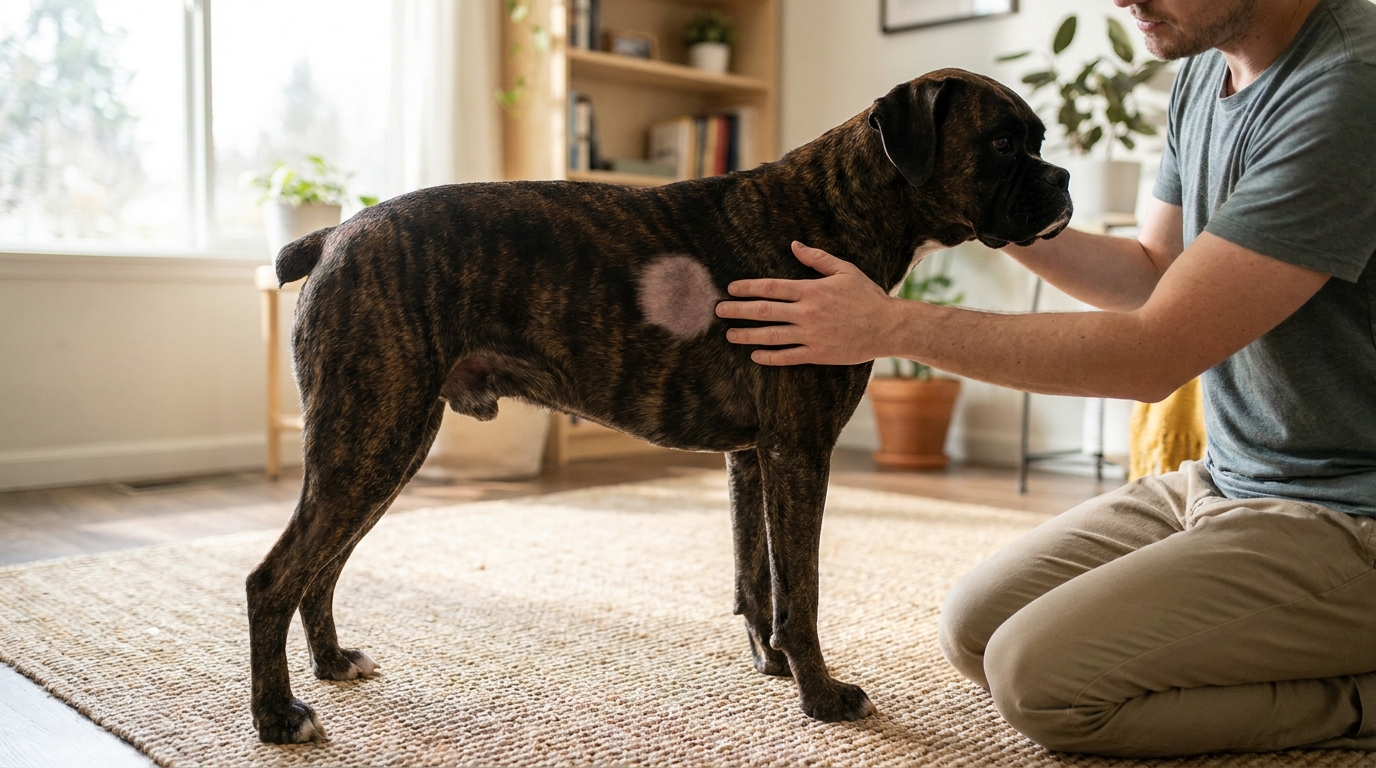
Fleas, allergies, mites, ringworm or hormones: how to read your dog's bald spots, what can spread to people and which signs need a vet today.
Quick answer: Patchy hair loss in dogs usually comes from flea allergy or other allergies, a skin infection, mites (mange) or ringworm, and less often hormone disease. See a vet this week for a new bald patch on an otherwise healthy dog, in person within days if it spreads, scabs or appears on another pet or a person, and in person today for oozing, smelly or painful sores, fever or lethargy.
This article is general information, not a diagnosis. If you think your pet is in danger, go to the nearest emergency animal hospital.
Why is my dog losing hair in patches?
Most patchy hair loss in dogs comes from itching and chewing (fleas, environmental or food allergy), a bacterial skin infection, mites or ringworm, and where the patches are and how itchy the dog is are the first clues a vet uses.
The Merck Veterinary Manual says itching or pain is a common cause of hair loss in animals, and lists bacterial skin infection, ringworm (dermatophytosis) and Demodex mites among diseases that damage hair follicles directly.
On a dog's tail, itchy hair loss at the base points to flea allergy, non-itchy thinning on top to hypothyroidism, and scaly, broken hairs to ringworm. Patterns overlap, so treat the table as a starting point. For itch with no fleas in sight, see why a dog itches when you find no fleas; for crusts along the back, see what scabs on a dog's back can mean.
| Pattern | Likely cause | Next step |
|---|---|---|
| Rump, tail base, itchy | Flea allergy | Flea plan, vet |
| Paws, belly, armpits, itchy | Allergy | Vet this week |
| Round, scaly, broken hairs | Ringworm | In person |
| Face, front legs, young dog | Demodex | In-person scraping |
| Ear edges, elbows, very itchy | Scabies | In person, all pets |
| Moth-eaten, pimples, crusts | Skin infection | In person |
| Licked wrist of front leg | Lick granuloma | Vet exam |
| Even both sides, no itch | Hormones | Blood, urine tests |
VCA Animal Hospitals says short-haired dogs with a skin infection (pyoderma) can look "moth-eaten," and the Merck Veterinary Manual says repeat skin infections usually have an underlying cause, such as allergy, mites or hormone disease.
When is hair loss in a dog urgent?
Hair loss in a dog is rarely an emergency by itself, but open, oozing or painful sores, fever or lethargy need an in-person vet today, new hives or face swelling need an in-person vet within the hour, and swelling with breathing trouble, vomiting, pale gums, weakness or collapse needs an emergency vet now. Any face swelling in a flat-faced breed, or hives within 1 hour of a shot, sting or new medicine, means an emergency vet now. Throat or tongue swelling, or hives with drooling or diarrhea, also means an emergency vet now, and spreading hives need an in-person vet now.
Ear or tail tips that turn purple or black (possible vasculitis, not ringworm) also need an emergency vet now. Tremors, wobbliness or a seizure after a flea or tick product need an emergency vet now. Call ASPCA Animal Poison Control at (888) 426-4435 (a consultation fee may apply) or the Pet Poison Helpline at (855) 764-7661 (a per-incident fee applies), or go to an ER. A dog that is already seizing, has collapsed or is struggling to breathe goes straight to the ER.
| Sign | How soon | Where |
|---|---|---|
| Swelling, hard breathing | Now | ER |
| Ear tips purple or black | Now | ER |
| Tremors after flea product | Now | ER or poison line |
| Many fleas, pale gums, weak | Now | ER |
| Hives or puffy face, normal breathing | Within 1 hr | In person |
| Oozing, raw, smelly or painful | Today | In person |
| Sore bumps after grooming | Today | In person |
| Fever, lethargy, not eating | Today | In person |
| Dry patch spreading, scabs | Within days | In person |
| Very itchy ear edges, elbows | Within days | In person, all pets |
| Patch on a person too | Within days | In person, doctor |
| Even loss, drinks more | Within days | In person |
| Crusts on bridge of nose | Within days | In person |
| New patch, dog well | This week | Video or clinic |
Itchy or not itchy: why it matters
Intense itching in a dog points to fleas, allergy, scabies or a skin infection; patchy hair loss with little or no itch can still be Demodex mites (often on a young dog's face and front legs) or ringworm; and even hair loss on both sides of the body with no itch points to hormone disease such as hypothyroidism or Cushing's disease, which a vet checks with blood tests (plus a urine screening test for Cushing's).
The Merck Veterinary Manual says hormone-related hair loss often starts in wear areas and is rarely itchy unless a skin infection sets in.
- Hypothyroidism: Merck describes non-itchy thinning on the lower and side trunk and the top of the tail. Blood tests (total T4, free T4 and TSH) confirm it, and one low T4 result alone does not. Hair loss with weight gain or low energy needs a vet within days for blood tests; see why some dogs are always cold, including thyroid disease.
- Cushing's disease: Merck describes even hair loss on the trunk that spares the head and feet, with heavy drinking and peeing and a pot belly; a vet may start with a urine test, but blood tests are needed to confirm it.
- Intact male dogs: Merck also lists excess estrogen, including from Sertoli cell tumors (a testicular tumor), as a cause of hair loss. An intact male dog with even hair loss on both sides needs an in-person exam within days.
Is it mange? Demodex vs scabies
Demodex mange in a dog is not contagious and usually shows as a few bald patches around the lips, eyes and front legs of dogs under 1 year old, while sarcoptic mange (scabies) is intensely itchy, spreads easily to other dogs and can cause an itchy rash on people; a skin scraping in person confirms Demodex, but scabies mites are often missed, so a vet may diagnose scabies in person from the pattern and the response to treatment.
Demodex. The Merck Veterinary Manual says most local cases clear on their own and that steroid creams and pills should not be used, so never use a leftover steroid cream on a bald patch. Widespread Demodex in a young dog needs an in-person exam within days, and today with fever, lethargy or swollen lymph nodes. New widespread Demodex in an adult dog, typically over 3 years old, needs an in-person exam within days, because Merck says it is often triggered by cancer, Cushing's disease, hypothyroidism or diabetes.
Scabies. Merck calls sarcoptic mange "a highly contagious disease of dogs" and says mites spread on brushes, towels and blankets. The Companion Animal Parasite Council says crusts usually sit on the ear edges, outer elbows and outer hocks, and that every animal in the home should be treated.
Could it be ringworm?
Ringworm is a fungal infection, not a worm, and the CDC says it spreads easily between people, pets and shared objects, so a bald, scaly patch with broken hairs on a dog, especially with an itchy rash on someone in the family, needs an in-person vet test.
The Merck Veterinary Manual says these patches show most often on the face, ear tips, tail and feet. A vet tests in the clinic with a fungal culture, a microscope check of hairs or an ultraviolet lamp, but Merck says no single test is a gold standard and that clearing the infection with treatment takes 6 to 12 weeks. Merck also says about 70% of dog ringworm is Microsporum canis, which also infects cats, so mention any new kitten or cat in the home.
The CDC tells pet owners to have other pets checked, wear gloves and long sleeves when handling the pet, wash hands with soap and running water, vacuum where the pet goes, and disinfect surfaces and bedding. The CDC also says people with weakened immune systems are at higher risk and more likely to get a severe infection. If anyone in the home has a weakened immune system, have someone else handle the dog.
Is it normal shedding or a true bald patch?
A dog that sheds heavily but has no bald patches is usually just replacing its coat: the Merck Veterinary Manual says shedding that leaves no patchy or even bald areas is probably a natural stage of hair replacement, while true bald patches on any breed need a cause found.
Double-coated dogs shed their undercoat in heavy seasonal waves with healthy skin underneath; see German Shepherd skin problems, from coat blow to hot spots. White, short-coated dogs can get sun damage on thinly haired skin, which the guide to pit bull skin allergies and bumps covers along with mange and other bumps.
Can licking, stress or pain cause bald spots?
Yes: a dog that licks one spot over and over can wear a bald, sometimes raw patch called a lick granuloma, and VCA Animal Hospitals says it most often forms on the wrist of a front leg and can come from allergies, infection or joint pain as well as anxiety, so a vet should rule out the physical causes first.
VCA says lick granulomas mainly affect medium to large breeds and that a biopsy may be needed to rule out mange or a tumor, so a raised lump that will not heal inside a licked spot needs an in-person exam. The Merck Veterinary Manual says chronic anxiety and too few outlets for normal behavior can start compulsive licking.
What RexVet visit data shows about skin and hair loss
Skin trouble was the top reason pet owners booked a RexVet video visit: 27% of visits named skin problems, itching, allergies or hair loss. Skin, itching, allergy and hair-loss concerns rose from 24% of RexVet visits in May-June to 31% in September-October.
These are concerns owners picked when booking, not diagnoses. The study's seasonal findings cover March to October only, so they say nothing about winter.
What can I do at home before the vet visit?
Before a vet visit for a dog's hair loss, make sure every pet in the home is on flea control labeled for its species, age and weight, stop licking with a cone or a soft shirt, take daylight photos every few days, and skip human creams, essential oils and leftover medicine.
- Flea control: The Merck Veterinary Manual says flea control has to cover every animal in the home and that clearing a home infestation often takes up to 3 months.
- Cats: The ASPCA warns that permethrin, found in some dog flea and tick products, is safe for dogs but can cause severe tremors and seizures in cats, so flea products must be used only on the species they are labeled for. A cat that is wobbly, trembles or has seizures after contact with a dog flea product needs an emergency vet now; on the way, you can call ASPCA Animal Poison Control at (888) 426-4435 (a consultation fee may apply).
- Photos and notes: Photograph each patch in daylight every few days, and note anything new, such as food, shampoo, grooming, boarding or another pet.
Will my dog's hair grow back?
A dog's hair usually grows back once the cause is treated, but slowly: a University of Minnesota veterinary dermatology handbook says a normal dog coat generally regrows within 3 to 4 months after clipping and calls slower regrowth abnormal.
Hair that has not grown back by then is worth a vet check; the Merck Veterinary Manual lists slow hair regrowth as an early sign of an underactive thyroid. The handbook also notes that hair loss after clipping is seen more often in plush-coated breeds, so do not shave a double-coated dog at home to check its skin.
When a video visit helps
RexVet, a nonprofit online vet service, serves pets located in Florida, New York and Virginia by video visit, with a veterinarian licensed in your pet's state. A $64.99 live video visit with a licensed RexVet vet fits a dog that is eating, drinking and acting normally and has new bald patches with no scabs, sores or crusts, or a few days of itching. One visit covers one pet; visits run about 8 AM to 11 PM ET. The veterinarian can look at the patches on camera, review photos, check the flea plan for every pet in the home, and say which in-person tests are needed and how soon: a skin scraping for mites, a fungal culture for ringworm, cytology for infection, or blood and urine tests for thyroid or adrenal (Cushing's) disease. A camera cannot run those tests, so the veterinarian can point you to a nearby clinic. Book a video visit.
No prescription is promised; the veterinarian gives advice and a care plan, and medicine for mites or ringworm often needs an in-person exam first. The last FAQ below covers state prescription limits and the pharmacy transfer fee.
Not a fit, so go in person first: any emergency sign above (emergency vet now), new hives or a puffy face with normal breathing (in person within the hour), oozing or painful sores, a fast-spreading raw patch, fever or lethargy (today), or patches that spread or scab, very itchy ear edges or elbows, a new rash on a person in the home or hair loss on both sides with heavy drinking (within days). If you think your dog is in danger, go to the nearest emergency vet.
Need an Expert Opinion on This Topic?
Book a video visit with a licensed vet, evenings and weekends included
See open timesFrequently Asked Questions
Why is my dog losing hair but not itching?
Non-itchy hair loss can be Demodex mites or ringworm when it is patchy, or hormone disease when it is even on both sides. The Merck Veterinary Manual says itching is usually absent or mild with local Demodex. Even, non-itchy loss on both sides needs an in-person vet within days for blood tests, plus a urine test for Cushing's disease.
Can my dog's hair loss spread to people or my other pets?
Sometimes: ringworm and sarcoptic mange (scabies) can spread from dogs to people and other pets, but Demodex mange does not. The Companion Animal Parasite Council says a person's rash from dog scabies is very itchy but usually clears without specific treatment. If someone in the home has a new itchy rash or scaly ring, the dog needs an in-person exam within days and the person should see their own doctor. Until then, wear gloves, wash your hands and wash the dog's bedding.
Can a food allergy make my dog lose hair?
Yes, indirectly: food allergy causes itching, and the licking and scratching can rub hair off. The Merck Veterinary Manual says food allergy itch is usually year-round and centers on the ears, paws and belly. A vet tests for it with a strict elimination diet of at least 8 weeks (some dogs need up to 12) after ruling out fleas, and confirms it if the itch improves on the diet and comes back when the old food is fed again; see how a food allergy elimination diet works.
Does my dog need a skin scraping for hair loss?
Often, yes: a deep skin scraping done in a clinic is how a vet confirms Demodex mites, though scabies mites are often missed on scrapings. A negative scraping does not rule out scabies, so a vet may diagnose it in person from the pattern and the response to treatment. Other clinic tests include a fungal culture for ringworm, cytology for infection, and blood and urine tests for hormone disease.
Is it normal for my dog to lose hair in the winter?
Shedding with no bald spots can be normal in winter, but a bald patch still needs a cause found. A few dogs have a seasonal pattern: seasonal flank alopecia causes even, non-itchy bald patches on both flanks. The Merck Veterinary Manual says fleas can persist year-round in warm climates, so keep flea control going. Merck also lists burns among causes of hair loss, so a bald or peeling patch after a heating pad or space heater needs an in-person vet.
Can an online vet help with my dog's hair loss in Florida, New York or Virginia?
Partly: a licensed RexVet vet can look at bald patches by video, but scrapings, cultures and blood tests happen in person. For a dog located in Florida, New York or Virginia, the veterinarian can say which tests are needed and how soon, but one visit may not give a diagnosis. In Florida, a prescription after a video visit alone is limited to FDA-approved animal drugs used as labeled, for up to 14 days (up to 1 month for products labeled solely for flea and tick control); it cannot be renewed without an in-person exam, and human-labeled drugs, compounded antibacterial, antifungal, antiviral or antiparasitic medicines, and controlled drugs need an in-person exam. Under federal rules, using a human medicine or an animal drug off-label needs a vet who has examined the dog in person, in every state, Virginia included. Virginia allows the exam itself to be done by video, but any prescription is still the veterinarian's call. New York's rules for veterinary video care, including prescribing, are still unsettled, so a visit there may cover less. A pharmacy transfer fee applies if a prescription is sent to an outside pharmacy.
FAQs
Why is my dog losing hair but not itching?
Non-itchy hair loss can be Demodex mites or ringworm when it is patchy, or hormone disease when it is even on both sides. The Merck Veterinary Manual says itching is usually absent or mild with local Demodex. Even, non-itchy loss on both sides needs an in-person vet within days for blood tests, plus a urine test for Cushing's disease.
Can my dog's hair loss spread to people or my other pets?
Sometimes: ringworm and sarcoptic mange (scabies) can spread from dogs to people and other pets, but Demodex mange does not. The Companion Animal Parasite Council says a person's rash from dog scabies is very itchy but usually clears without specific treatment. If someone in the home has a new itchy rash or scaly ring, the dog needs an in-person exam within days and the person should see their own doctor. Until then, wear gloves, wash your hands and wash the dog's bedding.
Can a food allergy make my dog lose hair?
Yes, indirectly: food allergy causes itching, and the licking and scratching can rub hair off. The Merck Veterinary Manual says food allergy itch is usually year-round and centers on the ears, paws and belly. A vet tests for it with a strict elimination diet of at least 8 weeks (some dogs need up to 12) after ruling out fleas, and confirms it if the itch improves on the diet and comes back when the old food is fed again; see how a food allergy elimination diet works.
Does my dog need a skin scraping for hair loss?
Often, yes: a deep skin scraping done in a clinic is how a vet confirms Demodex mites, though scabies mites are often missed on scrapings. A negative scraping does not rule out scabies, so a vet may diagnose it in person from the pattern and the response to treatment. Other clinic tests include a fungal culture for ringworm, cytology for infection, and blood and urine tests for hormone disease.
Is it normal for my dog to lose hair in the winter?
Shedding with no bald spots can be normal in winter, but a bald patch still needs a cause found. A few dogs have a seasonal pattern: seasonal flank alopecia causes even, non-itchy bald patches on both flanks. The Merck Veterinary Manual says fleas can persist year-round in warm climates, so keep flea control going. Merck also lists burns among causes of hair loss, so a bald or peeling patch after a heating pad or space heater needs an in-person vet.
Can an online vet help with my dog's hair loss in Florida, New York or Virginia?
Partly: a licensed RexVet vet can look at bald patches by video, but scrapings, cultures and blood tests happen in person. For a dog located in Florida, New York or Virginia, the veterinarian can say which tests are needed and how soon, but one visit may not give a diagnosis. In Florida, a prescription after a video visit alone is limited to FDA-approved animal drugs used as labeled, for up to 14 days (up to 1 month for products labeled solely for flea and tick control); it cannot be renewed without an in-person exam, and human-labeled drugs, compounded antibacterial, antifungal, antiviral or antiparasitic medicines, and controlled drugs need an in-person exam. Under federal rules, using a human medicine or an animal drug off-label needs a vet who has examined the dog in person, in every state, Virginia included. Virginia allows the exam itself to be done by video, but any prescription is still the veterinarian's call. New York's rules for veterinary video care, including prescribing, are still unsettled, so a visit there may cover less. A pharmacy transfer fee applies if a prescription is sent to an outside pharmacy.
Medically Reviewed
Reviewed by Dr. Tiffany Delacruz, DVM — licensed veterinarian and CEO of RexVet. Last reviewed November 5, 2026.
Content is for informational purposes and does not replace professional veterinary advice.
Chief Executive Officer · Licensed Veterinarian
Dr. Delacruz is a licensed Doctor of Veterinary Medicine specializing in preventive care and veterinary telehealth. She reviews all health content on RexVet to ensure accuracy and clinical relevance.
Sources & References
- · American Veterinary Medical Association — Telehealth Guidelines
- · AVMA — Pet Care Resources
- · U.S. FDA — Animal & Veterinary