
Dog Cloudy Eyes: Cataracts, Aging or an Emergency?
By RexVet Team | Reviewed by Dr. Tiffany Delacruz, DVM
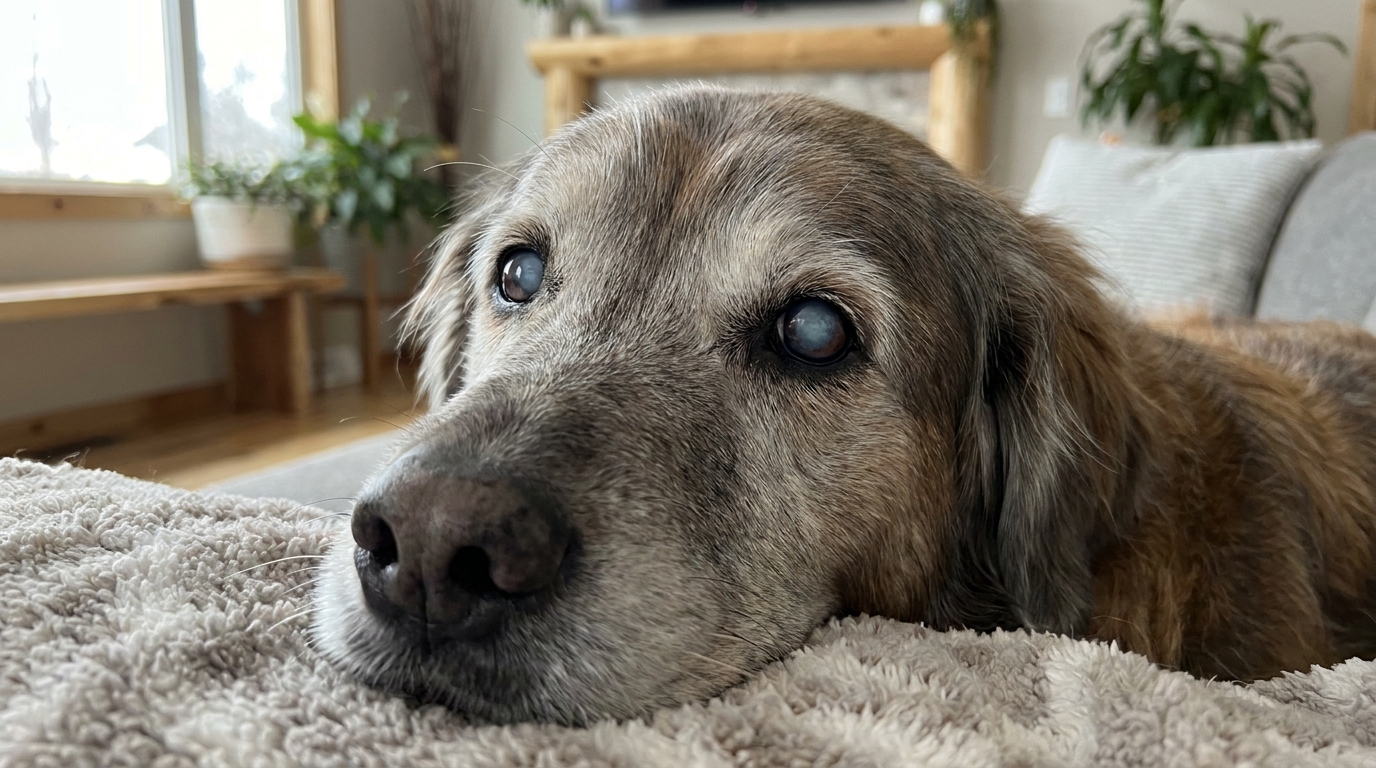
How to tell a normal aging haze from a cataract, and which cloudy-eye signs mean your dog needs a vet today or an ER now.
Quick answer: In a dog over about 8, a slow, even blue-gray haze in both eyes is usually nuclear sclerosis, normal aging that is not thought to cause significant vision loss. A whiter cloud, haze in one eye or bumping into things may be a cataract and needs an eye exam. A sudden cloudy eye needs a vet today; if it is red, bulging or painful, go to an ER now.
This article is general information, not a diagnosis. If you think your pet is in danger, go to the nearest emergency animal hospital.
Sudden or slow? Start here
Two questions sort most cloudy eyes: how fast did it appear, and is your dog in pain? A haze that crept in over months, looks the same in both eyes and doesn't bother your dog usually means a routine exam. A cloudy eye that appeared overnight, or affects one eye, is not normal aging, even in an old dog.
A cloudy eye that is also red, painful, held shut or bulging, or one with a widened pupil, means an emergency vet now. An eye injury, or a new cloudy spot with squinting or tearing, needs an in-person vet today.
The big worry is glaucoma, a painful rise in pressure inside the eye. The Merck Veterinary Manual calls acute glaucoma an emergency and a common cause of permanent blindness in dogs. Your dog may not squint; pain can show as hiding, low energy or not eating. If you suspect glaucoma, go now to an ER or any vet who can measure eye pressure; a veterinary ophthalmologist comes next.
Any new haze or blue spot in a flat-faced breed (Pug, Shih Tzu, Bulldog, Boxer) needs a vet right away, even with no sign of pain; if your vet can't see your dog today, go to an ER. After an injury or a chemical splash, flush the eye gently with lukewarm water or sterile saline, then go to an ER or a same-day vet. If something is stuck in the eye or it looks punctured, don't flush, press on or pull at it; go to an ER now. If redness is the main change, read what red eyes in a dog can mean.
Other signs that change the urgency:
| Sign with the cloudy eye | What it can mean | What to do |
|---|---|---|
| Squinting or pawing | Pain, ulcer, glaucoma | Vet today; ER if held shut, red or big pupil |
| Eye looks bigger or bulges | Glaucoma, eye pushed out | ER now |
| One pupil bigger, or not shrinking in light | Glaucoma, lens slip | ER now |
| Hiding, low energy, not eating | Eye pain, glaucoma | ER now |
| Bumping into things over hours or days | Sudden vision loss, glaucoma | ER now |
| Both eyes red or cloudy, plus fever or swollen glands | Body-wide illness, like tick-borne disease | Vet today |
| Drinking and peeing more | Diabetes | Vet within days |
| Recent eye surgery, new redness or haze | Swelling, pressure rise | Call surgeon today |
| No pain, slow change over months, both eyes | Aging or early cataract | Routine exam |
Cloudy eye causes at a glance
Haze can sit in the lens (just behind the pupil) or in the cornea (the clear front of the eye). Lens changes are usually painless (a slipped lens is the exception); corneal and pressure problems often hurt.
| Cause | What it looks like | How urgent |
|---|---|---|
| Aging lens (nuclear sclerosis) | Even blue-gray haze in the center, both eyes alike, dog sees well | Routine exam to confirm |
| Cataract | White or frosty cloud, can block the pupil, may bump into things | Vet within weeks; days if fast, young or diabetic |
| Corneal ulcer | Cloudy spot on the surface, squinting, tearing | Vet today |
| Deep ulcer | Dent, crater or gel-like spot on the eye | ER now |
| Glaucoma | Blue-white cornea, red eye, big pupil, eye looks larger | ER now |
| Lens slip (luxation) | Sudden blue eye, often a terrier | ER now |
| Uveitis | Cloudy, red, small pupil, squinting | ER now if red and painful; else today |
| Corneal edema | Slow blue or foggy haze, often starts at one edge | Vet in 1-3 days; ER if red, squint or big pupil |
| Dry eye (KCS) | Dull surface, thick sticky discharge | Vet within a week; today if squinting |
| Eye pushed out (proptosis) | Eye sits in front of the lids | ER now |
| Blood or pus inside the eye | Red or pale yellow layer in front | ER now or same day |
The American College of Veterinary Ophthalmologists (ACVO) lists squinting, redness, cloudiness, tearing and discharge as common signs of a corneal ulcer; if the squint stands out, read why a dog squints one eye. Uveitis is inflammation inside the eye, and when both eyes are affected, the Merck Veterinary Manual says to suspect a body-wide disease.
Nuclear sclerosis vs cataract: what you can and cannot tell at home
Nuclear sclerosis is a gradual hardening of the lens. ACVO calls it the most common age-related eye change and says it is often noticed after about 8 to 10 years of age. Merck describes a central, circular gray zone. It is not painful, needs no treatment and is not thought to cause significant vision loss, though the harder lens focuses less well up close, so some dogs bump into things.
A cataract is a disease change in the lens. It tends to look whiter or frostier, can cover the pupil and may be worse in one eye. ACVO says cataracts can form over days, weeks, months or years, and faster in younger dogs. Most are hereditary, and diabetes is the disease most often linked to them.
At home, note how fast the haze appeared, whether both eyes and pupils match, any squinting or discharge, and whether your dog bumps into things. You cannot tell nuclear sclerosis from an early cataract: Merck notes both can occur in the same eye, and only a dilated eye exam separates them. Haze in one eye only, or haze that changes over days, is not nuclear sclerosis.
Diabetic dogs and fast cataracts
According to the Merck Veterinary Manual, most diabetic dogs develop cataracts, even when their diabetes is well controlled, and these cataracts tend to form quickly. In a 1999 study of diabetic dogs at a university hospital (Beam and colleagues), about half developed cataracts within about 6 months of diagnosis and about three-quarters within about a year.
Speed matters. ACVO says lens-induced uveitis is common with diabetic cataracts, must be treated aggressively to prevent blindness and can lead to glaucoma. A diabetic dog with a new cloudy eye needs a vet within days, the same day if the eye is red or squinting, and an ER now if your dog is also vomiting, not eating or very tired.
Not diagnosed with diabetes? A new cloudy eye plus drinking a lot more water, peeing more, a big appetite or losing weight while still eating needs a vet within days for bloodwork and urine tests.
Breeds with a higher risk
- Cataracts (Merck): Boston Terrier, Cocker Spaniel, Siberian Husky, Standard Poodle, Bichon Frise, Golden and Labrador Retrievers, Miniature Schnauzer and West Highland White Terrier. Inherited cataracts can begin anywhere from birth to about 6 years.
- Corneal endothelial dystrophy (Merck): mainly older Boston Terriers, Chihuahuas and Dachshunds. It causes slow, painless corneal swelling in both eyes, starting at the upper outer edge, and ACVO notes it usually worsens.
- Corneal ulcers: in a VetCompass study of 104,233 UK dogs (O'Neill and colleagues, 2017), flat-faced dogs had about 11 times the odds of corneal ulcers compared with crossbreds, and Pugs, Boxers and Shih Tzus had the highest rates.
- Glaucoma (ACVO): Cocker Spaniel, Basset Hound, Beagle, Norwegian Elkhound, Great Dane, Siberian Husky, Samoyed, Chow Chow, Shar Pei and Jack Russell Terrier. Once one eye has primary glaucoma, the other eye is at higher risk.
ACVO explains that Pugs, Bulldogs and Shih Tzus have less feeling on the eye surface, so they may show no pain even with a serious injury, and their ulcers can quickly turn deep or "melt." Any cloudy or hazy look in these dogs, even a mild one, needs a vet right away; if your vet can't see your dog today, go to an ER. In these breeds the eye can also be pushed out in front of the lids (proptosis) by minor trauma or even restraint, and that needs an ER now.
Can my dog still see? Signs of vision loss
With nuclear sclerosis, usually yes. With a cataract, Merck says vision loss ranges from mild to blindness, and because dogs rely heavily on hearing and smell, owners can miss the early stage. ACVO adds that not all cataracts progress to full vision loss. Signs of failing sight include bumping into things, moving more cautiously and staying closer to you.
Sudden vision loss is different. Bumping into things over hours or days, or wide pupils, needs a vet the same day, even if the eyes look clear; if your vet can't see your dog today, go to an ER rather than waiting. If the eye is also cloudy, red or painful, or one pupil is bigger than the other, go to an ER now.
At home, keep furniture, beds and bowls in place, gate stairs and pool edges, and speak before you touch your dog.
What happens at the vet
A general-practice vet can confirm a cataract and check for urgent causes. Expect:
- An eye exam with the pupils dilated to see the lens
- A fluorescein stain, a dye that shows a corneal ulcer
- An eye pressure test for glaucoma and a Schirmer tear test for dry eye
- Bloodwork and urine tests if diabetes or a body-wide illness is a concern (ACVO notes uveitis can be caused by tick-borne disease, fungal infection or lymphoma)
- A referral to a board-certified veterinary ophthalmologist, who decides who is a surgery candidate
Surgery to remove the cloudy lens (phacoemulsification) is the only way to restore vision. Cornell's veterinary college lists a physical exam, blood tests, urinalysis, an electroretinogram (ERG) to check the retina and an ocular ultrasound first; surgery may not be done if retinal function is poor or the retina is detached. Cornell reports uncomplicated cataract surgery succeeds in 85% to 90% of dogs, and Merck notes it succeeds about as often in diabetic dogs as in dogs with inherited cataracts. Recovery means a hard cone for at least the first month, frequent drops and many rechecks, according to the University of Missouri Veterinary Health Center.
If anesthesia in an older dog worries you, read whether a senior dog is too old for anesthesia or surgery. Skipping surgery is a valid choice, but a cataract still needs rechecks, and many need anti-inflammatory drops to prevent painful inflammation and glaucoma.
What not to do
- Don't use human redness-relief eye drops on a dog. They don't treat the cause, and their active ingredients (tetrahydrozoline, oxymetazoline) can seriously poison a dog that licks or swallows even a small amount. If that happens, call ASPCA Animal Poison Control at (888) 426-4435 (a consultation fee may apply) or Pet Poison Helpline at (855) 764-7661 (a per-incident fee applies). If your dog is already drooling, vomiting, wobbly, weak or collapsing, go to an ER now.
- Never use leftover steroid or anti-inflammatory eye drops; on an ulcer they can make it melt, per Merck. A vet should stain the eye in person first. The same goes for leftover antibiotic or glaucoma drops from another pet or a person.
- Skip drops sold to dissolve cataracts. ACVO says no medical treatment is proven to reverse, slow or prevent cataracts, and some promoted products make them worse.
- Don't wait for a sudden haze to clear on its own; see a vet in person the same day.
When a video visit helps
If your dog's eyes have been getting hazy slowly and your dog is comfortable (no squinting, redness or pawing), a $64.99 live video visit with Dr. Tiffany Delacruz, DVM, can help you decide how soon your dog needs an in-person eye exam. Telling normal aging (nuclear sclerosis) from a cataract takes a dilated eye exam at a clinic. RexVet is a 501(c)(3) non-profit, and Dr. Delacruz is its one bookable vet.
Your dog must be located in Florida, New York or Virginia at the time of the visit, and live video slots run about 8 AM-11 PM ET. On camera, in good light, she can look at both eyes, compare the pupils, check for squinting, discharge and redness, and watch your dog move around a room. She can also ask about thirst, diabetes, medicines and how your dog gets around in dim light and unfamiliar places, then tell you how soon to see a clinic or a veterinary ophthalmologist. The one-time $120 Family Plan covers 4 visits over 12 months for every pet in the home and never auto-renews.
A video visit cannot dilate the pupils, examine the lens up close, measure eye pressure or stain the cornea, and no prescription is promised.
Need an Expert Opinion on This Topic?
Book a video visit with a licensed vet, evenings and weekends included
See open timesFrequently Asked Questions
Is a cloudy eye in a dog an emergency?
It depends on speed and what comes with it. A slow, even haze in both eyes of a comfortable older dog is usually not urgent; book a routine exam. Go to an ER now if a cloudy eye is also red, bulging or painful, if one pupil looks bigger or doesn't shrink in light, or if your dog suddenly starts bumping into things. Your dog may not squint; pain can show as hiding or not eating. See a vet today for any sudden cloudy eye or a new cloudy spot with squinting, and right away for any new haze in a flat-faced breed; if your vet can't see your dog today, go to an ER. Glaucoma can cause permanent blindness quickly.
Can dogs see with nuclear sclerosis?
Usually, yes. ACVO says nuclear sclerosis is not thought to cause significant vision loss, though the harder lens focuses less well up close. It needs no treatment, but only a dilated eye exam can rule out an early cataract in the same eye. If your dog bumps into things, have a vet check.
Do cataract eye drops for dogs work?
No eye drop has been proven to dissolve or reverse cataracts in dogs. A 2015 study reported improvement in 7 dog eyes treated with lanosterol, but later lab studies could not confirm that lanosterol reverses cataracts. Surgery is the only treatment that restores vision, though drops your own vet prescribes may still be needed to control inflammation caused by a cataract.
At what age do dogs get cloudy eyes?
Nuclear sclerosis is often noticed after about 8 to 10 years of age, and age-related eye changes can start to show on exams around 5 to 6. Cataracts can appear at any age: inherited cataracts can begin anywhere from birth to about 6 years, depending on the breed. Cloudiness in a puppy or a dog under about 6 is not aging, so book an exam within days.
Why did my dog's eye turn blue overnight?
Overnight haze is never normal aging. Causes include glaucoma, a slipped lens (more common in some terriers), uveitis, corneal swelling and an ulcer. Go to an ER now, or any vet who can measure eye pressure, if the eye is also red, painful or bulging, one pupil looks bigger, or your dog is a terrier. Otherwise, see a vet the same day.
Can a dog live happily with cataracts?
Many can, since dogs rely heavily on hearing and smell. A cataract still needs rechecks, and many need anti-inflammatory drops to prevent painful inflammation and glaucoma. A veterinary ophthalmologist can tell you whether surgery, the only way to restore vision, makes sense for your dog.
Can an online vet look at my dog's cloudy eye in Florida, New York or Virginia?
Partly. A video visit can triage a cloudy eye, but it cannot diagnose one. If your dog is located in Florida, New York or Virginia at the time of the visit, Dr. Tiffany Delacruz, DVM, can look at both eyes on camera in good light, compare the pupils, check for squinting, discharge and redness, review diabetes and medicine history, and tell you how soon your dog needs in-person care and where. The dilated lens exam (the only way to tell a cataract from normal aging), eye pressure testing, the fluorescein stain and the tear test all need an in-person visit. If medicine comes up, federal rules require an in-person relationship before a vet uses a human-labeled drug, or an animal drug off-label, in any state. Florida limits telehealth-only prescriptions to FDA-approved animal drugs used as labeled, for up to 14 days, with no renewal without an in-person exam. Glaucoma pressure drops are made for people, so under the federal rule they cannot come from a video visit alone in any state. Virginia allows an electronic exam, but the federal rule still applies, and New York's rules are not settled. A prescription is not guaranteed; RexVet is not a pharmacy, and a pharmacy transfer fee applies if one is sent to an outside pharmacy. A red, painful or bulging eye needs an ER now, not a video visit.
Is a cloudy eye in a cat the same thing?
This page covers dogs. Older cats can get a similar normal lens haze, but a cat's eye that turns cloudy suddenly, or is red or squinting, needs a vet the same day, and a red, painful or bulging eye needs an ER now.
FAQs
Is a cloudy eye in a dog an emergency?
It depends on speed and what comes with it. A slow, even haze in both eyes of a comfortable older dog is usually not urgent; book a routine exam. Go to an ER now if a cloudy eye is also red, bulging or painful, if one pupil looks bigger or doesn't shrink in light, or if your dog suddenly starts bumping into things. Your dog may not squint; pain can show as hiding or not eating. See a vet today for any sudden cloudy eye or a new cloudy spot with squinting, and right away for any new haze in a flat-faced breed; if your vet can't see your dog today, go to an ER. Glaucoma can cause permanent blindness quickly.
Can dogs see with nuclear sclerosis?
Usually, yes. ACVO says nuclear sclerosis is not thought to cause significant vision loss, though the harder lens focuses less well up close. It needs no treatment, but only a dilated eye exam can rule out an early cataract in the same eye. If your dog bumps into things, have a vet check.
Do cataract eye drops for dogs work?
No eye drop has been proven to dissolve or reverse cataracts in dogs. A 2015 study reported improvement in 7 dog eyes treated with lanosterol, but later lab studies could not confirm that lanosterol reverses cataracts. Surgery is the only treatment that restores vision, though drops your own vet prescribes may still be needed to control inflammation caused by a cataract.
At what age do dogs get cloudy eyes?
Nuclear sclerosis is often noticed after about 8 to 10 years of age, and age-related eye changes can start to show on exams around 5 to 6. Cataracts can appear at any age: inherited cataracts can begin anywhere from birth to about 6 years, depending on the breed. Cloudiness in a puppy or a dog under about 6 is not aging, so book an exam within days.
Why did my dog's eye turn blue overnight?
Overnight haze is never normal aging. Causes include glaucoma, a slipped lens (more common in some terriers), uveitis, corneal swelling and an ulcer. Go to an ER now, or any vet who can measure eye pressure, if the eye is also red, painful or bulging, one pupil looks bigger, or your dog is a terrier. Otherwise, see a vet the same day.
Can a dog live happily with cataracts?
Many can, since dogs rely heavily on hearing and smell. A cataract still needs rechecks, and many need anti-inflammatory drops to prevent painful inflammation and glaucoma. A veterinary ophthalmologist can tell you whether surgery, the only way to restore vision, makes sense for your dog.
Can an online vet look at my dog's cloudy eye in Florida, New York or Virginia?
Partly. A video visit can triage a cloudy eye, but it cannot diagnose one. If your dog is located in Florida, New York or Virginia at the time of the visit, Dr. Tiffany Delacruz, DVM, can look at both eyes on camera in good light, compare the pupils, check for squinting, discharge and redness, review diabetes and medicine history, and tell you how soon your dog needs in-person care and where. The dilated lens exam (the only way to tell a cataract from normal aging), eye pressure testing, the fluorescein stain and the tear test all need an in-person visit. If medicine comes up, federal rules require an in-person relationship before a vet uses a human-labeled drug, or an animal drug off-label, in any state. Florida limits telehealth-only prescriptions to FDA-approved animal drugs used as labeled, for up to 14 days, with no renewal without an in-person exam. Glaucoma pressure drops are made for people, so under the federal rule they cannot come from a video visit alone in any state. Virginia allows an electronic exam, but the federal rule still applies, and New York's rules are not settled. A prescription is not guaranteed; RexVet is not a pharmacy, and a pharmacy transfer fee applies if one is sent to an outside pharmacy. A red, painful or bulging eye needs an ER now, not a video visit.
Is a cloudy eye in a cat the same thing?
This page covers dogs. Older cats can get a similar normal lens haze, but a cat's eye that turns cloudy suddenly, or is red or squinting, needs a vet the same day, and a red, painful or bulging eye needs an ER now.
Medically Reviewed
Reviewed by Dr. Tiffany Delacruz, DVM — licensed veterinarian and CEO of RexVet. Last reviewed October 30, 2026.
Content is for informational purposes and does not replace professional veterinary advice.
Chief Executive Officer · Licensed Veterinarian
Dr. Delacruz is a licensed Doctor of Veterinary Medicine specializing in preventive care and veterinary telehealth. She reviews all health content on RexVet to ensure accuracy and clinical relevance.
Sources & References
- · American Veterinary Medical Association — Telehealth Guidelines
- · AVMA — Pet Care Resources
- · U.S. FDA — Animal & Veterinary