
Dog Red Eyes: Common Causes, Where the Red Is and When to Worry
By RexVet Team | Reviewed by Dr. Tiffany Delacruz, DVM
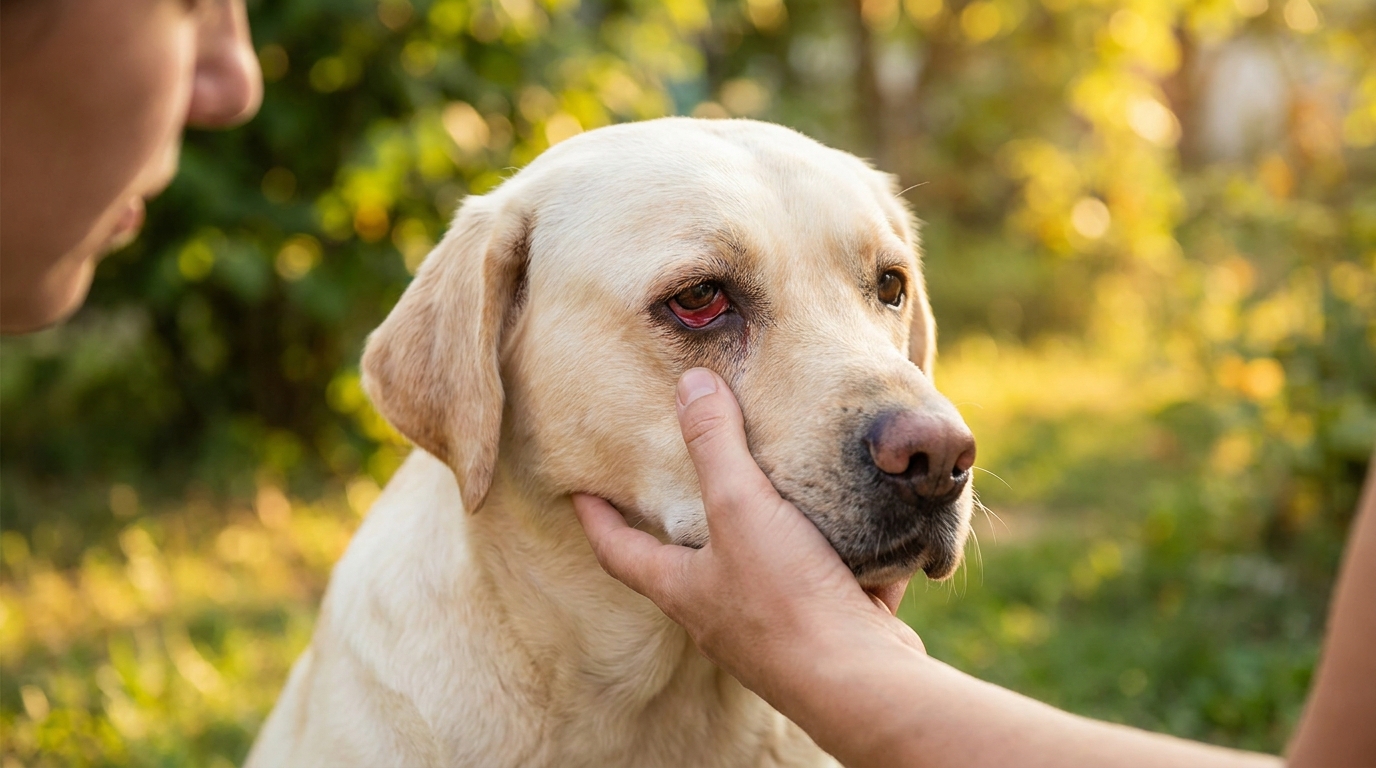
Where the red sits, and whether your dog holds the eye fully open, tells you how fast to act: a saline rinse, a vet today or an ER now.
Quick answer: Mild redness in both eyes, with clear tears, in a dog that holds them fully open and acts normal is often irritation or allergy. Rinse with sterile saline eyewash and see a vet if it isn't clearly better by tomorrow. Flat-faced breeds, squinting, pawing or yellow-green discharge need an in-person vet today. A cloudy, bluish or bulging eye, blood inside the eye or unequal pupils means an emergency vet now.
This article is general information, not a diagnosis. If you think your pet is in danger, go to the nearest emergency animal hospital.
Go to an Emergency Vet Now If You See Any of These
The Merck Veterinary Manual calls acute glaucoma an eye emergency and a common cause of permanent blindness in dogs. Go to an emergency vet now for:
- A cloudy, hazy or bluish eye.
- A bulging eye. Keep it moist with sterile saline; never push it back in.
- Unequal pupils with a red or painful eye, or a large pupil that doesn't shrink in light.
- Sudden bumping into things or other signs of vision loss.
- An eye your dog won't open at all.
- Blood, or a white or yellow layer, inside the eye.
- A dent, crater or bubble on the eye, or a soft, gooey-looking surface.
- Anything stuck in the eye, or a cat-scratch, thorn or stick injury. Don't try to remove it.
- Pain on opening the mouth, or the third eyelid coming across the eye.
- A terrier or Shar-Pei with a sudden red, painful, cloudy eye, which Merck links to a slipped lens.
- New redness or squinting in the second eye of a dog treated for glaucoma.
- A red eye after a car accident, fall or dog fight.
- Red eyes or a blood patch plus bruising, gum spots, a nosebleed, bloody urine or stool, pale gums, weakness or fast breathing (possible clotting problem or rat poison).
- Eyelid or face swelling after a sting, with hives, vomiting, trouble breathing, pale gums or collapse.
If your dog may have eaten rat bait or chewed a bottle of redness-relief drops (Visine, Clear Eyes, Lumify) or decongestant nasal spray, go now or call a poison line, even with no signs. Don't make your dog vomit. ASPCA Animal Poison Control: (888) 426-4435 (a consultation fee may apply). Pet Poison Helpline: (855) 764-7661 (a per-incident fee applies).
This list builds on the one in our dog squinting one eye guide. Squinting or pawing still needs an in-person vet today; if your clinic can't see your dog, or it's after hours, go to an emergency hospital. Flat-faced breeds (Pug, Bulldog, French Bulldog, Shih Tzu, Pekingese, Boston Terrier) with a red or squinting eye need to be seen right away.
Where Is the Red? A 30-Second Check
In good light, compare both eyes without prying the lids open. Note where the red is, whether the pupils match, and the key pain test: does your dog hold both eyes fully open? An open eye doesn't rule out glaucoma, whose pain often shows as behavior changes rather than squinting (Merck). Cloudiness, a pupil or vision change, bulging, blood inside the eye or a recent injury means an emergency vet now, wherever the red is. Flat-faced breeds, young puppies and dogs with glaucoma get no watch period. Glaucoma can start with only a slightly red eye and some squinting (Cornell Riney Canine Health Center).
| What you see | Likely causes | How fast |
|---|---|---|
| Pink or red lid lining, clear tears, eyes fully open, itchy face or paws | Allergy or an irritant such as dust, pollen or shampoo | Saline rinse; vet if not clearly better by tomorrow or it keeps coming back |
| Bloodshot white in one eye, no clear trigger, eye open | Irritation, but also early glaucoma or uveitis | In-person vet today; ask about a pressure check |
| Red eye with squinting or pawing, surface clear | A scratch, ulcer or something under the lid | In-person vet today |
| Red lining plus thick yellow-green discharge | Inflamed lining, often from dry eye or allergy; possible ulcer | In-person vet today |
| Solid bright-red patch on the white, no injury, dog otherwise well | Bleeding under the surface; can signal a clotting or blood pressure problem | In-person vet today; bloodwork likely |
| Red patch or red eyes plus bruising, gum spots, nosebleed or rat bait | Clotting problem or rat poison | ER now; call a poison line on the way |
| Red white plus a cloudy or bluish eye, or unequal pupils | Glaucoma, uveitis or a slipped lens | ER now |
| Red-pink bump in the inner corner, eye comfortable | Cherry eye | Vet within a few days; today if the gland looks dry or the eye squints |
| Red, swollen or crusty lids or skin around the eye | Inflamed lids, allergy, a sting or a bite | Today if the face swells; ER now with hives, vomiting or breathing trouble |
| Eye discharge plus fever, cough or runny nose in an unvaccinated puppy | Distemper or another infection | In-person vet today; call ahead, keep away from other dogs |
| Red eyes plus fever, tiredness or recent ticks | Tick fever or another infection | In-person vet today |
One Bloodshot Eye or Both: What It Tells You
One eye. Redness in one eye leans toward something local. Merck's one-eye causes include a foreign object, an inflamed tear sac and dry eye, and most corneal ulcers follow a scratch, a foreign object or a chemical. Primary glaucoma usually starts in one eye too, and the second eye eventually becomes involved (Cornell). Uveitis (inflammation inside the eye) can follow an injury, but tumors, lens problems and whole-body disease can also cause it, so it needs an in-person exam.
Both eyes. Redness in both eyes often points to allergies, irritants, dry eye or a whole-body illness. A veterinary ophthalmologist writing in dvm360 says true bacterial infection usually follows dry eye or severe allergies, and Merck says looks alone usually aren't enough to find the cause. Merck adds that blood patches on both whites raise concern for a platelet or clotting disorder.
Red Eyes From Allergies, Irritants and Dry Eye
Merck lists allergens and irritants among the common causes of a red, inflamed eye lining (conjunctivitis) in both eyes. With allergy, also look for paw licking or chewing and face rubbing, usually seasonal but sometimes all year (Merck).
Red and goopy eyes often mean dry eye (KCS), which Merck says usually affects both eyes and causes lasting redness with thick yellow-green discharge. A clinic confirms it with a tear test, and long-term treatment is managed in person. Less often, sulfa antibiotics trigger it; if your dog takes one and gets goopy eyes, call the prescribing vet.
Red, Swollen Eyelids or a Red Bump in the Corner
Red around the outside of the eye. Red, swollen or crusty lid rims (blepharitis) can come from skin disease, irritants, mites or bacteria, and insect bites can cause dramatic swelling (Merck). A swollen face means an in-person vet today; hives, vomiting or trouble breathing mean an emergency vet now.
A red-pink bump in the inner corner is usually cherry eye, a slipped tear gland, common in young dogs and in Beagles, Bulldogs and Cocker Spaniels (Merck). If the eye is comfortable, see a vet within a few days, and don't push on the gland. Ask for it to be put back, not removed: Merck says full removal leads to later dry eye in 30-40% of dogs.
Red Eyes After a Walk, Swim, Bath or Car Ride
Sand, chlorine, salt water, shampoo and wind-blown grit can all redden the eye lining. If the eye is open and looks clear, rinse with plain sterile saline eyewash, the ASPCA's preferred eye flush (lukewarm tap water in a pinch). Gently lift the upper lid and let the saline run across the eye from the inner corner outward. For a shampoo, chemical or pepper-spray splash, rinse and call your vet or a poison line at the same time. A chemical splash needs a vet right after the flush, at an emergency hospital if your clinic can't see your dog now, even if the eye looks fine, because burns from strong cleaners can show up late. Squinting after any splash needs an in-person vet today. See what can hide under the lids after a walk, tall grass or a bath.
When Red Eyes Mean a Whole-Body Illness
Red eyes plus fever, tiredness, poor appetite or recent ticks mean an in-person vet today, and bloodwork is likely.
A solid red patch on the white, often called a burst blood vessel, is bleeding under the surface. Merck says it needs no treatment by itself, but with no known injury the vet looks for the cause with blood and urine tests. In a 2019 study of 147 dogs (Saastamoinen, Journal of Small Animal Practice), most cases followed injuries such as car accidents and dog attacks, and 13 of the 28 with no injury had a bleeding disorder.
Clotting problems and rat poison. Anticoagulant rat poisons can cause bleeding into the eye, gut, nose, lungs or urine (Merck, written by ASPCA toxicologists). Red eyes with a nosebleed, bruising or blood in the urine mean an emergency vet now. Blood from both nostrils can also point to a clotting problem; see what nasal discharge in dogs means.
Tick fevers. Long-term ehrlichiosis can inflame the eyes and lower platelets, causing nosebleeds and bruising (Merck). Severe Rocky Mountain spotted fever can cause small purplish-red spots on the eye lining and gums. Tick fevers are treated at a clinic, often before results are back. The Companion Animal Parasite Council's 2026 forecast expects ehrlichiosis risk to stay high across the Southeast, including Florida. Brown dog ticks can live indoors, so risk can run all year. In New York and Virginia, ask your vet about local tick risk.
High blood pressure often causes retinal bleeding or detachment, and prompt treatment may save vision (Merck). Distemper causes eye and nose discharge, fever, cough and tiredness, and puppies under 4 months and unvaccinated dogs are most at risk (AVMA). Call a vet right away, before going in, so the clinic can keep your dog away from other dogs.
What's Safe at Home Before a Vet Looks?
No home remedy treats an infection, an ulcer or glaucoma. If both eyes are open and clear and no emergency sign applies, rinse with sterile saline, prevent pawing (a cone helps), and note which eye and when it started. If it isn't clearly better by tomorrow or keeps coming back, book a vet. That watch period never applies to squinting, thick discharge, a blood patch on the white, one bloodshot eye with no clear cause, a flat-faced breed, a young puppy or a dog with glaucoma. Veterinary ophthalmologists writing for WSAVA warn that steroids can make an ulcer melt, so no steroid or anti-inflammatory eye drop should go in until a vet has stained the eye in person.
| Product | OK before a vet looks? | Why |
|---|---|---|
| Plain sterile saline eyewash, not homemade | Yes | Rinses out dust, pollen or shampoo; the preferred eye flush (ASPCA) |
| Human redness drops (Visine, Clear Eyes, Lumify) | No | Not approved for pets; can do more harm than good (Pet Poison Helpline) |
| Leftover steroid eye drops (yours or a past pet's) | No | Can make an ulcer melt; only an eye stain rules one out |
| Leftover antibiotic eye ointment | Ask a vet first | Some contain a hidden steroid, and the wrong product delays diagnosis |
| Tea bags, chamomile, breast milk, honey | No | Not sterile, and none treats the cause |
If human drops already went in, call Pet Poison Helpline or your vet. For the full list, see Home Remedies: What Never to Put in the Eye in our squinting guide.
What the Vet Checks, and Why Some Tests Need a Clinic
Merck's emergency chapter says eye pressure should be measured in every dog with eye pain, a swollen cornea or a red white. The workup is hands-on: a Schirmer tear test (a paper strip under the lid) for dry eye, a fluorescein stain (a dye that shows scratches and ulcers), a tonometer (a painless pressure reading) for glaucoma, and dilating drops to see inside the eye. See why the stain test needs a clinic.
Can a Video Visit Help With Red Eyes?
RexVet is a non-profit vet telehealth service. If the redness is mild and in both eyes, your dog holds both eyes fully open, the eye surface looks clear, both pupils match, there's no solid red patch of blood on the white, and your dog is acting normal, but the redness isn't clearly better by tomorrow or keeps coming back, you can book a $64.99 live video visit with Dr. Tiffany Delacruz, DVM, for dogs in Florida, New York or Virginia (live video slots about 8 AM-11 PM ET). You hold the phone close to each eye and lid, and she can talk through the likely causes, tell you how soon your dog needs an in-person exam, and say whether to ask the clinic for a stain, tear test or pressure check.
A video visit can't do those tests, so it can't rule out an ulcer, glaucoma or dry eye. Many common dog eye drops are human-labeled and need an in-person exam first, and no steroid or anti-inflammatory drop should go in until a vet has stained the eye. So treatment depends on her exam and state law, and a prescription is not guaranteed. RexVet is not a pharmacy, so if she sends a prescription, a pharmacy transfer fee applies (see our Terms).
Flat-faced breeds (Pug, Bulldog, Shih Tzu and similar), young puppies and dogs already treated for glaucoma should skip video and be seen in person. Squinting, pawing at the eye, thick yellow-green discharge or one bloodshot eye with no clear cause needs an in-person vet today, not a video call. A cloudy, bulging or suddenly painful eye, blood inside the eye, or red eyes with pale gums, bruising or a nosebleed means an emergency vet now. For any red flag, or if it can't wait for those hours, go to an emergency vet.
Need an Expert Opinion on This Topic?
Book a video visit with a licensed vet, evenings and weekends included
See open timesFrequently Asked Questions
Why are my dog's eyes red but he is acting fine?
Mild redness in both eyes with clear tears, in a dog holding them fully open, is often allergy or an irritant like dust or pollen. But acting fine doesn't rule out dry eye, a small ulcer or early glaucoma (Cornell). Rinse with sterile saline and see a vet if it isn't clearly better by tomorrow; squinting or thick yellow-green discharge means an in-person vet today.
Can I use Visine or human eye drops on my dog?
No. Pet Poison Helpline says Visine isn't approved for pets and can do more harm than good. Use only plain sterile saline eyewash until a vet looks, and skip leftover steroid drops, which can worsen an ulcer. If your dog chews a bottle of redness drops, call a poison line or go to an emergency vet now.
Can my dog's red eye wait until morning?
Only if the redness is mild and in both eyes, both eyes are fully open and clear, the pupils match, there's no blood or injury, and your dog is acting normal. One bloodshot eye with no clear cause needs an in-person vet today. Flat-faced breeds, young puppies and dogs with glaucoma should never wait. Squinting needs an in-person exam today, at an emergency hospital if your clinic can't see your dog. A cloudy or bulging eye, unequal pupils or blood inside the eye means an emergency vet now.
Is my dog's red eye contagious to my other dogs?
Allergy, dry eye, injuries and glaucoma don't spread, but some infections can. Distemper spreads through sneezing, coughing and barking, and the AVMA says to call a vet immediately and keep the dog away from other dogs. Until you know the cause, keep bowls, bedding and play separate.
Is a burst blood vessel in my dog's eye serious?
It can be. In a 2019 study of 147 dogs, 13 of the 28 with no injury had a bleeding disorder. After an injury, go to an emergency vet. With no injury in a dog who seems well, see a vet in person today. With bruising, gum spots, a nosebleed or possible rat bait, go to an emergency vet now.
Can an online vet prescribe eye drops for my dog's red eye in Florida, New York or Virginia?
Not reliably, and never before the eye has been stained in person. Many dog eye drops carry human labels, and federal rules require an in-person relationship for those in every state. Florida limits telehealth-only prescriptions to FDA-approved animal drugs used as labeled, for up to 14 days, with no renewal without an in-person exam. Virginia allows an electronic exam, but the federal rule still applies, and New York's rules are not settled. A prescription is not guaranteed.
Why do my dog's eyes glow red in photos?
Usually it's normal. Most dogs have a tapetum lucidum, a reflective layer at the back of the eye that helps them see in dim light (Merck), and it reflects a camera flash. Some dogs, often blue-eyed ones, lack it, so the flash lights up red blood vessels instead (VCA). If the glow changes or differs between the eyes, tell your vet.
FAQs
Why are my dog's eyes red but he is acting fine?
Mild redness in both eyes with clear tears, in a dog holding them fully open, is often allergy or an irritant like dust or pollen. But acting fine doesn't rule out dry eye, a small ulcer or early glaucoma (Cornell). Rinse with sterile saline and see a vet if it isn't clearly better by tomorrow; squinting or thick yellow-green discharge means an in-person vet today.
Can I use Visine or human eye drops on my dog?
No. Pet Poison Helpline says Visine isn't approved for pets and can do more harm than good. Use only plain sterile saline eyewash until a vet looks, and skip leftover steroid drops, which can worsen an ulcer. If your dog chews a bottle of redness drops, call a poison line or go to an emergency vet now.
Can my dog's red eye wait until morning?
Only if the redness is mild and in both eyes, both eyes are fully open and clear, the pupils match, there's no blood or injury, and your dog is acting normal. One bloodshot eye with no clear cause needs an in-person vet today. Flat-faced breeds, young puppies and dogs with glaucoma should never wait. Squinting needs an in-person exam today, at an emergency hospital if your clinic can't see your dog. A cloudy or bulging eye, unequal pupils or blood inside the eye means an emergency vet now.
Is my dog's red eye contagious to my other dogs?
Allergy, dry eye, injuries and glaucoma don't spread, but some infections can. Distemper spreads through sneezing, coughing and barking, and the AVMA says to call a vet immediately and keep the dog away from other dogs. Until you know the cause, keep bowls, bedding and play separate.
Is a burst blood vessel in my dog's eye serious?
It can be. In a 2019 study of 147 dogs, 13 of the 28 with no injury had a bleeding disorder. After an injury, go to an emergency vet. With no injury in a dog who seems well, see a vet in person today. With bruising, gum spots, a nosebleed or possible rat bait, go to an emergency vet now.
Can an online vet prescribe eye drops for my dog's red eye in Florida, New York or Virginia?
Not reliably, and never before the eye has been stained in person. Many dog eye drops carry human labels, and federal rules require an in-person relationship for those in every state. Florida limits telehealth-only prescriptions to FDA-approved animal drugs used as labeled, for up to 14 days, with no renewal without an in-person exam. Virginia allows an electronic exam, but the federal rule still applies, and New York's rules are not settled. A prescription is not guaranteed.
Why do my dog's eyes glow red in photos?
Usually it's normal. Most dogs have a tapetum lucidum, a reflective layer at the back of the eye that helps them see in dim light (Merck), and it reflects a camera flash. Some dogs, often blue-eyed ones, lack it, so the flash lights up red blood vessels instead (VCA). If the glow changes or differs between the eyes, tell your vet.
Medically Reviewed
Reviewed by Dr. Tiffany Delacruz, DVM — licensed veterinarian and CEO of RexVet. Last reviewed October 23, 2026.
Content is for informational purposes and does not replace professional veterinary advice.
Chief Executive Officer · Licensed Veterinarian
Dr. Delacruz is a licensed Doctor of Veterinary Medicine specializing in preventive care and veterinary telehealth. She reviews all health content on RexVet to ensure accuracy and clinical relevance.
Sources & References
- · American Veterinary Medical Association — Telehealth Guidelines
- · AVMA — Pet Care Resources
- · U.S. FDA — Animal & Veterinary